T. Rowe Price expands crypto ETF strategy with up to 15 assets: Details

ambcryptoPubblicato 2026-03-17Pubblicato ultima volta 2026-03-17

Introduzione

T. Rowe Price has amended its filing with the SEC for its proposed actively managed crypto ETF, expanding its strategy to include a wider range of 5 to 15 digital assets. Beyond major cryptocurrencies like Bitcoin and Ethereum, the fund may invest in more volatile tokens such as Dogecoin, Shiba Inu, Solana, XRP, and SUI. The filing highlights a focus on security, with Anchorage Digital Bank serving as custodian, and initially uses a cash creation/redemption model. It also leaves open the possibility for future in-kind transactions and staking, pending regulatory clarity. This move reflects growing institutional interest in crypto and intensifying competition among asset managers to offer diversified products.

On the 16th of March, T. Rowe Price, an investment management company, filed an amended S-1 registration statement with the U.S. Securities and Exchange Commission (SEC), providing new details about its proposed Price Active Crypto ETF.

It is worth noting that T. Rowe Price first filed for the Price Active Crypto ETF with the U.S. SEC in October 2025.
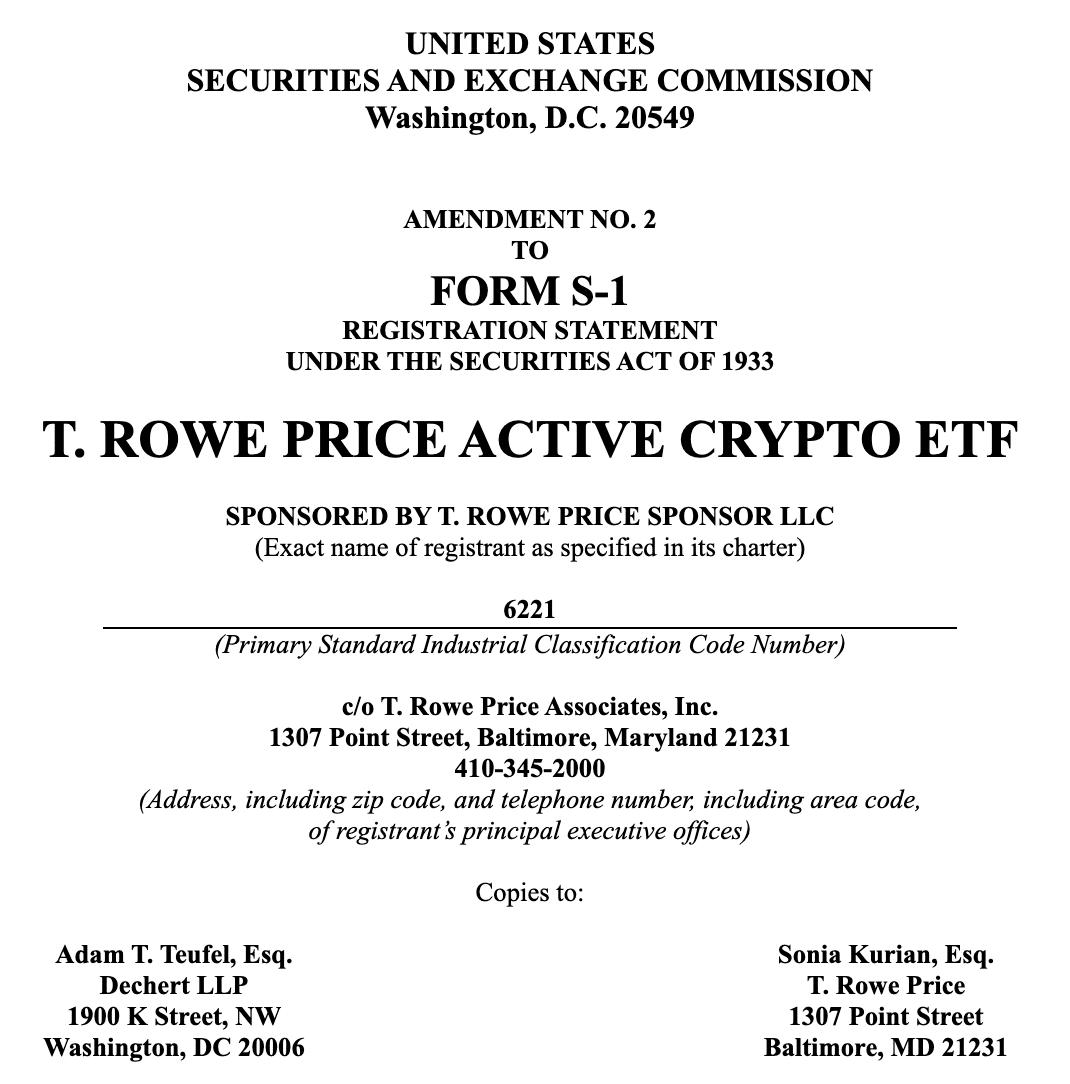
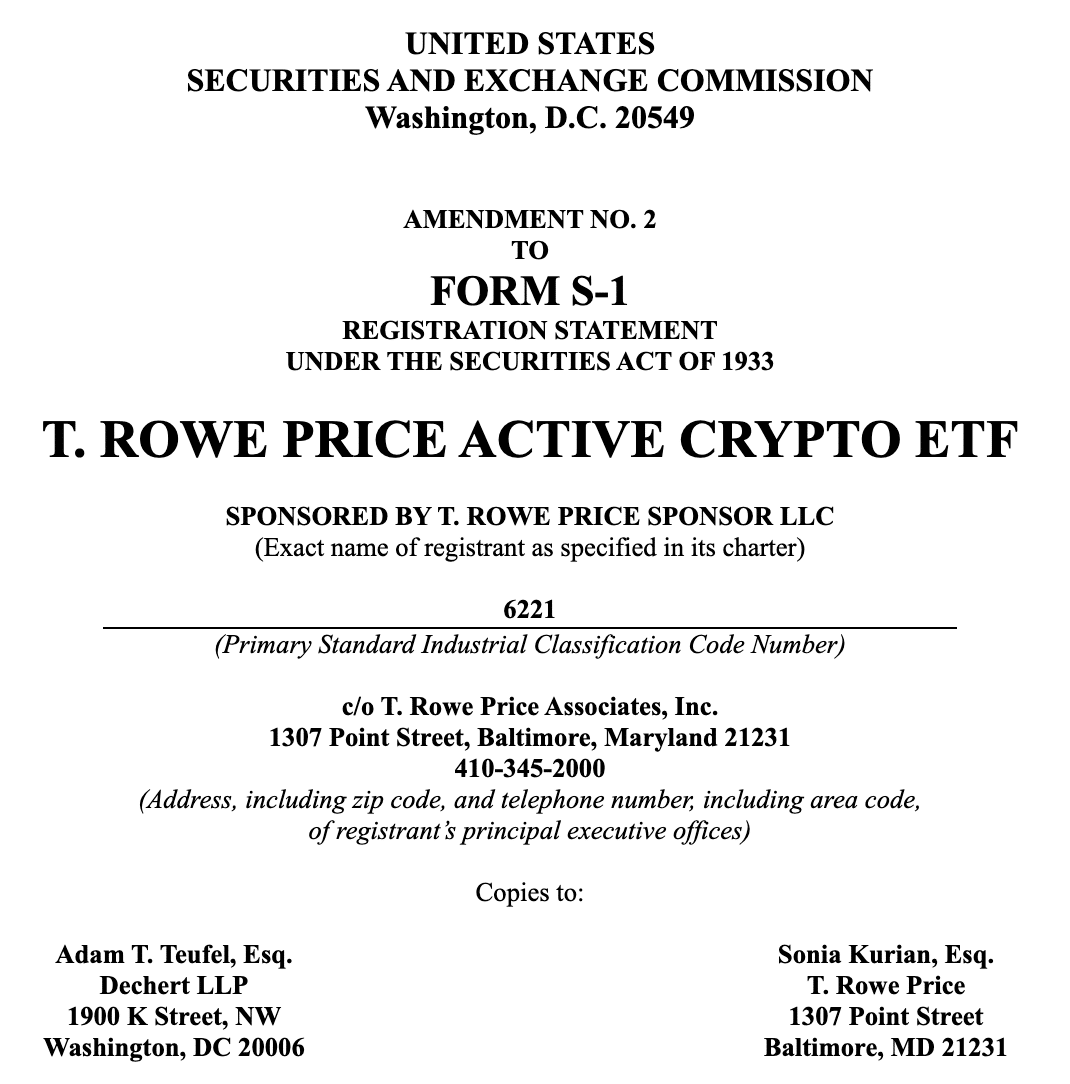
Source: SEC

T. Rowe amends its crypto ETF filing

The filing suggests that traditional financial firms may be becoming more open to crypto. Instead of focusing solely on major assets such as Bitcoin [BTC] and Ethereum [ETH], the firm is considering a broader strategy that includes more volatile tokens, such as Dogecoin [DOGE] and Shiba Inu [SHIB].

That said, the proposed ETF would be actively managed, meaning managers could shift investments among approximately five to fifteen digital assets depending on market conditions.

The list will also include altcoins such as Solana [SOL], Ripple [XRP], and SUI [Sui], aiming to generate returns by moving between assets rather than simply tracking a single cryptocurrency.

Several factors may explain why this shift is happening now. Regulatory clarity has improved with legislation such as the GENIUS Act, giving traditional firms greater confidence to enter the crypto market.

At the same time, competition is increasing. After the U.S. SEC approved Generic Listing Standards in 2025 to speed up approvals for crypto exchange-traded products, asset managers began racing to launch more diversified crypto ETFs.

How is this filing different from the October filing?

The firm’s amended structure reflects a strong focus on security and compliance. The digital assets will be stored with Anchorage Digital Bank, which will act as the custodian for the tokens.

Initially, the ETF will use a cash-based creation and redemption model, meaning investors will buy or sell shares using cash rather than exchanging cryptocurrencies directly.

However, the filing notes that the fund could permit “in-kind” transactions in the future if regulations permit.

In the future, the Fund may engage in in-kind creations and redemptions.

The fund will also use the FTSE Crypto U.S. Listed Index as a reference point to guide its investment decisions, while managers will retain flexibility to adjust the portfolio.

Moreover, the filing also mentions the possibility of staking. If introduced, this would allow the fund to generate additional income by supporting blockchain networks rather than relying solely on price gains.

However, T. Rowe Price said staking will only be considered once regulators and tax authorities provide clearer guidance. By working with Anchorage Digital as custodian, the firm is trying to ensure the fund meets strict regulatory standards.

Other ETF performance

The timing of T. Rowe Price’s filing update comes as the U.S. crypto ETF market shows mixed signals. At the time of writing, Bitcoin and Ethereum ETFs recorded net inflows of $199.4 million and $35.9 million, respectively, while investor interest in altcoins has become more mixed.

For example, Solana ETFs saw only about $2.1 million in inflows, while the XRP ETF recorded roughly $5.98 million in outflows.

Crypto ETF race intensifies

At the same time, competition among crypto ETF providers is intensifying, particularly on fees. Hashdex recently reduced the management fee for its Hashdex Nasdaq Crypto Index US ETF from 0.50% to 0.25%.

Additionally, large financial institutions are also starting to take stronger positions in the crypto market. Morgan Stanley, for instance, recently updated its filings as it prepares to expand access to digital assets for its wealth management clients.

Therefore, if approved, the Price Active Crypto ETF could represent another major step in the institutional adoption of digital assets.


Final Summary

  • By including altcoins such as Solana, XRP, and Sui, the fund highlights increasing institutional interest in diversified crypto strategies.
  • The proposal reflects intensifying competition in the crypto ETF market, as firms race to launch innovative and cost-efficient products.


Domande pertinenti

QWhat is the main update T. Rowe Price made to its crypto ETF filing on March 16th?

AT. Rowe Price filed an amended S-1 registration statement with the SEC, providing new details about its proposed Price Active Crypto ETF, including a broader strategy that could include up to 15 digital assets, such as more volatile tokens like Dogecoin and Shiba Inu.

QHow does the proposed Price Active Crypto ETF differ from a typical single-asset ETF?

AThe proposed ETF is actively managed, meaning managers can shift investments among approximately five to fifteen digital assets depending on market conditions, aiming to generate returns by moving between assets rather than simply tracking a single cryptocurrency.

QWhich company will serve as the custodian for the digital assets in T. Rowe Price's ETF?

AAnchorage Digital Bank will act as the custodian for the tokens in the proposed ETF.

QWhat regulatory development in 2025 helped speed up approvals for crypto exchange-traded products?

AThe U.S. SEC approved Generic Listing Standards in 2025 to speed up approvals for crypto exchange-traded products.

QWhat additional feature might the fund consider in the future, pending regulatory clarity?

AThe fund might consider staking in the future to generate additional income by supporting blockchain networks, but only once regulators and tax authorities provide clearer guidance.

Letture associate

9.42 Million Retail Investors Compete for Changxin Technology, Who Got Allotted?

Evergreen Technology's IPO subscription results are now available. On July 20, the domestic memory chip giant announced the offline preliminary allotment results and online lottery results for its IPO. A total of approximately 9.43 million retail investors participated in the online subscription, generating 770,000 winning lots with a final winning rate of about 0.4714%, setting a record for new shares on the STAR Market. After triggering a clawback mechanism from institutional to retail investors, the online retail allocation was significantly increased to 3.851 billion shares. Simultaneously, 285 institutional investors participated in the offline subscription, ultimately receiving 2.173 billion shares at an allotment rate of approximately 0.1756%. Leading insurers and public funds were among the major recipients. Notably, Liang Wenfeng, founder of the major AI model company DeepSeek, through his quantitative investment firms Ningbo Huanfang Quantitative and Zhejiang Jiuzhang Asset, secured the largest share among private funds, with a total allotment worth approximately 175 million yuan. Estimates suggest potential profits could reach 730 million yuan if Evergreen Technology's market capitalization reaches 3 trillion yuan post-listing. The company is expected to list on July 27 and could become the highest-valued tech stock on the A-share market, with various brokerages providing valuations ranging from 1 trillion to over 4 trillion yuan. However, recent significant corrections in global tech stocks may impact its post-listing performance. (Character count: 1,196)

marsbit47 min fa

9.42 Million Retail Investors Compete for Changxin Technology, Who Got Allotted?

marsbit47 min fa

L2 'Recalibration': When L1 Becomes Its Own Rollup, What Is Ethereum's Endgame?

The article discusses the evolving relationship between Ethereum's Layer 1 (L1) and Layer 2 (L2) solutions, moving beyond the initial "L2 for scaling" model. As Ethereum L1 itself scales (increasing Gas Limit, statelessness, zkEVM), the unique value proposition of L2s shifts from merely providing cheap execution to offering differentiated features like application-specific optimization, privacy, and flexible governance. The piece explores three key themes: 1. **L2's New Role:** L2s are transitioning from a pure scaling technology to a spectrum of execution environments with varying degrees of security inheritance from Ethereum L1. 2. **Interoperability as State Trust:** Solving L2 fragmentation is less about cross-chain bridges and more about enabling faster, trust-minimized state verification between environments. This involves initiatives like faster L1 finality, intent-based architectures (Open Intents Framework), and native account abstraction. 3. **Blurring Layers:** With the potential integration of zk-proofs into L1 validation (making L1 akin to its own "Rollup") and the concept of "Native Rollups," the rigid boundary between L1 and L2 may fade. The future could be a unified system with multiple execution domains (for DeFi, gaming, privacy, etc.) sharing a common security, settlement, and state framework. In conclusion, Ethereum's goal is not to abandon L2s or re-centralize everything on L1, but to re-integrate the fragmented user experience—liquidity, accounts, applications—while preserving the scaling benefits of a multi-environment ecosystem. The endgame is a cohesive "one chain" feeling for users, powered by diverse but securely interconnected execution layers.

marsbit1 h fa

L2 'Recalibration': When L1 Becomes Its Own Rollup, What Is Ethereum's Endgame?

marsbit1 h fa

Trading

Spot
活动图片




