Supported by 20+ Institutions: How Does Sui's New Primitive Hashi Rewrite the Rules of Bitcoin Financial Trust?

marsbitPubblicato 2026-04-15Pubblicato ultima volta 2026-04-15

Introduzione

Sui has introduced Hashi, a new decentralized Bitcoin (BTC)抵押原语 (primitive) designed to enable trust-minimized and secure use of native BTC in DeFi on the Sui blockchain, backed by over 20 major institutions. Hashi allows users to抵押 Bitcoin without transferring custody to centralized entities. BTC remains on the Bitcoin network in a dedicated address, while a抵押凭证 is generated on Sui. This凭证, representing the locked BTC, can be used in Sui's smart contracts for lending, borrowing, and other DeFi activities. The system relies on Sui validators for security, with a Guardian Layer for additional protection against risks like validator collusion. Key to Hashi is its role as a "primitive"—a foundational building block for developers. It provides a standardized interface to integrate native BTC抵押 capabilities into applications like lending protocols, structured products, and RWA strategies, reducing development barriers. Institutional support spans custody (e.g., BitGo, Cobo), trading (e.g., FalconX, Bullish), security (e.g., OtterSec, Certora), and protocols (e.g., Suilend, Scallop). This ecosystem support aims to facilitate large-scale institutional BTC adoption into DeFi upon mainnet launch. Hashi addresses core trust issues in Bitcoin金融 by prioritizing non-custodial security, transparency, and composability, potentially unlocking Bitcoin's $1.4 trillion market cap for decentralized finance without sacrificing user control.

Author: Deep Tide TechFlow

While market attention is being drawn away by U.S. stocks, AI, and gold, Sui recently announced a new move:

Hashi, a Bitcoin collateral primitive based on Sui, is about to launch and has garnered support from top-tier institutions.

Bitcoin finance, a topic that has been discussed for a long time but remains unresolved:

As the largest on-chain asset treasury with a market cap exceeding $1.4 trillion, the proportion of Bitcoin used in DeFi is still less than 0.22%.

The core reason it remains unresolved is not due to insufficient functionality but the wrong premise of trust. In many past attempts, users were often misled—you thought your Bitcoin was in your hands, but it was actually on someone else’s ledger. The collapses of Celsius, Voyager, Genesis, and other projects have repeatedly sounded the alarm for the logic of "sacrificing trust for efficiency."

Especially synthetic Bitcoin, although it has attracted a considerable number of retail users, this structure has failed to convert a large amount of Bitcoin into DeFi capital and cannot attract institutions and large asset holders who require stronger guarantees.

This is precisely the important opportunity for the launch of Sui’s new developer primitive Hashi:

Reconstructing the most critical trust base for Bitcoin finance.

Enabling native BTC collateral to be organized more transparently in Sui’s smart contract environment—no wrapping, no synthesizing, no handing over keys to any centralized entity—and turning this capability into directly reusable interfaces.
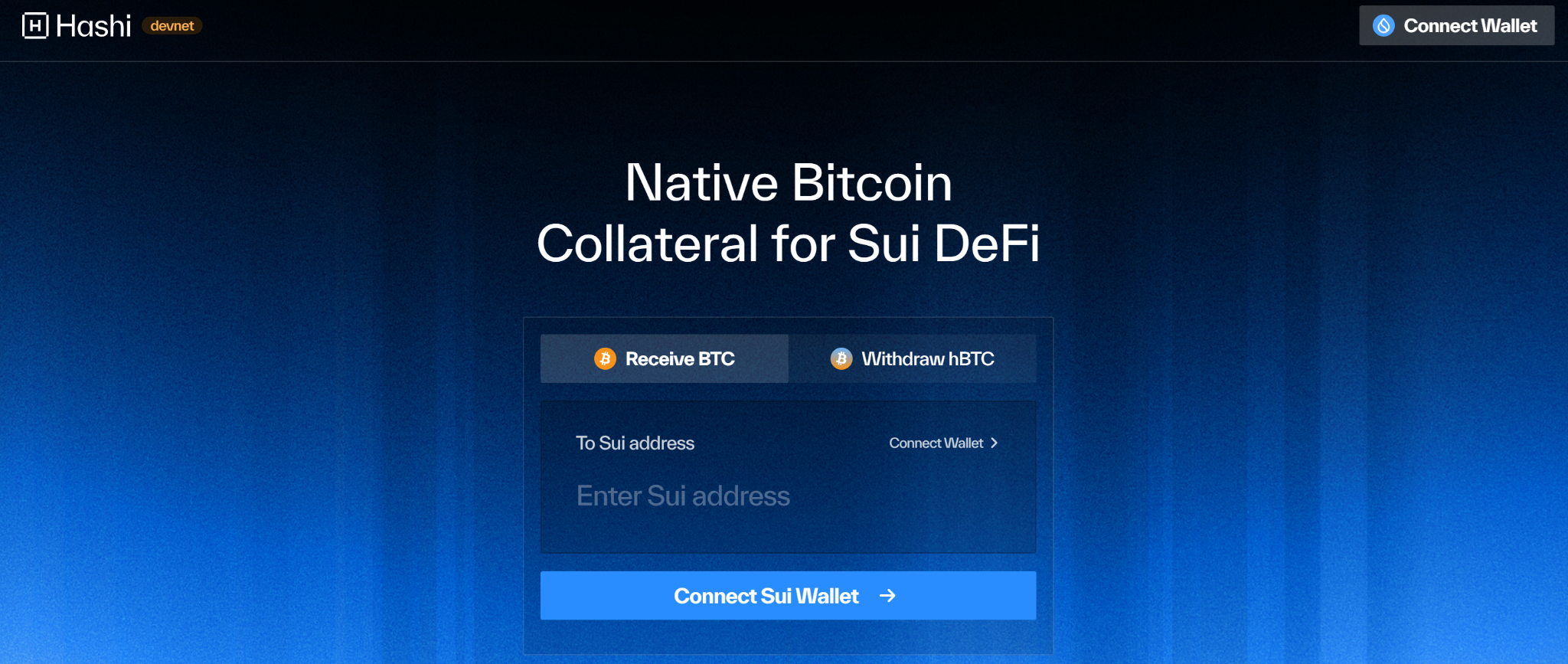
Hashi Native BTC Programmability: BTC Stays on the Chain, Collateral Rights Enter the Sui Network

The design philosophy of Hashi can be summarized in one sentence:

Assets remain on the Bitcoin network, rights exist on the Sui network—both occur simultaneously without interference.

Suppose you have one Bitcoin and want to use it as collateral to borrow some USDC.

In most past solutions:

You either deposit BTC into a centralized platform to obtain a borrowing limit or accept Wrapped BTC. Your Bitcoin, at some point, must be handed over to someone else, essentially trading "trust in an entity" for "programmability."

With Hashi:

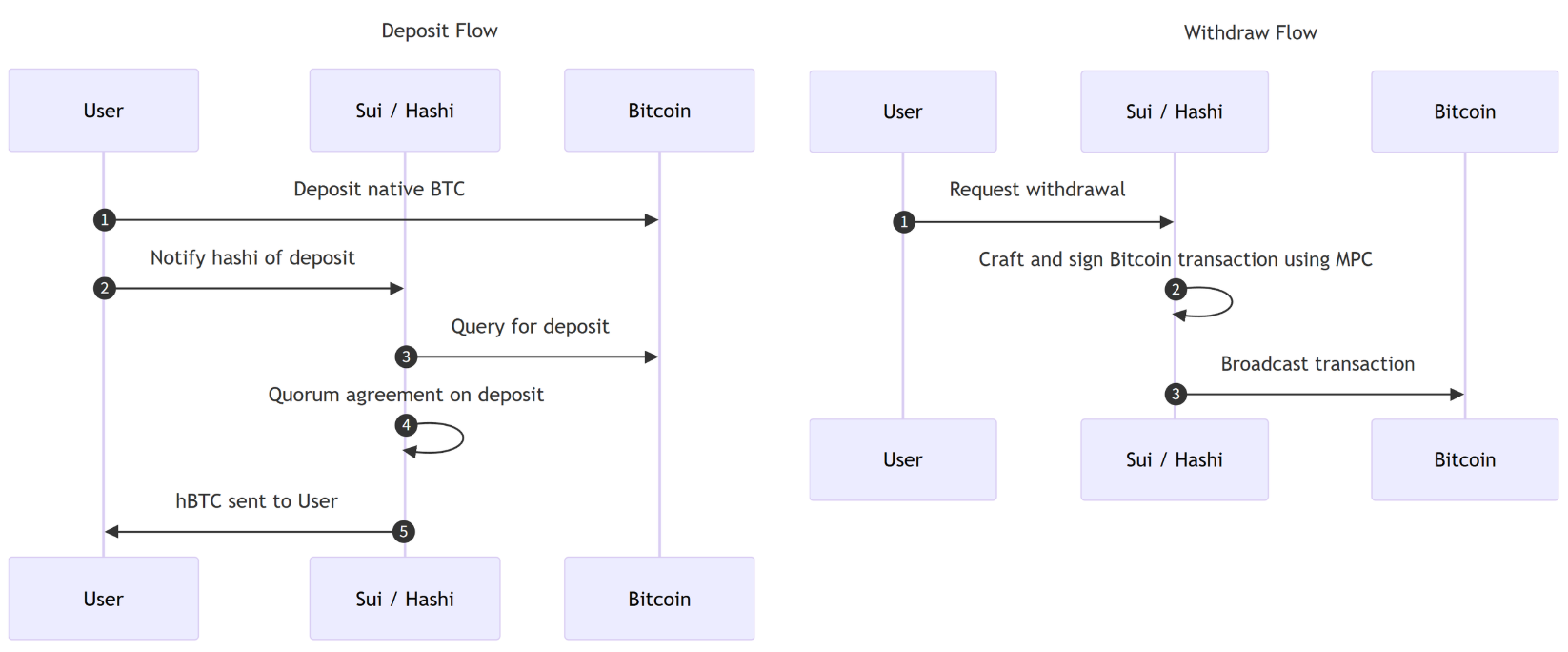
  • Deposit: Users deposit BTC into a dedicated address (a unique Bitcoin deposit address generated by Hashi for their Sui address). The private key for this address does not belong to any single entity but is collectively managed by the validators on the Sui network. The BTC can only be moved if enough validators reach a consensus. This means no single entity can run away with your money unless they control more than one-third of the entire Sui validator network.
  • Proof Generation: Validators simultaneously monitor the Bitcoin network. Once they confirm your BTC is locked in, a corresponding collateral proof is generated on the Sui chain. This proof is not a newly issued token or a wrapped asset; it is an on-chain certificate proving that a real BTC is locked, and you are its owner.
  • As Collateral: With this proof, you can borrow money, participate in DeFi, or set up yield strategies in Sui’s smart contracts. All rules are written in code and executed automatically, with no room for interference.
  • Repayment and Withdrawal: After repayment, validators automatically release the native BTC on the Bitcoin mainnet through MPC threshold signatures, which can be withdrawn to any Bitcoin address without manual intervention.
  • Guardian Layer: To prevent extreme situations (such as validator collusion), Hashi additionally introduces a Guardian Layer as a secondary check and backup protection, primarily monitoring large withdrawals or abnormal thresholds to prevent potential systemic risks.
Throughout the entire lifecycle:

BTC always remains on the Bitcoin mainnet and is not moved into any platform’s internal account;

No single centralized entity has exclusive control of the private key;

What circulates on Sui is the collateral right backed by real BTC, reopening the programmability of native BTC;

And the only entities users need to trust are the validator network and the smart contract.
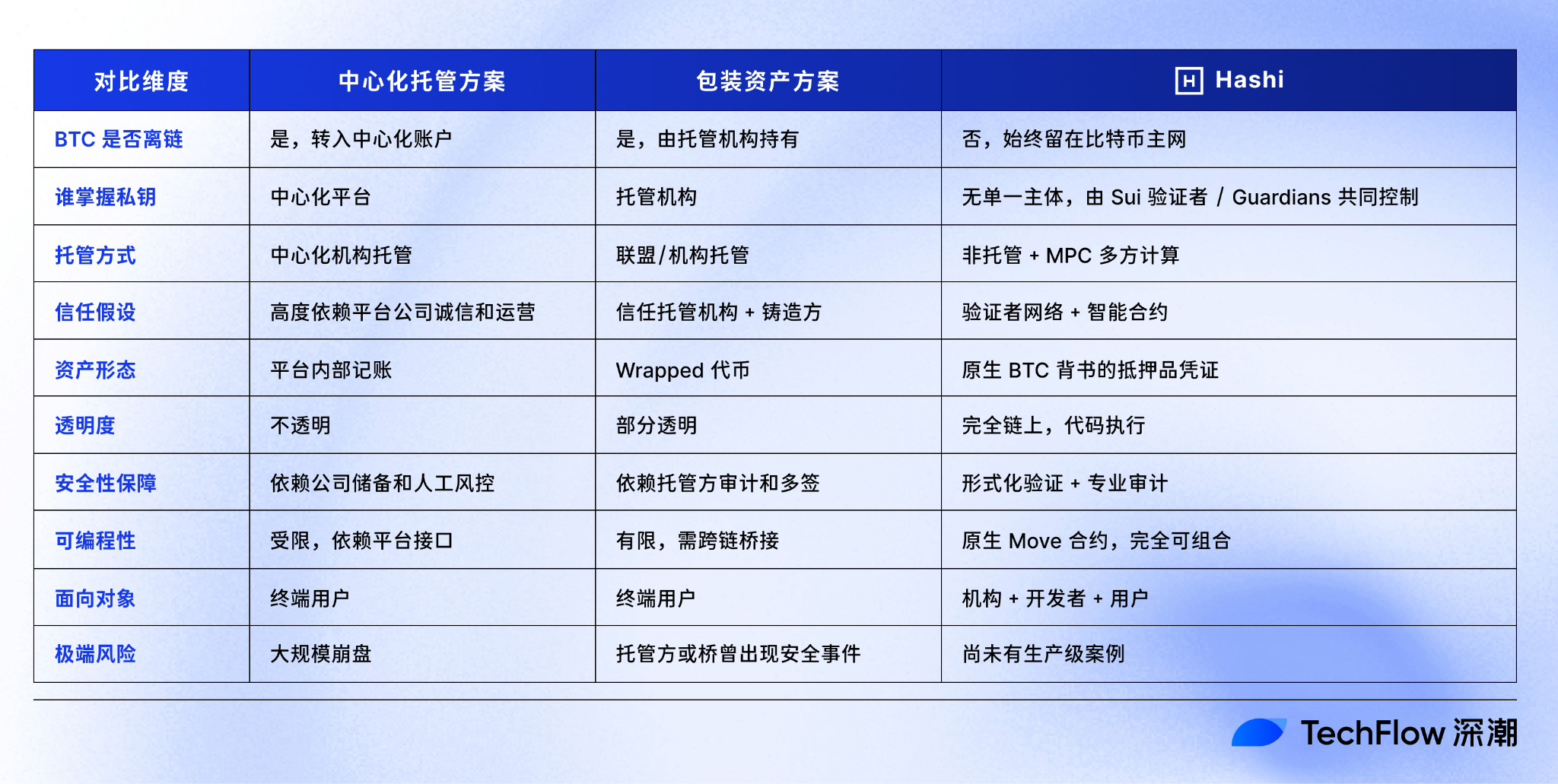
Simply put, Hashi is committed to enabling the collateral relationship of native BTC to be directly recognized by the on-chain financial system, with minimal trust placed in centralized entities.

During stable market conditions, users may perceive little difference, but in extreme situations like platform collapses or liquidity crises, it is the difference between whether your BTC is still there or not.

Not a Product, but a "Primitive": A Directly Reusable "Standard Brick"

From a design perspective, Hashi is a more decentralized, trust-minimized, and secure transparent Bitcoin financial solution.

However, if Hashi is understood solely as a single "solution," its most potential aspect might be missed.

It is important to note that for a long time, Sui has been striving to evolve from "a chain" to "a complete set of developer infrastructure." Whether it’s launching Walrus, Seal, or Nautilus, the goal has been to achieve full-stack nativity from execution, storage, permission control to off-chain computation, providing convenience for developers and building the necessary foundation for ecosystem prosperity.

This time, facing Bitcoin finance is no exception.

According to the official definition:

Hashi is the first decentralized Bitcoin collateral primitive developed by Mysten Labs, allowing developers to actively handle UTXOs from the Bitcoin network in Sui’s native smart contract language.

The key word is "primitive."

In the context of blockchain and DeFi, a primitive often refers to a fundamental building block or underlying infrastructure component. It is like a "standard brick" in Lego:

It is not an end product for ordinary users but a basic module for developers to build products.

Just as TCP/IP is not an app but all apps run on it; Hashi is not a product, but lending platforms, yield strategies, and structured products can all be built on it.

In other words, Hashi does not provide a closed financial service but an underlying capability, enabling native BTC to become collateral that Sui smart contracts can directly call.

As for what this collateral is used for, how it is used, and under what rules, Hashi does not interfere—it leaves it to the contracts, developers, and the market.
Before Hashi, if developers wanted to build a protocol with BTC as collateral, they faced numerous challenges: either accept the trust risks of centralized custody or implement the complex logic of native BTC collateral from scratch.

As a primitive, Hashi turns this difficult problem into a directly reusable interface.

Now, when building specific products, developers can directly call the mechanisms provided by Hashi, enabling their protocols to inherently possess native BTC collateral capabilities without having to solve underlying problems again, significantly reducing development barriers and time costs.

Users, whether institutional or retail, will, through products built on Hashi, for the first time truly gain the ability to earn yields with Bitcoin without giving up control over it. In the initial phase, lending will be the first use case for Hashi, allowing BTC to be lent out or used as collateral to borrow stablecoins. In the future, Hashi’s scenarios will gradually expand to vaults, insurance, structured products, credit derivatives, and RWA yield strategies.

Bitcoin is the asset with the broadest global consensus and deepest liquidity, but in the past, this wealth was almost invisible to the on-chain financial world: it is massive but not programmable; it is valuable but cannot be directly perceived and called by smart contracts.

Therefore, when Hashi turns the native BTC collateral capability into an interface that any developer can directly call, the upper-layer application space it can leverage far exceeds any specific product or protocol.

And the correctness of this judgment is already answered by the extensive institutional support Hashi has received.

Institutional Day One Support: Building a Complete Ecosystem Around Hashi

Currently, Hashi is live on Sui Devnet, primarily for developer testing and auditing, and has not yet entered the production environment. However, it has already received explicit support commitments from several leading industry institutions.

In terms of infrastructure: Including BitGo, Blockdaemon, Cobo, Ledger, and other major institutions, directly bridging institutional BTC from cold storage into on-chain collateral scenarios.

In terms of trading and liquidity: Including FalconX, Bullish, CF Benchmarks, and other major institutions, providing Hashi with reliable pricing, liquidity exits, and institutional-grade counterparty support.

In terms of security and compliance: Multiple teams, including security auditing firm OtterSec, smart contract formal verification security company Certora, and cryptography and zero-knowledge proof research and engineering team Asymptotic, have chosen to support Hashi and will conduct smart contract audits, formal verification, cryptography, and zero-knowledge proof research before Hashi’s mainnet launch.

At the same time, projects including Suilend, Scallop, NAVI Protocol, Matrixdock, and Bluefin have announced they will integrate Hashi to unleash on-chain financial potential, enabling retail and institutional users to quickly access BTC collateral lending experiences.

In addition, Soter Insure, a provider of institutional-grade insurance solutions, has announced a partnership with Hashi to bring built-in institutional-grade insurance mechanisms as a risk protection layer.

These institutions represent thousands of billions of dollars in Bitcoin nominal value and mature compliance infrastructure. Their commitment to integration at the Hashi Devnet stage means that once Hashi officially launches, large-scale institutional Bitcoin assets will have the practical conditions to enter on-chain scenarios.

At the same time, looking at these 20+ institutions together, an interesting fact emerges: they almost cover every环节 of a complete Bitcoin financial ecosystem:

From Bitcoin security custody, on-chain collateral, price pricing, liquidity support, lending protocols, yield strategies, RWA integration, to security audits and user entry, an end-to-end chain has already taken shape.

In other words, behind this list of supporters, a complete ecosystem map of Bitcoin finance围绕 the Hashi primitive will be ready from day one of Hashi’s mainnet launch.

Conclusion

Of course, Hashi is still in the Devnet stage. It has not yet undergone long-term testing in the mainnet environment, with real asset scale and extreme market fluctuations. Its production-level performance still needs time to verify. The path of Bitcoin finance will not immediately become smooth just because a new primitive emerges.

However, judging from the integration commitments of over 20 leading institutions in custody, liquidity, security, and protocol layers from day one, market recognition of this path is clear enough.

The story of Bitcoin finance has been told for many years, but the real breakthrough point has never been about "what can be done" but "why trust."

Past solutions, whether centralized custody or wrapped assets, essentially required users to make the same choice: either give up control for yield or hold the keys but be excluded from on-chain finance.

Hashi attempts to rewrite the question itself: making the collateral capability of native BTC an underlying interface that developers can directly call, enabling Bitcoin’s sleeping trillion-dollar treasury to be truly "seen" by the smart contract world in a non-custodial, verifiable, and composable way for the first time.

Reconstructing trust is often harder than stacking functions.

If the endgame of Bitcoin finance is to make Bitcoin truly the native collateral of on-chain finance, then what Hashi is doing may be laying the first pile for this bridge.


Domande pertinenti

QWhat is Hashi and how does it aim to change Bitcoin financial trust rules?

AHashi is a decentralized Bitcoin collateral primitive developed on Sui that enables native BTC to be used as programmable collateral in DeFi without requiring users to relinquish custody to centralized entities. It reconstructs the trust foundation by allowing BTC to remain on the Bitcoin network while its collateral rights are represented on Sui, managed collectively by validators without single-point control.

QHow does Hashi's deposit and抵押 process work technically?

AUsers deposit BTC into a unique Bitcoin address generated by Hashi for their Sui address. The private key of this address is collectively managed by Sui validators, requiring consensus for any movement. Validators monitor the Bitcoin network, confirm the deposit, and issue a抵押凭证 on Sui, which serves as proof of locked BTC. This凭证 can then be used in Sui's smart contracts for DeFi activities like borrowing.

QWhy is Hashi described as a 'primitive' rather than a product?

AHashi is termed a 'primitive' because it functions as a foundational building block or底层 infrastructure component for developers, not an end-user product. It provides a reusable interface that allows developers to integrate native BTC collateral capabilities directly into their applications (e.g., lending platforms, yield strategies) without rebuilding the complex underlying logic, thereby reducing development barriers and costs.

QWhich types of institutions have supported Hashi, and what roles do they play?

AHashi has garnered support from over 20 institutions across custody and infrastructure (e.g., BitGo, Cobo), trading and liquidity (e.g., FalconX, Bullish), security and compliance (e.g., OtterSec, Certora), and DeFi protocols (e.g., Suilend, Scallop). These institutions provide essential services like secure custody, liquidity, auditing, and integration, forming a comprehensive ecosystem for Bitcoin financial services on Sui.

QWhat are the potential risks or limitations of Hashi mentioned in the article?

AHashi is still in the Devnet phase and has not yet been tested in a mainnet environment with real assets and extreme market conditions. Its production-level performance requires further validation. Additionally, while it minimizes trust in centralized entities, it still relies on Sui validators and smart contract security, with a Guardian Layer added as a secondary check for risks like validator collusion.

Letture associate

Why Do You Always Lose Money on Polymarket? Because You're Betting on News, While the Pros Read the Rules

Why do you always lose money on Polymarket? Because you bet on news, while the pros study the rules. This article explains how top traders ("che tou") profit by meticulously analyzing market rules, not just predicting events. Polymarket, a prediction market platform, often sees disputes over event outcomes due to ambiguous rule wording. For instance, a market asking "Who will be the leader of Venezuela by the end of 2026?" was misinterpreted by many who bet on Delcy Rodríguez, assuming she held power. However, the rules specified "officially holds" as the formally appointed, sworn-in individual. Since Nicolás Maduro was still recognized as president officially, he won the market—even being in prison. To resolve such disputes, Polymarket uses a decentralized arbitration system via UMA protocol. The process involves: 1. Proposal: Anyone can propose a market outcome by staking 750 USDC, earning 5 USDC if unchallenged. 2. Dispute: A 2-hour window allows challenges with a 750 USDC stake; successful challengers earn 250 USDC. 3. Discussion: A 48-hour period on UMA Discord for evidence and debate. 4. Voting: UMA token holders vote in two 24-hour phases (blind then public). Outcomes require >65% consensus and 5M tokens voted; otherwise, four re-votes occur before Polymarket intervention. 5. Settlement: Results are final and automatic. Unlike traditional courts, Polymarket’s system lacks separation between arbitrators and stakeholders—voters often hold market positions, creating conflicts of interest. This leads to herd mentality in discussions and non-transparent outcomes without explanatory rulings, preventing precedent formation. Thus, success on Polymarket hinges on deep rule interpretation, not just event prediction, exploiting gaps between reality and contractual wording.

marsbit2 h fa

Why Do You Always Lose Money on Polymarket? Because You're Betting on News, While the Pros Read the Rules

marsbit2 h fa

DeepSeek Funding: Liang Wenfeng's 'Realist' Pivot

DeepSeek, a leading Chinese AI company, has initiated its first external funding round, aiming to raise at least $300 million at a valuation of no less than $10 billion. This move marks a significant shift from its founder Liang Wenfeng’s previous idealistic stance of rejecting external capital to maintain independence. Despite strong financial backing from its parent company, quantitative trading firm幻方量化 (Huanfang Quant), which provided an estimated $700 million in revenue in 2025 alone, DeepSeek faces mounting challenges. Key issues include a 15-month gap in major model updates, delays in its flagship V4 release, and the loss of several core researchers to competitors offering significantly higher compensation. The company is also undergoing a strategic pivot by migrating its infrastructure from NVIDIA’s CUDA to Huawei’s Ascend platform, a move aligned with China’s push for technological self-reliance amid U.S. export controls. However, DeepSeek lags behind rivals like智谱AI and MiniMax—both now publicly listed—in areas such as product ecosystem, multimodal capabilities, and commercialization. The funding round, though relatively small in scale, is seen as a way to establish a market-validated valuation anchor, making employee stock options more competitive and facilitating talent retention. It also signals DeepSeek’s transition from a pure research-oriented organization to a commercially-driven player in the global AI ecosystem.

marsbit3 h fa

DeepSeek Funding: Liang Wenfeng's 'Realist' Pivot

marsbit3 h fa

Trading

Spot
Futures

Articoli Popolari

Cosa è BITCOIN

Comprendere HarryPotterObamaSonic10Inu (ERC-20) e la sua posizione nel mondo delle criptovalute Negli ultimi anni, il mercato delle criptovalute ha assistito a un aumento della popolarità delle meme coin, catturando l'interesse non solo dei trader, ma anche di coloro che cercano coinvolgimento comunitario e valore di intrattenimento. Tra questi token unici c'è HarryPotterObamaSonic10Inu (ERC-20), un progetto intrigante che mescola riferimenti culturali nel tessuto delle criptovalute. Questo articolo esplora gli aspetti chiave di HarryPotterObamaSonic10Inu, analizzando i suoi meccanismi, l'etica guidata dalla comunità e il suo coinvolgimento con il panorama crittografico più ampio. Che cos'è HarryPotterObamaSonic10Inu (ERC-20)? Come suggerisce il suo nome, HarryPotterObamaSonic10Inu è una meme coin costruita sulla blockchain di Ethereum, classificata secondo lo standard ERC-20. A differenza delle criptovalute tradizionali che possono enfatizzare l'utilità pratica o il potenziale investimento, questo token prospera grazie al valore di intrattenimento e alla forza della sua comunità. Il progetto mira a creare un ambiente in cui gli utenti coinvolti possono riunirsi, condividere idee e partecipare ad attività ispirate a diversi fenomeni culturali. Una caratteristica notevole di HarryPotterObamaSonic10Inu è la zero tassa sulle transazioni. Questo elemento allettante tende a incoraggiare il trading e il coinvolgimento della comunità, privo di costi aggiuntivi che possono scoraggiare i trader di piccole dimensioni. L'offerta totale della moneta è fissata a un miliardo di token, un numero che segna la sua intenzione di mantenere una circolazione sostanziale all'interno della comunità. Creatore di HarryPotterObamaSonic10Inu (ERC-20) Le origini di HarryPotterObamaSonic10Inu sono avvolte in un certo mistero; i dettagli sul creatore rimangono sconosciuti. Lo sviluppo di questo token non presenta un team identificabile o un piano esplicito, cosa non rara nel settore delle meme coin. Invece, il progetto è emerso organicamente, con il suo progresso fortemente dipendente dall'entusiasmo e dalla partecipazione della sua comunità. Investitori di HarryPotterObamaSonic10Inu (ERC-20) Per quanto riguarda investimenti esterni e finanziamenti, HarryPotterObamaSonic10Inu rimane ambiguo. Il token non elenca alcuna fondazione di investimento conosciuta o un sostegno organizzativo significativo. Invece, la linfa vitale del progetto è la sua comunità di base, che informa la sua crescita e sostenibilità attraverso azioni collettive e coinvolgimento nello spazio crittografico. Come funziona HarryPotterObamaSonic10Inu (ERC-20)? In quanto meme coin, HarryPotterObamaSonic10Inu opera principalmente al di fuori delle strutture tradizionali che governano spesso il valore degli asset. Ci sono diversi aspetti distintivi che definiscono il funzionamento del progetto: Transazioni senza tasse: Senza costi fiscali sulle transazioni, gli utenti possono comprare e vendere liberamente il token senza preoccuparsi di costi nascosti. Coinvolgimento della comunità: Il progetto prospera sull'interazione della comunità, sfruttando le piattaforme social per creare entusiasmo e facilitare il coinvolgimento. Discussioni, condivisione di contenuti e coinvolgimento sono elementi cruciali che aiutano ad espandere la sua portata e a favorire la lealtà tra i sostenitori. Nessuna utilità pratica: Va notato che HarryPotterObamaSonic10Inu non offre un'utilità concreta all'interno dell'ecosistema finanziario. Piuttosto, è classificato come un token principalmente per attività di intrattenimento e comunitarie. Riferimento culturale: Il token incorpora astutamente elementi della cultura pop per attirare interesse, collegandosi a appassionati di meme e seguaci delle criptovalute. HarryPotterObamaSonic10Inu esemplifica come le meme coin operino in modo diverso rispetto ai progetti di criptovalute più tradizionali, entrando nel mercato come costrutti sociali innovativi piuttosto che come asset utilitari. Cronologia di HarryPotterObamaSonic10Inu (ERC-20) La storia di HarryPotterObamaSonic10Inu è segnata da diversi traguardi notevoli: Creazione: Il token è emerso da un meme virale, catturando l'immaginazione di molti appassionati di criptovalute. Le date di creazione specifiche non sono disponibili, sottolineando la sua crescita organica. Inserimento negli scambi: HarryPotterObamaSonic10Inu ha fatto il suo ingresso in vari scambi, consentendo un accesso e un trading più facili da parte della comunità. Iniziative di coinvolgimento della comunità: Attività in corso volte a migliorare l'interazione della comunità, comprese gare, campagne sui social media e generazione di contenuti da parte di fan e sostenitori. Piani di espansione futura: La tabella di marcia del progetto include il lancio di una collezione NFT, merchandising e un sito di eCommerce relativo ai suoi temi culturali, coinvolgendo ulteriormente la comunità e cercando di aggiungere più dimensioni al suo ecosistema. Punti chiave su HarryPotterObamaSonic10Inu (ERC-20) Natura guidata dalla comunità: Il progetto dà priorità al contributo collettivo e alla creatività, garantendo che il coinvolgimento degli utenti sia al centro del suo sviluppo. Classificazione come meme coin: Rappresenta l'epitome delle criptovalute basate sull'intrattenimento, distinguendosi dai veicoli d'investimento tradizionali. Nessuna affiliazione diretta con Bitcoin: Nonostante la somiglianza nel nome del ticker, HarryPotterObamaSonic10Inu è distintivo e non ha alcuna relazione con Bitcoin o altre criptovalute consolidate. Focus sulla collaborazione: HarryPotterObamaSonic10Inu è progettato per creare uno spazio per la collaborazione e la condivisione di storie tra i suoi detentori, fornendo un canale per la creatività e il legame comunitario. Prospettive future: L'ambizione di espandersi oltre il suo presupposto iniziale verso NFT e merchandising delinea un percorso per il progetto per potenzialmente entrare in strade più mainstream all'interno della cultura digitale. Poiché le meme coin continuano a catturare l'immaginazione della comunità crittografica, HarryPotterObamaSonic10Inu (ERC-20) si distingue per i suoi legami culturali e il suo approccio centrato sulla comunità. Anche se potrebbe non adattarsi al modello tipico di un token orientato all'utilità, la sua essenza risiede nella gioia e nella camaraderia coltivate tra i suoi sostenitori, evidenziando la natura in evoluzione delle criptovalute in un'epoca sempre più digitale. Con la continuazione dello sviluppo del progetto, sarà importante osservare come le dinamiche della comunità influenzano la sua traiettoria nel panorama in continuo cambiamento della tecnologia blockchain.

1.1k Totale visualizzazioniPubblicato il 2024.04.01Aggiornato il 2024.12.03

Cosa è BITCOIN

Come comprare BTC

Benvenuto in HTX.com! Abbiamo reso l'acquisto di Bitcoin (BTC) semplice e conveniente. Segui la nostra guida passo passo per intraprendere il tuo viaggio nel mondo delle criptovalute.Step 1: Crea il tuo Account HTXUsa la tua email o numero di telefono per registrarti il tuo account gratuito su HTX. Vivi un'esperienza facile e sblocca tutte le funzionalità,Crea il mio accountStep 2: Vai in Acquista crypto e seleziona il tuo metodo di pagamentoCarta di credito/debito: utilizza la tua Visa o Mastercard per acquistare immediatamente BitcoinBTC.Bilancio: Usa i fondi dal bilancio del tuo account HTX per fare trading senza problemi.Terze parti: abbiamo aggiunto metodi di pagamento molto utilizzati come Google Pay e Apple Pay per maggiore comodità.P2P: Fai trading direttamente con altri utenti HTX.Over-the-Counter (OTC): Offriamo servizi su misura e tassi di cambio competitivi per i trader.Step 3: Conserva Bitcoin (BTC)Dopo aver acquistato Bitcoin (BTC), conserva nel tuo account HTX. In alternativa, puoi inviare tramite trasferimento blockchain o scambiare per altre criptovalute.Step 4: Scambia Bitcoin (BTC)Scambia facilmente Bitcoin (BTC) nel mercato spot di HTX. Accedi al tuo account, seleziona la tua coppia di trading, esegui le tue operazioni e monitora in tempo reale. Offriamo un'esperienza user-friendly sia per chi ha appena iniziato che per i trader più esperti.

3.5k Totale visualizzazioniPubblicato il 2024.12.12Aggiornato il 2025.03.21

Come comprare BTC

Cosa è $BITCOIN

ORO DIGITALE ($BITCOIN): Un'Analisi Completa Introduzione all'ORO DIGITALE ($BITCOIN) L'ORO DIGITALE ($BITCOIN) è un progetto basato su blockchain che opera sulla rete Solana, con l'obiettivo di combinare le caratteristiche dei metalli preziosi tradizionali con l'innovazione delle tecnologie decentralizzate. Sebbene condivida un nome con Bitcoin, spesso definito “oro digitale” a causa della sua percezione come riserva di valore, l'ORO DIGITALE è un token separato progettato per creare un ecosistema unico all'interno del panorama Web3. Il suo obiettivo è posizionarsi come un asset digitale alternativo valido, anche se i dettagli riguardanti le sue applicazioni e funzionalità sono ancora in fase di sviluppo. Cos'è l'ORO DIGITALE ($BITCOIN)? L'ORO DIGITALE ($BITCOIN) è un token di criptovaluta esplicitamente progettato per l'uso sulla blockchain di Solana. A differenza di Bitcoin, che fornisce un ruolo di stoccaggio di valore ampiamente riconosciuto, questo token sembra concentrarsi su applicazioni e caratteristiche più ampie. Aspetti notevoli includono: Infrastruttura Blockchain: Il token è costruito sulla blockchain di Solana, nota per la sua capacità di gestire transazioni ad alta velocità e a basso costo. Dinamiche di Offerta: L'ORO DIGITALE ha un'offerta massima fissata a 100 quadrilioni di token (100P $BITCOIN), sebbene i dettagli riguardanti la sua offerta circolante siano attualmente non divulgati. Utilità: Sebbene le funzionalità precise non siano esplicitamente delineate, ci sono indicazioni che il token potrebbe essere utilizzato per varie applicazioni, potenzialmente coinvolgendo applicazioni decentralizzate (dApp) o strategie di tokenizzazione degli asset. Chi è il Creatore dell'ORO DIGITALE ($BITCOIN)? Attualmente, l'identità dei creatori e del team di sviluppo dietro l'ORO DIGITALE ($BITCOIN) rimane sconosciuta. Questa situazione è tipica tra molti progetti innovativi nel settore blockchain, in particolare quelli allineati con la finanza decentralizzata e i fenomeni delle meme coin. Sebbene tale anonimato possa favorire una cultura guidata dalla comunità, intensifica le preoccupazioni riguardo alla governance e alla responsabilità. Chi sono gli Investitori dell'ORO DIGITALE ($BITCOIN)? Le informazioni disponibili indicano che l'ORO DIGITALE ($BITCOIN) non ha alcun sostenitore istituzionale noto o investimenti di venture capital prominenti. Il progetto sembra operare su un modello peer-to-peer incentrato sul supporto e sull'adozione della comunità piuttosto che su percorsi di finanziamento tradizionali. La sua attività e liquidità si trovano principalmente su exchange decentralizzati (DEX), come PumpSwap, piuttosto che su piattaforme di trading centralizzate consolidate, evidenziando ulteriormente il suo approccio di base. Come Funziona l'ORO DIGITALE ($BITCOIN) Le meccaniche operative dell'ORO DIGITALE ($BITCOIN) possono essere elaborate in base al suo design blockchain e alle caratteristiche della rete: Meccanismo di Consenso: Sfruttando il proof-of-history (PoH) unico di Solana combinato con un modello di proof-of-stake (PoS), il progetto garantisce una validazione efficiente delle transazioni contribuendo all'alta performance della rete. Tokenomics: Sebbene meccanismi deflazionistici specifici non siano stati dettagliati ampiamente, l'ampia offerta massima di token implica che potrebbe soddisfare microtransazioni o casi d'uso di nicchia che devono ancora essere definiti. Interoperabilità: Esiste il potenziale per l'integrazione con l'ecosistema più ampio di Solana, inclusi vari piattaforme di finanza decentralizzata (DeFi). Tuttavia, i dettagli riguardanti integrazioni specifiche rimangono non specificati. Cronologia degli Eventi Chiave Ecco una cronologia che evidenzia traguardi significativi riguardanti l'ORO DIGITALE ($BITCOIN): 2023: Il dispiegamento iniziale del token avviene sulla blockchain di Solana, contrassegnato dal suo indirizzo di contratto. 2024: L'ORO DIGITALE guadagna visibilità poiché diventa disponibile per il trading su exchange decentralizzati come PumpSwap, consentendo agli utenti di scambiarlo contro SOL. 2025: Il progetto assiste a un'attività di trading sporadica e a un potenziale interesse per impegni guidati dalla comunità, sebbene non siano state documentate partnership significative o avanzamenti tecnici fino ad ora. Analisi Critica Punti di Forza Scalabilità: L'infrastruttura sottostante di Solana supporta alti volumi di transazioni, il che potrebbe migliorare l'utilità di $BITCOIN in vari scenari di transazione. Accessibilità: Il potenziale basso prezzo di trading per token potrebbe attrarre investitori al dettaglio, facilitando una partecipazione più ampia grazie a opportunità di proprietà frazionata. Rischi Mancanza di Trasparenza: L'assenza di sostenitori, sviluppatori o di un processo di audit pubblicamente noti potrebbe generare scetticismo riguardo alla sostenibilità e all'affidabilità del progetto. Volatilità del Mercato: L'attività di trading è fortemente dipendente dal comportamento speculativo, il che può comportare una significativa volatilità dei prezzi e incertezze per gli investitori. Conclusione L'ORO DIGITALE ($BITCOIN) emerge come un progetto intrigante ma ambiguo all'interno dell'evolvente ecosistema di Solana. Sebbene tenti di sfruttare la narrativa dell'“oro digitale”, la sua partenza dal ruolo consolidato di Bitcoin come riserva di valore sottolinea la necessità di una chiara differenziazione della sua utilità e struttura di governance. L'accettazione e l'adozione future dipenderanno probabilmente dall'affrontare l'attuale opacità e dalla definizione più esplicita delle sue strategie operative ed economiche. Nota: Questo rapporto comprende informazioni sintetizzate disponibili a ottobre 2023, e potrebbero essersi verificati sviluppi oltre il periodo di ricerca.

99 Totale visualizzazioniPubblicato il 2025.05.13Aggiornato il 2025.05.13

Cosa è $BITCOIN

Discussioni

Benvenuto nella Community HTX. Qui puoi rimanere informato sugli ultimi sviluppi della piattaforma e accedere ad approfondimenti esperti sul mercato. Le opinioni degli utenti sul prezzo di BTC BTC sono presentate come di seguito.

活动图片