Sui Reveals What Caused Three Mainnet Halts After Major Network Upgrade

bitcoinistPubblicato 2026-06-02Pubblicato ultima volta 2026-06-02

Introduzione

The Sui mainnet experienced three outages on May 28 and 29 following its 1.72 network upgrade. The first two halts, on Thursday and Friday morning, were caused by a bug in the new hybrid gas charging logic for address balances. A transaction cancellation due to insufficient funds could later trigger an underflow during the gas settlement process. A temporary patch was applied, but a masked error caused a repeat halt Friday morning. The third outage Friday afternoon was a separate issue triggered by a scheduled epoch change. A bug prevented validators from properly persisting the failed status of a randomness generation protocol, stalling the transition. All issues have been resolved with no risk to user funds, and network activity has resumed. The Sui Foundation cited lessons around improving epoch resilience and the critical nature of gas charging logic.

Sui’s mainnet suffered three separate outages across May 28 and May 29 after the network’s 1.72 release exposed edge cases in gas charging and validator restart logic, according to a postmortem from the Sui Foundation. The foundation said the issues have since been resolved, network activity has resumed, and “no user funds were at risk.”

The incidents began on Thursday, May 28, when Sui’s mainnet halted at around 7 a.m. PT and remained down until roughly 1:30 p.m. PT. A second outage followed on Friday morning, starting at about 5 a.m. PT and ending around 8:30 a.m. PT. The third halt began Friday afternoon at approximately 1:30 p.m. PT and was resolved around 7:20 p.m. PT.

According to the foundation, the first two outages stemmed from crash bugs involving the interaction between gas charging logic and Sui’s 1.72 upgrade, which introduced address balances. The third outage was separate, triggered during a scheduled epoch change after validator restarts exposed a latent bug in how randomness state was preserved.

“During the outages, no user funds were at risk, and the network did not revert any committed transactions when it resumed,” the Sui Foundation said. “As of now, validators have fully addressed the known issues caused by both the original gas-charging bug and the randomness-state bug, and network activity has resumed.”

Sui Gas Charging Bug Triggered Initial Halts

The first problem centered on Sui’s new address balance feature, which allows users to store funds and pay for gas without relying solely on coin objects. Transactions on Sui can pay gas through address balances, coin objects, or a hybrid structure combining both.

The edge case emerged in that hybrid gas path. When a transaction attempted to spend from an address balance that could not cover competing transactions, the scheduler correctly cancelled it with an InsufficientFundsForWithdraw error. But later, during gas smashing — the process of combining input coins into a single gas-paying coin — the same reservation could still attempt to debit funds again.

In the foundation’s explanation, the crash did not occur directly during gas smashing but during settlement, when balance deltas were reconciled by a system transaction. A negative delta applied to a zero balance caused an underflow.

The immediate fix was conceptually straightforward: avoid gas smashing when a transaction is cancelled with InsufficientFundsForWithdraw. Validators adopted that fix on Thursday, bringing the network back online. But the foundation acknowledged that the patch was an interim measure, chosen to restore the network while engineers developed a more complete solution.

“Changing gas logic is a delicate operation,” the foundation wrote. “As explained above, there are complicated interactions between address balances and coins. Other than fixing bugs, gas logic changes must preserve all previous behavior or use appropriate version gating.”

That interim patch contained a known weakness. If a transaction had multiple cancellation reasons, another error could mask the InsufficientFundsForWithdraw condition. When that happened Friday morning, the original underflow path could still be reached, causing a second halt.

Epoch Change Exposed Randomness-State Bug

The third outage came after the network had resumed normal operation Friday morning. At the next scheduled epoch change, validators failed to complete the transition because of a bug tied to Sui’s distributed key generation protocol, or DKG, which bootstraps randomness for transactions that depend on on-chain randomness.

During the earlier restart cycle, participation was not high enough for the next epoch’s DKG process, so randomness was disabled as designed. The problem was that the failure verdict was not written to disk. As validators restarted again, they came back up without remembering that DKG had failed.

“With validators no longer remembering DKG had failed, neither could happen, the paused queue grew, and end-of-epoch logic — which must drain that queue before closing — was left waiting on DKG that would never come,” the foundation said.

The fix had two parts: persisting DKG status across restarts and adding a mechanism that allowed validators to close the stuck epoch at a coordinated point. That mechanism was used once to close the affected epoch, after which the network moved into the next epoch and randomness was restored.

The postmortem framed the outages as a broader engineering lesson for Sui. The foundation said end-of-epoch resilience needs further investment, particularly around graceful degradation and operational force-close mechanisms. It also said gas charging deserves the same level of rigor as the Move VM or Mysticeti consensus, given its interaction with settlement, conservation checks, and scheduling.

At press time, SUI traded at $0.8798.
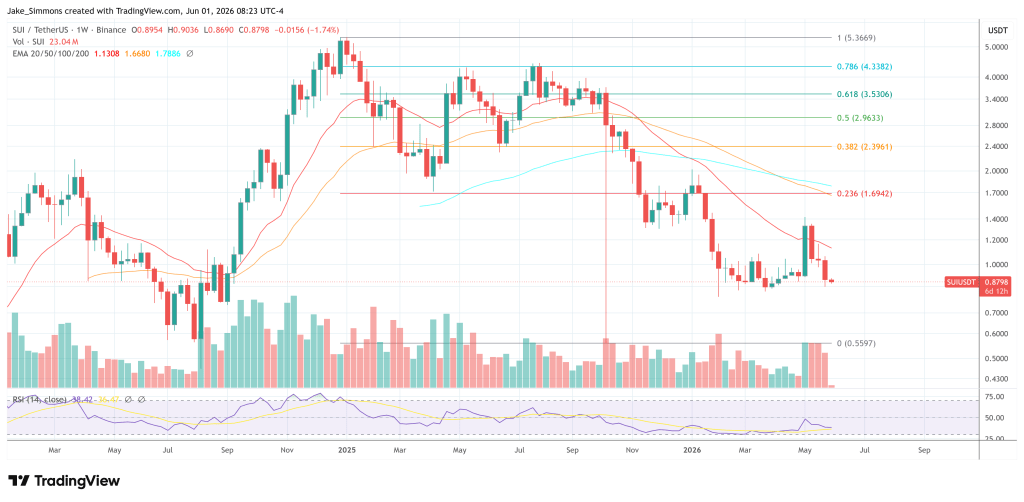
Sui remains below the 20-week EMA, 1-week chart | Source: SUIUSDT on TradingView.com

Domande pertinenti

QWhat were the root causes of the three mainnet halts experienced by Sui?

AThe first two outages were caused by crash bugs involving the interaction between the new address balance feature in the 1.72 upgrade and gas charging logic. The third outage was caused by a latent bug related to how randomness state was preserved during validator restarts, which was exposed during a scheduled epoch change.

QAccording to the postmortem, were any user funds at risk during the network outages?

ANo. The Sui Foundation stated that during the outages, no user funds were at risk, and the network did not revert any committed transactions when it resumed.

QWhat specific condition triggered the gas-charging bug that led to the first two halts?

AThe bug was triggered in a hybrid gas payment scenario. When a transaction attempted to spend from an address balance that could not cover competing transactions, it was cancelled. Later, during the 'gas smashing' process, the system incorrectly tried to debit funds from the same cancelled reservation again, leading to an underflow error during settlement.

QWhat was the key issue with the Distributed Key Generation (DKG) protocol that caused the third outage?

ADuring validator restarts, the failure verdict of a DKG process (which was disabled due to low participation) was not written to disk. When validators restarted again, they had no memory of the DKG failure. This caused the end-of-epoch logic to wait indefinitely for a DKG process that would never complete, stalling the epoch transition.

QWhat broader engineering lessons did the Sui Foundation highlight from these incidents?

AThe foundation highlighted two main areas for improvement: 1) Enhancing end-of-epoch resilience with better graceful degradation and operational force-close mechanisms. 2) Applying the same level of engineering rigor to gas charging logic as is applied to the Move VM or consensus, due to its complex interactions with settlement, conservation checks, and scheduling.

Letture associate

Trading Reflection: Why Does Trading Cryptocurrencies Become More Miserable the Longer You Do It? In Fact, Your Brain Has Been 'Damaged' by Stress.

Trading Reflection: Why Does Trading Cryptocurrency Become More Miserable Over Time? Your Brain Might Be Damaged by Stress This article explores the often-overlooked yet crucial psychological aspect of trading. It argues that long-term success depends less on intellect and more on the survival capacity of one's nervous system. The core issue is that sustained trading pressure disrupts normal brain chemistry. While initial hope and occasional wins provide dopamine-driven pleasure, repeated losses and constant market exposure trigger chronic cortisol release. This stress hormone, meant for short-term survival, keeps the trader in a perpetual "fight-or-flight" mode. Over time, this erodes sleep quality, depletes patience, and fuels emotional, impulsive decision-making. The author describes a dangerous cycle: fear of missing out leads to overtrading and lowered standards. As losses mount (30%, 50%), trading shifts from a pursuit of profit to a psychological battle for survival. The brain begins to associate prolonged stress with the occasional reward, trapping the trader in an addictive loop. Anxiety becomes a baseline state, and trading turns into a compulsive need to feel something—where green candles offer relief and red ones spark self-loathing. The most powerful move a trader can make, the article concludes, is sometimes to stop entirely—to avoid revenge trading, chasing losses, or seeking dopamine fixes. The key is to step back long enough to ask: is this still about passion, or is it a cage of stress hormones? The market and its opportunities will always return, but a trader who is mentally broken will have nothing left to capitalize on them. The best traders are not necessarily the smartest, but those who preserve their mental well-being long enough to stay in the game. Ultimately, the chase may not be for money, but for relief from the very pressure the game creates.

marsbit1 h fa

Trading Reflection: Why Does Trading Cryptocurrencies Become More Miserable the Longer You Do It? In Fact, Your Brain Has Been 'Damaged' by Stress.

marsbit1 h fa

Issued Two Work Badges to Unitree

At the keynote of his speech at the Taipei Music Center, Jensen Huang introduced a humanoid robot named Isaac GR00T. This robot, described as a 'reference design,' is a collaboration: its body comes from Unitree Robotics' H2 Plus, its hands from Singapore's Sharpa, and its 'brain'—the chip and full software stack—is from Nvidia, powered by the Jetson Thor. Huang positioned it as a turnkey solution for universities and researchers, aimed at drastically reducing setup time for experiments. On the same day as this reveal, Unitree Robotics passed its IPO review in Shanghai, seeking to raise 4.2 billion yuan, with a significant portion earmarked for developing its own embodied AI model—its own 'brain.' The article draws a parallel to the smartphone industry, where Qualcomm's 'reference design' led to homogenized hardware and concentrated profits in chips and software. It suggests Nvidia's GR00T initiative follows a similar playbook: by open-sourcing the model and framework, it aims to establish the industry standard, potentially relegating hardware makers to low-margin roles. While currently a body supplier for Nvidia's project, Unitree is actively pursuing its own AI brain, having open-sourced initial models and tested a more advanced one. The company faces a critical window to develop a competitive proprietary system before GR00T becomes the default. The article contrasts this with Tesla's vertically integrated approach for its Optimus robot, which uses in-house chips and benefits from its automotive data and manufacturing scale. It concludes that while the robot body still holds technical value and differentiation, the race for the 'brain' will ultimately define the industry's profit centers and power dynamics.

marsbit1 h fa

Issued Two Work Badges to Unitree

marsbit1 h fa

Trading

Spot
Futures

Articoli Popolari

Come comprare SUI

Benvenuto in HTX.com! Abbiamo reso l'acquisto di SUI Network (SUI) semplice e conveniente. Segui la nostra guida passo passo per intraprendere il tuo viaggio nel mondo delle criptovalute.Step 1: Crea il tuo Account HTXUsa la tua email o numero di telefono per registrarti il tuo account gratuito su HTX. Vivi un'esperienza facile e sblocca tutte le funzionalità,Crea il mio accountStep 2: Vai in Acquista crypto e seleziona il tuo metodo di pagamentoCarta di credito/debito: utilizza la tua Visa o Mastercard per acquistare immediatamente SUI NetworkSUI.Bilancio: Usa i fondi dal bilancio del tuo account HTX per fare trading senza problemi.Terze parti: abbiamo aggiunto metodi di pagamento molto utilizzati come Google Pay e Apple Pay per maggiore comodità.P2P: Fai trading direttamente con altri utenti HTX.Over-the-Counter (OTC): Offriamo servizi su misura e tassi di cambio competitivi per i trader.Step 3: Conserva SUI Network (SUI)Dopo aver acquistato SUI Network (SUI), conserva nel tuo account HTX. In alternativa, puoi inviare tramite trasferimento blockchain o scambiare per altre criptovalute.Step 4: Scambia SUI Network (SUI)Scambia facilmente SUI Network (SUI) nel mercato spot di HTX. Accedi al tuo account, seleziona la tua coppia di trading, esegui le tue operazioni e monitora in tempo reale. Offriamo un'esperienza user-friendly sia per chi ha appena iniziato che per i trader più esperti.

532 Totale visualizzazioniPubblicato il 2024.12.12Aggiornato il 2026.06.02

Come comprare SUI

Discussioni

Benvenuto nella Community HTX. Qui puoi rimanere informato sugli ultimi sviluppi della piattaforma e accedere ad approfondimenti esperti sul mercato. Le opinioni degli utenti sul prezzo di SUI SUI sono presentate come di seguito.

活动图片