Strive's Paper Loss Warning: Pressure from Strategy Preferred Shares Has Spread Across the Entire Bitcoin Treasury Track

Foresight NewsPubblicato 2026-07-09Pubblicato ultima volta 2026-07-09

Introduzione

Strive's disclosure that its holdings of Strategy's (STRC) preferred shares lost $7.08 million in value over eight days signals that credit risks are spreading across the Bitcoin reserve industry through cross-holdings. While not proof of insolvency, it shows how valuation pressure on one firm's securities can directly impact another's balance sheet. Strategy responded with a comprehensive credit management framework, including raising STRC dividends to 12%, authorizing share buybacks, and formalizing a plan to potentially sell Bitcoin to bolster its $2.55 billion cash reserve. However, third-party models value STRC at around $49.89 per share, far below its $100 face value, highlighting that its price depends critically on the sustainability of dividends and Strategy's financial health. The market now watches for two scenarios: either the risk is contained to Strategy, or it spreads industry-wide if STRC's discount deepens, dividends become unsustainable, and pressure spills over to securities like Strive's SATA. Key indicators to monitor are the discount rates of STRC and SATA, cash coverage for dividends, share issuance activity, and whether Bitcoin sales move from authorization to execution.


Author:Liam 'Akiba' Wright

Compile:Saoirse,Foresight News


The preferred shares issued by bitcoin reserve companies have long ceased to be purely income-generating assets; they have become a credit benchmark testing the balance sheet robustness of bitcoin enterprises. While market focus remains concentrated on Strategy, data disclosed by Strive, the seventh-largest bitcoin-holding listed company globally, directly demonstrates the real impact of risk spillover: another bitcoin reserve company holds Strategy preferred shares, and the value fluctuations of this holding have become a clear signal of market pressure.


In an update document released on June 29, Strive disclosed that between June 18 and June 26, the number of its held 505,000 STRC shares did not change, but the fair value of this holding fell from $44.738 million to $37.658 million.


In just 8 days, with no adjustment to the share count, the holding value evaporated by $7.08 million. Based on a simple calculation of the declared fair value, the market's valuation of Strive's STRC holdings dropped from approximately $88.59 per share to $74.57 per share.


This disclosure document does not prove the company is insolvent, forced to sell assets, or that its capital structure has completely failed. However, it reveals a more critical fact: even before a major crisis erupts, the risk associated with bitcoin reserve preferred shares can transmit to other companies' balance sheets through cross-shareholdings.


As of June 26, Strive still holds 19,864 bitcoins, possesses $141.7 million in cash and equivalents, and has 7,829,502 of its own SATA preferred shares outstanding. But the core signal released by this financial report is not its own asset scale, but rather that its exposure to Strategy preferred shares has fundamentally altered investors' judgment logic for the entire sector.


The market has long debated the STRC issued by Strategy: whether investors would treat this product as a stable income instrument or as a high-risk credit asset tied to bitcoin price action, market liquidity, and Strategy's dividend payment capability. Strive's disclosure makes this question even more pressing.


Different bitcoin reserve companies cross-holding each other's preferred shares establish a clear and visible cross-company risk transmission channel. Once STRC trades at a discount, Strive will reflect asset losses in its financial report's fair value. If Strive's subsequently issued SATA preferred shares also face market skepticism, the market can intuitively judge whether the current pressure is a single-company issue or has spread throughout the industry via the preferred share financing model.


The initial marketing points for these reserve preferred shares were stable yield, fixed par value, and regular dividends, which strongly appealed to investors preferring stable returns. However, when market focus shifts to discount-to-par ratios, cash reserve coverage, dividend adjustment mechanisms, share buybacks, and potential asset sales, the trading nature of these securities completely shifts towards credit-like risk assets.


The core question investors now care most about is: Does the issuer have sufficient cash, smooth financing channels, and adequate bitcoin liquidity to guarantee the credibility of dividend payments?
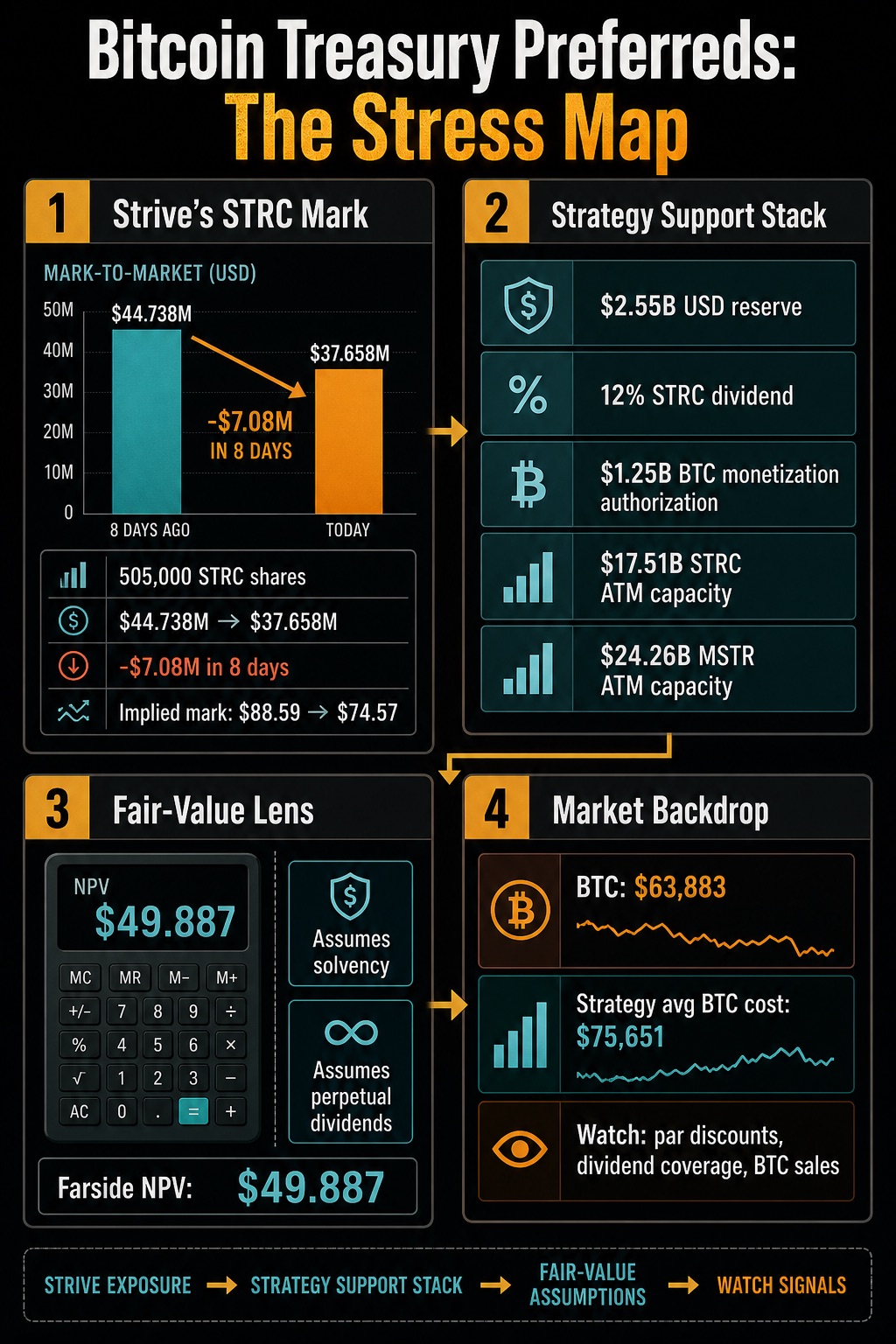

Strive's $7.08 million unrealized loss on its STRC preferred shares in 8 days exposes industry cross-holding risk. Simultaneously listing Strategy's full toolkit for stabilization—cash reserves, high dividends, coin sales, share issuance, etc.—alongside the third-party estimated STRC fair value of only $49.887 and the current bitcoin price far below the company's average cost basis, the article highlights the need to closely track preferred share discounts, dividend coverage capability, and bitcoin selling actions to judge industry risk trends.


Strategy's New Operational Framework: Essentially Credit Risk Management


The regulatory filing submitted by Strategy on June 29 further confirms the aforementioned shift in logic. The company introduced a Digital Credit Capital Framework, accompanied by policies including US Dollar Reserve Management Rules, a revised STRC dividend plan, a preferred share repurchase program, a common stock repurchase program, and a Bitcoin Monetization Plan. This combination of tools is specifically designed to address stressed capital structures.


Strategy disclosed that as of June 28, its US dollar reserve size reached $2.55 billion. The board mandated that management must retain cash reserves sufficient to cover at least the next 12 months of annual preferred share dividends and interest expenses, unless specifically authorized by the board to lower this threshold. The document also stated that reserve funds could be replenished through selling tokens under the Bitcoin Monetization Plan or via other capital market operations.


This reserve is crucial because Strategy increased the regular annualized dividend for STRC to 12%, payable monthly in two installments, applicable to record dates on or after July 1. The company has announced a $0.50 per share cash dividend for the settlement periods ending July 31 and August 15, with specific payment conditions subject to the STRC issuance agreement.


While raising dividends can support this income product in the short term, it also raises new questions: if the security continues to trade at a discount, can this high-dividend policy be sustained long-term?


Strategy clearly outlined the policy linkage logic: the STRC dividend plan will comprehensively consider the STRC secondary market price, overall market yields, credit spreads, bitcoin price and volatility, reserve coverage, capital market environment, and the company's overall capital structure. The document also emphasized that STRC dividends are not guaranteed obligations and will not be unilaterally increased simply because STRC's market price is below par value.


The entire policy system follows an active credit management approach. The company also authorized up to $1 billion for repurchasing its own digital credit securities. If management judges that repurchases can enhance enterprise value and optimize the capital structure, STRC will be the priority repurchase target. An additional $1 billion was authorized for repurchasing Class A common stock. These repurchase authorizations do not obligate the company to execute them but clearly demonstrate all the tools management can employ if discount risks continue to worsen.


Within the same capital framework, bitcoin sales were also formally incorporated as a response measure. The board approved the Bitcoin Monetization Plan, allowing the company to raise up to $1.25 billion by selling bitcoin to supplement US dollar reserves. If management determines this method is preferable to issuing additional common stock or other capital market operations, proceeds from coin sales can be used to cover preferred share dividends and interest expenses and also provide funds for share repurchases.


The company explicitly stated that this plan does not mandate forced bitcoin sales. However, this authorization fundamentally changes the market narrative: this company, originally built around hoarding bitcoin as its core business, now has a formal channel to utilize its bitcoin assets to stabilize its credit system.


Fair Value Calculations: The Core Test is Dividend Sustainability


The STRC fair value calculator publicly available from third-party firm Farside explains why the market discussion has long moved beyond surface-level yields. CryptoSlate queried the tool's data on July 7. Under preset calculation conditions, STRC's net present value per share was only $49.887. The calculation model defaults to an initial coupon rate of 11.50%, which steps down to 3.60% starting from month 33.


This calculation has a key prerequisite assumption: the enterprise continues normal operations and permanently pays dividends in full. This valuation is not the official pricing provided by Strategy, nor should it be conflated with Strategy's announced 12% annualized STRC dividend policy. However, it clearly reflects the core variable that preferred share investors truly focus on: valuation is highly dependent on dividend sustainability, the discount rate, and the issuer's ability to continue making interest payments amidst bitcoin price movements and capital market fluctuations.


The broader bitcoin market environment further amplifies this credit test. CryptoSlate bitcoin price data shows that on July 8, bitcoin was quoted around $62,000, with a 24-hour decline of 1.8%, a 7-day gain of 5.5%, a total market capitalization of $1.24 trillion, and bitcoin's market share of the total crypto market at 58%.


However, Strategy's June 28 bitcoin holdings data shows the company holds 847,363 bitcoins with an average cost basis of $75,651. While the current market price being far below the average cost won't force immediate sales, it also explains why the market is highly focused on reserve policies, at-the-market (ATM) issuance mechanisms, and terms related to bitcoin monetization.


Strategy's ATM issuance data intuitively shows this business model still possesses ample financing space. Between June 22 and 28, the company did not issue additional preferred shares via the ATM channel. It only sold 12,669,017 shares of MSTR common stock, raising net proceeds of $1.1524 billion. Remaining issuance capacity stands at: $17.5108 billion for STRC preferred shares and $24.2575 billion for MSTR common shares, alongside other preferred share issuance programs.


The entire business model still has multiple cushioning tools. But the key question is: What price must be paid to deploy these tools when investors demand higher yields, securities trade at significant discounts, or stronger collateral assets are required?


Two Scenarios: Judging Whether Risk Has Fully Spread


The market's current judgment on the subsequent trend is divided into two core logics:


Scenario One: Risk Contained, Affecting Only Strategy


STRC discount narrows. US dollar reserves and dividend policies stabilize market sentiment. The Bitcoin Monetization Plan remains only a backup option. Strive's asset impairment is merely a one-off, short-term shock from cross-holdings. The rest of the industry's reserve companies remain unaffected. Pressure remains concentrated solely on Strategy itself.


Scenario Two: Risk Fully Spreads


STRC remains deeply discounted long-term. Raising dividends fails to placate the market. The company increasingly relies on the common stock ATM issuance channel. The Bitcoin Monetization Plan transitions from authorization to actual selling. Simultaneously, Strive's own issued SATA preferred shares come under pressure. They are no longer viewed as independent products but are grouped with STRC by the market as high-risk assets. At that point, bitcoin reserve preferred shares evolve from a single-company issue into a systemic risk for the entire sector.


Existing disclosure documents do not prove the second scenario is occurring yet, but they sufficiently explain the root of market concern: Strive's holding of STRC directly translates Strategy's discount risk into a fair value loss on another company's financial report.


Strategy's introduced framework integrates dividends, cash reserves, share buybacks, ATM issuances, and potential bitcoin sales into a unified risk buffer system. Meanwhile, the Farside valuation tool highlights that corporate viability and the assumption of perpetual dividends are the core determinants of preferred share value.


The core indicators for subsequent market observation are clear: whether the discount-to-par for STRC and SATA widens, whether dividend cash coverage capability is credible, whether companies increase the intensity of common or preferred share issuance, and whether bitcoin sales remain only at the authorization stage.


Future financial reports disclosed by Strive will become a critical signal to judge whether the loss on its Strategy preferred shares is merely an isolated case or the first public sign of bitcoin reserve credit risk spreading industry-wide via the preferred share model.


Crypto di tendenza

Domande pertinenti

QWhat key risk did Strive's disclosure regarding its STRC holdings highlight for the entire Bitcoin reserve enterprise sector?

AIt highlighted the risk of cross-holdings, where market pressure or devaluation of one company's preferred shares (like Strategy's STRC) can directly cause mark-to-market losses on the balance sheets of other companies in the sector (like Strive). This creates a clear channel for risk contagion beyond a single firm's problems.

QWhat are the two potential scenarios for risk evolution in the Bitcoin reserve preferred share market described in the article?

AThe two scenarios are: 1) Contained Risk, where STRC's discount narrows, confidence in cash reserves and dividend policies is restored, and the pressure remains limited to Strategy. 2) System-wide Diffusion, where STRC remains deeply discounted, cash reserves and increased dividends fail to stabilize the market, leading to actual Bitcoin sales, and pressure spreads to other preferred shares like SATA, transforming it into a sector-wide systemic risk.

QAccording to the article, how has Strategy's recently announced framework fundamentally changed the nature of its business and the preferred shares?

AIt has shifted the framework from a pure Bitcoin accumulation business to an active credit risk management model. By formally integrating tools like a mandatory cash reserve for dividends, revised dividend policies, share buyback plans, and a potential Bitcoin monetization plan, it treats its preferred shares (STRC) as credit instruments whose value depends on the company's financial strength and ability to service its obligations.

QWhat is the core factor determining the fair value of Strategy's STRC preferred share, as illustrated by the third-party valuation tool mentioned in the article?

AThe core factor is the sustainability of the dividend payments. The valuation model heavily depends on the critical assumption that the company will continue to operate normally and fully pay dividends in perpetuity. Therefore, the share's value is tied to the issuer's long-term solvency and cash flow generation capacity.

QWhat specific metrics does the article suggest are crucial for monitoring to assess the spread of risk in the sector going forward?

AKey monitoring metrics include: the discount-to-par value of STRC and other preferred shares like SATA; the credibility of the cash coverage for dividend payments; whether companies increase the pace of issuing common or preferred shares via ATM programs; and whether authorized Bitcoin sales plans transition from a contingency into actual asset sales.

Letture associate

Are the Frantic Acquisitions of Crypto Companies by Giants Good or Bad?

In a bear market, giants are actively acquiring crypto companies. Recent months have seen at least five major deals: Samsung Securities bought a 2% stake in Upbit operator Dunamu; Robinhood acquired WonderFi for $180 million to enter the Canadian market; Figure purchased Kiavi for $717 million to expand into on-chain real estate credit; Franklin Templeton bought 250Digital to launch Franklin Crypto; and Blockworks acquired data platform Messari at a steep discount—over 90% less than its 2022 $300 million valuation. These moves highlight a strategic shift. Cash-rich giants are consolidating resources at low cost, targeting companies with established compliance frameworks to navigate tightening global regulations. Acquisitions like WonderFi and the Upbit stake provide immediate market access and licensed user bases. Figure's deal signals real-world asset (RWA) tokenization moving from concept to large-scale implementation, with Kiavi's $7+ billion annual transaction volume being integrated into on-chain capital markets. Franklin Crypto's launch targets institutional investors like pension funds, offering them tailored, compliant crypto strategies. For these strategic players, bear markets present an ideal entry point: valuations are depressed, speculative noise is minimized, and they can acquire robust technology and compliance infrastructure at a fraction of the cost. This acquisition wave marks a transitional phase for crypto—from a wild frontier toward an institutional, regulated financial system. Giants are positioning themselves to capture future growth when macroeconomic conditions and liquidity improve, leaving latecomers behind.

marsbit31 min fa

Are the Frantic Acquisitions of Crypto Companies by Giants Good or Bad?

marsbit31 min fa

In the MiCA Era, Europe's New Cryptography Landscape: Why is Germany Taking Center Stage?

With MiCA's transitional arrangements concluding, Europe's crypto industry has undergone a regulatory consolidation. Post-MiCA, platforms must secure CASP authorization to operate compliantly within the EU. As of July 1st, only about 12% of crypto firms have received authorization, with Germany emerging as a key player, holding 57 authorizations (roughly 23% of the EU total). This positions Germany as a primary compliance gateway to the EU's unified market. Germany's advantage stems from its established, function-based regulatory framework, which integrated crypto activities into existing banking, securities, and payment systems pre-MiCA. This allowed a smoother transition and attracted both domestic platforms (like Bitcoin.de, BISON) and international ones (like Coinbase Germany). A distinctive trend is German banks becoming direct retail entry points for crypto services. Examples include DZ Bank integrating "meinKrypto" into its VR Banking App and the Sparkassen savings bank network planning to offer crypto trading via DekaBank. This mainstreams crypto access for ordinary users. Beyond trading, Germany is evolving into a digital asset infrastructure hub. Deutsche Börse Group's Clearstream is developing a next-generation platform for issuing, settling, and servicing both traditional and tokenized securities. Furthermore, German banks like DekaBank and DZ Bank are key participants in the Qivalis project, a European initiative for a regulated euro stablecoin, positioning Germany at the intersection of critical future capabilities like custody, settlement, and cross-border services.

marsbit1 h fa

In the MiCA Era, Europe's New Cryptography Landscape: Why is Germany Taking Center Stage?

marsbit1 h fa

Trading

Spot

Articoli Popolari

Cosa è BITCOIN

Comprendere HarryPotterObamaSonic10Inu (ERC-20) e la sua posizione nel mondo delle criptovalute Negli ultimi anni, il mercato delle criptovalute ha assistito a un aumento della popolarità delle meme coin, catturando l'interesse non solo dei trader, ma anche di coloro che cercano coinvolgimento comunitario e valore di intrattenimento. Tra questi token unici c'è HarryPotterObamaSonic10Inu (ERC-20), un progetto intrigante che mescola riferimenti culturali nel tessuto delle criptovalute. Questo articolo esplora gli aspetti chiave di HarryPotterObamaSonic10Inu, analizzando i suoi meccanismi, l'etica guidata dalla comunità e il suo coinvolgimento con il panorama crittografico più ampio. Che cos'è HarryPotterObamaSonic10Inu (ERC-20)? Come suggerisce il suo nome, HarryPotterObamaSonic10Inu è una meme coin costruita sulla blockchain di Ethereum, classificata secondo lo standard ERC-20. A differenza delle criptovalute tradizionali che possono enfatizzare l'utilità pratica o il potenziale investimento, questo token prospera grazie al valore di intrattenimento e alla forza della sua comunità. Il progetto mira a creare un ambiente in cui gli utenti coinvolti possono riunirsi, condividere idee e partecipare ad attività ispirate a diversi fenomeni culturali. Una caratteristica notevole di HarryPotterObamaSonic10Inu è la zero tassa sulle transazioni. Questo elemento allettante tende a incoraggiare il trading e il coinvolgimento della comunità, privo di costi aggiuntivi che possono scoraggiare i trader di piccole dimensioni. L'offerta totale della moneta è fissata a un miliardo di token, un numero che segna la sua intenzione di mantenere una circolazione sostanziale all'interno della comunità. Creatore di HarryPotterObamaSonic10Inu (ERC-20) Le origini di HarryPotterObamaSonic10Inu sono avvolte in un certo mistero; i dettagli sul creatore rimangono sconosciuti. Lo sviluppo di questo token non presenta un team identificabile o un piano esplicito, cosa non rara nel settore delle meme coin. Invece, il progetto è emerso organicamente, con il suo progresso fortemente dipendente dall'entusiasmo e dalla partecipazione della sua comunità. Investitori di HarryPotterObamaSonic10Inu (ERC-20) Per quanto riguarda investimenti esterni e finanziamenti, HarryPotterObamaSonic10Inu rimane ambiguo. Il token non elenca alcuna fondazione di investimento conosciuta o un sostegno organizzativo significativo. Invece, la linfa vitale del progetto è la sua comunità di base, che informa la sua crescita e sostenibilità attraverso azioni collettive e coinvolgimento nello spazio crittografico. Come funziona HarryPotterObamaSonic10Inu (ERC-20)? In quanto meme coin, HarryPotterObamaSonic10Inu opera principalmente al di fuori delle strutture tradizionali che governano spesso il valore degli asset. Ci sono diversi aspetti distintivi che definiscono il funzionamento del progetto: Transazioni senza tasse: Senza costi fiscali sulle transazioni, gli utenti possono comprare e vendere liberamente il token senza preoccuparsi di costi nascosti. Coinvolgimento della comunità: Il progetto prospera sull'interazione della comunità, sfruttando le piattaforme social per creare entusiasmo e facilitare il coinvolgimento. Discussioni, condivisione di contenuti e coinvolgimento sono elementi cruciali che aiutano ad espandere la sua portata e a favorire la lealtà tra i sostenitori. Nessuna utilità pratica: Va notato che HarryPotterObamaSonic10Inu non offre un'utilità concreta all'interno dell'ecosistema finanziario. Piuttosto, è classificato come un token principalmente per attività di intrattenimento e comunitarie. Riferimento culturale: Il token incorpora astutamente elementi della cultura pop per attirare interesse, collegandosi a appassionati di meme e seguaci delle criptovalute. HarryPotterObamaSonic10Inu esemplifica come le meme coin operino in modo diverso rispetto ai progetti di criptovalute più tradizionali, entrando nel mercato come costrutti sociali innovativi piuttosto che come asset utilitari. Cronologia di HarryPotterObamaSonic10Inu (ERC-20) La storia di HarryPotterObamaSonic10Inu è segnata da diversi traguardi notevoli: Creazione: Il token è emerso da un meme virale, catturando l'immaginazione di molti appassionati di criptovalute. Le date di creazione specifiche non sono disponibili, sottolineando la sua crescita organica. Inserimento negli scambi: HarryPotterObamaSonic10Inu ha fatto il suo ingresso in vari scambi, consentendo un accesso e un trading più facili da parte della comunità. Iniziative di coinvolgimento della comunità: Attività in corso volte a migliorare l'interazione della comunità, comprese gare, campagne sui social media e generazione di contenuti da parte di fan e sostenitori. Piani di espansione futura: La tabella di marcia del progetto include il lancio di una collezione NFT, merchandising e un sito di eCommerce relativo ai suoi temi culturali, coinvolgendo ulteriormente la comunità e cercando di aggiungere più dimensioni al suo ecosistema. Punti chiave su HarryPotterObamaSonic10Inu (ERC-20) Natura guidata dalla comunità: Il progetto dà priorità al contributo collettivo e alla creatività, garantendo che il coinvolgimento degli utenti sia al centro del suo sviluppo. Classificazione come meme coin: Rappresenta l'epitome delle criptovalute basate sull'intrattenimento, distinguendosi dai veicoli d'investimento tradizionali. Nessuna affiliazione diretta con Bitcoin: Nonostante la somiglianza nel nome del ticker, HarryPotterObamaSonic10Inu è distintivo e non ha alcuna relazione con Bitcoin o altre criptovalute consolidate. Focus sulla collaborazione: HarryPotterObamaSonic10Inu è progettato per creare uno spazio per la collaborazione e la condivisione di storie tra i suoi detentori, fornendo un canale per la creatività e il legame comunitario. Prospettive future: L'ambizione di espandersi oltre il suo presupposto iniziale verso NFT e merchandising delinea un percorso per il progetto per potenzialmente entrare in strade più mainstream all'interno della cultura digitale. Poiché le meme coin continuano a catturare l'immaginazione della comunità crittografica, HarryPotterObamaSonic10Inu (ERC-20) si distingue per i suoi legami culturali e il suo approccio centrato sulla comunità. Anche se potrebbe non adattarsi al modello tipico di un token orientato all'utilità, la sua essenza risiede nella gioia e nella camaraderia coltivate tra i suoi sostenitori, evidenziando la natura in evoluzione delle criptovalute in un'epoca sempre più digitale. Con la continuazione dello sviluppo del progetto, sarà importante osservare come le dinamiche della comunità influenzano la sua traiettoria nel panorama in continuo cambiamento della tecnologia blockchain.

1.8k Totale visualizzazioniPubblicato il 2024.04.01Aggiornato il 2024.12.03

Cosa è BITCOIN

Come comprare BTC

Benvenuto in HTX.com! Abbiamo reso l'acquisto di Bitcoin (BTC) semplice e conveniente. Segui la nostra guida passo passo per intraprendere il tuo viaggio nel mondo delle criptovalute.Step 1: Crea il tuo Account HTXUsa la tua email o numero di telefono per registrarti il tuo account gratuito su HTX. Vivi un'esperienza facile e sblocca tutte le funzionalità,Crea il mio accountStep 2: Vai in Acquista crypto e seleziona il tuo metodo di pagamentoCarta di credito/debito: utilizza la tua Visa o Mastercard per acquistare immediatamente BitcoinBTC.Bilancio: Usa i fondi dal bilancio del tuo account HTX per fare trading senza problemi.Terze parti: abbiamo aggiunto metodi di pagamento molto utilizzati come Google Pay e Apple Pay per maggiore comodità.P2P: Fai trading direttamente con altri utenti HTX.Over-the-Counter (OTC): Offriamo servizi su misura e tassi di cambio competitivi per i trader.Step 3: Conserva Bitcoin (BTC)Dopo aver acquistato Bitcoin (BTC), conserva nel tuo account HTX. In alternativa, puoi inviare tramite trasferimento blockchain o scambiare per altre criptovalute.Step 4: Scambia Bitcoin (BTC)Scambia facilmente Bitcoin (BTC) nel mercato spot di HTX. Accedi al tuo account, seleziona la tua coppia di trading, esegui le tue operazioni e monitora in tempo reale. Offriamo un'esperienza user-friendly sia per chi ha appena iniziato che per i trader più esperti.

4.1k Totale visualizzazioniPubblicato il 2024.12.12Aggiornato il 2026.06.02

Come comprare BTC

Cosa è $BITCOIN

ORO DIGITALE ($BITCOIN): Un'Analisi Completa Introduzione all'ORO DIGITALE ($BITCOIN) L'ORO DIGITALE ($BITCOIN) è un progetto basato su blockchain che opera sulla rete Solana, con l'obiettivo di combinare le caratteristiche dei metalli preziosi tradizionali con l'innovazione delle tecnologie decentralizzate. Sebbene condivida un nome con Bitcoin, spesso definito “oro digitale” a causa della sua percezione come riserva di valore, l'ORO DIGITALE è un token separato progettato per creare un ecosistema unico all'interno del panorama Web3. Il suo obiettivo è posizionarsi come un asset digitale alternativo valido, anche se i dettagli riguardanti le sue applicazioni e funzionalità sono ancora in fase di sviluppo. Cos'è l'ORO DIGITALE ($BITCOIN)? L'ORO DIGITALE ($BITCOIN) è un token di criptovaluta esplicitamente progettato per l'uso sulla blockchain di Solana. A differenza di Bitcoin, che fornisce un ruolo di stoccaggio di valore ampiamente riconosciuto, questo token sembra concentrarsi su applicazioni e caratteristiche più ampie. Aspetti notevoli includono: Infrastruttura Blockchain: Il token è costruito sulla blockchain di Solana, nota per la sua capacità di gestire transazioni ad alta velocità e a basso costo. Dinamiche di Offerta: L'ORO DIGITALE ha un'offerta massima fissata a 100 quadrilioni di token (100P $BITCOIN), sebbene i dettagli riguardanti la sua offerta circolante siano attualmente non divulgati. Utilità: Sebbene le funzionalità precise non siano esplicitamente delineate, ci sono indicazioni che il token potrebbe essere utilizzato per varie applicazioni, potenzialmente coinvolgendo applicazioni decentralizzate (dApp) o strategie di tokenizzazione degli asset. Chi è il Creatore dell'ORO DIGITALE ($BITCOIN)? Attualmente, l'identità dei creatori e del team di sviluppo dietro l'ORO DIGITALE ($BITCOIN) rimane sconosciuta. Questa situazione è tipica tra molti progetti innovativi nel settore blockchain, in particolare quelli allineati con la finanza decentralizzata e i fenomeni delle meme coin. Sebbene tale anonimato possa favorire una cultura guidata dalla comunità, intensifica le preoccupazioni riguardo alla governance e alla responsabilità. Chi sono gli Investitori dell'ORO DIGITALE ($BITCOIN)? Le informazioni disponibili indicano che l'ORO DIGITALE ($BITCOIN) non ha alcun sostenitore istituzionale noto o investimenti di venture capital prominenti. Il progetto sembra operare su un modello peer-to-peer incentrato sul supporto e sull'adozione della comunità piuttosto che su percorsi di finanziamento tradizionali. La sua attività e liquidità si trovano principalmente su exchange decentralizzati (DEX), come PumpSwap, piuttosto che su piattaforme di trading centralizzate consolidate, evidenziando ulteriormente il suo approccio di base. Come Funziona l'ORO DIGITALE ($BITCOIN) Le meccaniche operative dell'ORO DIGITALE ($BITCOIN) possono essere elaborate in base al suo design blockchain e alle caratteristiche della rete: Meccanismo di Consenso: Sfruttando il proof-of-history (PoH) unico di Solana combinato con un modello di proof-of-stake (PoS), il progetto garantisce una validazione efficiente delle transazioni contribuendo all'alta performance della rete. Tokenomics: Sebbene meccanismi deflazionistici specifici non siano stati dettagliati ampiamente, l'ampia offerta massima di token implica che potrebbe soddisfare microtransazioni o casi d'uso di nicchia che devono ancora essere definiti. Interoperabilità: Esiste il potenziale per l'integrazione con l'ecosistema più ampio di Solana, inclusi vari piattaforme di finanza decentralizzata (DeFi). Tuttavia, i dettagli riguardanti integrazioni specifiche rimangono non specificati. Cronologia degli Eventi Chiave Ecco una cronologia che evidenzia traguardi significativi riguardanti l'ORO DIGITALE ($BITCOIN): 2023: Il dispiegamento iniziale del token avviene sulla blockchain di Solana, contrassegnato dal suo indirizzo di contratto. 2024: L'ORO DIGITALE guadagna visibilità poiché diventa disponibile per il trading su exchange decentralizzati come PumpSwap, consentendo agli utenti di scambiarlo contro SOL. 2025: Il progetto assiste a un'attività di trading sporadica e a un potenziale interesse per impegni guidati dalla comunità, sebbene non siano state documentate partnership significative o avanzamenti tecnici fino ad ora. Analisi Critica Punti di Forza Scalabilità: L'infrastruttura sottostante di Solana supporta alti volumi di transazioni, il che potrebbe migliorare l'utilità di $BITCOIN in vari scenari di transazione. Accessibilità: Il potenziale basso prezzo di trading per token potrebbe attrarre investitori al dettaglio, facilitando una partecipazione più ampia grazie a opportunità di proprietà frazionata. Rischi Mancanza di Trasparenza: L'assenza di sostenitori, sviluppatori o di un processo di audit pubblicamente noti potrebbe generare scetticismo riguardo alla sostenibilità e all'affidabilità del progetto. Volatilità del Mercato: L'attività di trading è fortemente dipendente dal comportamento speculativo, il che può comportare una significativa volatilità dei prezzi e incertezze per gli investitori. Conclusione L'ORO DIGITALE ($BITCOIN) emerge come un progetto intrigante ma ambiguo all'interno dell'evolvente ecosistema di Solana. Sebbene tenti di sfruttare la narrativa dell'“oro digitale”, la sua partenza dal ruolo consolidato di Bitcoin come riserva di valore sottolinea la necessità di una chiara differenziazione della sua utilità e struttura di governance. L'accettazione e l'adozione future dipenderanno probabilmente dall'affrontare l'attuale opacità e dalla definizione più esplicita delle sue strategie operative ed economiche. Nota: Questo rapporto comprende informazioni sintetizzate disponibili a ottobre 2023, e potrebbero essersi verificati sviluppi oltre il periodo di ricerca.

127 Totale visualizzazioniPubblicato il 2025.05.13Aggiornato il 2025.05.13

Cosa è $BITCOIN

Discussioni

Benvenuto nella Community HTX. Qui puoi rimanere informato sugli ultimi sviluppi della piattaforma e accedere ad approfondimenti esperti sul mercato. Le opinioni degli utenti sul prezzo di BTC BTC sono presentate come di seguito.

活动图片