Author: Ding Dang
Original Title: Strategy Buys 10,000 BTC in a Week: How Much is Left Available in the Market?
Over the past two weeks, Strategy has once again significantly increased its Bitcoin holdings: acquiring over 10,000 BTC in a single week, valued at more than $900 million.
As a well-known long-term holder in the market, against the backdrop of Bitcoin's continued price decline and its own mNAV falling below 1, Strategy did not sell as the market had feared, but instead provided the opposite answer—firmly buying. To date, Strategy holds approximately 671,000 BTC in total, with a total value exceeding $50 billion, continuously solidifying its position as one of the world's largest institutional Bitcoin holders.
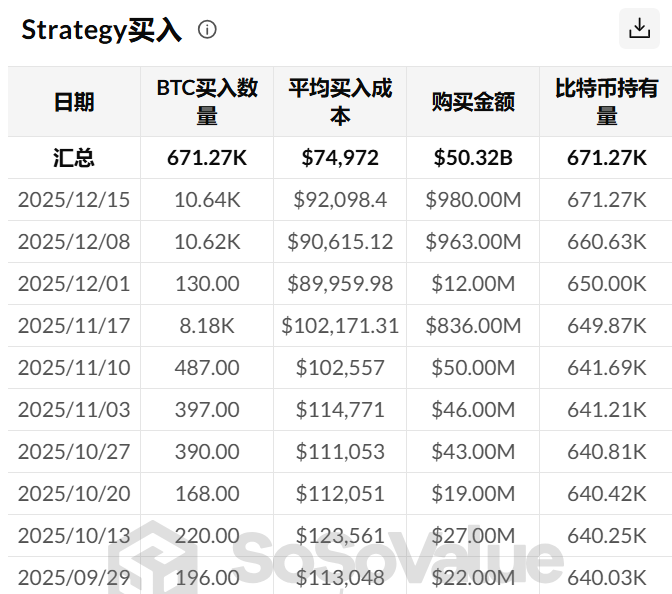
This move has also sparked deeper market reflection: with such large-scale continuous buying, how much Bitcoin is truly available for trading in the market?
The theoretical maximum supply of Bitcoin is 21 million, but the actual circulating supply is far smaller. Approximately 19.96 million BTC have been mined so far, accounting for 95% of the total supply, with only about 1.04 million yet to be produced. The current block reward is 3.125 BTC, with around 450 new coins added daily, and it will halve again in 2028. At this pace, the last Bitcoin is expected to be mined around 2140.
However, what truly determines market supply is not the unmined new coins but the liquid portion of the existing supply.
According to statistics, over 30% of Bitcoin has not moved for a long time and is considered "dormant holdings"; another approximately 20% is suspected to be permanently lost. Additionally, institutional and public holdings, including listed companies, ETFs, and national funds, continue to rise, with most of these BTC exiting high-frequency circulation. Furthermore, Bitcoin reserves on exchanges have dropped to multi-year lows, meaning the "floating supply" available for immediate sale is rapidly shrinking. Against the backdrop of whales quietly buying and long-term holders holding tightly, market liquidity is facing structural tightening.
Regarding the issue of Bitcoin's true circulating supply, crypto analyst Murphy conducted a systematic analysis. Odaily Planet Daily further integrated data and perspectives on this basis, attempting to present the full picture behind the scarcity narrative—as buying power persists and available supply shrinks, the market structure may be quietly shifting.
Long-Term Holders' "Institutionalized Hoarding" is Taking Over Circulating Supply
Long-term holders have now become the most important structural force in the Bitcoin market. According to Glassnode, this group collectively holds approximately 14.35 million BTC, accounting for over 70% of the circulating supply.
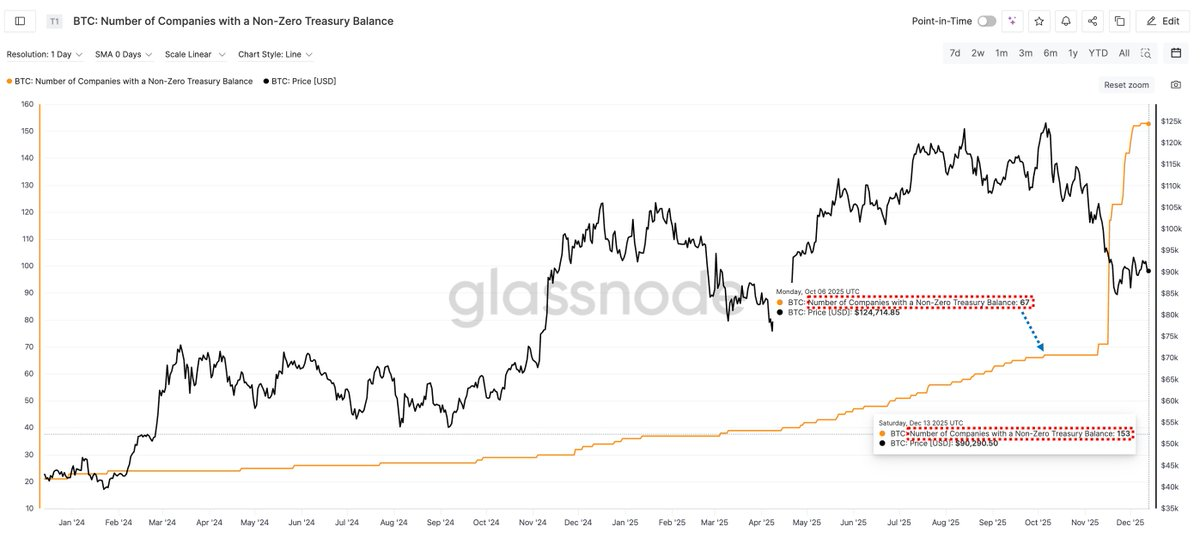
Further breakdown: There are currently 153 companies holding BTC with "non-zero balances," the core of which are 29 listed companies, collectively holding 1.082 million BTC (including Other holding 54,331 BTC). Among these 29 listed companies, Strategy alone holds 671,000 BTC, accounting for 62%.
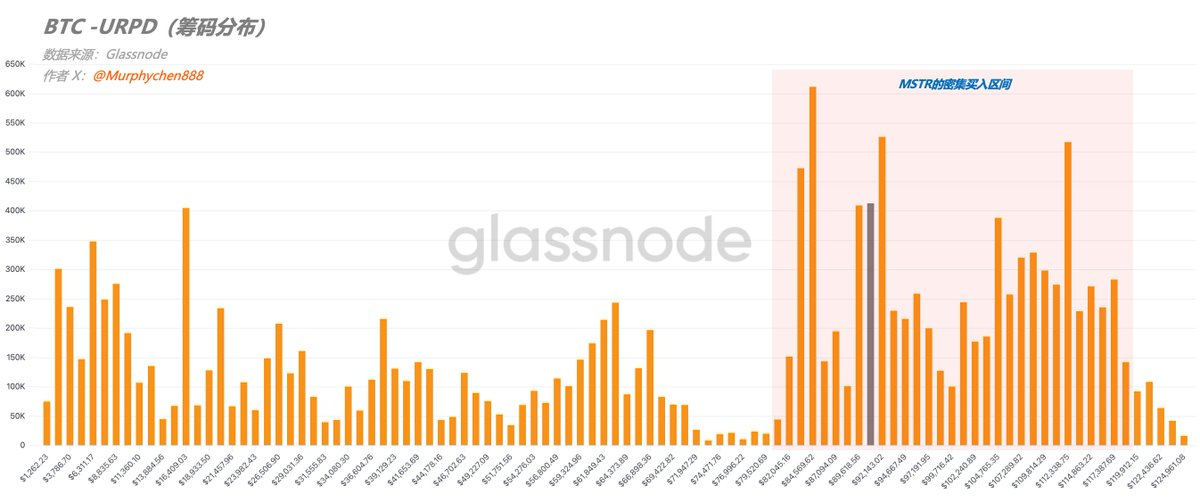
Combined with URPD (UTXO Realized Price Distribution) data, Strategy's intensive buying range coincides with the most densely concentrated area in BTC's supply structure, roughly between $80,000 and $118,000. This means that Strategy played a significant role in the large-volume trading at high price levels. This is also why MSTR and ETFs are considered the driving force behind this bull cycle.
It is worth noting that on October 6, there were only 67 companies holding "non-zero BTC balances." However, as BTC experienced a deep correction, this number suddenly surged, and there are now 153. Does this mean that new corporate players are quietly entering the market during the price decline?
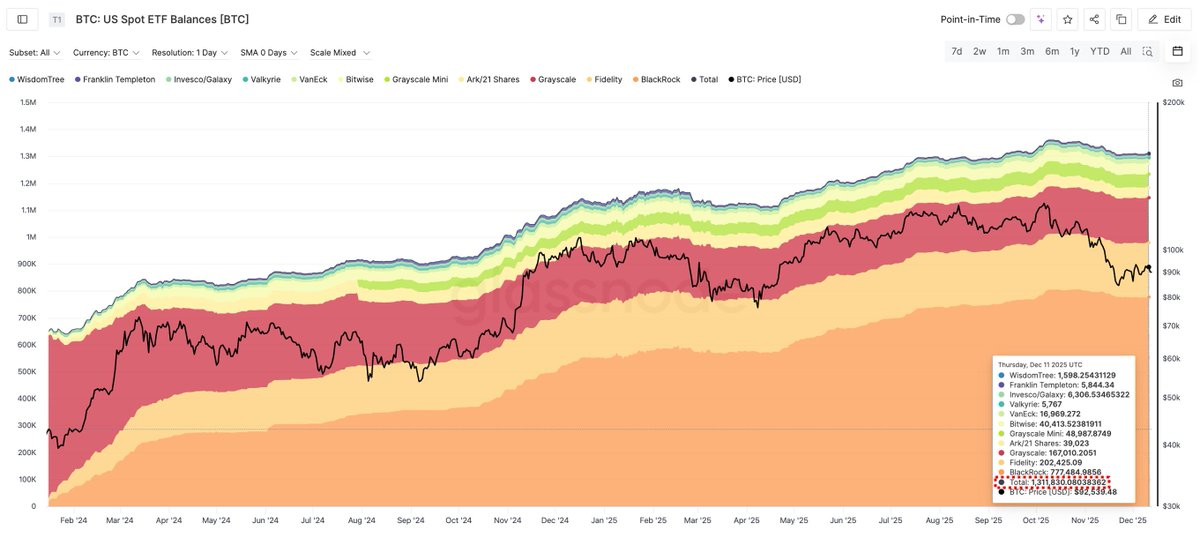
In addition to corporate reserves, spot Bitcoin ETFs currently hold approximately 1.311 million BTC. The top three are: BlackRock with about 777,000, Fidelity with about 202,000, and Grayscale with about 167,000.
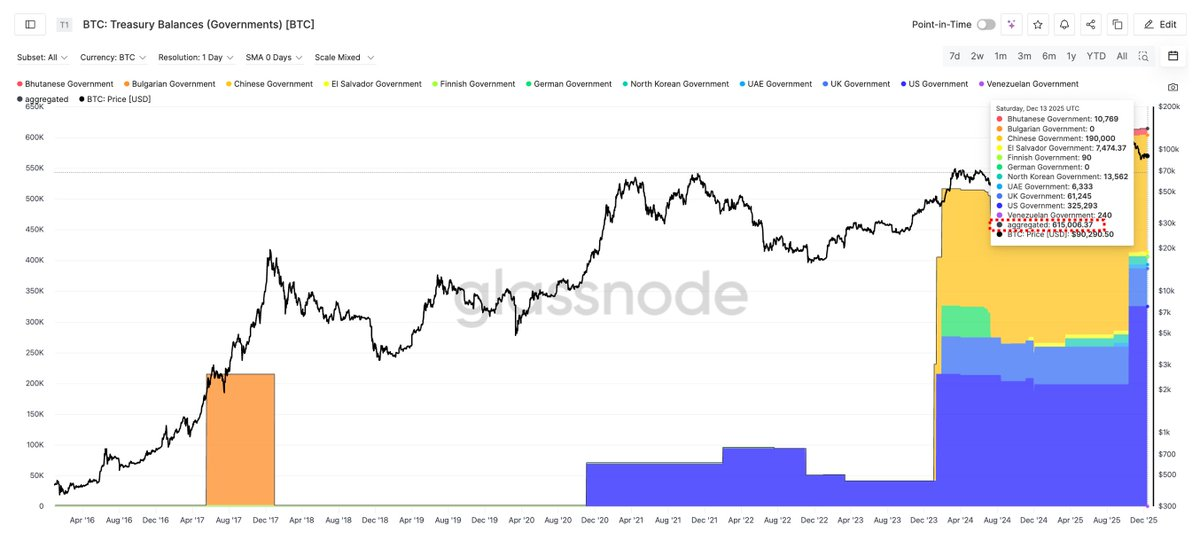
Furthermore, governments worldwide hold approximately 615,000 BTC. The U.S. government leads with 325,000, while the Chinese government ranks second with about 190,000 BTC. It should be noted that the Chinese government has never officially disclosed such holdings; this data primarily comes from Glassnode, and its statistical scope may still have uncertainties compared to the real situation.
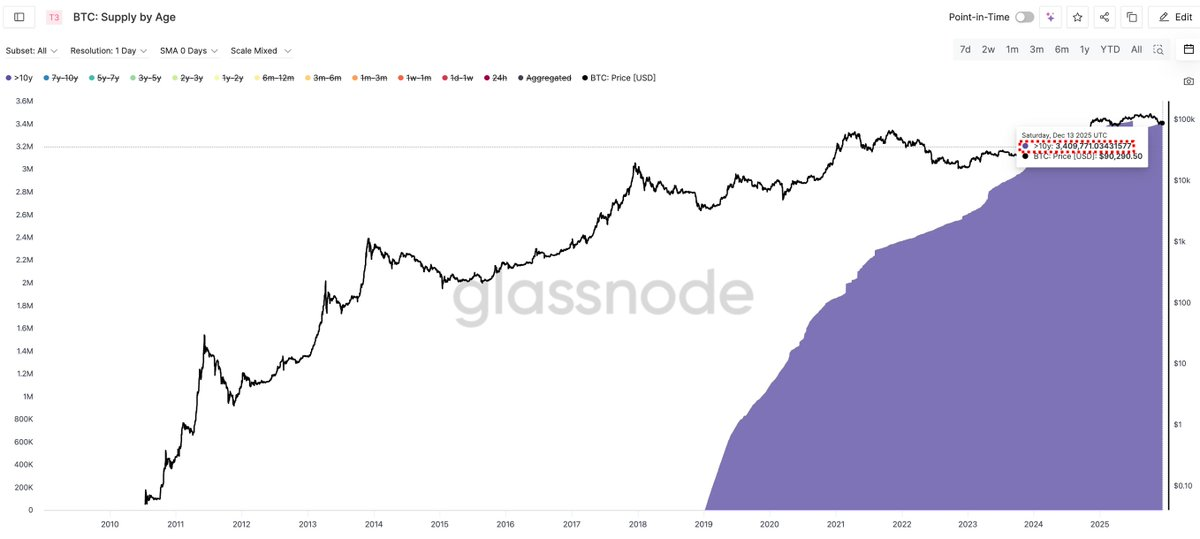
Additionally, about 3.409 million BTC have not moved for over 10 years. These assets include cold wallets of early exchanges and truly "faith-based OGs"; however, it is also important to note that a significant portion has likely exited the circulation system due to reasons such as lost private keys or the holder's death, including the approximately 1 million BTC widely believed to belong to Satoshi Nakamoto.
How Much of the Mined BTC is Actually "Unbuyable"?
Murphy later provided a more detailed analysis of this data. Unlike traditional bank accounts with "password recovery" features, Bitcoin relies entirely on private keys to prove ownership. Once a private key is lost or inaccessible, the corresponding Bitcoin can never be moved or spent. Although they remain recorded on the blockchain, economically, they are equivalent to being permanently destroyed.
If we break down the circulating supply by date range, where each range refers to the creation date of the UTXO, we can see that the cumulative amount of BTC "born" between 2010-2014 peaked in December 2014, then declined rapidly (as they were spent); since January 2019, there has been almost no significant change.
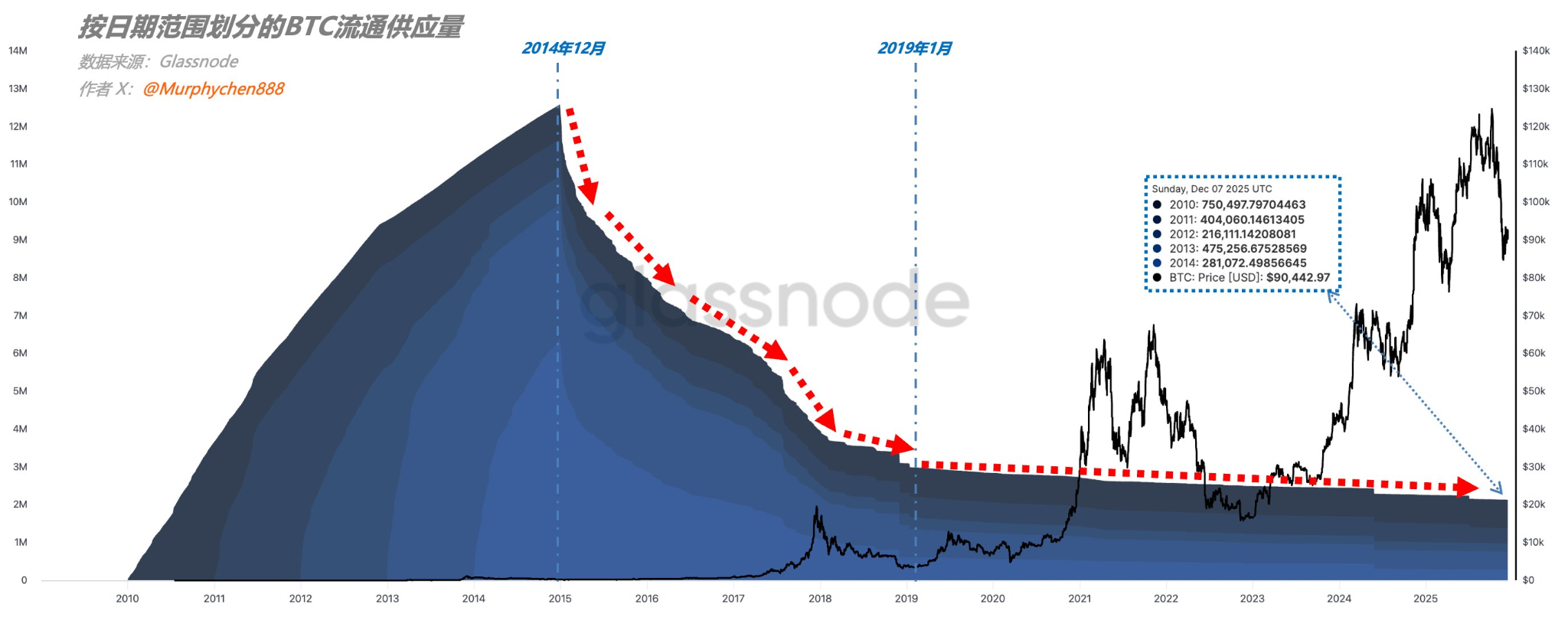
These ancient BTC that remain today, aside from those held by absolute believers, are likely mostly lost. According to Murphy's estimate, this proportion is at least 50%, meaning at least 1.06 million BTC.
There is also a group of "supreme" coins with UTXO creation dates in 2009. They have hardly moved since December 2011, and to this day, this address group holds 1.08 million BTC.
In other words, at least approximately 2.14 million BTC may be permanently immovable in practice.
Truly Liquid Supply
Looking at the most direct indicator—exchange balances—the Bitcoin held in exchange wallets is currently about 2.49 million, and this trend continues to decline, hitting a new low since 2023.
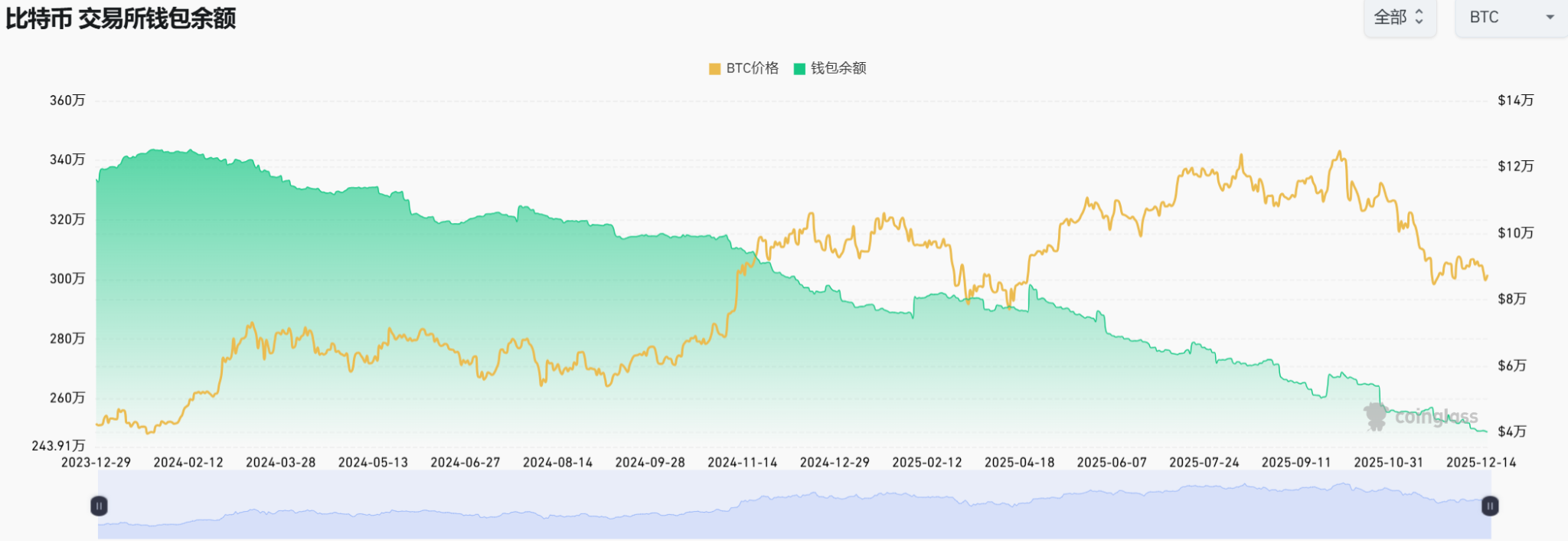
In other words, while demand continues to become "institutionalized," supply is constantly contracting, and the pool of Bitcoin available for trading is becoming increasingly smaller.
Twitter:https://twitter.com/BitpushNewsCN
Bitpush TG Discussion Group:https://t.me/BitPushCommunity
Bitpush TG Subscription: https://t.me/bitpush