Strategy Scoops Up 10,000 BTC in a Single Week: How Much Is Left to Buy on the Market?

Odaily星球日报Pubblicato 2025-12-17Pubblicato ultima volta 2025-12-17

Introduzione

Strategy, a major long-term Bitcoin holder, has significantly increased its BTC holdings by over 10,000 BTC (worth $900 million) in a single week, despite a declining market and its mNAV falling below 1. This brings its total holdings to approximately 671,000 BTC, valued at over $50 billion, reinforcing its position as one of the world's largest institutional Bitcoin holders. This aggressive accumulation raises questions about the actual available supply of Bitcoin on the market. While 19.96 million BTC have been mined (95% of the total 21 million cap), the truly liquid supply is far smaller. An estimated 30% of Bitcoin is held long-term in "dormant" wallets, and around 20% is presumed permanently lost. Furthermore, institutional ownership from public companies, ETFs, and national funds is rapidly growing, and exchange balances have hit multi-year lows, indicating a shrinking pool of immediately sellable "float." Key data points on illiquid supply: - Long-term holders possess ~14.35 million BTC (over 70% of circulating supply). - 153 corporations hold BTC, with 29 public companies accounting for 1.082 million BTC. Strategy alone holds 671,000 BTC, representing 62% of that corporate total. - Spot Bitcoin ETFs hold ~1.311 million BTC, led by BlackRock (777,000 BTC) and Fidelity (202,000 BTC). - Governments hold ~615,000 BTC, with the U.S. (325,000 BTC) and China (190,000 BTC, per Glassnode) as the largest holders. - ~3.409 million BTC haven't moved in over a decade, with at l...

Original | Odaily Planet Daily (@OdailyChina)

Author | Ding Dang (@XiaMiPP)
Over the past two weeks, Strategy has once again significantly increased its Bitcoin holdings: adding over 10,000 BTC in a single week, valued at more than $900 million.

As a well-known long-term holder in the market, against the backdrop of Bitcoin's continued price decline and its own mNAV falling below 1, Strategy has not sold off as the market feared, but instead provided a completely opposite answer—firmly buying. To date, Strategy holds approximately 671,000 BTC in total, with a total value exceeding $50 billion, continuously solidifying its position as one of the world's largest Bitcoin-holding institutions.
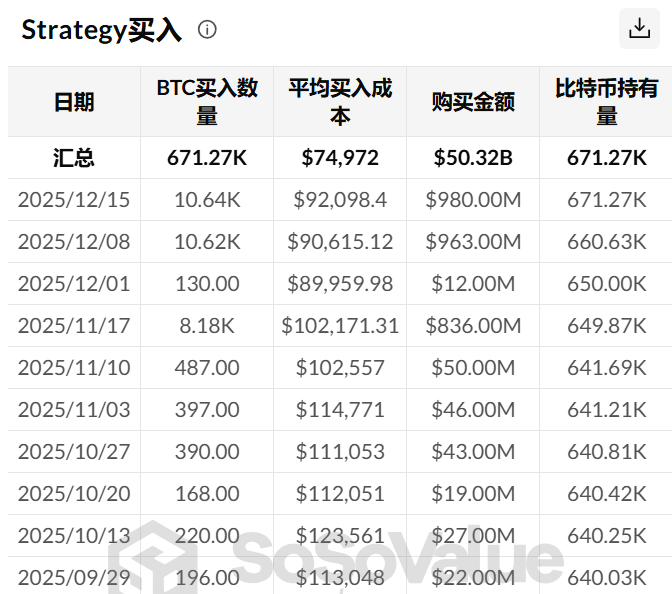
This move has also sparked deeper market reflection: With such large-scale continuous buying, how much Bitcoin is truly available for trading on the market?

The theoretical maximum supply of Bitcoin is 21 million, but the actual circulating supply is far less. Approximately 19.96 million have been mined so far, accounting for 95% of the total, with only about 1.04 million yet to be produced. The current block reward is 3.125 BTC, with about 450 new coins added daily, and it will halve again in 2028. At this pace, the last Bitcoin is expected to be mined around 2140.

However, what truly determines market supply is not the unmined new coins, but the liquid portion of the existing supply.

According to statistics, over 30% of Bitcoin has not moved for a long time and is considered "dormant holdings"; another approximately 20% is suspected to be permanently lost. Additionally, institutional and public holdings, including listed companies, ETFs, and national funds, continue to rise, with most of these BTC exiting high-frequency circulation. Furthermore, Bitcoin reserves on exchanges have dropped to multi-year lows, meaning the "floating supply" available for immediate sale is rapidly contracting. Against the backdrop of whales quietly accumulating and long-term holders holding firm, market liquidity is facing structural tightening.

Regarding the issue of Bitcoin's true circulating supply, crypto analyst Murphy has conducted a systematic review. Odaily Planet Daily has further integrated data and perspectives on this basis, attempting to present the full picture of data behind this scarcity narrative—as buying power persists and available supply shrinks, the market structure may be quietly shifting.

Long-Term Holders' "Institutionalized Hoarding" is Taking Over Circulating Supply

Long-term holders have now become the most important structural force in the Bitcoin market. According to Glassnode statistics, this group collectively holds approximately 14.35 million BTC, accounting for over 70% of the circulating supply.

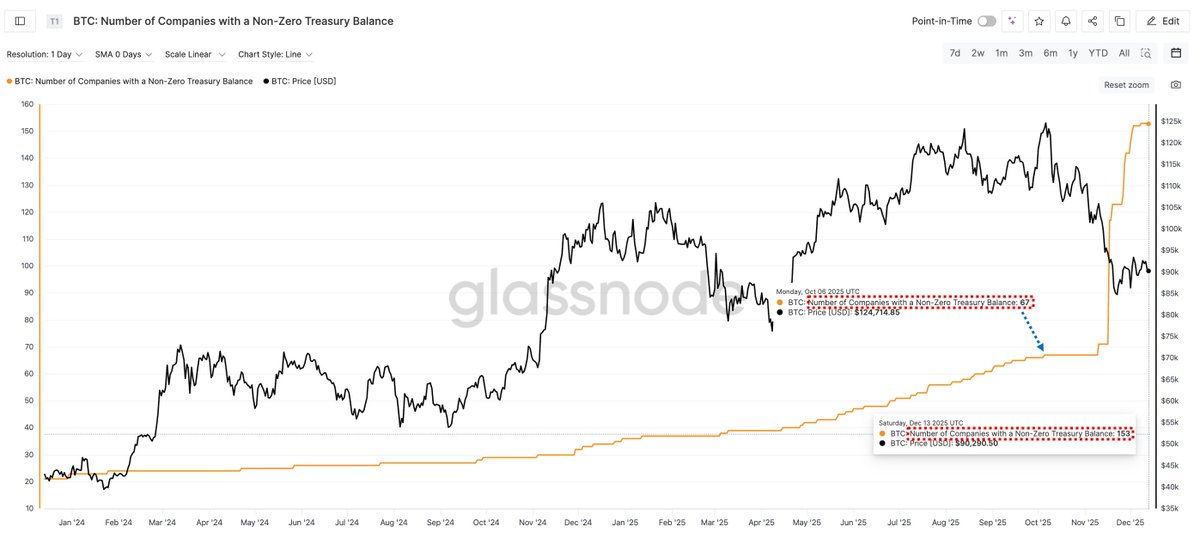
A further breakdown. There are currently 153 enterprises holding BTC with "non-zero balances," the core of which are 29 listed companies, collectively holding 1.082 million Bitcoin (including Other holding 54,331). Among these 29 listed companies, Strategy alone holds 671,000 BTC, accounting for a high 62%.

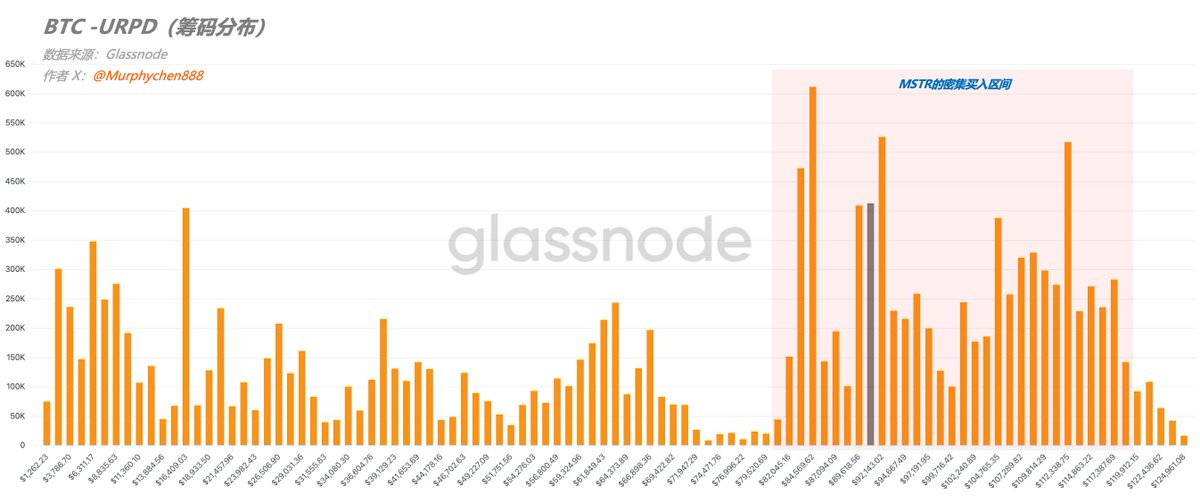
If combined with URPD (UTXO Realized Price Distribution) data, Strategy's intensive buying range coincides precisely with the most densely stacked area in BTC's chip structure, roughly concentrated between $80,000 and $118,000. This means that Strategy indeed played a significant role in the large amount of chip exchange in the high-price range. This is also why MSTR and ETFs are considered the driving force behind this bull cycle.
It is important to note that on October 6, there were only 67 enterprises holding "BTC non-zero balances." However, as BTC experienced a deep correction, this number suddenly surged, and there are now 153. Does this mean that new enterprise-level players are quietly entering the market during the price decline?
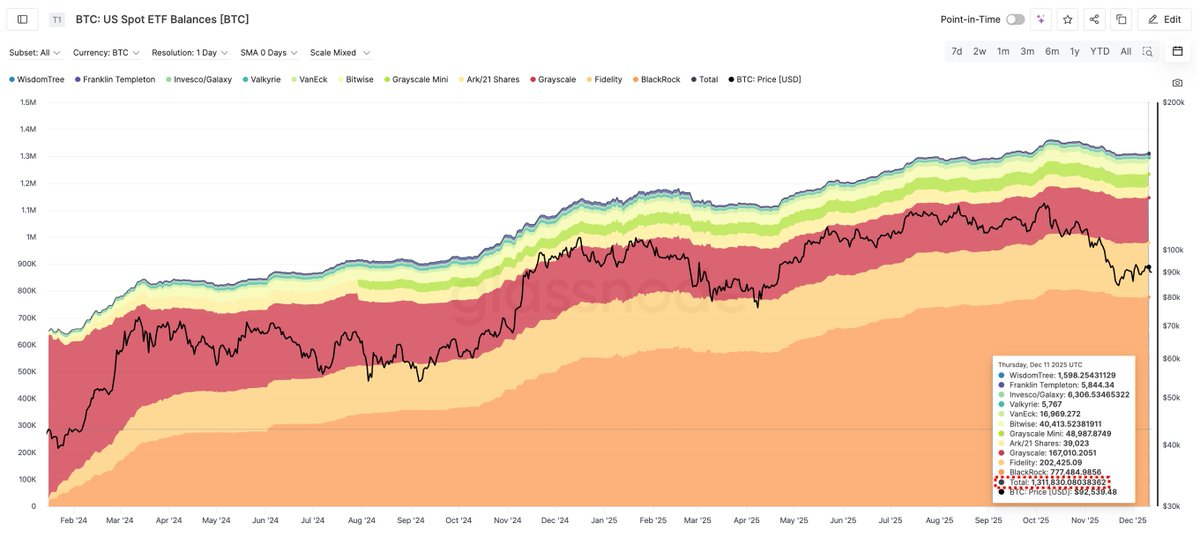
In addition to BTC reserves held by实体企业 (实体企业 - physical/real enterprises), spot Bitcoin ETFs currently hold approximately 1.311 million BTC in total. The top three are: BlackRock with about 777,000, Fidelity with about 202,000, and Grayscale with about 167,000.
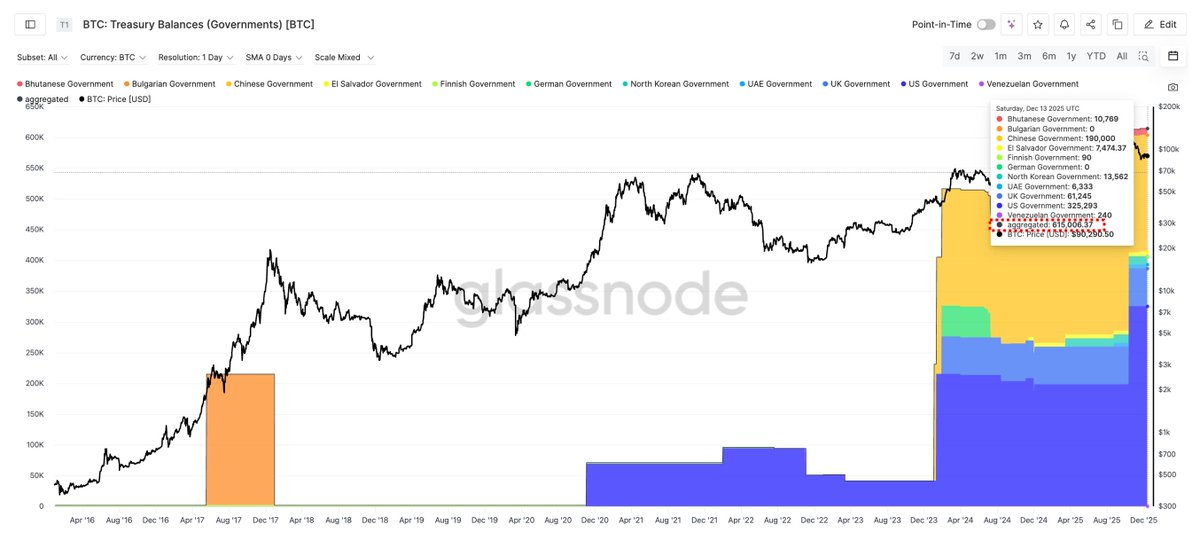
Furthermore, governments worldwide hold approximately 615,000 BTC in total. The U.S. government leads with 325,000; ranking second is the Chinese government, holding about 190,000 BTC. It should be noted that the Chinese government has never officially disclosed related holdings. This data primarily comes from Glassnode, and its statistical caliber still has uncertainties compared to the actual situation.
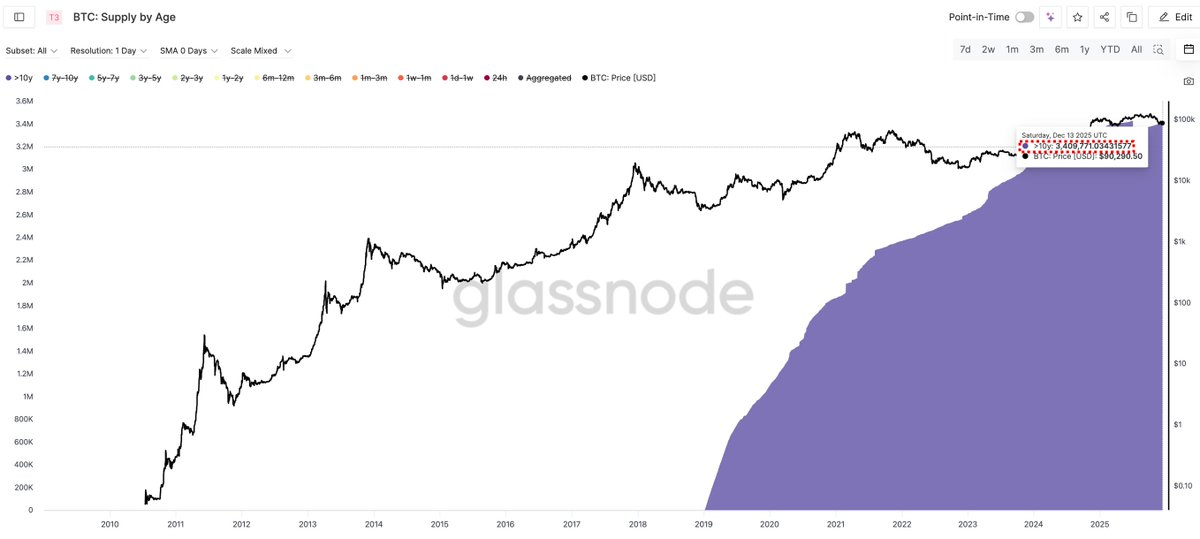
Additionally, the number of Bitcoins that have not moved for over 10 years is approximately 3.409 million. These assets consist of cold wallets from early exchanges and truly "faith-based OGs"; but it is also important not to overlook that a significant portion of these have likely exited the circulation system de facto due to reasons such as lost private keys or the holder's death. This includes the approximately 1 million BTC widely believed to belong to Satoshi Nakamoto.
How Much of the Mined BTC Is Actually "Unbuyable"?

Murphy subsequently provided a more detailed梳理 (sorting out) of this data. Unlike traditional bank accounts which have a "forgot password recovery" function, Bitcoin relies entirely on private keys to prove ownership. Once a private key is lost or becomes inaccessible, the corresponding Bitcoin can never be moved or spent again. Although they are still recorded on the blockchain, economically, they are equivalent to being permanently destroyed.

If we细分 (break down) the circulating supply by date range, where each date range refers to the creation date of the UTXO. Then we can see that the cumulative peak for BTC "born" from 2010-2014 occurred in December 2014, after which it declined rapidly (as they were spent); it has shown almost no significant change since around January 2019 to the present.
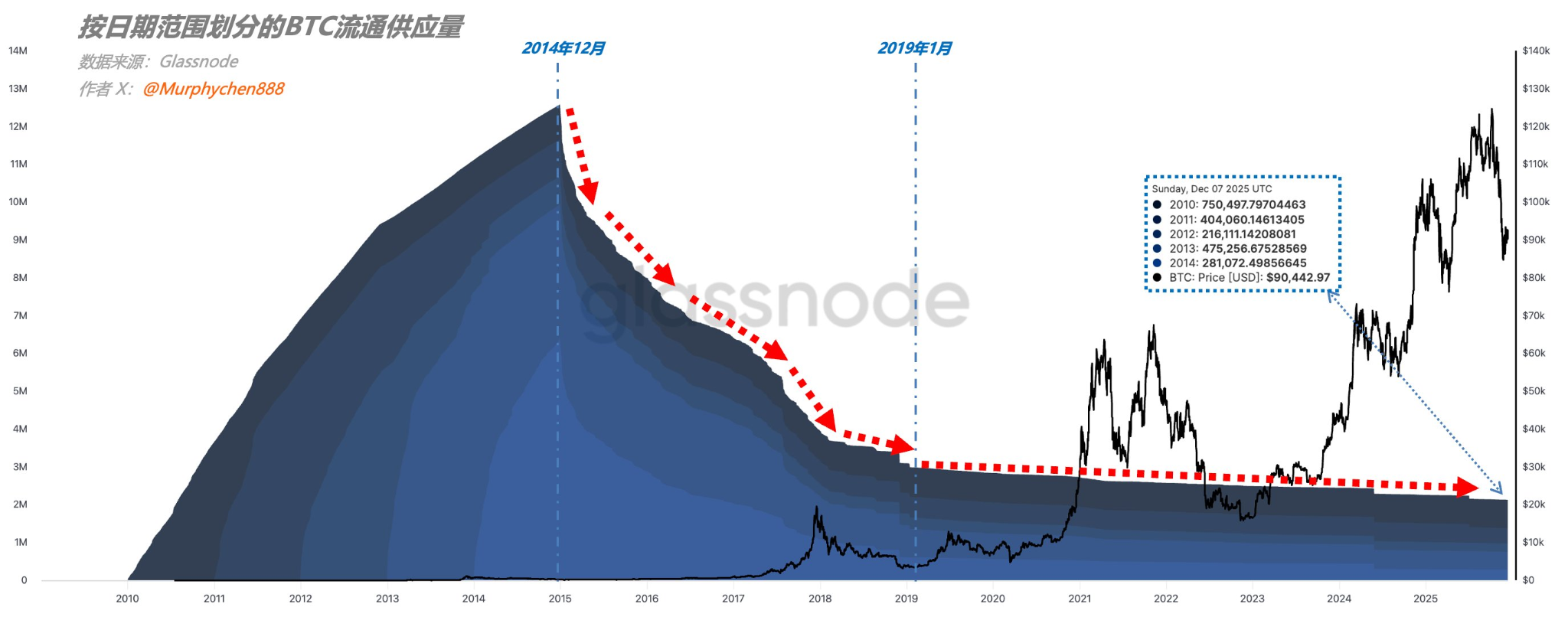
These ancient BTC that remain today, apart from those held by absolutely faithful holders, should mostly be lost. According to Murphy's estimate, this proportion is at least 50% or more, meaning at least 1.06 million or more.

There is another set of "supreme king" coins, with UTXO creation dates in 2009. They have hardly moved since after December 2011, and to this day, this address group holds 1.08 million BTC.

This means that at least approximately 2.14 million BTC may be permanently immovable in practice.

The Truly Liquid Supply

Looking at the most direct indicator—exchange balances—the Bitcoin held in exchange wallets is currently about 2.49 million, and this trend is continuously declining, having hit a new low since 2023.
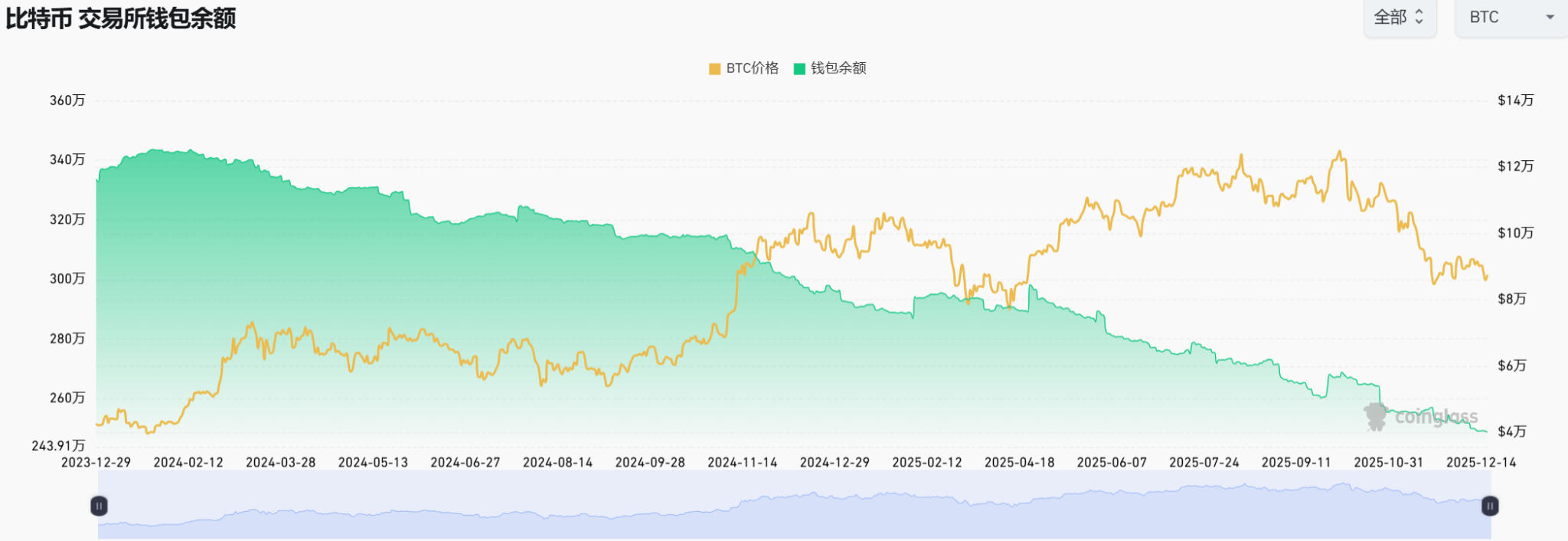
In other words, while demand continues to become "institutionalized," supply is continuously contracting. The pool of Bitcoin available for trading is getting smaller and smaller.


Crypto di tendenza

Domande pertinenti

QHow many bitcoins did Strategy purchase in a single week, and what was the total value?

AStrategy purchased over 10,000 bitcoins in a single week, with a total value exceeding $900 million.

QWhat is the total number of bitcoins that Strategy currently holds, and what is its total value?

AStrategy currently holds approximately 671,000 bitcoins, with a total value exceeding $50 billion.

QWhat percentage of the total Bitcoin supply has already been mined, and how many remain to be produced?

AApproximately 95% of the total Bitcoin supply has been mined, with about 19.96 million bitcoins already in existence. Only about 1.04 million remain to be produced.

QAccording to the article, what is the estimated amount of bitcoins that are permanently lost or otherwise unable to be moved?

AThe article estimates that at least 2.14 million bitcoins, including those from 2009 and 2010-2014, are likely permanently lost or unable to be moved due to lost private keys.

QHow many bitcoins are currently held on exchanges, and what does this trend indicate about market liquidity?

AThere are currently about 2.49 million bitcoins held on exchanges, a number that is trending downward and is at a multi-year low, indicating a contraction in immediately available supply and market liquidity.

Letture associate

In Just 11 Days, Claude Rewrote Millions of Lines of Code, an Epic AI Engineering Feat Sparks Fury

In just 11 days, Bun's founder Jarred Sumner used Anthropic's Claude AI models to rewrite its million lines of code from Zig to Rust. This move sparked significant controversy, particularly from Zig's creator, Andrew Kelley, who publicly criticized Sumner's engineering practices and the decision to use AI for such a massive rewrite. Bun, a high-performance JavaScript/TypeScript runtime and rival to Node.js, was originally written in Zig. After Anthropic acquired Bun, the team encountered persistent stability and memory safety bugs in the Zig codebase. These issues, combined with Zig's strict policy against LLM-generated code, led to the decision to rewrite in Rust. The rewrite was executed using Claude AI tools at an estimated API cost of $165,000, dramatically reducing the expected time and financial cost. Andrew Kelley's response was scathing. He blamed the original bugs on poor engineering habits, calling Bun's Zig code a collection of "hacks on top of hacks." He expressed relief that Bun was no longer associated with Zig, fearing it would misrepresent the language and attract low-quality, AI-generated contributions. The tech community is divided; some view Kelley's critique as unprofessional, while others see it as a defense of engineering integrity. A major concern about the AI-driven rewrite is the resulting code quality. The translation from Zig left approximately 27,000 lines of unsafe Rust code, raising fears about long-term maintainability and technical debt. The debate centers on whether this project is a milestone in AI-assisted development or a future maintenance nightmare.

marsbit34 min fa

In Just 11 Days, Claude Rewrote Millions of Lines of Code, an Epic AI Engineering Feat Sparks Fury

marsbit34 min fa

From Auto Finance to Bitcoin to AI Engines: An Analysis of Cango's 'What Not to Do' Strategy

From Auto Finance to Bitcoin and Now AI: Cango's "What Not to Do" Strategy Cango, a Chinese auto finance platform that went public on the NYSE in 2018, is undergoing its third major transformation. After selling its entire auto business in 2024, it pivoted to become a large-scale Bitcoin miner, acquiring 50 exahash of mining rigs from Bitmain. However, its true goal was never Bitcoin, but owning and controlling energy infrastructure. Now, Cango is pivoting again. While most listed Bitcoin miners are leasing power to giant hyperscalers for AI training clusters, Cango is taking the opposite path. It has launched an AI inference subsidiary called EcoHash, focusing not on training but on distributed inference. The company's strategy hinges on the insight that over 70% of mining industry power is controlled by small, independent sites (10-50 MW), which are too small for hyperscalers but ideal for low-latency AI inference. Cango aims to partner with these small operators, providing the AI technology, customers, and financing through its EcoLink software layer, which can distribute workloads across sites for reliability. Cango maintains a hybrid model, running roughly 31.7 EH/s of Bitcoin mining for cash flow while aggressively cleaning its balance sheet—slashing long-term debt by 94.5% to $30.6 million and raising $75 million for its AI venture. Its first AI deployment will be at a 50 MW site in Georgia. The strategy faces skepticism, given the high costs of converting mining sites and the potential for an AI bubble. However, Cango's leadership believes discipline around "what not to do"—avoiding direct competition with hyperscalers in training—positions it to capture the long-tail demand for distributed AI inference power.

Foresight News50 min fa

From Auto Finance to Bitcoin to AI Engines: An Analysis of Cango's 'What Not to Do' Strategy

Foresight News50 min fa

Strategy's Bitcoin Sales Cap Far Exceeds $1.25 Billion: A Detail the Market Overlooked

The article discusses how MicroStrategy's potential Bitcoin sales go far beyond the announced $1.25 billion "reserve-building capacity." It clarifies a key distinction in the company's "BTC Monetization Program": selling Bitcoin to *build* a new dollar reserve (the $1.25B cap) versus selling to *replenish* the existing USD Reserve after it's used for expenses like preferred share dividends. The recent $216M BTC sale for dividend payments was a "replenishment," leaving the headline $1.25B building quota untouched. The plan actually outlines three potential funding pools from BTC sales: 1) Building the reserve ($1.25B cap), 2) Covering preferred share/ debt costs (no specified cap), and 3) Funding buyback programs (up to $20B). This means the structured sales potential exceeds $30 billion, not including uncapped replenishment sales. The piece argues this marks MicroStrategy's shift from a passive "buy-and-hold" Bitcoin proxy to an actively managed entity using BTC as a balance-sheet tool to manage its complex capital structure (common stock, preferred shares, debt, reserve). This creates new dynamics and potential conflicts, as actions benefiting one part (e.g., selling BTC to pay dividends) may pressure another (e.g., undermining the "never sell" narrative). Investors must now parse the company's specific terminology ("build" vs. "replenish") to understand the true scope of future BTC sales, which is significantly larger than the market initially perceived.

marsbit56 min fa

Strategy's Bitcoin Sales Cap Far Exceeds $1.25 Billion: A Detail the Market Overlooked

marsbit56 min fa

Goldman Sachs Report Deconstructs the Competitive Landscape of China's AI Large Models: Who Will Be the Long-Term Winner?

Goldman Sachs analyzes China's AI large language model (LLM) landscape, identifying key players and a strategic shift towards efficiency and global expansion. The report highlights that Chinese open-source/open-weight models are closing the performance gap with top global proprietary models at significantly lower cost, driven by architectural innovations like MoE. This enables a "two-tier" market: a high-end segment (e.g., GLM5.2, Qwen3.7 Max) with pricing at ~$1 per million tokens, and a low-end, price-sensitive global segment. Open-source strategies aid adoption but limit monetization, as deployments via third-party platforms (e.g., AWS Bedrock, Alibaba Cloud) may not generate direct revenue for model creators. The industry is thus moving towards "open-weight + community license" models with revenue-sharing to improve unit economics. Internationally, the focus is shifting from "token maximization" to ROI-driven enterprise adoption, particularly in non-U.S. markets. Major cloud platforms are integrating Chinese models (e.g., DeepSeek, MiniMax). Using a competitive framework based on pricing power, cost advantage, and financial strength, Goldman Sachs identifies **Zhipu AI** and **DeepSeek** as leaders in foundational text models, and **ByteDance** (with Seedance) leading in multimodal/video generation. **MiniMax** and **Kuaishou** are also rated favorably. The firm forecasts China's AI model API/subscription revenue growing from ~RMB 35bn (2026E) to RMB 879bn by 2030.

marsbit57 min fa

Goldman Sachs Report Deconstructs the Competitive Landscape of China's AI Large Models: Who Will Be the Long-Term Winner?

marsbit57 min fa

Trading

Spot

Articoli Popolari

Come comprare O

Benvenuto in HTX.com! Abbiamo reso l'acquisto di O1 exchange (O) semplice e conveniente. Segui la nostra guida passo passo per intraprendere il tuo viaggio nel mondo delle criptovalute.Step 1: Crea il tuo Account HTXUsa la tua email o numero di telefono per registrarti il tuo account gratuito su HTX. Vivi un'esperienza facile e sblocca tutte le funzionalità,Crea il mio accountStep 2: Vai in Acquista crypto e seleziona il tuo metodo di pagamentoCarta di credito/debito: utilizza la tua Visa o Mastercard per acquistare immediatamente O1 exchangeO.Bilancio: Usa i fondi dal bilancio del tuo account HTX per fare trading senza problemi.Terze parti: abbiamo aggiunto metodi di pagamento molto utilizzati come Google Pay e Apple Pay per maggiore comodità.P2P: Fai trading direttamente con altri utenti HTX.Over-the-Counter (OTC): Offriamo servizi su misura e tassi di cambio competitivi per i trader.Step 3: Conserva O1 exchange (O)Dopo aver acquistato O1 exchange (O), conserva nel tuo account HTX. In alternativa, puoi inviare tramite trasferimento blockchain o scambiare per altre criptovalute.Step 4: Scambia O1 exchange (O)Scambia facilmente O1 exchange (O) nel mercato spot di HTX. Accedi al tuo account, seleziona la tua coppia di trading, esegui le tue operazioni e monitora in tempo reale. Offriamo un'esperienza user-friendly sia per chi ha appena iniziato che per i trader più esperti.

76 Totale visualizzazioniPubblicato il 2026.06.19Aggiornato il 2026.06.29

Come comprare O

Come comprare PROS

Benvenuto in HTX.com! Abbiamo reso l'acquisto di Pharos (PROS) semplice e conveniente. Segui la nostra guida passo passo per intraprendere il tuo viaggio nel mondo delle criptovalute.Step 1: Crea il tuo Account HTXUsa la tua email o numero di telefono per registrarti il tuo account gratuito su HTX. Vivi un'esperienza facile e sblocca tutte le funzionalità,Crea il mio accountStep 2: Vai in Acquista crypto e seleziona il tuo metodo di pagamentoCarta di credito/debito: utilizza la tua Visa o Mastercard per acquistare immediatamente PharosPROS.Bilancio: Usa i fondi dal bilancio del tuo account HTX per fare trading senza problemi.Terze parti: abbiamo aggiunto metodi di pagamento molto utilizzati come Google Pay e Apple Pay per maggiore comodità.P2P: Fai trading direttamente con altri utenti HTX.Over-the-Counter (OTC): Offriamo servizi su misura e tassi di cambio competitivi per i trader.Step 3: Conserva Pharos (PROS)Dopo aver acquistato Pharos (PROS), conserva nel tuo account HTX. In alternativa, puoi inviare tramite trasferimento blockchain o scambiare per altre criptovalute.Step 4: Scambia Pharos (PROS)Scambia facilmente Pharos (PROS) nel mercato spot di HTX. Accedi al tuo account, seleziona la tua coppia di trading, esegui le tue operazioni e monitora in tempo reale. Offriamo un'esperienza user-friendly sia per chi ha appena iniziato che per i trader più esperti.

69 Totale visualizzazioniPubblicato il 2026.06.22Aggiornato il 2026.06.29

Come comprare PROS

Cosa è VERONA

I. Introduzione al Progetto VERONA è una blockchain costruita per tutti, ovunque attraverso l'astrazione della catena. Utilizzando il suo livello di astrazione generalizzato, VERONA si distingue integrando funzionalità blockchain complesse, come conti, firme e interoperabilità, direttamente a livello di protocollo. Questo approccio consente di interagire con le applicazioni blockchain senza la necessità di comprendere le tecnologie sottostanti.1) Informazioni di Base Nome:VERONA(VERONA)III. Link Correlati Link al sito ufficiale:https://xion.burnt.com/ Whitepaper:https://xion.burnt.com/whitepaper.pdf Esploratori:https://explorer.burnt.com/ Social Media: https://x.com/burnt_xion Nota: L'introduzione al progetto proviene dai materiali pubblicati o forniti dal team ufficiale del progetto, che è solo a scopo di riferimento e non costituisce consulenza per investimenti. HTX non si assume responsabilità per eventuali perdite dirette o indirette risultanti.

102 Totale visualizzazioniPubblicato il 2026.06.22Aggiornato il 2026.06.22

Cosa è VERONA

Discussioni

Benvenuto nella Community HTX. Qui puoi rimanere informato sugli ultimi sviluppi della piattaforma e accedere ad approfondimenti esperti sul mercato. Le opinioni degli utenti sul prezzo di A A sono presentate come di seguito.

活动图片