Strategy Extends Bitcoin Accumulation With New 2,932 BTC Purchase

bitcoinistPubblicato 2026-01-27Pubblicato ultima volta 2026-01-27

Introduzione

Strategy, a leading Bitcoin treasury company, has expanded its holdings with a new purchase of 2,932 BTC, valued at approximately $264.1 million. This acquisition, funded through stock offerings, brings the company's total Bitcoin reserves to 712,647 BTC, representing about 3.57% of the circulating supply. These holdings are currently valued at $62.23 billion, reflecting an unrealized gain. In related news, Bitmine, another major corporate holder, added 40,302 ETH to its treasury and has staked over 2 million ETH, claiming to be the world's largest staker. Meanwhile, Bitcoin spot ETFs experienced significant net outflows of $1.33 billion last week, the highest since February 2025, nearly erasing the previous week's gains. Bitcoin's price has declined over 5% in the past week, trading around $88,000.

Bitcoin treasury company Strategy has unveiled its latest purchase of the cryptocurrency, this time tokens worth a total of $264.1 million.

Strategy Has Expanded Its Bitcoin Treasury By 2,932 BTC

In a new post on X, Strategy co-founder and chairman has shared the details related to the latest Bitcoin acquisition from the company. In total, the new purchase has added 2,932 tokens to the firm’s treasury at an average price of $90,061 per token.

According to the filing with the US Securities and Exchange Commission (SEC), the buy took place between January 20th and 25th. Strategy funded the $264.1 million acquisition using proceeds from its STRC and MSTR at-the-market (ATM) stock offerings.

In the last two weeks, the company has made purchases involving a substantial size. Last week, the company added Bitcoin worth $2.13 billion, while the week before that, it spent $1.25 billion on the cryptocurrency. Compared to these, the latest buy isn’t too big, but nonetheless showcases continued resolve for accumulation from Saylor’s firm.

Following the latest purchase, Strategy’s Bitcoin reserves have grown to 712,647 BTC, equivalent to about 3.57% of the asset’s total circulating supply. Currently, these holdings are worth around $62.23 billion, up nearly 15% over the company’s investment of $54.19 billion.

Strategy is the largest digital asset corporate holder in the world, with its closest competition being Bitmine, a BTC mining company that pivoted to an Ethereum treasury strategy last year.

According to a Monday press release, Bitmine has also participated in accumulation during the past week, adding 40,302 ETH ($116.5 million) to its holdings. The firm’s total treasury reserve has now risen to 4,243,338 ETH ($12.24 billion), corresponding to a supply share of 3.52%.

Recently, Bitmine has been putting its Ethereum toward staking to earn a passive interest on its holdings. In the past week, the company has increased its locked stake by 171,264 ETH, taking total staked supply to more than 2 million tokens. “Bitmine has staked more ETH than other entities in the world,” said Tom Lee, Bitmine chairman.

In some other news, Bitcoin spot exchange-traded funds (ETFs) saw a high amount of net outflows in the past week, according to data from SoSoValue.
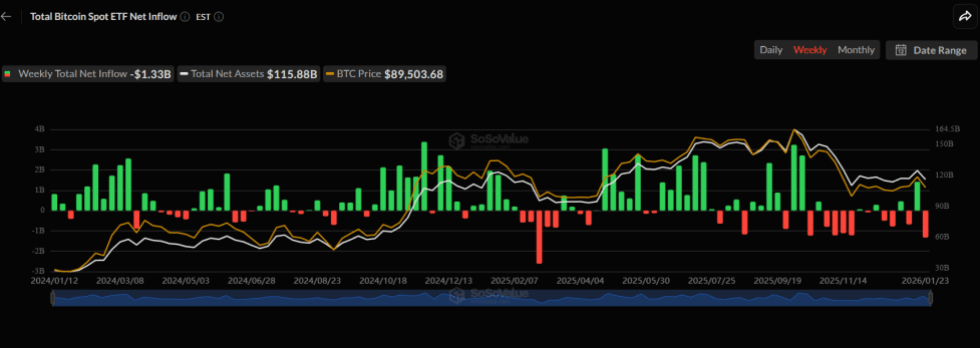
The trend in the BTC spot ETF netflow over the last couple of years | Source: SoSoValue

As displayed in the above graph, the weekly Bitcoin spot ETF netflow measured at -$1.33 billion last week. This is the highest outflow that these investment vehicles have witnessed since the end of February 2025.

Just a week prior, the market situation was the complete reverse, as spot ETFs saw net inflows amounting to $1.42 billion. The latest streak of outflows, however, have nearly entirely retraced this growth.

BTC Price

At the time of writing, Bitcoin is floating around $88,000, down more than 5% in the last seven days.

The price of the coin seems to have plunged recently | Source: BTCUSDT on TradingView


Domande pertinenti

QHow many Bitcoins did Strategy purchase in its latest acquisition, and what was the total value?

AStrategy purchased 2,932 BTC at a total value of $264.1 million.

QWhat is the primary source of funding for Strategy's latest Bitcoin purchase?

AThe purchase was funded using proceeds from its STRC and MSTR at-the-market (ATM) stock offerings.

QWhat percentage of Bitcoin's total circulating supply does Strategy now hold after this purchase?

AStrategy now holds 712,647 BTC, which is equivalent to about 3.57% of the asset's total circulating supply.

QHow did the net flow for Bitcoin spot ETFs perform last week according to the article?

ABitcoin spot ETFs saw net outflows of $1.33 billion last week, the highest since the end of February 2025.

QWhat significant action has Bitmine taken with its Ethereum holdings recently?

ABitmine has been staking its Ethereum to earn passive interest and has staked more than 2 million tokens, which it claims is more than any other entity in the world.

Letture associate

Lowering Expectations for BTC's Next Bull Market

The author, Alex Xu, explains his decision to significantly reduce his Bitcoin holdings (from full to ~30% of his portfolio) during the current bull cycle, citing a lowered long-term outlook for BTC's price appreciation in the next cycle. He outlines six key reasons for this reduced expectation: 1. **Diminished Growth Drivers:** The narrative of exponential user adoption has largely played out with institutional ETF adoption. The next major growth phase—adoption by sovereign national reserves or central banks—seems unlikely in the near future. 2. **Personal Opportunity Cost:** More attractive investment opportunities have emerged in other assets, such as undervalued companies. 3. **Industry-Wide Contraction:** The broader crypto industry is struggling, with most Web3 business models (SocialFi, GameFi, DePIN) failing. This overall萧条 (depression) reduces the fundamental demand and consensus for Bitcoin. 4. **Strain on Major Buyer:** MicroStrategy, a major corporate buyer of BTC, faces rising financing expenses for its debt, which could slow its purchasing rate and create significant marginal pressure on the market. 5. **Increased Competition from Gold:** The emergence of "tokenized gold" has closed the functional gap (portability, divisibility) between physical gold and Bitcoin, offering a strong competitor in the non-sovereign store-of-value space. 6. **Security Budget Concerns:** The block reward halving continues to exacerbate the long-standing issue of funding Bitcoin's network security, with new fee source explorations like Ordinals and L2s largely failing. The author's decision to hold a significant (though reduced) position reflects a cautious, not bearish, outlook. He remains open to increasing his exposure if the fundamental reasons for his skepticism change or if new positive catalysts emerge.

marsbit17 min fa

Lowering Expectations for BTC's Next Bull Market

marsbit17 min fa

Can Iran 'Control' the Strait of Hormuz?

Iran has announced a comprehensive plan to assert control over the strategic Strait of Hormuz, a critical global oil shipping chokepoint. The proposed measures include requiring all vessels to obtain Iranian permission for passage, imposing fees for security, environmental protection, and navigation management—preferably paid in Iranian rials—and absolutely banning Israeli ships. Vessels from countries deemed hostile by Iran’s top security bodies may also be barred. Analysts suggest Iran’s motives are multifaceted: increasing pressure on the U.S. and Israel by leveraging control over oil transit to influence global prices and inflation; creating a new revenue stream, potentially exceeding $7.7 billion annually, to counter Western sanctions and support postwar reconstruction; and using transit permissions as bargaining chips in future negotiations, notably with the U.S. However, the plan faces significant practical and diplomatic challenges. Enforcing comprehensive interception and fee collection in the busy waterway, patrolled by international military forces, would be difficult. The U.S. has already countering with a blockade of Iranian ports and threats to intercept any ship paying fees, potentially strangling Iran’s oil exports and fee revenue. Broad international opposition, led by European and Gulf states, and legal controversies further complicate implementation. The proposal may ultimately serve more as a negotiating tactic than a feasible policy, with its execution remaining highly uncertain.

marsbit1 h fa

Can Iran 'Control' the Strait of Hormuz?

marsbit1 h fa

Trading

Spot
Futures
活动图片




