Story Co-Founder Defends Token Unlock Delays; Why Long-Term Scaling Matters For $MAXI

bitcoinistPubblicato 2026-02-09Pubblicato ultima volta 2026-02-09

Introduzione

Story Protocol co-founder S.Y. Lee defends delayed token unlocks, arguing that extended vesting periods prevent premature sell pressure and support long-term protocol development. This approach prioritizes sustainable growth over short-term liquidity. Similarly, meme coin project Maxi Doge ($MAXI) emphasizes high-conviction holding through staking rewards, a 'Leverage King' culture, and planned utility features. Having raised over $4.5M in presale, it aims to build a resilient, engaged community by incentivizing long-term participation and reducing launch-day sell pressure.

In a market sector often defined by impatience and ‘up-only’ demands, Story Protocol co-founder S.Y. Lee has taken a contrarian stance: slower is better. Addressing the recent controversy surrounding delayed token unlocks, Lee defended the decision to extend vesting cliffs.

His argument? Premature liquidity often strangles protocol development before it achieves escape velocity. In a recent interview with CoinDesk, Lee pointed to Worldcoin’s extended lockups as a successful precedent, suggesting that longer runways prevent the rampant sell pressure that historically capsizes early-stage infrastructure projects.

That signals a fundamental shift in how crypto capital creates value. The era of ‘fair launch’ farming, where liquidity is mercenary and fleeting, is giving way to high-conviction retention models. Lee’s defense highlights a crucial friction point: retail traders want immediate access, but sustainable ecosystems require entrenched capital. By prioritizing long-term alignment over short-term liquidity events, Story is betting that patience pays a higher yield than speed.

This pivot toward strength accumulation rather than quick exits isn’t isolated to infrastructure layers. It’s beginning to permeate the high-octane world of meme coins, where community conviction is the only true fundamental. While Story locks up tokens to build IP rails, a new contender, Maxi Doge, is locking in value through a culture of ‘1000x leverage’ mentality and heavy staking incentives.

Just as Story demands patience for protocol health, Maxi Doge ($MAXI) demands grit for portfolio health, positioning itself as the counter-narrative to low-effort, low-reward trading.

Maxi Doge Brings ‘Never Skip Leg Day’ Mentality to Meme Sector

While Story Protocol focuses on intellectual property, Maxi Doge effectively tokenizes market resilience. The project operates under a distinct philosophy: ‘Never skip leg day, never skip a pump.’

In a sector cluttered with derivative dog coins that collapse at the first sign of volatility, $MAXI is engineered to mirror the psychology of high-conviction traders. It addresses a specific retail pain point, the lack of whale-sized conviction, by gamifying the holding process through a culture of strength and heavy leverage.

The project differentiates itself through its planned utility that reinforces holding behavior. Future features like holder-only trading competitions and a ‘Maxi Fund’ treasury are designed to deepen liquidity rather than drain it.

The ‘Leverage King’ culture isn’t just marketing fluff; it’s a mechanism to filter out weak hands. It creates a community base that mirrors the long-term alignment S.Y. Lee advocates for at the protocol level. By integrating viral gym-bro humor with actual financial incentives, the project creates a feedback loop where community engagement directly correlates with token stability.
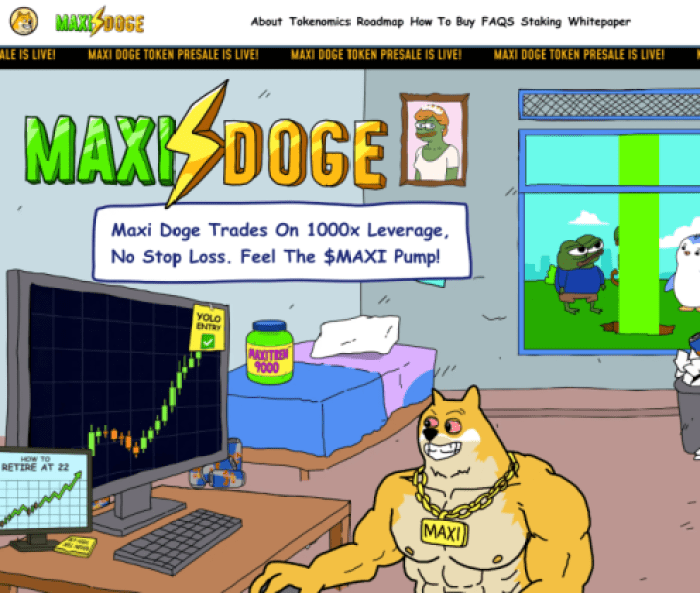
Plus, the ecosystem includes planned partner events with futures platform integrations, allowing top ROI hunters to compete for leaderboard rewards. That turns passive holding into active participation. The risk here for casual observers? Dismissing the aesthetic as pure satire.

Beneath the ‘beefcake’ branding lies a structured economy designed to outperform the original $DOGE by rewarding those who grind through the bear and bull cycles alike.

EXPLORE THE HEAVYWEIGHT DIVISION AT MAXI DOGE

Whale Activity and Staking Rewards Signal High Conviction

The market’s appetite for this high-conviction model is visible in the on-chain data. Maxi Doge has raised over $4.5M. That significant figure suggests retail and institutional interest is coalescing around the project before it hits open markets. With tokens currently priced at $0.0002803, early entrants are positioning themselves ahead of the public listing, betting on the project’s ability to capture the ‘gym-bro’ meme niche. If you want to know more check out our ‘What is Maxi Doge?‘ guide.

Smart money seems to be validating this thesis. On-chain data from Etherscan shows 2 whale wallets each accumulated $314K. Although not a sign of success, this level of capital injection during a presale phase is rare for standard meme coins and implies that sophisticated actors see value beyond the hype.

To lock in this capital, Maxi Doge uses a dynamic staking APY, with daily planned automatic smart contract distributions derived from a 5% staking allocation pool. This setup mirrors the delayed gratification model defended by Story Protocol’s founders, rewarding users who commit their assets to the network for up to one year. By incentivizing a lock-up of supply, the project aims to reduce sell pressure on launch day, creating a firmer floor price than competitors relying solely on viral momentum.

CHECK OUT THE $MAXI PRESALE

This article is for informational purposes only and does not constitute financial advice. Cryptocurrencies are high-risk assets; invest only what you can afford to lose.


Domande pertinenti

QWhat is the main argument made by Story Protocol co-founder S.Y. Lee regarding token unlock delays?

AS.Y. Lee argues that slower token unlocks and extended vesting cliffs are beneficial because premature liquidity often strangles protocol development before it achieves escape velocity. He believes longer runways prevent rampant sell pressure that can capsize early-stage projects, prioritizing long-term alignment over short-term liquidity events.

QHow does Maxi Doge ($MAXI) differentiate itself from other meme coins in the market?

AMaxi Doge differentiates itself by tokenizing market resilience and promoting a high-conviction 'Never skip leg day' mentality. It gamifies the holding process through features like holder-only trading competitions, a 'Maxi Fund' treasury, and staking incentives, aiming to create a community with long-term alignment and reduce sell pressure.

QWhat on-chain data indicates significant interest in Maxi Doge before its public listing?

AOn-chain data shows that Maxi Doge has raised over $4.5M in its presale, with two whale wallets each accumulating $314K worth of tokens. This level of capital injection during the presale phase is rare for standard meme coins and suggests both retail and institutional interest.

QHow does Maxi Doge's staking mechanism work to incentivize long-term holding?

AMaxi Doge uses a dynamic staking APY with daily automatic smart contract distributions derived from a 5% staking allocation pool. This rewards users who commit their assets to the network for up to one year, reducing sell pressure on launch day and creating a firmer floor price.

QWhat is the core philosophy behind Maxi Doge's approach to the meme coin sector?

AMaxi Doge's core philosophy is 'Never skip leg day, never skip a pump,' which emphasizes market resilience and high-conviction trading. It aims to counter low-effort, low-reward trading by fostering a culture of strength, leverage, and active community participation through financial incentives and gamified holding.

Letture associate

As Consensus Accelerates, What Are Young Investors Betting On?

Title: As Consensus Forms Faster, What Are Young Investors Betting On? In the rapid evolution of tech investment, a new generation of young investors is navigating a landscape where AI, robotics, commercial aerospace, and quantum computing are advancing simultaneously. Traditional investment logic based on financial models is giving way to a need for deep technical understanding and the ability to act before industry consensus forms. An analysis of trends from the "WAIC FUTURE TECH" list of young investment leaders reveals key shifts in focus. The first major trend is the movement of AI from the digital screen into the physical world. Investment is shifting from large language models and chatbots towards embodied AI, robotics, AI hardware, and edge computing. While demonstrations generate excitement, the real challenge lies in achieving scalable, reliable, and cost-effective delivery in complex real-world environments like factories and logistics. Success depends not just on algorithms but on the integration of sensors, actuators, and control systems. Second, the competitive focus for large models is moving beyond raw capability toward building an "intelligence flywheel." The goal is to create self-reinforcing systems where user interaction generates data, improving the model, which in turn enhances the user experience and attracts more engagement. Companies that successfully embed AI into workflows to create these closed-loop systems can build lasting value that isn't easily erased by the next model upgrade. Third, facing a potential bottleneck in high-quality human-generated data, investors are looking at new underlying technologies. Reinforcement learning and self-play, as demonstrated by AlphaGo Zero, offer paths for AI to generate its own experience. Scientific foundation models, which aim to build general AI capabilities for fields like life sciences and materials discovery, represent a non-consensus direction that could unlock new frontiers of knowledge and data. Finally, in deep-tech areas like quantum computing, commercial aerospace, and space-based infrastructure, patient capital is essential. These fields have long, uncertain development and validation cycles involving complex engineering, supply chains, and regulations. Investment here requires a long-term view, focusing on foundational team capabilities and the eventual emergence of market demand, even if commercial returns are distant. Collectively, these trends illustrate how young investors are adapting to a new era. They are learning to make earlier, technically-informed judgments, balance hype with real-world viability, and provide the patient capital needed to build the deep-tech foundations of the future.

marsbit20 min fa

As Consensus Accelerates, What Are Young Investors Betting On?

marsbit20 min fa

Can Japan Buy Growth with AI? Will the Bond Market Believe It?

Japan's cabinet has introduced the 2026 Basic Policy on Economic and Fiscal Management and Reform, shifting its primary fiscal target. The new framework moves away from the traditional annual primary balance goal and instead prioritizes a stable reduction of the debt-to-GDP ratio. This change is tied to a strategy of increased "responsible proactive fiscal" spending, aiming to boost long-term growth through investments in strategic sectors like AI, semiconductors, energy, and robotics. The government estimates total public and private investment in 62 key technologies could exceed 370 trillion yen by 2040. The market reaction has been mixed and cautious. While equity markets may respond to policy signals, bond markets are focused on fiscal credibility. Concerns center on whether the weakening of the clear primary balance anchor could lead to looser fiscal discipline. If investors doubt that these strategic investments will generate sufficient productivity gains, tax revenue, and nominal growth to outpace rising interest costs, they may demand higher yields on Japanese Government Bonds (JGBs). Recent volatility in the yen and JGB yields, with the 10-year yield briefly reaching 2.9%, reflects this skepticism. The success of this new framework hinges on two factors: whether Japan can achieve a nominal growth rate consistently higher than its long-term interest rates, and whether future budgets demonstrate disciplined control over bond issuance. The government's narrative is that strategic investment is essential to break Japan's cycle of low growth, aging, and labor shortages. However, the bond market will continuously assess the credibility of this plan, pricing the risk that it may represent fiscal expansion rather than a viable growth strategy.

marsbit58 min fa

Can Japan Buy Growth with AI? Will the Bond Market Believe It?

marsbit58 min fa

Misjudged A-Shares: Resilience, Expectations, and Confidence

China's A-share market recently faced selling pressure, especially in tech sectors, initially triggered by a global tech sell-off that began in South Korea. However, the article argues this is a case of "mistaken injury" and highlights the market's underlying resilience. This resilience stems from three main pillars: **1) Tech Sector Fundamentals:** Unlike Korea's market dominated by a few memory chip stocks, China's tech sector is diversified across computing, communications, electronics, and semiconductors, supported by dual narratives of global AI supply chains and domestic substitution. Core areas like optical modules and fiber optics continue to show strong earnings growth. **2) "National Team" Support:** State-backed institutions and large corporations have made significant market purchases and announced buybacks, providing liquidity and signaling confidence. This is seen as a stabilizing policy signal, often associated with market bottoms. **3) Broader Market Pillars:** Other major sectors are showing endogenous recovery momentum. Consumer stocks benefit from stabilizing CPI and signs of sector recovery (e.g., liquor price hikes). Cyclical sectors like aluminum have high earnings, potential price increases due to tight supply, and low valuations. The financial sector offers stable dividends and low valuations. The conclusion is that the sell-off was driven by external contagion, not a collapse in fundamentals. With strong policy support and recovering momentum across key sectors, the A-share market possesses the toughness to regain stability.

marsbit1 h fa

Misjudged A-Shares: Resilience, Expectations, and Confidence

marsbit1 h fa

Trading

Spot
活动图片




