Stop Focusing Only on Bitcoin—We Are Already in a Bear Market

marsbitPubblicato 2025-12-18Pubblicato ultima volta 2025-12-18

Introduzione

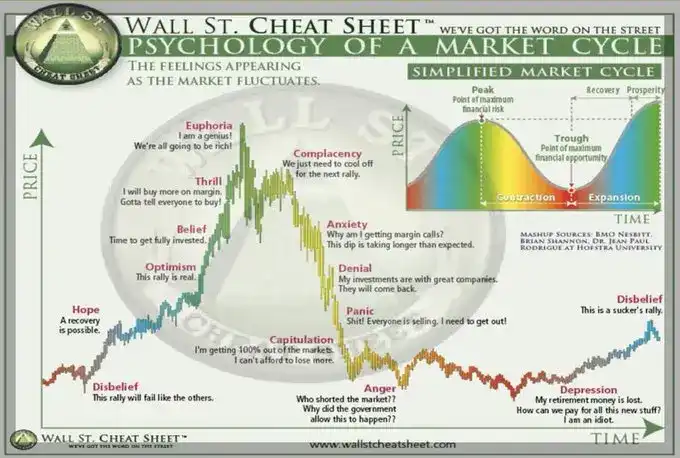
The author argues that the crypto market has been in a bear market for about a year, despite many investors' reluctance to accept it. The peak of market euphoria occurred around November 2024, with the launch of $TRUMP marking the final exuberance. Two key misconceptions are highlighted: First, the meme coin frenzy was not a precursor to an "altseason"—it *was* the altseason itself. Unlike previous cycles with distinct new narratives and liquidity splits between "dumb money" and "hot money," this cycle lacked differentiation, keeping both groups in the same arena. Second, Bitcoin is no longer driven primarily by crypto-native cycles but by institutional and macro factors, meaning its price resilience doesn’t indicate an ongoing bull market. The bear market began after the $TRUMP peak, and the market has since gone through phases of anxiety, denial, panic, and now anger and depression. The author writes to encourage debate, correct flawed mental models, and signal a intention to begin accumulating near what they believe is the bottom.

Author: XY

Compiled by: Tim, PANews

One Year into the Bear Market

It took me some time to convince myself: we are in a bear market, and it has been going on for about a year.

November 2024 was a period of market excitement, and the launch of $TRUMP pushed the market into extreme euphoria—it was the final frenzy that no one wanted to believe was the end.

Below, I will explain my perspective.

It all starts with that old cliché: "History doesn't repeat itself, but it often rhymes."

This foolish saying has been hugely misleading for market analysis—it's downright harmful.

It has made us overly reliant on historical patterns and, at the same time, eroded our ability to question.

Yes, this reliance on historical patterns for prediction is like viewing the world through a prism carved with old designs. It inevitably misinterprets new realities and ultimately causes us to overlook the latest driving factors in the market. This is precisely where the danger lies.

More specifically, we misread two fundamental changes.

Change One

We thought Meme mania was the spark that would ignite altseason, but in reality, Meme mania was altseason itself.

When Meme coins surged one after another, we thought it was just the beginning.

Some talked about altseason, and a few bold ones even mentioned a raging bull market.

We were all wrong.

Keep in mind that previous cycles always featured bubble叠加-bubble phenomena, typically driven by new narratives. These new narratives gave rise to new markets, which often led to differentiation.

This differentiation was important because it split liquidity into two distinct groups.

The first group is dumb money.

This type of capital prefers simple operations, market depth, and low barriers to entry, staying within highly liquid tokens.

The second group is hot money.

This capital actively pursues returns and is willing to overcome complexity to find opportunities.

The subsequent short-term rotation of hot money fueled bullish trends, which eventually evolved into what people called altseason.

This cycle never produced that trend. There was no new narrative to explore this time.

From start to finish, both groups remained in the same arena.

Dumb money could participate effortlessly, and hot money could still profit by getting in early.

Our mistake was expecting an "altseason" to occur.

But it never happened.

The only path the market had was: from Bitcoin to a new narrative, then to altseason.

That used to be the script you wanted.

But the reality is that Meme mania became the altseason people anticipated.

November 2024 marked the peak profitability for most traders, and TRUMP was the climax of the market狂欢.

Change Two

Bitcoin is no longer driven internally by the crypto market but is instead dominated by institutions and macro markets.

And the macro environment follows a different timeline and reacts differently to changes.

After the TRUMP surge, many interpreted Bitcoin's resilience as the market still being in a consolidation or bull market correction phase.

This interpretation stemmed from an anchoring bias based on past experiences: people are accustomed to the idea that Bitcoin must crash sharply to confirm a bear market, applying this to a market structure now dominated by institutions.

This cognitive framework is outdated.

Bitcoin has actually decoupled from the native cryptocurrency market cycle.

Once you recognize this, the subsequent developments make perfect sense.

The bear market began after the MEME coin TRUMP, regardless of Bitcoin's price performance.

So, stop focusing only on Bitcoin.

From January 2025 to the present, the market has fully gone through the three stages of anxiety, denial, and panic. If you've made profits, you can clearly see these stages in the people around you; if you've suffered losses, you've experienced these emotions firsthand.

We are now in the stage of anger and depression.

So, why am I writing this post?

Two reasons.

First, one of the reasons the crypto market has been profitable for me is the ability to buy near the bottom. If you misjudge the market phase, this advantage disappears.

If you think the bear market isn't over yet, you'll keep waiting for the bottom to arrive, unaware that you're already in it.

Second, I hope this perspective sparks fierce debate or helps people become alert and break free from the wrong cognitive framework.

I have extremely high confidence in this judgment.

That's why I will soon start acting to prove my judgment.
Crypto di tendenza

Domande pertinenti

QAccording to the author, when did the bear market in cryptocurrency actually begin?

AThe author states that the bear market began around the time of the $TRUMP meme coin frenzy, which was in November 2024, and has been going on for about a year.

QWhat were the two fundamental changes that the author believes most people misread about the market cycle?

AThe two changes were: 1) Meme frenzy was the altcoin season itself, not a precursor to it, and 2) Bitcoin is now dominated by institutional and macro markets, not the internal crypto market cycle.

QWhy does the author argue that there was no traditional 'altcoin season' in this cycle?

AThe author argues there was no traditional altcoin season because no new narrative emerged to create a differentiation between 'dumb money' and 'hot money.' Both groups operated in the same arena of meme coins, so the expected rotation of hot money into other altcoins never occurred.

QWhat is the danger of relying on the saying 'history doesn't repeat itself, but it often rhymes' for market analysis?

AThe author calls this saying misleading and pernicious because it creates a path dependency and reduces our ability to question new realities, causing us to misread new market factors and ignore the latest driving forces.

QWhat is the author's main purpose for writing this article?

AThe author's main purposes are: 1) To help people recognize they are already in a bear market so they can take advantage of buying near the bottom, and 2) To spark debate and help people break free from incorrect cognitive frameworks about the market.

Letture associate

7 Months After the Collapse of Huiwang, Southeast Asia's Escrow Platforms Undergo a Major Reshuffle

Following the collapse of Huione Pay—dubbed the "Alipay of Southeast Asia"—seven months ago, the region's underground financial guarantee platform sector is undergoing a significant reshuffle. This power vacuum has been swiftly filled by emerging platforms such as XinBi, Tiger/Navigator, JinBei (renamed JinBo), Dali/Tiancheng, and FullyLight. These platforms, operating largely via Telegram and offering services like escrow for illicit transactions, have absorbed the vast user base and markets left behind by Huione. While positioning themselves as "trust intermediaries," their primary clientele consists of networks involved in online scams, money laundering, illegal gambling, and even human trafficking. For instance, the Tiger/Navigator platform explicitly provides "escrow" services for kidnapping-for-ransom operations ("强押车交易"). Data underscores the immense scale: Huione alone processed over $103 billion in cryptocurrency payments and facilitated over $31 billion through its escrow market before its downfall, linking it to Cambodia's notorious Prince Group. Since its collapse, competitors have seen explosive growth. For example, the XinBi platform has accumulated over $1.6 billion in total USDT revenue, while platforms like NewPay, OkPay (under Dali), and FullyLight Wallet collectively processed over $4.8 billion in USDT in a single year. This ecosystem thrives in regions like Cambodia and Myanmar, where regulatory gaps allow these platforms to act as critical financial infrastructure for sprawling cybercrime industries, from scam compounds to online casinos. The article concludes that the moniker "Southeast Asian Alipay" is a misnomer, obscuring the platforms' fundamental role in enabling serious criminal enterprises rather than representing legitimate financial innovation.

Odaily星球日报38 min fa

7 Months After the Collapse of Huiwang, Southeast Asia's Escrow Platforms Undergo a Major Reshuffle

Odaily星球日报38 min fa

The Changing Landscape: What Are Crypto VCs Experiencing?

Title: The Shifting Landscape of Crypto Venture Capital The era of dedicated crypto venture capital funds is undergoing a significant transformation. Once essential for navigating the sector's complexity and high risk, these specialized funds are now facing an identity crisis as the market matures. This shift mirrors historical patterns in other specialized investment classes like cleantech and SPACs, where initial information advantages dissipate as technologies become mainstream and integrated into existing industry frameworks. The article argues that crypto is reaching a critical inflection point, transitioning from a "building phase" to an "integration phase." Major players like Stripe, BlackRock, and Visa now engage with crypto not for its novel mechanics but as a foundational financial infrastructure. Their needs—regulatory compliance, banking partnerships, distribution channels—align with traditional fintech, a domain easily understood by large, generalist funds like Sequoia and Founders Fund. This evolution creates a "barbell effect" within the VC landscape. On one end are massive, diversified platforms that can incorporate crypto as one vertical among many. On the other are small, nimble funds focused on niche, experimental projects. The middle ground—medium-sized dedicated crypto funds—is being squeezed out. Their typical fund size makes it impossible to generate sufficient returns solely from early-stage crypto bets, yet they cannot compete with giants for later-stage deals. Consequently, leading crypto-native firms like Paradigm and Framework Ventures are expanding into AI, robotics, and other sectors, driven partly by LP pressure for better returns amid a broader VC DPI crisis. Others, like Dragonfly and a16z, have narrowed their crypto focus predominantly to financial infrastructure like stablecoins, reframing the sector's core narrative. For crypto entrepreneurs, this consolidation presents challenges. While generalist funds offer larger checks and broader resources, crypto projects now compete fiercely with AI for attention and capital within these firms. Furthermore, the long-term, non-commercial foundational work that built the ecosystem—funded by dedicated crypto VCs—is less likely to attract generalist capital focused on direct returns. The conclusion is that "crypto investor" as a standalone category is becoming obsolete, akin to "internet investor." Crypto is becoming a baseline infrastructure layer. The future will see a barbell structure: large-scale growth financing handled by generalist funds, while pioneering, speculative projects are funded by small, specialized vehicles. The dedicated crypto funds of the 2017-2021 boom, which incubated core infrastructure, are giving way to this new, bifurcated reality.

Foresight News55 min fa

The Changing Landscape: What Are Crypto VCs Experiencing?

Foresight News55 min fa

As Consensus Accelerates, What Are Young Investors Betting On?

Title: As Consensus Forms Faster, What Are Young Investors Betting On? In the rapid evolution of tech investment, a new generation of young investors is navigating a landscape where AI, robotics, commercial aerospace, and quantum computing are advancing simultaneously. Traditional investment logic based on financial models is giving way to a need for deep technical understanding and the ability to act before industry consensus forms. An analysis of trends from the "WAIC FUTURE TECH" list of young investment leaders reveals key shifts in focus. The first major trend is the movement of AI from the digital screen into the physical world. Investment is shifting from large language models and chatbots towards embodied AI, robotics, AI hardware, and edge computing. While demonstrations generate excitement, the real challenge lies in achieving scalable, reliable, and cost-effective delivery in complex real-world environments like factories and logistics. Success depends not just on algorithms but on the integration of sensors, actuators, and control systems. Second, the competitive focus for large models is moving beyond raw capability toward building an "intelligence flywheel." The goal is to create self-reinforcing systems where user interaction generates data, improving the model, which in turn enhances the user experience and attracts more engagement. Companies that successfully embed AI into workflows to create these closed-loop systems can build lasting value that isn't easily erased by the next model upgrade. Third, facing a potential bottleneck in high-quality human-generated data, investors are looking at new underlying technologies. Reinforcement learning and self-play, as demonstrated by AlphaGo Zero, offer paths for AI to generate its own experience. Scientific foundation models, which aim to build general AI capabilities for fields like life sciences and materials discovery, represent a non-consensus direction that could unlock new frontiers of knowledge and data. Finally, in deep-tech areas like quantum computing, commercial aerospace, and space-based infrastructure, patient capital is essential. These fields have long, uncertain development and validation cycles involving complex engineering, supply chains, and regulations. Investment here requires a long-term view, focusing on foundational team capabilities and the eventual emergence of market demand, even if commercial returns are distant. Collectively, these trends illustrate how young investors are adapting to a new era. They are learning to make earlier, technically-informed judgments, balance hype with real-world viability, and provide the patient capital needed to build the deep-tech foundations of the future.

marsbit1 h fa

As Consensus Accelerates, What Are Young Investors Betting On?

marsbit1 h fa

Trading

Spot

Articoli Popolari

Come comprare O

Benvenuto in HTX.com! Abbiamo reso l'acquisto di O1 exchange (O) semplice e conveniente. Segui la nostra guida passo passo per intraprendere il tuo viaggio nel mondo delle criptovalute.Step 1: Crea il tuo Account HTXUsa la tua email o numero di telefono per registrarti il tuo account gratuito su HTX. Vivi un'esperienza facile e sblocca tutte le funzionalità,Crea il mio accountStep 2: Vai in Acquista crypto e seleziona il tuo metodo di pagamentoCarta di credito/debito: utilizza la tua Visa o Mastercard per acquistare immediatamente O1 exchangeO.Bilancio: Usa i fondi dal bilancio del tuo account HTX per fare trading senza problemi.Terze parti: abbiamo aggiunto metodi di pagamento molto utilizzati come Google Pay e Apple Pay per maggiore comodità.P2P: Fai trading direttamente con altri utenti HTX.Over-the-Counter (OTC): Offriamo servizi su misura e tassi di cambio competitivi per i trader.Step 3: Conserva O1 exchange (O)Dopo aver acquistato O1 exchange (O), conserva nel tuo account HTX. In alternativa, puoi inviare tramite trasferimento blockchain o scambiare per altre criptovalute.Step 4: Scambia O1 exchange (O)Scambia facilmente O1 exchange (O) nel mercato spot di HTX. Accedi al tuo account, seleziona la tua coppia di trading, esegui le tue operazioni e monitora in tempo reale. Offriamo un'esperienza user-friendly sia per chi ha appena iniziato che per i trader più esperti.

151 Totale visualizzazioniPubblicato il 2026.06.19Aggiornato il 2026.06.29

Come comprare O

Come comprare PROS

Benvenuto in HTX.com! Abbiamo reso l'acquisto di Pharos (PROS) semplice e conveniente. Segui la nostra guida passo passo per intraprendere il tuo viaggio nel mondo delle criptovalute.Step 1: Crea il tuo Account HTXUsa la tua email o numero di telefono per registrarti il tuo account gratuito su HTX. Vivi un'esperienza facile e sblocca tutte le funzionalità,Crea il mio accountStep 2: Vai in Acquista crypto e seleziona il tuo metodo di pagamentoCarta di credito/debito: utilizza la tua Visa o Mastercard per acquistare immediatamente PharosPROS.Bilancio: Usa i fondi dal bilancio del tuo account HTX per fare trading senza problemi.Terze parti: abbiamo aggiunto metodi di pagamento molto utilizzati come Google Pay e Apple Pay per maggiore comodità.P2P: Fai trading direttamente con altri utenti HTX.Over-the-Counter (OTC): Offriamo servizi su misura e tassi di cambio competitivi per i trader.Step 3: Conserva Pharos (PROS)Dopo aver acquistato Pharos (PROS), conserva nel tuo account HTX. In alternativa, puoi inviare tramite trasferimento blockchain o scambiare per altre criptovalute.Step 4: Scambia Pharos (PROS)Scambia facilmente Pharos (PROS) nel mercato spot di HTX. Accedi al tuo account, seleziona la tua coppia di trading, esegui le tue operazioni e monitora in tempo reale. Offriamo un'esperienza user-friendly sia per chi ha appena iniziato che per i trader più esperti.

145 Totale visualizzazioniPubblicato il 2026.06.22Aggiornato il 2026.06.29

Come comprare PROS

Cosa è VERONA

I. Introduzione al Progetto VERONA è una blockchain costruita per tutti, ovunque attraverso l'astrazione della catena. Utilizzando il suo livello di astrazione generalizzato, VERONA si distingue integrando funzionalità blockchain complesse, come conti, firme e interoperabilità, direttamente a livello di protocollo. Questo approccio consente di interagire con le applicazioni blockchain senza la necessità di comprendere le tecnologie sottostanti.1) Informazioni di Base Nome:VERONA(VERONA)III. Link Correlati Link al sito ufficiale:https://xion.burnt.com/ Whitepaper:https://xion.burnt.com/whitepaper.pdf Esploratori:https://explorer.burnt.com/ Social Media: https://x.com/burnt_xion Nota: L'introduzione al progetto proviene dai materiali pubblicati o forniti dal team ufficiale del progetto, che è solo a scopo di riferimento e non costituisce consulenza per investimenti. HTX non si assume responsabilità per eventuali perdite dirette o indirette risultanti.

163 Totale visualizzazioniPubblicato il 2026.06.22Aggiornato il 2026.06.22

Cosa è VERONA

Discussioni

Benvenuto nella Community HTX. Qui puoi rimanere informato sugli ultimi sviluppi della piattaforma e accedere ad approfondimenti esperti sul mercato. Le opinioni degli utenti sul prezzo di A A sono presentate come di seguito.

活动图片














