Stop Blindly Clicking Confirm: Ethereum Wants You to Understand What You're Signing

marsbitPubblicato 2026-05-20Pubblicato ultima volta 2026-05-20

Introduzione

The article criticizes the common practice of "blind signing" in Web3, where users confirm cryptographic transactions without understanding the content, typically presented as unreadable hexadecimal code. It introduces Ethereum's new initiative, "Clear Signing," as a solution aimed at making transaction signatures human-readable. Clear Signing, based on the ERC-7730 standard, allows protocols to provide standardized, structured metadata (like a "translation dictionary") that explains the semantic meaning of a transaction—such as "Swap 1,000 USDC for at least 0.42 WETH on Uniswap V3." This metadata is stored in a public registry for wallets to fetch and display in plain language, moving beyond mere structured data formats like EIP-712. The article clarifies that Clear Signing is not an instant fix but a foundational infrastructure shift that requires widespread adoption by protocols and wallet support. It complements, rather than replaces, existing wallet security features like transaction simulation. The initiative represents a crucial step toward genuine user sovereignty by restoring informed consent, making blockchain accessible to non-technical users and addressing a long-standing security and usability debt in the ecosystem.

Author: Xiaobai

This article is an original submission from the author. The views expressed are solely the author's personal understanding. ETHPanda has edited and organized the content.

Blockchain has always emphasized "being your own bank," but few have seriously addressed another question: If users fundamentally cannot understand what they are signing, how real is that control? From blind signing to Clear Signing, Ethereum is finally working on a fundamental, albeit overdue, piece of the puzzle, aiming to make transaction signatures slowly transition from being understandable by programmers to something comprehensible by ordinary users.

Blind Signing Isn't User Carelessness

I've had a lingering question ever since I started using a crypto wallet.

Why does the wallet confirmation screen always show a string of hexadecimal code every time I go to sign?

I'm clearly clicking Swap, Mint, Claim, or Approve on a website, but at the final confirmation step, the screen suddenly switches to a bunch of 0x-prefixed gibberish. Countless educational videos repeatedly warn people not to sign randomly, as many phishing sites steal assets this way.

This creates a major contradiction.

On one hand, telling regular users that signing is dangerous and they must be careful. On the other hand, presenting the very thing they need to see in a format utterly incomprehensible to the average person.

This isn't user carelessness; it's an inherently anti-human interaction design.

I later learned this situation has a name: blind signing. When you click confirm, cryptographically you are authorizing a transaction, but from a human understanding perspective, you are essentially signing a document you cannot read.

The problem isn't that users don't understand security is important; it's that they lack sufficient information to judge whether something is safe or not.

The Ethereum Foundation recently announced that Clear Signing is now live, with a straightforward goal: to make human-readable transaction signing the default experience. The Clear Signing website puts it even more plainly: See what you sign. Let you truly see what you are signing.

It's not just a simple wallet UI optimization; it's building a foundational piece that Ethereum has been missing for ordinary users.

Wallet security in the past mostly focused on warning you before something went wrong. For example, some browser extensions would check if a site is a phishing risk and flash red warnings. Wallets like Rabby also added many transaction previews and risk warnings, showing you roughly how your asset balance would change after signing.

These are very useful.

But they are more like adding security guards next to the transaction, rather than solving the problem at the root of the signature itself. You still have to trust the extension, trust the wallet simulation, trust its ability to identify the risks of that website and that transaction.

Clear Signing Aims to Translate Transactions into Plain Language

What Clear Signing wants to do is more fundamental.

It doesn't just tell you "this site might be dangerous." It enables protocol developers to write the transaction semantics in a standard format, allowing wallets to reliably translate calldata into human-understandable actions.

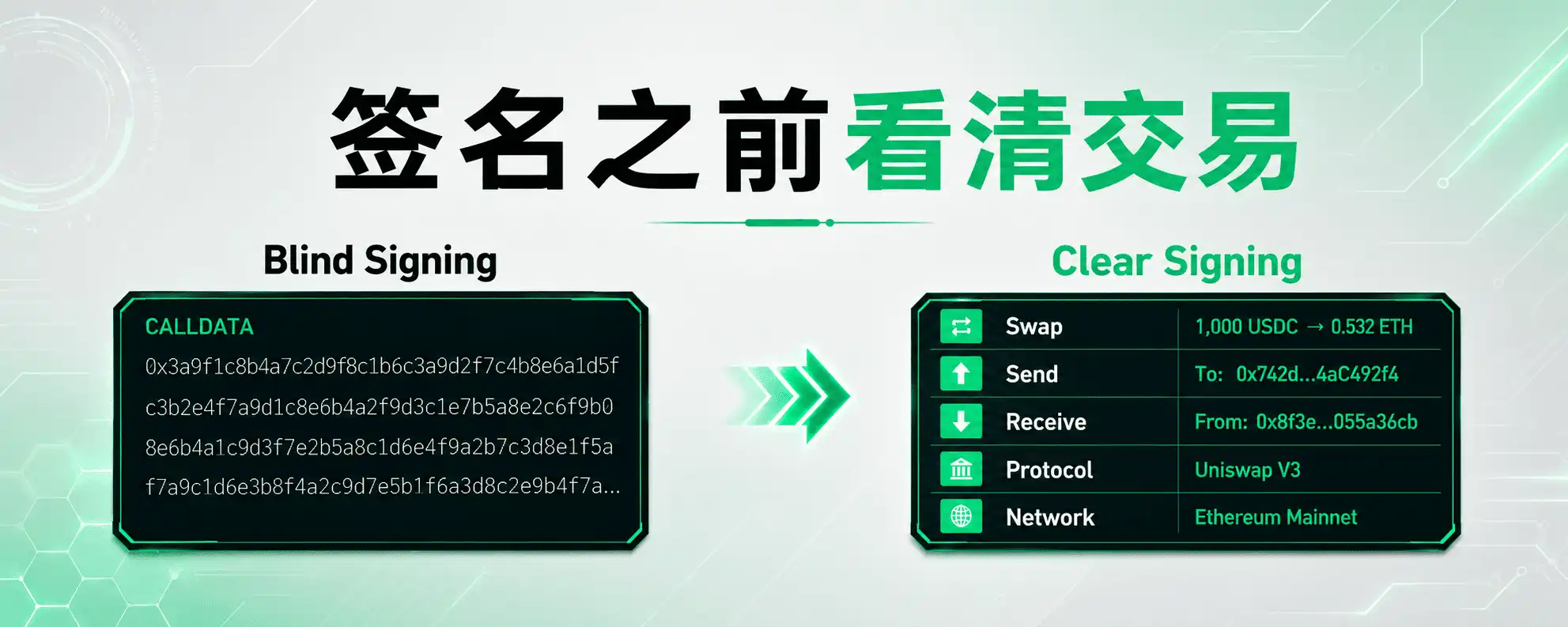
For example, what you used to see was a long string of hex.

Ideally in the future, what you should see is: Swap, sending 1,000 USDC, minimum to receive 0.42 WETH, protocol is Uniswap V3, network is Ethereum.

This is what the signature confirmation page should look like for humans.

Here we can reference Ray's explanation. In his post, he said something I think is very insightful: "Structured code is still code."

This statement actually highlights the difference between EIP-712 and ERC-7730. EIP-712 turns chaotic signature data into structured data, but structured doesn't equal human-readable. What ordinary users truly need is not rows of neater variable names and parameters, but action language they can understand at a glance.

Ray also described Clear Signing as **"adding a layer of translation between code and the ordinary user."** That's an excellent analogy.

How ERC-7730 and the Registry Work

The core standard behind Clear Signing is ERC-7730.

It defines a JSON metadata format.

In simple terms, it allows protocol developers to create a "translation dictionary" for their contract functions. They specify, in advance and in a standard way, how a particular contract function, a particular parameter, or an amount field should be displayed to the user. This description is then submitted to a public registry. Before signing, the wallet consults this dictionary to translate the underlying calldata into a confirmation page the user can understand.

An ABI can tell a wallet, "Here is a uint256 amount."

But an ABI can't necessarily tell the user that this amount is for USDC with 6 decimals, or for ETH with 18 decimals. Nor can it necessarily tell the user if this operation is a Swap, Stake, Approve, or Claim.

ERC-7730 fills in this semantic layer.

The registry then plays the role of a public directory. The clear-signing-erc7730-registry repository maintains the metadata files within the registry directory. Protocol developers submit their description files, and wallets and tools read them, finally enabling the translation of transactions into clearer human language.

According to the snapshot from the Clear Signing website on May 7, 2026, the registry already covers 44 protocols and has published 346 descriptors. Projects like 1inch, Aave, Circle, Lido, Uniswap, Safe, WalletConnect, and WETH can already be seen in the list.

It's Not a Magic Switch, But the Direction is Right

The numbers look promising, but Clear Signing has only just begun.

Blind signing problems haven't suddenly disappeared just because the EF made an announcement. In reality, a vast number of contracts have not registered according to ERC-7730, and wallet integration won't happen overnight either. The official website currently clearly states Ledger is live, Trezor is in development. Other wallets, tools, and protocols will need time to integrate.

So the practical issue Cos raises is crucial. Protocols need to complete registration according to the ERC-7730 standard for wallets and tools supporting ERC-7730 to parse and display information properly. At the same time, the existing parsing, simulation, and risk-warning capabilities on the wallet side must remain and cannot be discarded.

I really agree with this point.

Clear Signing addresses what a transaction *claims* it will do. Transaction simulations like Rabby's address what *might* happen after execution. One looks at intent, the other at outcome. A truly good wallet security experience should have both layers.

Because attackers won't stop evolving.

If users start trusting clear signatures in the future, attackers might try submitting misleading metadata, or use long-tail contracts, unregistered contracts, or complex batch transactions to bypass proper display. The official documentation also specifically mentions that wallets need to decide for themselves which registries, review signals, and attestations to trust.

Therefore, Clear Signing is not a magic switch; it's more like a new industry discipline.

Protocols need to clearly define transaction semantics.

The registry needs to have review and trust signals.

Wallets need to decide which metadata can be displayed.

Users finally don't have to be forced to face indecipherable gibberish.

I think this is especially significant for the Chinese-speaking community.

It's not that many people don't want to enter the on-chain ecosystem; the barrier is genuinely too high. Most users aren't programmers, and even programmers might not understand Solidity, calldata, ABI, selector, permit, delegatecall, and so on.

The on-chain experience of the past often defaulted to the assumption that users should bear the cost of understanding themselves.

If you can't understand it, you're not professional enough.

If you get scammed, you weren't careful enough.

If you're afraid to use it, you haven't learned enough yet.

But this isn't the posture a mass-market application should have.

If a financial-grade system requires ordinary users to understand hexadecimal code before signing, that's not a failure of user education; it's a sign the product and infrastructure haven't matured yet.

I had a similar idea earlier during the Web3 Winter Internship Program by LXDAO and ETHPanda. At the time, I submitted a PR to add security courses in Headbook. My thought was simple: I wanted to help educate users on how wallets parse the first four hexadecimal digits of a signature (the function selector) to understand its meaning. I didn't have a complete solution back then, just a simple belief that users shouldn't have to guess their fate based on hex.

Looking back now, ERC-7730 is systematically answering this question.

It's not just about parsing the first four selector digits; it's about enabling protocols to write verifiable, reusable, wallet-consumable structured metadata for functions, fields, amounts, addresses, and context.

This is more important than simply looking up a function name.

Because function names can be deceptive too. A malicious function could be named `claimRewards` or `deposit`. The truly valuable display isn't just telling you what the function is called, but telling you the action, asset, amount, protocol, network, and risk boundaries associated with that signature.

This is informed consent.

In its early days, Ethereum sacrificed a lot of human readability to get smart contracts running fast. Historically, this is understandable. Without that rapid experimentation then, there might not be the DeFi, NFT, DAO, and the entire EVM ecosystem we have today.

But technical debt doesn't disappear; it only returns to collect payment later, in the form of phishing, accidental signatures, malicious approvals, and cold wallet thefts, as the user base grows.

Future Outlook

Now with the emergence of Clear Signing, it at least shows the Ethereum ecosystem is seriously starting to pay back this debt.

I don't think it will change everyone's wallet experience in a matter of months. A more realistic assessment is that over the next few years, as mainstream protocols submit metadata, mainstream wallets gradually add support, and auditing and attestation mechanisms improve, clear signing will slowly become the default experience.

But the direction is right.

Blockchain shouldn't remain forever in the stage of "only those who understand code dare to use it." True mass adoption isn't about making everyone learn to read calldata; it's about enabling everyone to understand, in their own language, what they are authorizing before they sign.

The world has suffered from blind signing for far too long.

This is the significance of Clear Signing: It's not about making wallets look prettier; it's about gradually returning the right to informed consent for transaction signatures back to the users.


Domande pertinenti

QWhat is the main issue addressed by Clear Signing in the Ethereum ecosystem, according to the article?

AThe main issue addressed by Clear Signing is 'blind signing,' where users are presented with complex hexadecimal data (like calldata) they cannot understand when confirming a transaction, making informed consent nearly impossible for non-technical users. Clear Signing aims to provide 'human-readable transaction signing' so users can see and understand what they are authorizing.

QHow does ERC-7730 specifically work to enable Clear Signing?

AERC-7730 defines a standardized JSON metadata format. Protocol developers use this format to create a 'translation dictionary' for their contract functions. This dictionary explains how function parameters, amounts, and actions should be displayed in a user-friendly way. This metadata is submitted to a public registry. Wallets can then query this registry before a user signs a transaction to translate the underlying calldata into a clear, human-readable confirmation screen.

QWhat is the role of the registry in the Clear Signing framework?

AThe registry acts as a public directory or catalog. It stores and maintains the metadata files (descriptors) submitted by various protocols according to the ERC-7730 standard. Wallets and other tools read from this registry to obtain the information needed to translate complex transaction data into clear, understandable language for the end-user. As of the article's snapshot, it covered 44 protocols and 346 descriptors.

QAccording to the article, how does Clear Signing differ from existing wallet safety features like transaction simulations and risk warnings?

AClear Signing addresses a more foundational layer. Features like transaction simulations (e.g., in Rabby) show the *potential outcome* of a transaction (what might happen after signing). Clear Signing focuses on revealing the *intent* of the transaction (what the user is actually authorizing at the moment of signing). The article argues that a good security experience requires both layers: understanding the claimed action (Clear Signing) and understanding the potential consequences (simulations).

QWhy does the author believe Clear Signing is particularly significant for achieving mass adoption of blockchain?

AThe author believes that for blockchain to achieve mass adoption, it must move beyond a state where only those who understand code can use it safely. Clear Signing is a step towards this by shifting the burden of understanding from the user to the infrastructure. It aims to return the 'right to informed consent' to users by allowing them to understand transactions in their own language, rather than expecting everyone to learn to read calldata or hexadecimal data.

Letture associate

Warsh's First Day in Office, Markets Deliver a 'Wake-up Call': Rate Hike Expected This Year

On his first day in office, newly inaugurated Federal Reserve Chairman Warsh received a stark market warning, with expectations now fully pricing in a 25-basis-point interest rate hike this year. The shift was triggered by hawkish remarks from Fed Governor Waller, who stated that inflation is now the key policy "driver" and that the odds of a hike or cut are evenly split. This sent short-term Treasury yields higher. Waller signaled a significant pivot in his stance, citing disappointing inflation and labor data. He suggested removing "easing bias" language from Fed statements and did not rule out future rate increases if inflation fails to recede, though he noted immediate action isn't warranted without signs of unanchored inflation expectations. Chairman Warsh faces immediate pressure at his first FOMC meeting in June. With the preferred inflation gauge at a three-year high, analysts warn that failing to hike could be interpreted as an implicit easing of policy. The geopolitical situation in the Middle East is adding to existing price pressures. The market's expectation for a hike contrasts sharply with earlier forecasts for multiple cuts. While long-term Treasury yields have been contained by lower energy prices recently, analysts note they remain under structural upward pressure. Warsh's swearing-in at the White House highlights political scrutiny over Fed independence. However, the market has made it clear that inflation is the most urgent challenge, leaving the new chairman little time to settle in.

marsbit1 h fa

Warsh's First Day in Office, Markets Deliver a 'Wake-up Call': Rate Hike Expected This Year

marsbit1 h fa

Has Microsoft Lost Its Way in the AI Race, and Can Copilot Bring It Back on Track?

Microsoft, once seen as an early AI frontrunner due to its investment in OpenAI, is navigating a strategic shift amid increased competition. Its initial reliance on OpenAI’s GPT models has been complicated by OpenAI’s growing ambitions as a direct competitor, rapid advancements from rivals like Claude and Gemini, and the disruptive rise of AI agents, which challenge its traditional SaaS business model. These factors contributed to stock declines and slower-than-expected adoption of its flagship Copilot products. In response, CEO Satya Nadella has taken a hands-on role in product development, signaling the urgency of change. Microsoft is pivoting from a model-centric strategy to a "model-agnostic" enterprise platform approach. It aims to become the foundational layer connecting various AI models—from OpenAI, Anthropic, or its own new "Superintelligence" team—with enterprise workflows, data, security, and cloud services. Recent organizational changes merged consumer and enterprise Copilot teams to accelerate innovation, exemplified by new products like Copilot Tasks and Copilot Cowork. However, this transformation comes at a high cost. Microsoft faces massive capital expenditures, potentially reaching ~$190 billion by 2026, to support AI infrastructure. While its platform strategy shows early signs of traction with growing Azure AI revenue, it must balance startup-like agility with the reliability expected by enterprise clients. The core challenge is no longer being the sole AI winner but defending its position as the essential enterprise software entry point amidst rapid technological commoditization and the shift towards always-on AI agents.

marsbit1 h fa

Has Microsoft Lost Its Way in the AI Race, and Can Copilot Bring It Back on Track?

marsbit1 h fa

Why Haven't Forex Stablecoins Taken Off?

Why FX Stablecoins Never Took Off: A Path Forward via Synthetic FX Despite the explosive growth of stablecoin-powered digital banking, which has seen ~$6B in VC investment and a 24x surge in crypto card spending in under a year, a major limitation persists: these banks are essentially dollar-only accounts. This leaves 95-99% of global accounts, which are denominated in non-USD currencies, underserved. Attempts to create native foreign currency (FX) stablecoins (like EURC) have largely failed, with total FX stablecoin TVL at ~$600M compared to $400B for USD stablecoins—a 700x gap. These FX tokens face critical challenges: fragile pegs due to low liquidity, limited exchange/FinTech acceptance, poor on/off-ramps, complex regional compliance, and a chicken-and-egg adoption problem. The article argues that the solution lies not in competing with entrenched USD stablecoin networks (USDT/USDC), but in adopting a synthetic FX model inspired by traditional finance. Specifically, it advocates for Mark-to-Market Non-Deliverable Forwards (NDFs)—cash-settled FX derivatives that allow users to maintain underlying USD stablecoin holdings while having their account balance and P&L denominated in a foreign currency. This approach offers key advantages: strong oracle-based pegs, retention of deep USD stablecoin liquidity and yield, superior on/off-ramps, scalability to any currency with a reliable feed, and capital efficiency. It mirrors how modern institutional FX markets operate. Primary use cases for on-chain NDFs include: 1. **Digital Banks/Wallets:** Enabling multi-currency accounts for international users without leaving the USD stablecoin ecosystem, boosting deposits and retention. 2. **FX Carry Trade Vaults:** Offering access to sovereign interest rate differentials (e.g., earning yield on BRL) in a more stable and scalable format than crypto-native products like Ethena. 3. **Global Enterprise Payments:** Allowing merchants to receive payments in local currency equivalents while settling in USD stablecoins, similar to services offered by Stripe for fiat. The conclusion is that synthetic FX, not native FX stablecoins, is the viable path to integrating foreign exchange into the growing stablecoin digital banking landscape, potentially unlocking the next phase of institutional DeFi and multi-trillion-dollar global adoption.

链捕手2 h fa

Why Haven't Forex Stablecoins Taken Off?

链捕手2 h fa

IOSG Founder: Web3 Is 'Losing Blood,' How Can Practitioners Survive Better?

IOSG Founder: Web3 Is "Bleeding Out" – How Can Practitioners Survive Better? In a candid reflection, the founder of IOSG Ventures voices deep concerns about the current state of Web3, describing an ecosystem experiencing severe "blood loss." Despite the recent MuShanghai event showcasing a successful pivot towards a more diverse, global community, a somber reality persists: many crypto-native attendees were there exploring exits or new labels in biotech, AI, and robotics. The core issue is identified as a breakdown in the ecosystem's positive feedback loop. Alarmingly, underestimated "low-probability bad events" are occurring simultaneously: a significant brain drain of Chinese developers to AI, a lack of breakout applications despite massive funding, and a widening credibility gap for practitioners globally, often stigmatized as scam artists. This has created a dire接班人 (successor) problem, with the next generation seeing little professional prestige or financial upside in crypto compared to fields like AI. A significant portion of the critique focuses on Ethereum and Vitalik Buterin. While not pessimistic about Ethereum's technology, the founder worries that critical development windows were missed by focusing on niche technical narratives like ZK and L2 instead of mass-market applications. A more urgent concern is that Vitalik may be isolated in an "information bubble," shielded from the grassroots community's hardships by layers of intermediaries, preventing crucial feedback from reaching him. The call is for Vitalik to return to a founder's mindset, re-engage directly with the community, and rally efforts for the next decade. The divergence between U.S. and Chinese OG (Original Gangster) ecosystems is stark. While many U.S. builders reinvest their wealth into the ecosystem, the Chinese scene suffers from a severe lack of "造血能力" (blood-making ability), with most market-driven funds struggling and many early success stories cashing out entirely. This threatens the entire Asian Web3 ecosystem's survival. For individual practitioners, survival advice is pragmatic: find your core "why," maintain life balance beyond token prices, continuously learn new skills (like AI), form small, trusted alliances for mutual support, and practice self-compassion. The industry's greatest need is not money or tech, but lighthouses—individuals at all levels who offer mentorship, grants, referrals, and honest reflection to guide others. The piece concludes with a direct appeal: OGs must pay forward the opportunities the industry gave them; founders must not struggle alone; and builders must continue their work, ensuring it remains a viable profession. The survival of Web3's "cathedral" depends not on any single leader but on the collective responsibility of everyone who remains.

marsbit3 h fa

IOSG Founder: Web3 Is 'Losing Blood,' How Can Practitioners Survive Better?

marsbit3 h fa

Trading

Spot
Futures

Articoli Popolari

Cosa è ETH 3.0

ETH3.0 e $eth 3.0: Un'Analisi Approfondita del Futuro di Ethereum Introduzione Nel panorama in rapida evoluzione delle criptovalute e della tecnologia blockchain, ETH3.0, spesso indicato come $eth 3.0, è emerso come un argomento di considerevole interesse e speculazione. Il termine comprende due concetti principali che warrantono chiarimenti: Ethereum 3.0: Questo rappresenta un potenziale futuro aggiornamento volto ad aumentare le capacità dell'attuale blockchain di Ethereum, concentrandosi principalmente sul miglioramento della scalabilità e delle prestazioni. ETH3.0 Meme Token: Questo progetto di criptovaluta distinto cerca di sfruttare la blockchain di Ethereum per creare un ecosistema incentrato sui meme, promuovendo il coinvolgimento all'interno della comunità delle criptovalute. Comprendere questi aspetti di ETH3.0 è essenziale non solo per gli appassionati di criptovalute, ma anche per coloro che osservano tendenze tecnologiche più ampie nello spazio digitale. Che cos'è ETH3.0? Ethereum 3.0 Ethereum 3.0 è pubblicizzato come un aggiornamento proposto per la rete Ethereum già stabilita, che è stata la spina dorsale di molte applicazioni decentralizzate (dApps) e contratti smart sin dalla sua nascita. I miglioramenti previsti si concentrano principalmente sulla scalabilità, integrando tecnologie avanzate come lo sharding e le prove a conoscenza zero (zk-proofs). Queste innovazioni tecnologiche mirano a facilitare un numero senza precedenti di transazioni al secondo (TPS), potenzialmente raggiungendo milioni, affrontando così una delle limitazioni più significative della tecnologia blockchain attuale. Il miglioramento non è meramente tecnico, ma anche strategico; è volto a preparare la rete Ethereum per un'adozione e un'utilità diffuse in un futuro contrassegnato da un aumento della domanda di soluzioni decentralizzate. ETH3.0 Meme Token Al contrario di Ethereum 3.0, l'ETH3.0 Meme Token si avventura in un dominio più leggero e giocoso, combinando la cultura dei meme di internet con la dinamica delle criptovalute. Questo progetto consente agli utenti di acquistare, vendere e scambiare meme sulla blockchain di Ethereum, fornendo una piattaforma che promuove il coinvolgimento della comunità attraverso la creatività e interessi condivisi. L'ETH3.0 Meme Token mira a dimostrare come la tecnologia blockchain possa intersecarsi con la cultura digitale, creando casi d'uso che siano sia divertenti che finanziariamente praticabili. Chi è il Creatore di ETH3.0? Ethereum 3.0 L'iniziativa verso Ethereum 3.0 è principalmente propulsa da un consorzio di sviluppatori e ricercatori all'interno della comunità di Ethereum, tra cui Justin Drake. Conosciuto per le sue intuizioni e contributi all'evoluzione di Ethereum, Drake è stato una figura di spicco nelle discussioni riguardanti la transizione di Ethereum verso un nuovo livello di consenso, chiamato “Beam Chain.” Questo approccio collaborativo allo sviluppo significa che Ethereum 3.0 non è il prodotto di un creatore singolo, ma piuttosto una manifestazione di ingegno collettivo focalizzato sul progresso della tecnologia blockchain. ETH3.0 Meme Token I dettagli riguardanti il creatore dell'ETH3.0 Meme Token sono attualmente non rintracciabili. La natura dei token meme conduce spesso a una struttura più decentralizzata e guidata dalla comunità, il che potrebbe spiegare la mancanza di attribuzione specifica. Questo si allinea con l'etica della comunità crypto più ampia, dove l'innovazione spesso nasce da sforzi collaborativi piuttosto che individuali. Chi sono gli Investitori di ETH3.0? Ethereum 3.0 Il supporto per Ethereum 3.0 proviene principalmente dalla Ethereum Foundation insieme a una comunità entusiasta di sviluppatori e investitori. Questa associazione fondamentale fornisce un considerevole grado di legittimità e migliora le prospettive di implementazione di successo poiché sfrutta la fiducia e la credibilità costruite nel corso degli anni di operazioni della rete. Nel clima in rapida evoluzione delle criptovalute, il supporto della comunità gioca un ruolo cruciale nello sviluppo e nell'adozione, posizionando Ethereum 3.0 come un serio contenditore per i futuri progressi della blockchain. ETH3.0 Meme Token Sebbene le fonti attualmente disponibili non forniscano informazioni esplicite riguardo ai fondamenti o alle organizzazioni di investimento che sostengono l'ETH3.0 Meme Token, ciò è indicativo del modello di finanziamento tipico per i token meme, che spesso si basa sul supporto di base e sul coinvolgimento della comunità. Gli investitori in tali progetti sono tipicamente individui motivati dal potenziale per innovazioni guidate dalla comunità e dallo spirito di cooperazione trovato all'interno della comunità crypto. Come Funziona ETH3.0? Ethereum 3.0 Le caratteristiche distintive dell'Ethereum 3.0 risiedono nella sua proposta di implementazione della tecnologia di sharding e zk-proof. Lo sharding è un metodo di partizionamento della blockchain in pezzi più piccoli e gestibili o “shard,” che possono elaborare transazioni in modo concorrente piuttosto che sequenziale. Questa decentralizzazione dell'elaborazione aiuta a prevenire la congestione e garantisce che la rete rimanga reattiva anche sotto un carico pesante. La tecnologia delle prove a conoscenza zero (zk-proof) contribuisce con un ulteriore livello di sofisticazione consentendo la validazione delle transazioni senza rivelare i dati sottostanti coinvolti. Questo aspetto non solo migliora la privacy, ma aumenta anche l'efficienza complessiva della rete. Si parla anche di incorporare una macchina virtuale Ethereum a conoscenza zero (zkEVM) in questo aggiornamento, amplificando ulteriormente le capacità e l'utilità della rete. ETH3.0 Meme Token L'ETH3.0 Meme Token si distingue capitalizzando sulla popolarità della cultura dei meme. Stabilisce un mercato per gli utenti che desiderano partecipare al trading di meme, non solo per divertimento, ma anche per potenziale guadagno economico. Integrando funzioni come lo staking, la fornitura di liquidità e meccanismi di governance, il progetto promuove un ambiente che incentiva l'interazione e la partecipazione della comunità. Offrendo una miscela unica di intrattenimento e opportunità economica, l'ETH3.0 Meme Token mira ad attrarre un pubblico variegato, che va dagli appassionati di crypto ai semplici intenditori di meme. Timeline di ETH3.0 Ethereum 3.0 11 Novembre 2024: Justin Drake accenna al prossimo aggiornamento ETH 3.0, incentrato sui miglioramenti della scalabilità. Questo annuncio segna l'inizio delle discussioni formali riguardo l'architettura futura di Ethereum. 12 Novembre 2024: La proposta attesa per Ethereum 3.0 dovrebbe essere svelata a Devcon a Bangkok, preparando il terreno per un feedback più ampio della comunità e potenziali passi successivi nello sviluppo. ETH3.0 Meme Token 21 Marzo 2024: L'ETH3.0 Meme Token viene ufficialmente elencato su CoinMarketCap, segnando il suo ingresso nel dominio pubblico delle criptovalute e aumentando la visibilità per il suo ecosistema basato sui meme. Punti Chiave In conclusione, Ethereum 3.0 rappresenta una significativa evoluzione all'interno della rete Ethereum, concentrandosi sul superamento delle limitazioni riguardanti scalabilità e prestazioni attraverso tecnologie avanzate. I suoi aggiornamenti proposti riflettono un approccio proattivo alle future esigenze e usabilità. D'altra parte, l'ETH3.0 Meme Token incarna l'essenza della cultura guidata dalla comunità nello spazio delle criptovalute, sfruttando la cultura dei meme per creare piattaforme coinvolgenti che incoraggiano la creatività e la partecipazione degli utenti. Comprendere gli scopi e le funzionalità distinte di ETH3.0 e $eth 3.0 è fondamentale per chiunque sia interessato ai continui sviluppi nello spazio crypto. Con entrambe le iniziative che tracciano percorsi unici, esse sottolineano collettivamente la natura dinamica e multifacetica dell'innovazione blockchain.

173 Totale visualizzazioniPubblicato il 2024.04.04Aggiornato il 2024.12.03

Cosa è ETH 3.0

Cosa è ETHEREUM

HarryPotterTrumpHomerSimpson777Inu: Panoramica di un Progetto Crypto Web3 Introduzione Nel mondo in rapida evoluzione delle criptovalute e della finanza decentralizzata, progetti innovativi emergono frequentemente, catturando l'interesse della comunità degli investitori e degli appassionati di crypto. Uno di questi progetti è HarryPotterTrumpHomerSimpson777Inu, una criptovaluta che si trova all'incrocio tra cultura popolare e tecnologia blockchain. Questo token guidato dalla comunità mescola personaggi e figure politiche ben noti, con l'obiettivo di creare una piattaforma coinvolgente e promuovere un'adozione diffusa. Che cos'è HarryPotterTrumpHomerSimpson777Inu? HarryPotterTrumpHomerSimpson777Inu è un token costruito sulla blockchain di Ethereum, progettato per essere accessibile e divertente per un pubblico diversificato. L'unicità di questo progetto deriva dal suo approccio tematico, che intreccia elementi di fantasia, politica e intrattenimento. Sfruttando il fascino nostalgico di personaggi amati, il progetto cerca di creare un'esperienza di criptovaluta coinvolgente, incoraggiando il coinvolgimento e la partecipazione della comunità. L'obiettivo principale di HarryPotterTrumpHomerSimpson777Inu è stabilire un token che risuoni con gli utenti a livello personale, promuovendo sia il divertimento che il coinvolgimento nell'ambito crypto. Questo branding distintivo mira ad attrarre individui che in precedenza potrebbero non essersi interessati alle criptovalute, facilitando un nuovo punto di ingresso per utenti potenziali. Creatore di HarryPotterTrumpHomerSimpson777Inu L'identità del creatore dietro HarryPotterTrumpHomerSimpson777Inu rimane sconosciuta. Questa non è una pratica rara nel dominio delle criptovalute, dove l'anonimato è spesso preferito dai fondatori come mezzo di protezione della privacy e promozione di un ethos decentralizzato. Questa oscurità non diminuisce il valore del progetto; al contrario, riflette una tendenza più ampia all'interno del settore, dove molti progetti di successo sono emersi da origini anonime. Investitori di HarryPotterTrumpHomerSimpson777Inu Le informazioni pubbliche riguardo agli investitori di HarryPotterTrumpHomerSimpson777Inu sono limitate. La natura del progetto, incentrata sul coinvolgimento della comunità, suggerisce una dipendenza da investimenti di piccole dimensioni da parte di singoli appassionati piuttosto che da sostegni sostanziali da fondazioni di investimento consolidate o corporation. Questo livello di trasparenza nel finanziamento è tipico di molti progetti di criptovaluta guidati dalla comunità, dove il supporto spesso proviene da movimenti di base piuttosto che da investitori istituzionali. Come Funziona HarryPotterTrumpHomerSimpson777Inu? Operando sulla blockchain di Ethereum, HarryPotterTrumpHomerSimpson777Inu sfrutta la sua solida infrastruttura per facilitare transazioni e promuovere interazioni tra gli utenti all'interno della comunità. Ciò che distingue questo progetto è il suo posizionamento tematico: canalizzando il carisma di personaggi iconici provenienti da diversi ambiti culturali, crea un'identità di marca distintiva. Questo approccio non solo attrae gli utenti, ma coltiva anche una comunità fedele attorno al token. Le meccaniche operative del progetto si concentrano sul coinvolgimento della comunità. Adotta un modello decentralizzato che incoraggia la partecipazione, consentendo agli utenti di interagire attraverso vari canali mentre promuovono lo scambio di idee e esperienze. Inoltre, il progetto abbraccia i principi del Web3, privilegiando la sovranità degli utenti e la decentralizzazione, che sono i pilastri del futuro di Internet. Timeline di HarryPotterTrumpHomerSimpson777Inu La storia di HarryPotterTrumpHomerSimpson777Inu è segnata da diversi eventi decisivi: 12 agosto 2023: L'inizio di HarryPotterTrumpHomerSimpson777Inu, segnando il suo ingresso nell'ecosistema delle criptovalute. Fase di Sviluppo: Un periodo focalizzato sulla costruzione di una strategia completa per stimolare la crescita guidata dalla comunità e il coinvolgimento degli utenti. Listing sugli Scambi: Sebbene i dettagli specifici di listing non siano stati divulgati, il progetto è stato reso accessibile su vari scambi di criptovalute, migliorando la sua visibilità nel mercato. Coinvolgimento della Comunità: Sforzi continui per coinvolgere attivamente la comunità, stabilendo canali di dialogo e promuovendo la partecipazione attraverso varie attività, tra cui concorsi, discussioni e votazioni comunitarie. Aspetti Chiave di HarryPotterTrumpHomerSimpson777Inu Focus sulla Comunità Un tratto distintivo di HarryPotterTrumpHomerSimpson777Inu è la sua forte enfasi sul coinvolgimento della comunità. Il progetto incoraggia attivamente gli utenti a partecipare a discussioni, condividere idee e contribuire all'evoluzione del progetto. Questa interazione coltiva un senso di appartenenza e di ownership tra i membri della comunità, essenziale per la sostenibilità a lungo termine del token. Utilizzo della Blockchain di Ethereum La scelta di costruire sulla blockchain di Ethereum consente a HarryPotterTrumpHomerSimpson777Inu di sfruttare le sue caratteristiche di sicurezza ben consolidate e architettura decentralizzata. Questa base garantisce affidabilità per le transazioni e fornisce un framework affidabile su cui sviluppare varie funzionalità. Approccio Tematico Unico Fusione di elementi della cultura pop nella sua identità, HarryPotterTrumpHomerSimpson777Inu crea una narrazione coinvolgente che lo differenzia da altre criptovalute. L'amalgama di personaggi e temi genera riconoscimento e intrigo immediati, rendendo il token relazionabile a un'ampia gamma di utenti potenziali. Anonimato nello Sviluppo Il creatore anonimo del progetto rimane una caratteristica ricorrente in molte iniziative di criptovaluta. Questo aspetto evidenzia un ethos di decentralizzazione, introducendo anche un livello di mistero che potrebbe affascinare un segmento della comunità crypto, attirando l'attenzione sul progetto e invitando l'impegno da parte di utenti che supportano l'idea di un'iniziativa decentralizzata e gestita dalla comunità. Conclusione HarryPotterTrumpHomerSimpson777Inu si presenta come un'aggiunta distintiva al panorama delle criptovalute, combinando il fascino della cultura popolare con le meccaniche innovative della tecnologia blockchain. Sebbene i dettagli riguardanti il creatore e gli investitori specifici rimangano non divulgati, il focus del progetto sulla comunità e il suo approccio tematico lo contraddistinguono come un potenziale attore influente nel contesto del Web3 e delle criptovalute. Man mano che l'ecosistema delle criptovalute continua ad espandersi, iniziative come HarryPotterTrumpHomerSimpson777Inu ci ricordano le molteplici modalità in cui la blockchain può connettere le comunità globali attraverso narrazioni e valori condivisi.

873 Totale visualizzazioniPubblicato il 2024.04.06Aggiornato il 2024.12.03

Cosa è ETHEREUM

Come comprare ETH

Benvenuto in HTX.com! Abbiamo reso l'acquisto di Ethereum (ETH) semplice e conveniente. Segui la nostra guida passo passo per intraprendere il tuo viaggio nel mondo delle criptovalute.Step 1: Crea il tuo Account HTXUsa la tua email o numero di telefono per registrarti il tuo account gratuito su HTX. Vivi un'esperienza facile e sblocca tutte le funzionalità,Crea il mio accountStep 2: Vai in Acquista crypto e seleziona il tuo metodo di pagamentoCarta di credito/debito: utilizza la tua Visa o Mastercard per acquistare immediatamente EthereumETH.Bilancio: Usa i fondi dal bilancio del tuo account HTX per fare trading senza problemi.Terze parti: abbiamo aggiunto metodi di pagamento molto utilizzati come Google Pay e Apple Pay per maggiore comodità.P2P: Fai trading direttamente con altri utenti HTX.Over-the-Counter (OTC): Offriamo servizi su misura e tassi di cambio competitivi per i trader.Step 3: Conserva Ethereum (ETH)Dopo aver acquistato Ethereum (ETH), conserva nel tuo account HTX. In alternativa, puoi inviare tramite trasferimento blockchain o scambiare per altre criptovalute.Step 4: Scambia Ethereum (ETH)Scambia facilmente Ethereum (ETH) nel mercato spot di HTX. Accedi al tuo account, seleziona la tua coppia di trading, esegui le tue operazioni e monitora in tempo reale. Offriamo un'esperienza user-friendly sia per chi ha appena iniziato che per i trader più esperti.

2.9k Totale visualizzazioniPubblicato il 2024.12.10Aggiornato il 2025.03.21

Come comprare ETH

Discussioni

Benvenuto nella Community HTX. Qui puoi rimanere informato sugli ultimi sviluppi della piattaforma e accedere ad approfondimenti esperti sul mercato. Le opinioni degli utenti sul prezzo di ETH ETH sono presentate come di seguito.

活动图片













