Starknet Launches Privacy-First Bitcoin strkBTC, Targeting Institutional On-Chain Finance

marsbitPubblicato 2026-07-21Pubblicato ultima volta 2026-07-21

Introduzione

Starknet introduces strkBTC, a privacy-focused version of Bitcoin designed for institutional on-chain finance. As digital assets face increased scrutiny, two major challenges emerge: the public visibility of all transactions and the looming threat of quantum computing to current cryptographic signatures. Bitcoin, representing over 56% of the crypto market, highlights these issues most clearly. strkBTC, built on Starknet’s STRK20 privacy framework, allows Bitcoin to be used privately on-chain while maintaining compliance. It operates in two modes: a public mode like standard ERC-20 tokens, and a shielded mode that hides balances and transactions from public view. This addresses the need for confidentiality in institutional finance, similar to traditional markets’ private trading venues. A third-party auditor, Financial Privacy Inc, holds view keys for regulatory access when necessary. Additionally, Starknet is positioned ahead in quantum resistance. Its STARK-based proof system relies on hash functions rather than elliptic-curve cryptography, making it less vulnerable to quantum attacks. Starknet’s native account abstraction also allows easier migration to quantum-resistant signatures without protocol-level forks. The team has outlined a roadmap to achieve end-to-end quantum security before “Q-day,” though dependencies on Ethereum’s own migration remain. While strkBTC currently uses a trusted bridge consortium, Starknet plans to transition toward more trustless, Bitcoin-nat...

Author: Castle Labs

Compiled by: TechFlow Deep Tides

Deep Tides Guide: As on-chain finance increasingly converges with traditional markets, two critical issues emerge: all capital flows are publicly visible, and quantum computing poses a threat to existing cryptographic signatures. Bitcoin, as the largest asset holding over 56% of the crypto market's share, serves as the clearest test case for both problems. Starknet's strkBTC solution attempts to address visibility and longevity simultaneously: enabling private Bitcoin transfers while preparing the technology for the quantum era.
As on-chain finance moves closer to traditional markets, digital assets are facing higher standards and more stringent requirements.

This new world presents two key issues: on-chain capital flows are publicly visible to everyone, and the cryptographic signatures underpinning the entire technology face a threat from quantum computing.

This is most evident with Bitcoin.

Bitcoin currently accounts for over 56% of the total crypto market capitalization, remaining the anchor of the entire crypto market, despite having almost no programmability itself.

To enhance its utility and programmability, Bitcoin is cross-chained out, entering the world of on-chain finance through wrapped tokens.

But Bitcoin in DeFi needs more than just higher yields; it needs a way to transfer large amounts without broadcasting it publicly, and a guarantee that it remains secure when tomorrow's quantum computers arrive.

The same is true for other assets in on-chain finance: assets need to be transferred, settled, and combined without exposing every position to the public, and they cannot rely on cryptographic technologies that may not survive the next decade.

We have been tracking a protocol that seems to have understood these issues earlier than most and built its solutions around these two problems.

While Starknet launched its BTCFi campaign earlier this year, it's not just about making Bitcoin usable on-chain. It's treating Bitcoin as the first clear test case for the conditions that individuals and institutions genuinely care about: private by default, disclosable when necessary, and hardened for a post-quantum future.

For context on Starknet's work in this area, we previously covered why $2 trillion worth of Bitcoin sits idle and how Starknet's roadmap charts a path to trustless BTC, as well as Starknet's new privacy framework STRK20, and why they designed the system for "privacy through ownership."

Privacy and the Quantum Countdown

A core tenet of the crypto world has always been "don't trust, verify," which is precisely what transparent blockchains have allowed us to do. Verify balances, peek at transfers, examine cash flows, monitor contract interactions. Everything is public for everyone.

You can understand how this started.

Transparency builds trust, but complete transparency harms intellectual property, strategy, personal safety, and operational privacy. This is especially true today, where AI-driven deanonymization can link public addresses to real identities with up to 90% accuracy.

Privacy is not only a human right but also critical infrastructure needed for user protection and institutional adoption on-chain.

Individuals need privacy to avoid surveillance, profiling, harassment, crime, and political exposure. Institutions need privacy to ensure the confidentiality of holdings, order flows, and other data, as well as to prevent counterparty visibility and strategy leaks. Furthermore, privacy needs to be configurable for selective disclosure to auditors, regulators, or compliance departments.

Previous attempts at on-chain privacy have repeatedly highlighted trade-offs:

Pure anonymity privacy pools like Tornado Cash faced compliance pressures, leading to OFAC sanctions, criminal charges, and prison sentences for developers, stark proof that non-compliant paths are fraught with political and legal risk.

Native privacy coins (e.g., Monero, Zcash) demonstrated that hiding transactions is possible but have struggled to integrate with the rest of the on-chain world, unable to compose with DeFi primitives at scale, pointing to a problem bigger than privacy itself: liquidity, interoperability, and compliance issues.

Private execution systems like Aztec saw early demand for private DeFi, but they often faced high costs, fragmented liquidity, and poor user experiences.

The lack of privacy leads to issues not just in the isolated on-chain world but also permeates the physical world. On-chain addresses tied to real people and publicly visible balances create higher risks of attack. CertiK reported 34 verified physical attacks against cryptocurrency holders in the first four months of 2026, a 41% increase year-over-year, representing only the documented portion of these severely underreported incidents. More specifically, in France, there were 41 crypto-related kidnappings from January to May 2026, averaging one every 2.5 days.

Privacy is not just about hiding transaction activity or protecting alpha; it's increasingly about lowering personal and operational risk.

While privacy issues are being actively addressed in the industry, another threat from quantum computing has emerged. A path that simultaneously solves visibility and longevity could propel blockchains closer to becoming next-generation financial infrastructure.

This March, a Google Quantum AI report co-authored by Justin Drake (Ethereum Foundation) and Dan Boneh (Stanford University) identified multiple attack vectors and estimated that roughly $100 billion in the Ethereum ecosystem is at risk. It also singled out Starknet as having a stronger post-quantum standing than other major L2s because its proof system is based on hash-based STARK assumptions rather than elliptic curve cryptography.
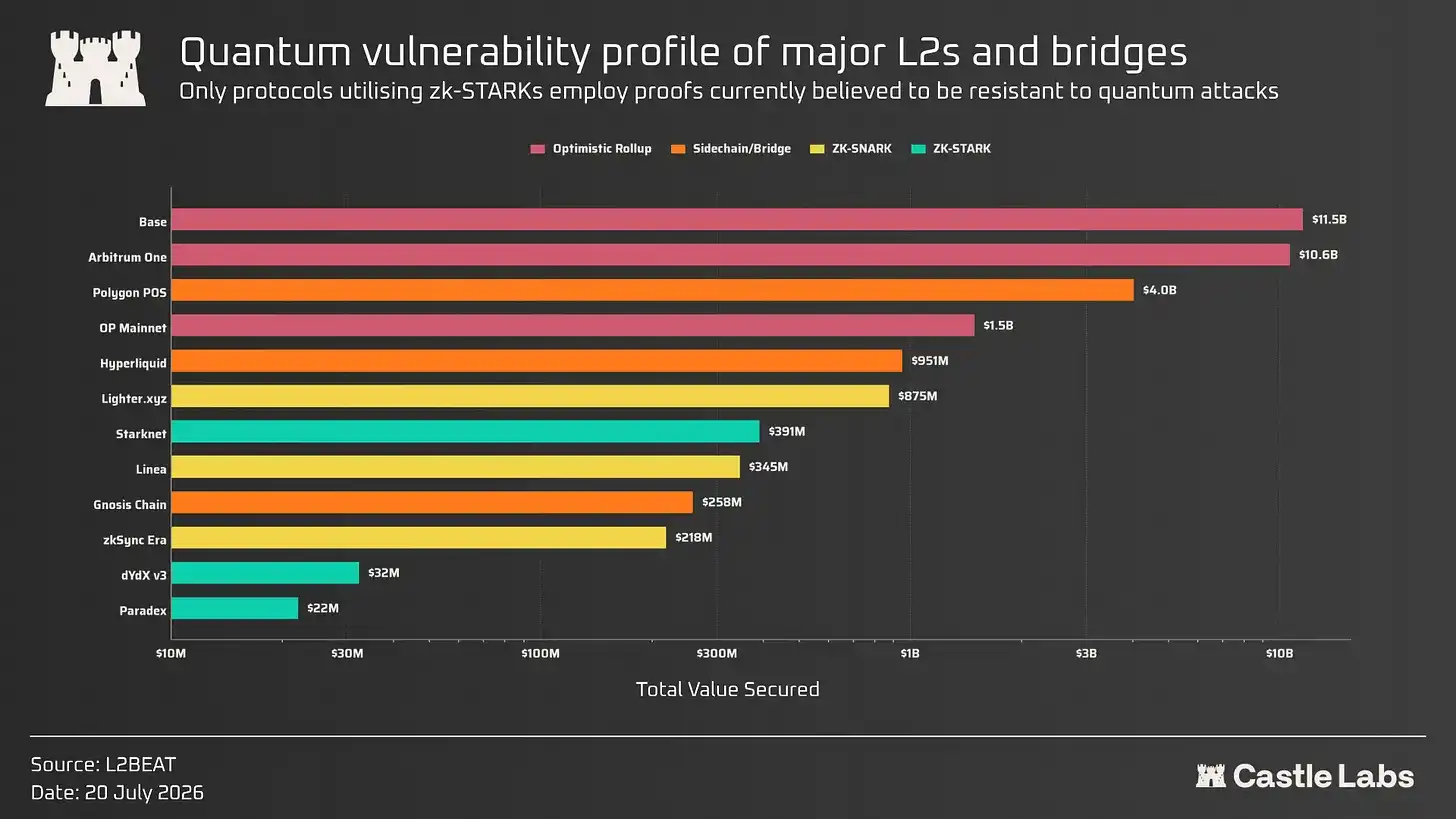
The paper focused on secp256k1 public key exposure, relevant to Bitcoin and Ethereum wallets, stating that a sufficiently powerful quantum computer could attack wallets in less than 9 minutes. Justin Drake later warned that there is "at least a 10% chance" quantum computers could recover private keys from exposed public keys by 2032.

While not a reality today, the long-term security and longevity of assets meant to be held for decades are being called into question.

Bitcoin is the world's most important digital asset, and as it increasingly serves as collateral, reserves, and assets on institutional balance sheets, its security and privacy requirements rise.

In the next section, we highlight a solution being developed around Bitcoin, the largest and clearest test case for these privacy challenges.

strkBTC: Private Bitcoin on Starknet

We've likely all used wrapped BTC tokens. They bring Bitcoin into other ecosystems and make it composable: as a tradable asset, as collateral, as liquidity.

What they don't solve is visibility.

While wrapped BTC can become productive, every move remains monitorable, inspectable, and counterparty-tradeable. Deposits, loans, trades, LP positions, repayments, withdrawals, wallet clustering, treasury flows. All public by default.

This is not how serious financial markets operate, and until this is addressed, on-chain finance will keep hitting an institutional ceiling.

In traditional finance, privacy is built into the infrastructure, whether you're a retail user or an institutional giant. In fact, a large portion of equity trading volume flows through private or over-the-counter venues like dark pools, where counterparties see what they need, regulators retain access when required, and the public sees aggregated volume, not every real-time move.

Cryptocurrency treats visibility as the standard. In reality, privacy should be the norm.

strkBTC is Starknet's attempt to let Bitcoin flow in the on-chain finance world without this limitation.

strkBTC is an ERC-20 on Starknet, backed by BTC locked on the Bitcoin network, and built on StarkWare's privacy framework STRK20 for shielded balances and private transfers.

STRK20 provides strkBTC with two modes:

In public mode, it behaves like a standard ERC-20: users can hold, transfer, supply to lending markets, provide liquidity, or use it as collateral.

In shielded mode, selected balances and transfers are hidden from public view. Users can shield, trade privately, and unshield back to public balances directly from within their wallet.
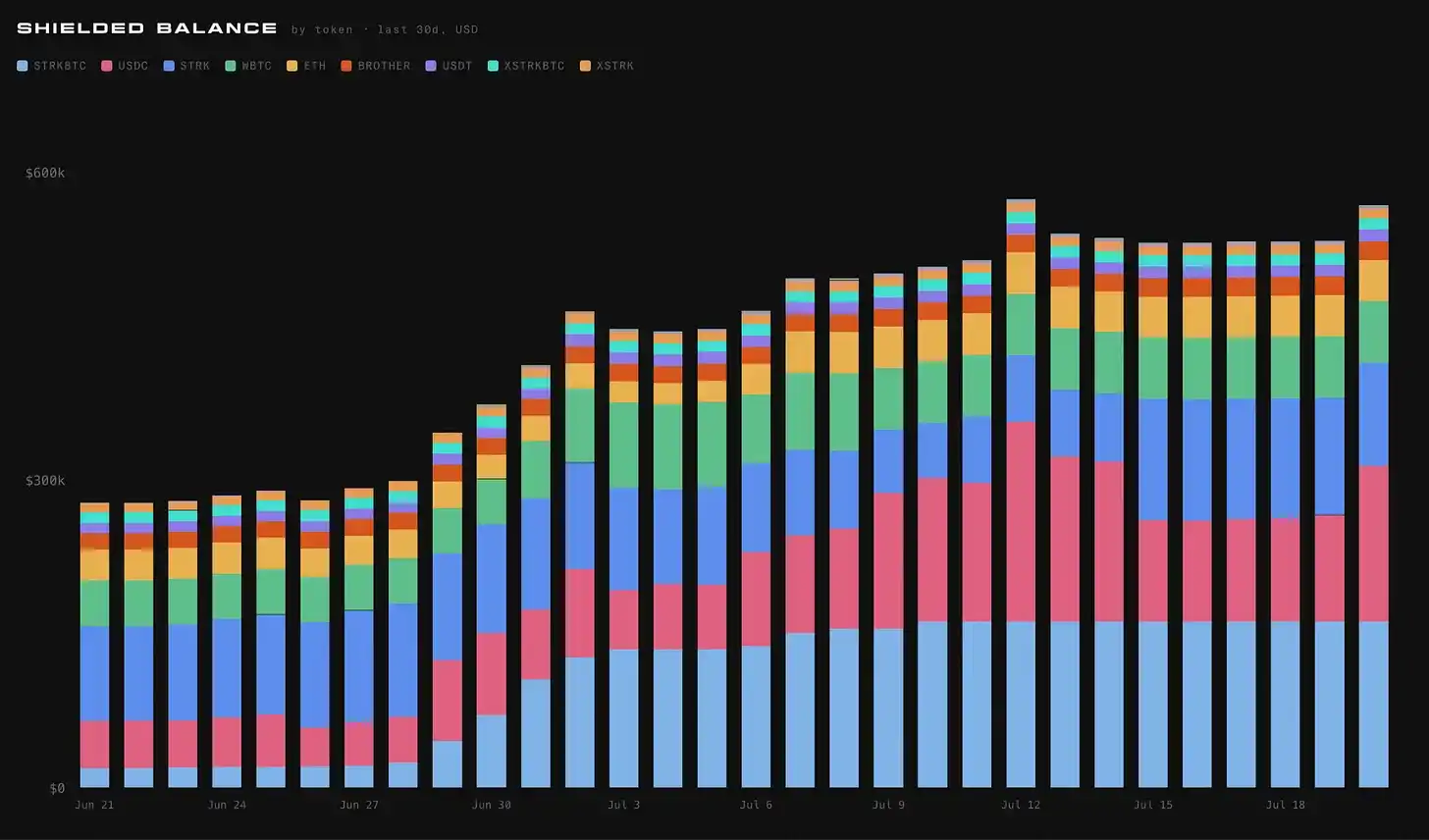
Before the Starknet v0.14.2 upgrade, which enabled STRK20, applications wanting to verify STARK proofs on Starknet had to do so within a smart contract, making it expensive and complex due to proof size. Now, transactions can directly reference off-chain proofs, with Starknet consensus handling verification natively via in-protocol proof verification.

This unlocks privacy at the protocol level, versus the historical friction of separate apps, chains, pools, or mixers, which added complexity, cost, and liquidity fragmentation. This allows applications to focus on building better products, as the underlying infrastructure has made private operations easily accessible to builders.

Compliance is a key part of the design, opening Starknet to institutions coming on-chain.

When users shield strkBTC, associated viewing keys are shared with Financial Privacy Inc. (also known as FPI), an independent third-party auditor operating the compliance infrastructure for STRK20, granting them scoped access in the event of a valid regulatory request. While this may not align with pure cypherpunk philosophy, it aligns much more closely with traditional markets. Private to the public, disclosed to regulators.

The bridge follows similar logic, operated by a trusted strkBTC consortium composed of Twinstake, NEAR Intents, Luganodes, UTXO Management, and Xverse. Currently, these independent signers support minting and burning between BTC and strkBTC. The consortium is not the final state; however, Starknet is committed to a hardening roadmap over time.

strkBTC is not meant to be just another wrapped token; it's meant to unlock the potential of a programmable, composable BTC whose moves aren't broadcast, solving the first issue: visibility.

The next issue is longevity.

The Quantum Problem for Blockchains

Every blockchain relies on public-key cryptography. When a user signs a transaction, they reveal their public key while keeping their private key hidden. This is routine on Bitcoin and most other blockchains, considered perfectly normal and secure in today's environment. But in a post-quantum world, this assumption becomes somewhat unstable.

As mentioned earlier, a sufficiently powerful quantum computer running Shor's algorithm could theoretically derive the private key from an exposed public key. This means public key exposure, the harmless part of transaction validation, could soon become a potential attack surface. This isn't unique to any single chain, as the same elliptic curve underpinnings lie beneath Bitcoin, Ethereum, and Solana.

The threat is shared, but the response capabilities are not. The most exposed chains are often the slowest to move, with Bitcoin being the clearest example.

Bitcoin isn't short on ideas for a post-quantum future. If anything, it has too many. The problem is agreeing on the trade-offs the network is willing to accept: larger signatures, higher costs, legacy coin handling, user migration, wallet support, miner policies, or battles over freezing dormant and unmigrated coins.

Clearly, Bitcoin's problem is as much social and political as it is technical.

Dan Boneh, a co-author of the Google paper, calmed everyone down in a recent interview: "Bitcoin should not panic, but it also can't ignore this. Moving too fast could be worse than waiting, because a rushed post-quantum migration could introduce catastrophic bugs before quantum is a live attack."

Bitcoin will likely solve its quantum problem, but not quickly or cleanly.

This slowness is, in some ways, a feature of sound money, but it also leaves a door open. While the base layer debates, more agile stacks can build the longevity that Bitcoin itself cannot yet commit to.

Ethereum and its extended L2s won't escape this problem. Most rollups settle to Ethereum and rely on it for data availability, thus inheriting the base layer's exposure. Ethereum is aware of this and has released its own multi-year migration plan, but until that plan arrives, every chain built on it is exposed to Ethereum's post-quantum migration problem.

This is where Starknet is ahead. While it settles to Ethereum like any other L2, Starknet's core, its proof layer, is built on foundations that don't rely on quantum-vulnerable cryptography. While the exposure inherited from Ethereum is real, everything within Starknet's own stack carries less migration debt than most major chains, and it has more in the pipeline.

Architectural Advantages

Starknet's advantageous position stems from two design choices, both made before quantum computing was a pressing concern.

The first is the proof layer, the system generating STARK proofs to secure every state transition on the network. It relies on hash functions, not the elliptic curve mathematics threatened by quantum computers, a design established since a 2018 paper co-authored by StarkWare CEO Eli Ben-Sasson. This is the critical security layer and why Google's paper listed Starknet as the only major L2 already ahead.

The second is native account abstraction. On most chains, signature schemes are fixed at the protocol level, so replacing them requires a hard fork, with every user and app having to follow. Starknet lets accounts define how to verify identity themselves, so users can migrate to quantum-resistant signatures without changing the protocol layer. According to StarkWare, a quantum-resistant wallet, S2morrow, is already deployed using Falcon-512, and OpenZeppelin is building a standardized version.

On many chains, such a change would mean coordinating a whole-protocol migration. On Starknet, much of the work can start with wallet upgrades. This doesn't mean every Starknet wallet is quantum-resistant, but this model provides an easier path for Starknet users.

StarkWare is now working to close the remaining gaps. Last week they released a roadmap to make Starknet end-to-end quantum-resistant before Q-day. Q-day refers to the point in time when quantum computers become powerful enough to break today's cryptography.

The roadmap is divided into three phases:
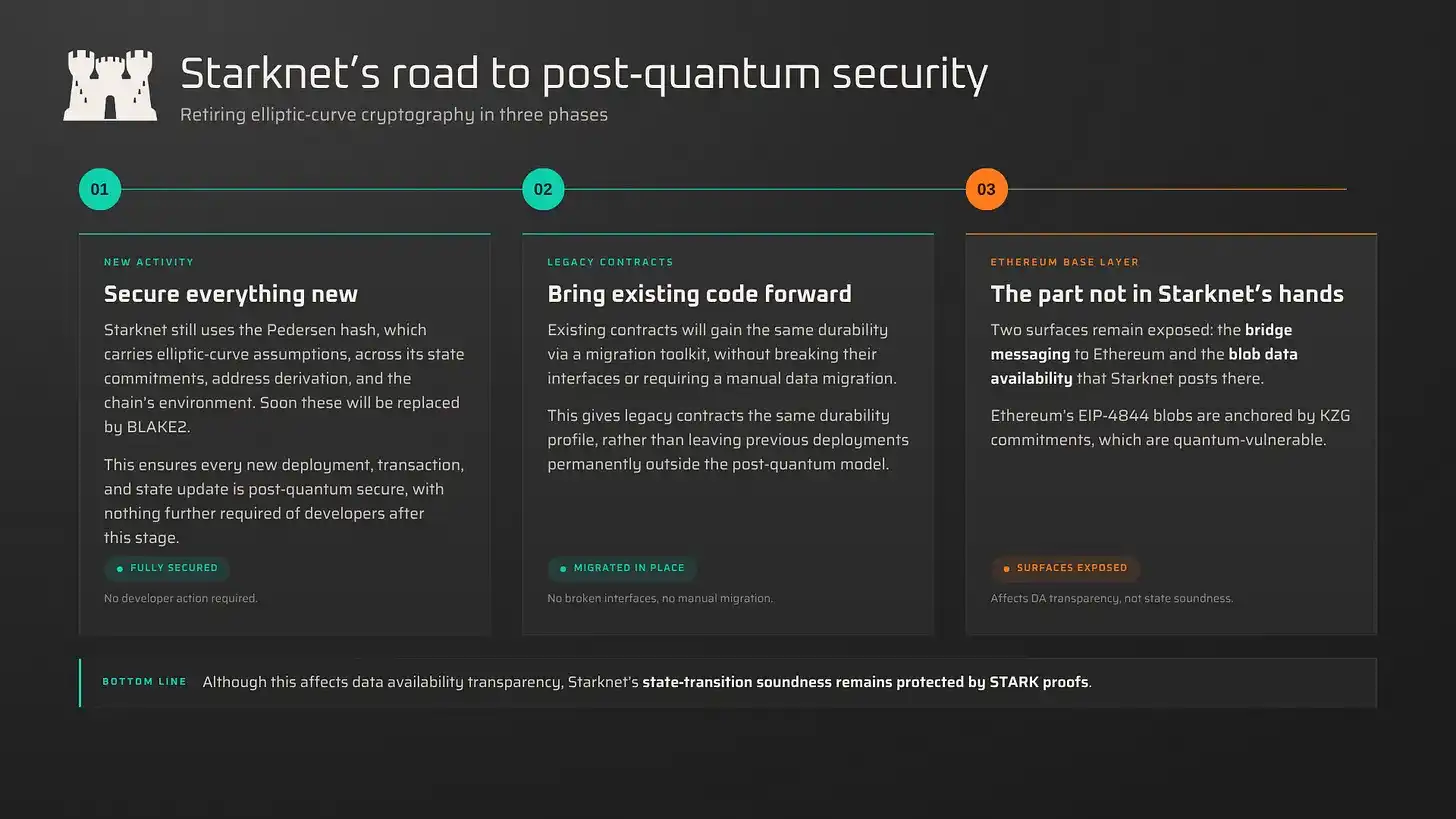
None of this means Starknet is fully quantum-resistant today, nor does the roadmap claim so.

What Still Needs Proving?

Starknet can replace Pedersen with BLAKE2, improve quantum-resistant wallet support, and provide migration paths for legacy contracts, but it cannot eliminate all problems inherited from the base layer. Bridged messages and blob data availability still depend on Ethereum's own quantum-resistant roadmap. Starknet can harden the parts it controls, but what's inherited from Ethereum will progress on Ethereum's timeline. That said, the Ethereum Foundation has outlined structured fork milestones, aiming to complete core quantum-resistant infrastructure around 2029.

strkBTC has a similar staged story. Currently, the bridge relies on a consortium to coordinate minting and burning between BTC and strkBTC. This is a trusted starting point, not the ideal trustless final state. Starknet aims to move from the consortium model to Bitcoin-native verification, then to a less-trust BitVM design, and finally, if Bitcoin enables the required opcodes in the future, to a fully trustless OP_CAT-based design.

Viewing keys are another part yet to be proven. They are Starknet's pragmatic answer to institutional privacy: publicly opaque but selectively disclosable, but they haven't been stress-tested in real scenarios, raising questions about who can request disclosure, under what conditions, and with what safeguards.

Digital assets, including Bitcoin, don't need another wrapper. They need surrounding infrastructure that can operate on-chain without compromising the two things institutions care about most: confidentiality today and longevity tomorrow.

strkBTC solves confidentiality by providing a private, selectively disclosable path for BTC into DeFi. Starknet's existing architecture and roadmap target longevity: its proof layer already avoids the elliptic curve assumptions that burden other protocols with quantum-resistant migration, and its roadmap now extends this advantage to the remaining pieces, explicitly aiming to make Starknet quantum-resistant before "Q-day."

While outcomes are still early, the direction is clear: the next institutional phase of on-chain finance needs more than just yield. It needs privacy, compliance, programmability, and longevity all integrated within the same tech stack.


Crypto di tendenza

Domande pertinenti

QWhat are the two main challenges for on-chain finance as it approaches traditional markets, as described in the article?

AThe two main challenges are: 1) All capital flows are publicly visible, compromising operational and personal privacy. 2) The threat of quantum computing to existing cryptographic signatures, which endangers the long-term security of assets.

QWhat is strkBTC and how does it address the issue of transaction visibility on-chain?

AstrkBTC is a private version of Bitcoin on Starknet, built as an ERC-20 token backed by BTC locked on the Bitcoin network. It leverages StarkWare's STRK20 privacy framework to offer two modes: a public mode (like a standard ERC-20) and a shielded mode where selected balances and transfers are hidden from public view. This allows for private transfers, addressing the issue of default public visibility in on-chain finance.

QHow does Starknet's architecture give it a stronger position regarding the quantum computing threat compared to other major L2s?

AStarknet's proof system is based on hash-based STARK assumptions, not elliptic curve cryptography, which is vulnerable to quantum attacks. This design choice, made before quantum computing was a pressing concern, means its core proof layer is inherently more quantum-resistant. Additionally, its native account abstraction allows wallets to migrate to quantum-resistant signature schemes without requiring a protocol-level hard fork.

QWhat role does the 'viewing key' play in strkBTC's privacy and compliance model?

AWhen a user shields their strkBTC, a related viewing key is shared with an independent third-party auditor called Financial Privacy Inc. (FPI). This key grants FPI scoped access, enabling selective disclosure of transaction details to regulators or compliance bodies upon valid requests. This model provides privacy from the public while allowing for necessary regulatory oversight, aligning with traditional market practices.

QWhat are the stated future goals for the strkBTC bridge and Starknet's overall quantum resistance according to the article?

AFor the strkBTC bridge, the goal is to evolve from the current trusted consortium model to Bitcoin-native verification, then to a less-trust BitVM design, and finally to a fully trustless design based on OP_CAT if Bitcoin enables the required opcodes. For overall quantum resistance, Starknet has a roadmap aiming to make the network end-to-end quantum-secure before 'Q-day' (the point when quantum computers can break current cryptography). This involves upgrading hash functions, improving wallet support, and providing migration paths, though it acknowledges dependencies on Ethereum's own quantum migration timeline.

Letture associate

9.42 Million Retail Investors Compete for Changxin Technology, Who Got Allotted?

Evergreen Technology's IPO subscription results are now available. On July 20, the domestic memory chip giant announced the offline preliminary allotment results and online lottery results for its IPO. A total of approximately 9.43 million retail investors participated in the online subscription, generating 770,000 winning lots with a final winning rate of about 0.4714%, setting a record for new shares on the STAR Market. After triggering a clawback mechanism from institutional to retail investors, the online retail allocation was significantly increased to 3.851 billion shares. Simultaneously, 285 institutional investors participated in the offline subscription, ultimately receiving 2.173 billion shares at an allotment rate of approximately 0.1756%. Leading insurers and public funds were among the major recipients. Notably, Liang Wenfeng, founder of the major AI model company DeepSeek, through his quantitative investment firms Ningbo Huanfang Quantitative and Zhejiang Jiuzhang Asset, secured the largest share among private funds, with a total allotment worth approximately 175 million yuan. Estimates suggest potential profits could reach 730 million yuan if Evergreen Technology's market capitalization reaches 3 trillion yuan post-listing. The company is expected to list on July 27 and could become the highest-valued tech stock on the A-share market, with various brokerages providing valuations ranging from 1 trillion to over 4 trillion yuan. However, recent significant corrections in global tech stocks may impact its post-listing performance. (Character count: 1,196)

marsbit1 h fa

9.42 Million Retail Investors Compete for Changxin Technology, Who Got Allotted?

marsbit1 h fa

Trading

Spot

Articoli Popolari

Cosa è BITCOIN

Comprendere HarryPotterObamaSonic10Inu (ERC-20) e la sua posizione nel mondo delle criptovalute Negli ultimi anni, il mercato delle criptovalute ha assistito a un aumento della popolarità delle meme coin, catturando l'interesse non solo dei trader, ma anche di coloro che cercano coinvolgimento comunitario e valore di intrattenimento. Tra questi token unici c'è HarryPotterObamaSonic10Inu (ERC-20), un progetto intrigante che mescola riferimenti culturali nel tessuto delle criptovalute. Questo articolo esplora gli aspetti chiave di HarryPotterObamaSonic10Inu, analizzando i suoi meccanismi, l'etica guidata dalla comunità e il suo coinvolgimento con il panorama crittografico più ampio. Che cos'è HarryPotterObamaSonic10Inu (ERC-20)? Come suggerisce il suo nome, HarryPotterObamaSonic10Inu è una meme coin costruita sulla blockchain di Ethereum, classificata secondo lo standard ERC-20. A differenza delle criptovalute tradizionali che possono enfatizzare l'utilità pratica o il potenziale investimento, questo token prospera grazie al valore di intrattenimento e alla forza della sua comunità. Il progetto mira a creare un ambiente in cui gli utenti coinvolti possono riunirsi, condividere idee e partecipare ad attività ispirate a diversi fenomeni culturali. Una caratteristica notevole di HarryPotterObamaSonic10Inu è la zero tassa sulle transazioni. Questo elemento allettante tende a incoraggiare il trading e il coinvolgimento della comunità, privo di costi aggiuntivi che possono scoraggiare i trader di piccole dimensioni. L'offerta totale della moneta è fissata a un miliardo di token, un numero che segna la sua intenzione di mantenere una circolazione sostanziale all'interno della comunità. Creatore di HarryPotterObamaSonic10Inu (ERC-20) Le origini di HarryPotterObamaSonic10Inu sono avvolte in un certo mistero; i dettagli sul creatore rimangono sconosciuti. Lo sviluppo di questo token non presenta un team identificabile o un piano esplicito, cosa non rara nel settore delle meme coin. Invece, il progetto è emerso organicamente, con il suo progresso fortemente dipendente dall'entusiasmo e dalla partecipazione della sua comunità. Investitori di HarryPotterObamaSonic10Inu (ERC-20) Per quanto riguarda investimenti esterni e finanziamenti, HarryPotterObamaSonic10Inu rimane ambiguo. Il token non elenca alcuna fondazione di investimento conosciuta o un sostegno organizzativo significativo. Invece, la linfa vitale del progetto è la sua comunità di base, che informa la sua crescita e sostenibilità attraverso azioni collettive e coinvolgimento nello spazio crittografico. Come funziona HarryPotterObamaSonic10Inu (ERC-20)? In quanto meme coin, HarryPotterObamaSonic10Inu opera principalmente al di fuori delle strutture tradizionali che governano spesso il valore degli asset. Ci sono diversi aspetti distintivi che definiscono il funzionamento del progetto: Transazioni senza tasse: Senza costi fiscali sulle transazioni, gli utenti possono comprare e vendere liberamente il token senza preoccuparsi di costi nascosti. Coinvolgimento della comunità: Il progetto prospera sull'interazione della comunità, sfruttando le piattaforme social per creare entusiasmo e facilitare il coinvolgimento. Discussioni, condivisione di contenuti e coinvolgimento sono elementi cruciali che aiutano ad espandere la sua portata e a favorire la lealtà tra i sostenitori. Nessuna utilità pratica: Va notato che HarryPotterObamaSonic10Inu non offre un'utilità concreta all'interno dell'ecosistema finanziario. Piuttosto, è classificato come un token principalmente per attività di intrattenimento e comunitarie. Riferimento culturale: Il token incorpora astutamente elementi della cultura pop per attirare interesse, collegandosi a appassionati di meme e seguaci delle criptovalute. HarryPotterObamaSonic10Inu esemplifica come le meme coin operino in modo diverso rispetto ai progetti di criptovalute più tradizionali, entrando nel mercato come costrutti sociali innovativi piuttosto che come asset utilitari. Cronologia di HarryPotterObamaSonic10Inu (ERC-20) La storia di HarryPotterObamaSonic10Inu è segnata da diversi traguardi notevoli: Creazione: Il token è emerso da un meme virale, catturando l'immaginazione di molti appassionati di criptovalute. Le date di creazione specifiche non sono disponibili, sottolineando la sua crescita organica. Inserimento negli scambi: HarryPotterObamaSonic10Inu ha fatto il suo ingresso in vari scambi, consentendo un accesso e un trading più facili da parte della comunità. Iniziative di coinvolgimento della comunità: Attività in corso volte a migliorare l'interazione della comunità, comprese gare, campagne sui social media e generazione di contenuti da parte di fan e sostenitori. Piani di espansione futura: La tabella di marcia del progetto include il lancio di una collezione NFT, merchandising e un sito di eCommerce relativo ai suoi temi culturali, coinvolgendo ulteriormente la comunità e cercando di aggiungere più dimensioni al suo ecosistema. Punti chiave su HarryPotterObamaSonic10Inu (ERC-20) Natura guidata dalla comunità: Il progetto dà priorità al contributo collettivo e alla creatività, garantendo che il coinvolgimento degli utenti sia al centro del suo sviluppo. Classificazione come meme coin: Rappresenta l'epitome delle criptovalute basate sull'intrattenimento, distinguendosi dai veicoli d'investimento tradizionali. Nessuna affiliazione diretta con Bitcoin: Nonostante la somiglianza nel nome del ticker, HarryPotterObamaSonic10Inu è distintivo e non ha alcuna relazione con Bitcoin o altre criptovalute consolidate. Focus sulla collaborazione: HarryPotterObamaSonic10Inu è progettato per creare uno spazio per la collaborazione e la condivisione di storie tra i suoi detentori, fornendo un canale per la creatività e il legame comunitario. Prospettive future: L'ambizione di espandersi oltre il suo presupposto iniziale verso NFT e merchandising delinea un percorso per il progetto per potenzialmente entrare in strade più mainstream all'interno della cultura digitale. Poiché le meme coin continuano a catturare l'immaginazione della comunità crittografica, HarryPotterObamaSonic10Inu (ERC-20) si distingue per i suoi legami culturali e il suo approccio centrato sulla comunità. Anche se potrebbe non adattarsi al modello tipico di un token orientato all'utilità, la sua essenza risiede nella gioia e nella camaraderia coltivate tra i suoi sostenitori, evidenziando la natura in evoluzione delle criptovalute in un'epoca sempre più digitale. Con la continuazione dello sviluppo del progetto, sarà importante osservare come le dinamiche della comunità influenzano la sua traiettoria nel panorama in continuo cambiamento della tecnologia blockchain.

1.8k Totale visualizzazioniPubblicato il 2024.04.01Aggiornato il 2024.12.03

Cosa è BITCOIN

Come comprare BTC

Benvenuto in HTX.com! Abbiamo reso l'acquisto di Bitcoin (BTC) semplice e conveniente. Segui la nostra guida passo passo per intraprendere il tuo viaggio nel mondo delle criptovalute.Step 1: Crea il tuo Account HTXUsa la tua email o numero di telefono per registrarti il tuo account gratuito su HTX. Vivi un'esperienza facile e sblocca tutte le funzionalità,Crea il mio accountStep 2: Vai in Acquista crypto e seleziona il tuo metodo di pagamentoCarta di credito/debito: utilizza la tua Visa o Mastercard per acquistare immediatamente BitcoinBTC.Bilancio: Usa i fondi dal bilancio del tuo account HTX per fare trading senza problemi.Terze parti: abbiamo aggiunto metodi di pagamento molto utilizzati come Google Pay e Apple Pay per maggiore comodità.P2P: Fai trading direttamente con altri utenti HTX.Over-the-Counter (OTC): Offriamo servizi su misura e tassi di cambio competitivi per i trader.Step 3: Conserva Bitcoin (BTC)Dopo aver acquistato Bitcoin (BTC), conserva nel tuo account HTX. In alternativa, puoi inviare tramite trasferimento blockchain o scambiare per altre criptovalute.Step 4: Scambia Bitcoin (BTC)Scambia facilmente Bitcoin (BTC) nel mercato spot di HTX. Accedi al tuo account, seleziona la tua coppia di trading, esegui le tue operazioni e monitora in tempo reale. Offriamo un'esperienza user-friendly sia per chi ha appena iniziato che per i trader più esperti.

4.1k Totale visualizzazioniPubblicato il 2024.12.12Aggiornato il 2026.06.02

Come comprare BTC

Cosa è $BITCOIN

ORO DIGITALE ($BITCOIN): Un'Analisi Completa Introduzione all'ORO DIGITALE ($BITCOIN) L'ORO DIGITALE ($BITCOIN) è un progetto basato su blockchain che opera sulla rete Solana, con l'obiettivo di combinare le caratteristiche dei metalli preziosi tradizionali con l'innovazione delle tecnologie decentralizzate. Sebbene condivida un nome con Bitcoin, spesso definito “oro digitale” a causa della sua percezione come riserva di valore, l'ORO DIGITALE è un token separato progettato per creare un ecosistema unico all'interno del panorama Web3. Il suo obiettivo è posizionarsi come un asset digitale alternativo valido, anche se i dettagli riguardanti le sue applicazioni e funzionalità sono ancora in fase di sviluppo. Cos'è l'ORO DIGITALE ($BITCOIN)? L'ORO DIGITALE ($BITCOIN) è un token di criptovaluta esplicitamente progettato per l'uso sulla blockchain di Solana. A differenza di Bitcoin, che fornisce un ruolo di stoccaggio di valore ampiamente riconosciuto, questo token sembra concentrarsi su applicazioni e caratteristiche più ampie. Aspetti notevoli includono: Infrastruttura Blockchain: Il token è costruito sulla blockchain di Solana, nota per la sua capacità di gestire transazioni ad alta velocità e a basso costo. Dinamiche di Offerta: L'ORO DIGITALE ha un'offerta massima fissata a 100 quadrilioni di token (100P $BITCOIN), sebbene i dettagli riguardanti la sua offerta circolante siano attualmente non divulgati. Utilità: Sebbene le funzionalità precise non siano esplicitamente delineate, ci sono indicazioni che il token potrebbe essere utilizzato per varie applicazioni, potenzialmente coinvolgendo applicazioni decentralizzate (dApp) o strategie di tokenizzazione degli asset. Chi è il Creatore dell'ORO DIGITALE ($BITCOIN)? Attualmente, l'identità dei creatori e del team di sviluppo dietro l'ORO DIGITALE ($BITCOIN) rimane sconosciuta. Questa situazione è tipica tra molti progetti innovativi nel settore blockchain, in particolare quelli allineati con la finanza decentralizzata e i fenomeni delle meme coin. Sebbene tale anonimato possa favorire una cultura guidata dalla comunità, intensifica le preoccupazioni riguardo alla governance e alla responsabilità. Chi sono gli Investitori dell'ORO DIGITALE ($BITCOIN)? Le informazioni disponibili indicano che l'ORO DIGITALE ($BITCOIN) non ha alcun sostenitore istituzionale noto o investimenti di venture capital prominenti. Il progetto sembra operare su un modello peer-to-peer incentrato sul supporto e sull'adozione della comunità piuttosto che su percorsi di finanziamento tradizionali. La sua attività e liquidità si trovano principalmente su exchange decentralizzati (DEX), come PumpSwap, piuttosto che su piattaforme di trading centralizzate consolidate, evidenziando ulteriormente il suo approccio di base. Come Funziona l'ORO DIGITALE ($BITCOIN) Le meccaniche operative dell'ORO DIGITALE ($BITCOIN) possono essere elaborate in base al suo design blockchain e alle caratteristiche della rete: Meccanismo di Consenso: Sfruttando il proof-of-history (PoH) unico di Solana combinato con un modello di proof-of-stake (PoS), il progetto garantisce una validazione efficiente delle transazioni contribuendo all'alta performance della rete. Tokenomics: Sebbene meccanismi deflazionistici specifici non siano stati dettagliati ampiamente, l'ampia offerta massima di token implica che potrebbe soddisfare microtransazioni o casi d'uso di nicchia che devono ancora essere definiti. Interoperabilità: Esiste il potenziale per l'integrazione con l'ecosistema più ampio di Solana, inclusi vari piattaforme di finanza decentralizzata (DeFi). Tuttavia, i dettagli riguardanti integrazioni specifiche rimangono non specificati. Cronologia degli Eventi Chiave Ecco una cronologia che evidenzia traguardi significativi riguardanti l'ORO DIGITALE ($BITCOIN): 2023: Il dispiegamento iniziale del token avviene sulla blockchain di Solana, contrassegnato dal suo indirizzo di contratto. 2024: L'ORO DIGITALE guadagna visibilità poiché diventa disponibile per il trading su exchange decentralizzati come PumpSwap, consentendo agli utenti di scambiarlo contro SOL. 2025: Il progetto assiste a un'attività di trading sporadica e a un potenziale interesse per impegni guidati dalla comunità, sebbene non siano state documentate partnership significative o avanzamenti tecnici fino ad ora. Analisi Critica Punti di Forza Scalabilità: L'infrastruttura sottostante di Solana supporta alti volumi di transazioni, il che potrebbe migliorare l'utilità di $BITCOIN in vari scenari di transazione. Accessibilità: Il potenziale basso prezzo di trading per token potrebbe attrarre investitori al dettaglio, facilitando una partecipazione più ampia grazie a opportunità di proprietà frazionata. Rischi Mancanza di Trasparenza: L'assenza di sostenitori, sviluppatori o di un processo di audit pubblicamente noti potrebbe generare scetticismo riguardo alla sostenibilità e all'affidabilità del progetto. Volatilità del Mercato: L'attività di trading è fortemente dipendente dal comportamento speculativo, il che può comportare una significativa volatilità dei prezzi e incertezze per gli investitori. Conclusione L'ORO DIGITALE ($BITCOIN) emerge come un progetto intrigante ma ambiguo all'interno dell'evolvente ecosistema di Solana. Sebbene tenti di sfruttare la narrativa dell'“oro digitale”, la sua partenza dal ruolo consolidato di Bitcoin come riserva di valore sottolinea la necessità di una chiara differenziazione della sua utilità e struttura di governance. L'accettazione e l'adozione future dipenderanno probabilmente dall'affrontare l'attuale opacità e dalla definizione più esplicita delle sue strategie operative ed economiche. Nota: Questo rapporto comprende informazioni sintetizzate disponibili a ottobre 2023, e potrebbero essersi verificati sviluppi oltre il periodo di ricerca.

154 Totale visualizzazioniPubblicato il 2025.05.13Aggiornato il 2025.05.13

Cosa è $BITCOIN

Discussioni

Benvenuto nella Community HTX. Qui puoi rimanere informato sugli ultimi sviluppi della piattaforma e accedere ad approfondimenti esperti sul mercato. Le opinioni degli utenti sul prezzo di BTC BTC sono presentate come di seguito.

活动图片