Standard Chartered Bank’s 50-Fold Fantasy: Predicting AAVE to Reach $3,500

链捕手Pubblicato 2026-06-25Pubblicato ultima volta 2026-06-25

Introduzione

Standard Chartered Bank has issued an optimistic research report predicting that the AAVE token could surge 50-fold to $3,500 by 2030. This forecast is based on the projection that the total value locked (TVL) in DeFi will grow 37x to approximately $2.7 trillion, driven by stablecoin expansion and the tokenization of real-world assets (RWA). The bank's model links Aave's potential valuation directly to its protocol revenue, which is primarily driven by net interest margins. The report highlights Aave's current dominant position, noting it captures over 80% of the net earnings ("protocol retained earnings") in the lending sector while holding only about half of its TVL. It also points to the recent launch of the Aave V4 architecture and a healthy revenue stream of $142 million in 2025 as positive fundamentals. Grayscale's separate analysis, applying traditional valuation metrics like DCF, concluded AAVE is currently undervalued. However, the article notes significant challenges. Aave's peer-to-pool lending model suffers from inherent capital inefficiency, with an estimated $52 million annual "deadweight loss" due to idle funds needed for liquidity buffers. This structural flaw was exposed during the April KelpDAO exploit, which locked a WETH pool at 100% utilization for days. Emerging protocols like Morpho, with more efficient point-to-point models, are cited as growing competitive threats. In summary, while institutional forecasts paint a macro picture of massive growth fu...

Author: Jae, PANews

Following its bullish call on UNI, Standard Chartered Bank has made another bold statement to the crypto industry: AAVE could surge 50-fold by the end of 2030, reaching $3,500.

Related reading:Standard Chartered Opens 40x "Bet," Calls for UNI to Rise to $100

Aggressive rhetoric, exaggerated multiples, coupled with a familiar script: AAVE’s price surged past $80, with 24-hour gains once approaching 20%. The on-chain lending market is in an uproar—some cheer the traditional giant’s bullish stance on AAVE, while others mock Standard Chartered as another sell-side entity carried away by hype.

Aave’s next battle will unfold at the intersection of fantasy and reality.

Standard Chartered Uses Excel to Draw a 50x "Candlestick" for AAVE

If one were to condense Standard Chartered’s AAVE research report into one sentence, it would be:Deposit scale determines lending capacity, lending capacity drives fee income, and fee income ultimately translates into token market capitalization. Over the past 12 months, approximately 90% of Aave’s fee revenue came from the net interest spread between deposits and loans.

The traditional valuation framework based on linear mapping logic has been directly applied by Standard Chartered to the lending protocol. According to its pricing model, AAVE will follow a stepwise upward trajectory.
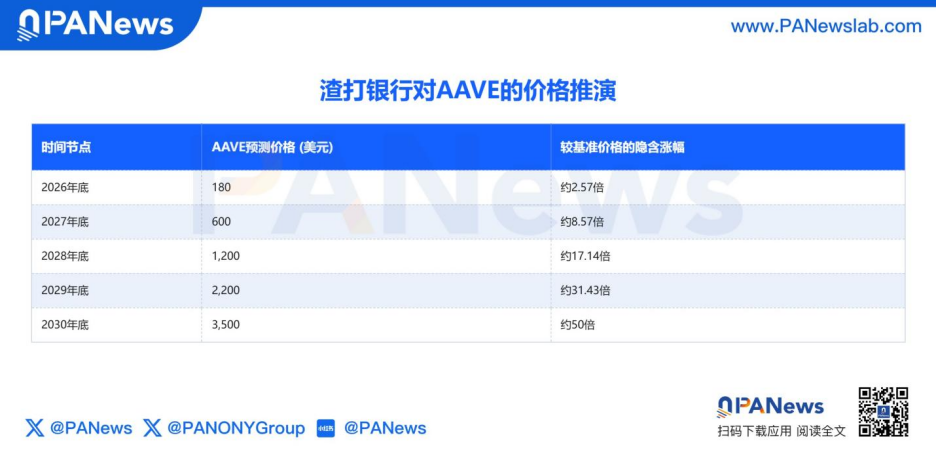
Standard Chartered’s assumptions stem from predictions about two major trends in the DeFi sector:

  • DeFi TVL (Total Value Locked) will grow 37-fold. Standard Chartered predicts that by 2030, the total value of active assets in DeFi will grow 37 times from current levels, reaching approximately $2.7 trillion. This will be driven by a $2 trillion expansion in stablecoin scale and the massive wave of on-chain migration of RWAs (Real World Assets).

  • RWA penetration in DeFi will increase from 3.5% to 30%. This means trillions of dollars in traditional assets will flow into on-chain lending protocols.

Looking back at its peak in October last year, Aave once managed deposits as high as $75 billion. If viewed as a traditional bank, this scale would place it among the top 35 banks in the United States.

Standard Chartered believes that Aave’s operational efficiency far surpasses that of traditional banks reliant on physical branches and redundant manpower. Once the tokenization wave arrives, Aave will leverage its Horizon permissioned lending market and the fee capture from its stablecoin GHO to convert the benefits of RWA on-chain into tangible protocol revenue.

Regarding the capital outflow triggered by the KelpDAO rsETH bridging security incident in April, Standard Chartered Bank characterizes it as a short-term fluctuation during the bottoming phase, not a collapse in the long-term protocol fundamentals.

Even setting aside the long-term narrative and focusing on a medium-to-short-term perspective, Aave’s fundamentals remain robust enough.

On June 18, Grayscale released an in-depth report on Aave, applying the traditional finance DCF (Discounted Cash Flow) model and P/E (Price-to-Earnings) ratio method to value a DeFi protocol for the first time.

Grayscale concluded:AAVE is a typical cash-flow-driven asset, currently trading at undervalued levels.
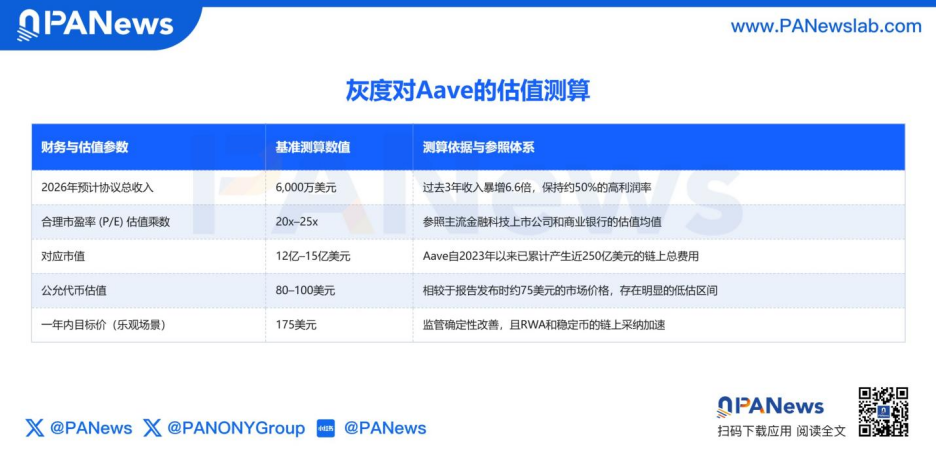
Grayscale emphasized that Aave’s full-year protocol revenue for 2025 was as high as $142 million, indicating healthy cash flow. More importantly, the token buyback and burn plan launched by Aave DAO in April last year, as well as the "Aave Will Win" proposal’s shift of product revenue to token holders, have institutionally established the transmission path from "protocol revenue generation → token value appreciation.”

Monopolizing 80% of Profits with Half the Sector's TVL, Idle Funds Remain Its Achilles' Heel

Beyond the macro vision painted by institutional capital, Aave has also built a deep moat at the micro level.

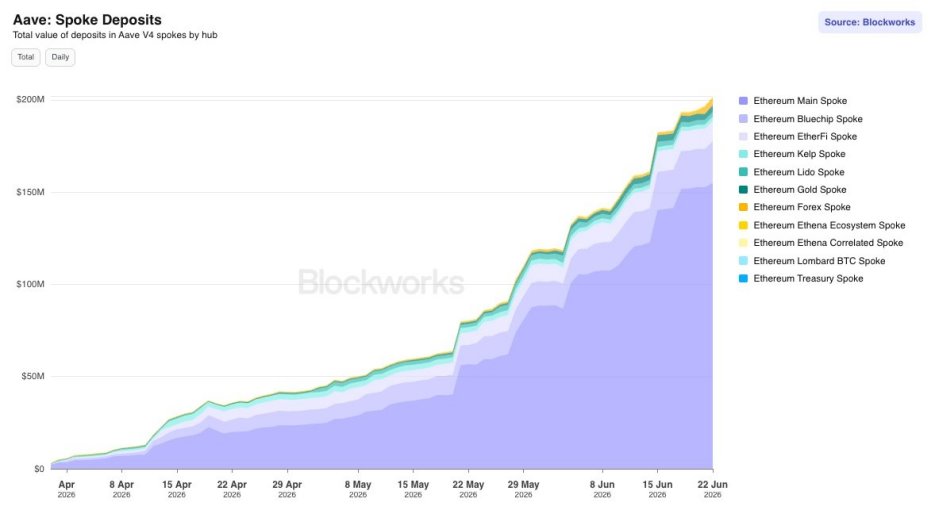
First, there is the breakthrough of the new-generation technical architecture, Aave V4. As the largest underlying architecture rewrite since the protocol’s inception in 2020, V4 employs a "liquidity hub-and-spoke" design to break the silo effect of single-chain liquidity. To date, V4’s total deposits have surpassed $200 million, with loan volumes nearing $60 million.
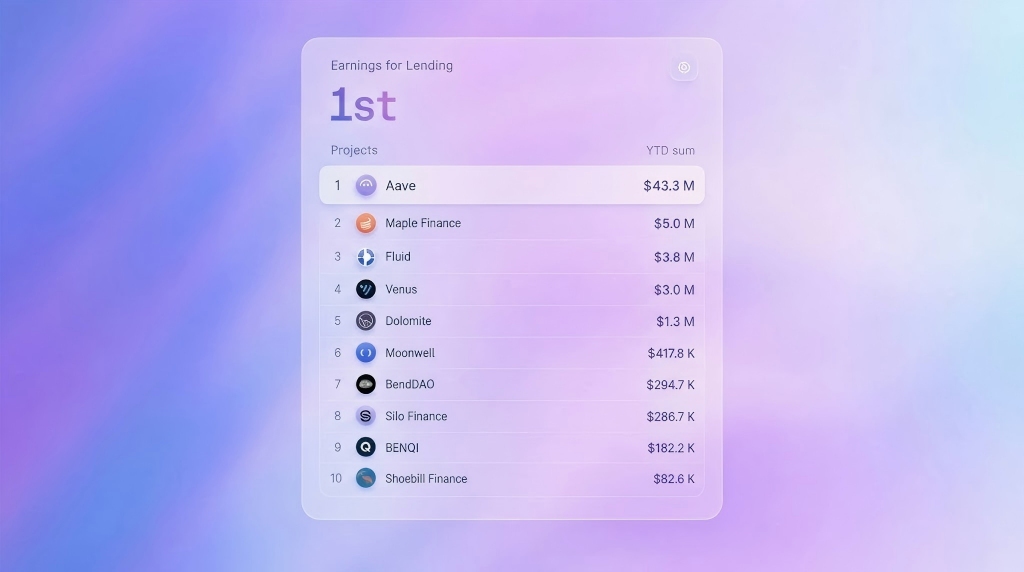
More remarkable is its profitability. On-chain data analytics firm MSB Intel pointed out that year-to-date, Aave has accumulated approximately $43.3 million in "protocol retained earnings" within the lending sector, accounting for 80.7% of the entire sector’s profits. Protocols like Maple Finance, Fluid, Venus, ranked behind it, each generating less than $5 million in profit, not on the same scale as Aave.

In the traditional business world, a company’s substance is often determined by net profit, not total assets. Retained earnings are an indicator that, after deducting relevant operational costs and token inflation incentives, truly reflects a protocol’s on-chain net revenue generation capability.

In other words, Aave uses roughly half of the sector’s TVL to capture over 80% of its net profit. This near-monopolistic profit structure is the hardest cornerstone in Standard Chartered’s 50-fold prediction.
On the flip side, the structural flaw once highlighted by crypto research firm Delphi Digital remains an unresolved challenge. The root of the problem lies within Aave’s peer-to-pool lending model.

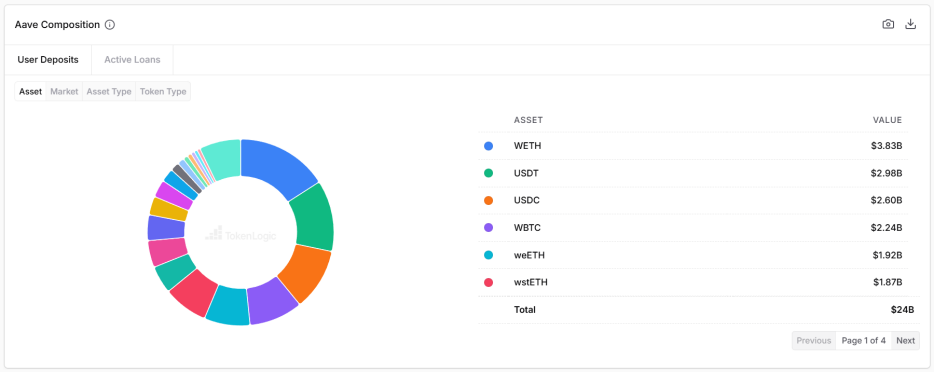
According to Delphi Digital’s estimates, in the three primary markets of WETH, USDT, and USDC, Aave incurs an annual invisible loss (Deadweight Loss) of approximately $52 million due to idle funds, a scale almost equivalent to half of its annualized net revenue for Q1 2026.
The systemic disconnect between deposit and borrowing rates is an inherent defect of the peer-to-pool model. To ensure depositors can redeem their funds at any time without loss, Aave must maintain a massive idle liquidity buffer within its pools. This results in depositors receiving rates typically 25% to 35% lower than what borrowers pay. The difference is the opportunity cost of idle funds. Even if the DAO governance layer sets the reserve factor to 0, the invisible loss from idle funds would still be as high as $36 million.

The KelpDAO incident in April further revealed the fragility of this model. After hackers drained nearly $200 million worth of WETH, the WETH pool utilization rate was locked at 100% for five days. Ordinary depositors could neither withdraw nor participate in liquidations, leaving a scar on Aave that has yet to fully heal.

This structural flaw makes Aave susceptible to "upstream risk" contagion. Coupled with the inherent shortcoming of low capital efficiency, it also gives latecomers an opportunity to break through. Emerging lending protocols like Morpho, focusing on modular isolation, peer-to-peer matching, and minimalist underlying design, are encroaching on Aave’s market share from an efficiency standpoint, becoming its most formidable challenger beneath the throne.

Looking back from the midpoint of 2026, Aave stands at the corner of fantasy and reality.

The "$3,500" pie chart drawn by Standard Chartered Bank reflects traditional finance’s ambition for asset tokenization. Beyond mere TVL growth, Aave’s future focus will be on finding a viable path to support a trillion-dollar asset scale.

The throne of DeFi lending remains, but the foundation beneath it still requires a process of reconstruction or reinforcement.


Crypto di tendenza

Domande pertinenti

QWhat is Standard Chartered Bank's price target for AAVE by the end of 2030, and what multiple increase does this represent from its current price?

AStandard Chartered Bank's price target for AAVE by the end of 2030 is $3,500, which represents a 50-fold (or 5,000%) increase from its price at the time of the report.

QWhat are the two major DeFi trends that Standard Chartered's prediction for AAVE is based on?

AStandard Chartered's prediction is based on two major DeFi trends: 1) DeFi TVL (Total Value Locked) growing 37-fold to approximately $2.7 trillion by 2030, driven by stablecoin expansion and the tokenization of real-world assets (RWA). 2) The penetration rate of RWA in DeFi increasing from 3.5% to 30%.

QAccording to Grayscale's report, what makes AAVE a 'cash flow-driven asset', and what valuation methods did they apply?

AGrayscale's report states that AAVE is a cash flow-driven asset because it generated substantial protocol revenue of $142 million in 2025 and has mechanisms like token buyback/burn plans that link protocol earnings to token value. They applied traditional financial valuation methods, specifically the DCF (Discounted Cash Flow) model and P/E (Price-to-Earnings) ratio, to value the DeFi protocol.

QWhat is AAVE's key competitive advantage in terms of profitability within the lending sector, as highlighted by MSB Intel?

AAccording to MSB Intel, AAVE's key competitive advantage is its dominant profitability. Year-to-date, it has generated approximately $43.3 million in 'Protocol Retained Earnings', accounting for 80.7% of the entire lending sector's profits, despite holding only about half of the sector's TVL.

QWhat is the fundamental structural flaw in Aave's peer-to-pool lending model identified by Delphi Digital, and what is its consequence?

AThe fundamental structural flaw identified by Delphi Digital is the systemic disconnect between deposit and borrowing rates, necessitating a large idle liquidity buffer in the pool. This leads to significant 'deadweight loss' or opportunity cost, estimated at $52 million annually for major markets, representing low capital efficiency. A consequence of this model was evident during the KelpDAO hack, where the WETH pool was locked at 100% utilization for days, preventing user withdrawals.

Letture associate

STRC 跌破面值,比特币财库实验进入下半场

The price of STRC, Strategy's dividend-paying preferred stock, has fallen below its $100 face value, triggering a re-evaluation of the "bitcoin treasury" corporate model. This highlights a critical tension: the company's asset base consists of high-volatility, non-cash-flow-generating Bitcoin, while its capital structure requires continuous cash payouts for dividends and interest. The decline of STRC signals that market pressure is shifting from asset price volatility to the pricing of the company's financing tools. Strategy's core model involves a three-step conversion: turning equity into Bitcoin exposure, converting Bitcoin holdings into capital market credit, and packaging non-yielding BTC into cash-paying securities like STRC. While Strategy holds a massive 847,363 BTC, the focus is now on cash flow mismatches. The company faces annual preferred stock dividend obligations of approximately $1.7 billion, far exceeding the cash flow from its legacy software business. Its ability to meet these obligations relies on continued access to capital markets. The market is now scrutinizing which of three potential costs becomes untenable first: rising dividend costs to attract investors, dilution costs from issuing more common stock, or the reputational cost of selling BTC—a move contrary to its "hodl" narrative. For the broader crypto market, a constrained Strategy means the potential loss of a predictable, narrative-driven marginal buyer for Bitcoin. The STRC discount serves as a reminder that the longevity of such models depends not just on Bitcoin's price, but also on financing windows, cash reserves, and investor willingness to pay a "trust premium" for the structure.

marsbit7 min fa

STRC 跌破面值,比特币财库实验进入下半场

marsbit7 min fa

Tidal Investment: We Remain Bullish on the AI Industry Chain, But the Reasons Have Changed

Tidal Investment remains optimistic about the AI industry chain, but the rationale has shifted. The market narrative has changed. While recent large-scale IPOs (e.g., SpaceX) and major fundraising plans by tech giants like Alphabet and Meta have caused some nervousness, this isn't a sign of an AI peak. The focus has moved from the initial question of AI's viability to the sustainability of massive investment cycles. The key players—primarily the major cloud providers—are not slowing down; their capital expenditure (Capex) guidance for 2026 has been increased across the board (e.g., Alphabet to $180B, Amazon to $200B). This investment cycle is proving resilient and difficult to stop. Unlike traditional hardware cycles, current AI Capex is distributed across multiple physical layers—computing, memory, networking, and critically, power infrastructure. Bottlenecks are shifting from chips to elements like electricity, transformers, and cooling systems, which have much longer lead times and cannot be easily pre-built like fiber optics during the dot-com bubble. Supply chain data (e.g., Eaton's 240% YoY data center orders) confirms this broad-based, project-driven expansion. Market concerns are acknowledged but viewed differently. First, while Capex growth currently outpaces revenue growth, raising ROI questions, this mirrors the early scaling phase of cloud computing itself. A change in view would require concrete signals like downward Capex revisions or missed AI product targets, which haven't materialized by mid-2026. Second, comparisons to the 2000 dot-com bust are flawed. That crash was driven by a massive, parallel oversupply of cheap capacity (fiber). The current cycle faces *supply constraints* in critical, capital-intensive physical infrastructure that cannot be overbuilt as easily. In conclusion, the wave of fundraising reflects the next, more complex act of the AI story. Physical bottlenecks and sustained high Capex plans suggest this is not the finale but an ongoing, capital-intensive build-out phase. The script has changed, but the play is far from over.

marsbit2 h fa

Tidal Investment: We Remain Bullish on the AI Industry Chain, But the Reasons Have Changed

marsbit2 h fa

Tidal Investment: We Remain Bullish on the AI Industry Chain, But for Different Reasons Now

Tidal Investments remains optimistic about the AI industry chain, but the rationale has shifted. The market is concerned about massive concurrent fundraising by tech giants like SpaceX, OpenAI, Alphabet, and Meta, fearing an AI peak. However, the authors argue this signals the next act of AI development, not its end. Capital expenditure (Capex) from major cloud providers (Alphabet, Amazon, Meta, Microsoft, Oracle) continues to surge aggressively into 2026. This investment cycle is more resilient than past hardware cycles due to its scale and complexity. Bottlenecks have shifted from chips to critical physical infrastructure like power grids, transformers, cooling, and data center construction—areas with long lead times and limited capacity for rapid expansion. Supply chain data (e.g., Eaton's orders) confirms substantial, tangible progress. Key market concerns are addressed: 1. **ROI vs. Capex Growth**: While Capex growth outpaces revenue, the authors note cloud giants have historically overcome similar phases through scale. The cycle will only be in danger if Capex guidance is cut, orders are canceled, or AI product demand falters—none of which are currently observed. 2. **Comparison to the 2000 Dot-com Bubble**: Unlike the telecom bubble, where cheap, oversupplied fiber crashed prices, AI infrastructure (especially power) is constrained, customized, and subject to lengthy approvals, making a similar supply glut and crash unlikely. In conclusion, the wave of fundraising reflects the immense, ongoing capital needs for AI's next phase, constrained by slow-moving physical bottlenecks. The AI cycle is not over; the script has simply changed.

链捕手2 h fa

Tidal Investment: We Remain Bullish on the AI Industry Chain, But for Different Reasons Now

链捕手2 h fa

Grayscale: These 15 Profitable Crypto Protocols Are Severely Undervalued

Grayscale Research identifies 15 top-revenue crypto protocols trading at significant valuation discounts, with many at single-digit or even 1x revenue multiples. Protocols like Pump.fun, PancakeSwap, and Meteora have market capitalizations roughly equal to their annual revenue. The report argues these financially-focused protocols (DEXs, lending, staking) are fundamentally undervalued and could benefit from the potential passage of the CLARITY Act, expected as soon as next month. This legislation aims to clarify digital asset regulation, potentially reducing institutional barriers and driving on-chain activity. The analysis breaks down the protocols into three groups: the "1x Club" (market cap ≈ revenue), mid-tier protocols with 3-9x multiples (e.g., Aave, Lido, Jupiter), and high-multiple protocols like Hyperliquid (15x) and Uniswap (37x), where valuation reflects future potential rather than current cash flows. Grayscale applies a traditional DCF model to Aave, suggesting a one-year price target of ~$175, representing ~130% upside from current levels. The report notes a risk-off macro environment since the Iran conflict has further compressed valuations, creating a potential entry window. The conclusion highlights that while the valuation data presents an intriguing opportunity, the investment thesis is contingent on the CLARITY Act's passage and subsequent institutional capital flows. Investors are cautioned to consider Grayscale's inherent conflict of interest as a crypto asset manager with products tied to these assets.

marsbit2 h fa

Grayscale: These 15 Profitable Crypto Protocols Are Severely Undervalued

marsbit2 h fa

Trading

Spot
Futures

Articoli Popolari

Cosa è $BANK

Banca AI: Un Passo Rivoluzionario nel Futuro della Banca Introduzione In un'era caratterizzata da rapidi progressi tecnologici, Banca AI si trova all'incrocio tra intelligenza artificiale (AI) e servizi bancari. Questo progetto innovativo mira a ridefinire il panorama finanziario, migliorando l'efficienza operativa, le misure di sicurezza e le esperienze dei clienti attraverso il potere dell'AI. Mentre ci impegniamo in questa esplorazione di Banca AI, esamineremo cosa comporta il progetto, le sue dinamiche operative, il suo contesto storico e i traguardi significativi. Cos'è Banca AI? Alla sua essenza, Banca AI rappresenta un'iniziativa trasformativa volta a integrare l'intelligenza artificiale in varie operazioni bancarie. Questo progetto sfrutta le capacità dell'AI per automatizzare processi, migliorare i protocolli di gestione del rischio e potenziare l'interazione con i clienti attraverso servizi personalizzati. Gli obiettivi principali di Banca AI includono: Automazione delle Funzioni Bancarie: Sfruttando le tecnologie AI, Banca AI mira ad automatizzare compiti di routine, riducendo il carico sulle risorse umane e aumentando l'efficienza. Miglioramento della Gestione del Rischio: Il progetto utilizza algoritmi AI per prevedere e identificare i rischi, rafforzando così le misure di sicurezza contro le frodi e altre minacce. Personalizzazione dei Servizi Bancari: Banca AI si concentra sull'offrire prodotti e servizi finanziari su misura analizzando i dati e i comportamenti dei clienti. Miglioramento dell'Esperienza del Cliente: L'implementazione di soluzioni guidate dall'AI, come chatbot e assistenti virtuali, mira a fornire agli utenti interazioni più umane, rivoluzionando il modo in cui i clienti si relazionano con le banche. Con questi obiettivi, Banca AI si posiziona come un attore cruciale nel rendere la banca più efficiente, sicura e centrata sull'utente. Chi è il Creatore di Banca AI? I dettagli riguardanti il creatore di Banca AI rimangono sconosciuti. Pertanto, non è stata identificata alcuna persona o organizzazione specifica nelle informazioni disponibili. L'anonimato che circonda la nascita del progetto solleva domande, ma non sminuisce la sua ambiziosa visione e obiettivi. Chi sono gli Investitori di Banca AI? Simile al creatore del progetto, informazioni specifiche riguardo gli investitori o le organizzazioni di supporto di Banca AI non sono state divulgate. Senza queste informazioni, è difficile delineare il sostegno finanziario e istituzionale che potrebbe spingere il progetto in avanti. Tuttavia, l'importanza di avere una solida base di investimento è fondamentale per sostenere lo sviluppo in un campo così innovativo. Come Funziona Banca AI? Banca AI opera su più fronti innovativi, concentrandosi su fattori unici che la differenziano dai framework bancari tradizionali. Di seguito sono riportate le caratteristiche operative chiave: Automazione: Applicando algoritmi di machine learning, Banca AI automatizza vari processi manuali all'interno delle banche. Ciò si traduce in una riduzione dei costi operativi e consente ai lavoratori umani di reindirizzare i propri sforzi verso attività più strategiche. Gestione Avanzata del Rischio: L'integrazione dell'AI nelle pratiche di gestione del rischio fornisce alle banche strumenti per prevedere con precisione potenziali minacce come le frodi, garantendo che le informazioni e i beni dei clienti rimangano al sicuro. Raccomandazioni Finanziarie Personalizzate: Attraverso l'apprendimento continuo dalle interazioni con i clienti, i sistemi AI sviluppano una comprensione sfumata delle esigenze degli utenti, consentendo loro di offrire consigli su misura per le decisioni finanziarie. Interazioni Migliorate con i Clienti: Utilizzando chatbot e assistenti virtuali alimentati dall'AI, Banca AI consente un'esperienza cliente più coinvolgente, permettendo agli utenti di risolvere rapidamente le loro richieste, riducendo così i tempi di attesa e migliorando i livelli di soddisfazione. Tutte queste caratteristiche operative posizionano Banca AI come un pioniere nel settore bancario, stabilendo nuovi standard per la fornitura di servizi e l'eccellenza operativa. Timeline di Banca AI Comprendere la traiettoria di Banca AI richiede uno sguardo al suo contesto storico. Di seguito è riportata una timeline che evidenzia traguardi e sviluppi importanti: Inizio 2010: La concettualizzazione dell'integrazione dell'AI nei servizi bancari ha cominciato a guadagnare attenzione mentre le istituzioni bancarie riconoscevano i potenziali benefici. 2018: Si è verificato un aumento significativo nell'implementazione delle tecnologie AI quando le banche hanno iniziato a utilizzare strumenti AI come i chatbot per servizi clienti di base e sistemi di gestione del rischio per migliorare la sicurezza. 2023: La sofisticazione dell'AI ha continuato ad avanzare, con l'introduzione dell'AI generativa per compiti più complessi come l'elaborazione di documenti e l'analisi degli investimenti in tempo reale. Quest'anno ha segnato un significativo salto nelle capacità offerte alle banche dalla tecnologia AI. 2024-Stato Attuale: A partire da quest'anno, Banca AI è su una traiettoria ascendente, con ricerche e sviluppi in corso pronti a migliorare ulteriormente le capacità nelle operazioni bancarie. L'esplorazione continua delle applicazioni AI suggerisce sviluppi entusiasmanti in arrivo. Punti Chiave su Banca AI Integrazione dell'AI nella Banca: Banca AI si concentra sull'adozione dell'intelligenza artificiale per snellire i processi bancari e migliorare le esperienze degli utenti. Focus su Automazione e Gestione del Rischio: Il progetto enfatizza fortemente queste aree, mirando a spostare il carico di compiti di routine mentre migliora le strutture di sicurezza attraverso analisi predittive. Soluzioni Bancarie Personalizzate: Sfruttando i dati dei clienti, Banca AI consente servizi bancari su misura che si adattano alle esigenze individuali degli utenti. Impegno per lo Sviluppo: Banca AI rimane impegnata in sforzi di ricerca e sviluppo continuativi, garantendo la sua adattabilità e rilevanza continua man mano che la tecnologia continua a evolversi. Conclusione In sintesi, Banca AI rappresenta un passo cruciale in avanti nell'industria bancaria, sfruttando l'intelligenza artificiale per rimodellare i paradigmi operativi, migliorare la sicurezza e promuovere la soddisfazione del cliente. Nonostante le lacune nelle informazioni riguardo il creatore e gli investitori, gli obiettivi chiari e i meccanismi funzionali di Banca AI forniscono una solida base per la sua continua evoluzione. Mentre la tecnologia AI continua ad avanzare e fondersi con il settore bancario, Banca AI è ben posizionata per avere un impatto significativo sul futuro dei servizi finanziari, migliorando il modo in cui comprendiamo e interagiamo con la banca.

116 Totale visualizzazioniPubblicato il 2024.04.06Aggiornato il 2024.12.03

Cosa è $BANK

Come comprare BANK

Benvenuto in HTX.com! Abbiamo reso l'acquisto di Lorenzo Protocol (BANK) semplice e conveniente. Segui la nostra guida passo passo per intraprendere il tuo viaggio nel mondo delle criptovalute.Step 1: Crea il tuo Account HTXUsa la tua email o numero di telefono per registrarti il tuo account gratuito su HTX. Vivi un'esperienza facile e sblocca tutte le funzionalità,Crea il mio accountStep 2: Vai in Acquista crypto e seleziona il tuo metodo di pagamentoCarta di credito/debito: utilizza la tua Visa o Mastercard per acquistare immediatamente Lorenzo ProtocolBANK.Bilancio: Usa i fondi dal bilancio del tuo account HTX per fare trading senza problemi.Terze parti: abbiamo aggiunto metodi di pagamento molto utilizzati come Google Pay e Apple Pay per maggiore comodità.P2P: Fai trading direttamente con altri utenti HTX.Over-the-Counter (OTC): Offriamo servizi su misura e tassi di cambio competitivi per i trader.Step 3: Conserva Lorenzo Protocol (BANK)Dopo aver acquistato Lorenzo Protocol (BANK), conserva nel tuo account HTX. In alternativa, puoi inviare tramite trasferimento blockchain o scambiare per altre criptovalute.Step 4: Scambia Lorenzo Protocol (BANK)Scambia facilmente Lorenzo Protocol (BANK) nel mercato spot di HTX. Accedi al tuo account, seleziona la tua coppia di trading, esegui le tue operazioni e monitora in tempo reale. Offriamo un'esperienza user-friendly sia per chi ha appena iniziato che per i trader più esperti.

693 Totale visualizzazioniPubblicato il 2025.05.09Aggiornato il 2026.06.02

Come comprare BANK

Discussioni

Benvenuto nella Community HTX. Qui puoi rimanere informato sugli ultimi sviluppi della piattaforma e accedere ad approfondimenti esperti sul mercato. Le opinioni degli utenti sul prezzo di BANK BANK sono presentate come di seguito.

活动图片