Stablecoins See Largest Conversion Spreads In Africa, Research Shows

bitcoinistPubblicato 2026-02-12Pubblicato ultima volta 2026-02-12

Introduzione

Research from Borderless.xyz reveals that Africa has the highest median conversion spreads for stablecoin-to-fiat transactions globally, reaching nearly 300 basis points (3%) in January. This is significantly higher than Latin America's 1.3% and Asia's 0.07%. Within Africa, costs vary widely; South Africa has a low rate of 1.5% due to competition, while Botswana and Congo saw spreads exceeding 19% and 13%, respectively. The high costs are attributed to local market structure and lack of liquidity rather than blockchain technology. While stablecoins offer potential for cheaper remittances, the final conversion cost depends heavily on local competition and infrastructure, limiting savings in many African corridors.

Africa’s promise of cheaper remittances via stablecoins is clashing with reality in many places. According to data from Borderless.xyz, January’s median spread for stablecoin-to-fiat conversions across Africa reached nearly 300 basis points — about 3% — far higher than Latin America’s roughly 1.3% and Asia’s tiny 0.07%. That gap matters. It hits wallets where people send money home.

Conversion Costs Vary By Market

Reports note huge differences inside the continent. South Africa showed one of the lowest conversion costs at about 1.5%, where several providers compete and markets have deeper liquidity.

At the other extreme, Botswana’s median spread climbed to almost 19.4% in January, although pricing eased later that month. Congo also saw conversion levels above 13%. The dataset covered 66 currency corridors and nearly 94,000 rate observations, so these are not isolated blips.
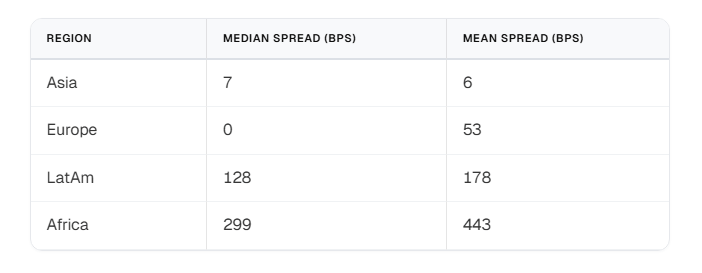
Average regional spreads for stablecoin transactions. Source: Borderless.xyz

Competition And Liquidity Shape Rates

The numbers point to a simple takeaway: who sits between the stablecoin and the local cash matters. Where multiple payment providers operate, conversion costs generally sit between about 1.5% and 4%.

Where a single outfit dominates, spreads can top 13%. The “spread” here is the gap between what a provider will buy and sell a stablecoin for — like a bid-ask gap in traditional markets — and it is the execution cost a sender ultimately pays.

Based on reports, it appears these frictions come from local market structure and liquidity more than from the underlying blockchain tech.
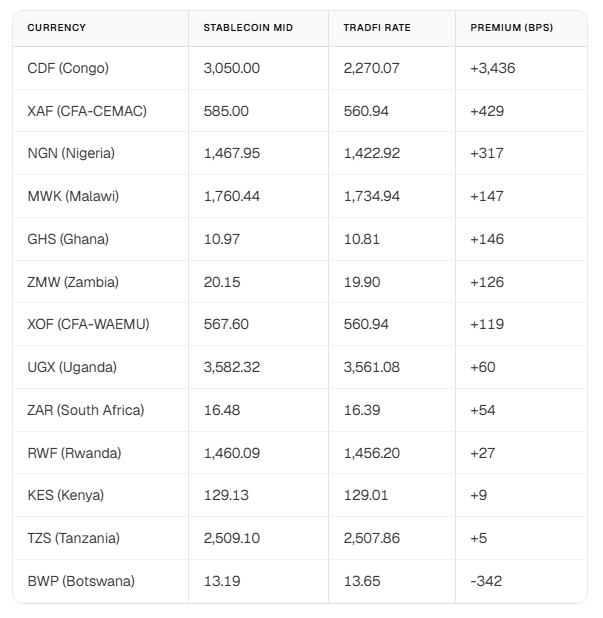
Table shows mid-market stablecoin rates, local Tradfi rates, and the resulting BPS premium per currency. Source: Borderless.xyz

Stablecoins Compared With Traditional FX

Borderless.xyz also measured how stablecoin mid-rates stack up against interbank FX mid-market rates, a metric the company calls the TradFi premium.

Across 33 currencies globally, the median difference was about five basis points, or 0.05%, meaning stablecoins and traditional mid-market rates were largely aligned in many places.

In Africa, however, the median gap widened to close to 120 basis points, or about 1.2%. That larger premium helps explain why stablecoins do not automatically translate into big savings for every corridor.

BTCUSD trading at $67,018 on the 24-hour chart: TradingView

What This Means For Senders And Markets

Economists say stablecoins are cutting remittance costs in Africa, noting that legacy services often charge around $6 for every $100 sent.

The recent data adds nuance: faster settlement and lower fees are possible, but only when local on-ramps and off-ramps work well. For consumers, that means potential savings in some corridors and frustratingly high costs in others.

For regulators and market entrants, the signal is clear — boosting competition and liquidity at the local level is as important as improving cross-border rails.

Stablecoins have opened a route that can be cheaper and quicker. Yet in practice, the last mile — turning crypto into local money — still depends on local players, pricing models, and market depth.

Featured image from andBeyond, chart from TradingView

Domande pertinenti

QWhich continent has the highest median spread for stablecoin-to-fiat conversions according to the research?

AAfrica has the highest median spread for stablecoin-to-fiat conversions at nearly 300 basis points (about 3%), which is far higher than Latin America's 1.3% and Asia's 0.07%.

QWhat factors are identified as the primary drivers of high conversion costs for stablecoins in certain African countries?

AThe primary drivers are local market structure and liquidity. High conversion costs occur where a single payment provider dominates, leading to spreads that can top 13%, whereas areas with multiple competing providers see lower costs between 1.5% and 4%.

QHow does the median TradFi premium for stablecoins in Africa compare to the global median?

AThe median TradFi premium in Africa is about 120 basis points (1.2%), which is significantly wider than the global median of approximately 5 basis points (0.05%).

QWhat was the median spread for stablecoin conversions in Botswana in January, according to the report?

ABotswana's median spread for stablecoin conversions climbed to almost 19.4% in January, although the pricing eased later that month.

QWhy don't stablecoins automatically translate into big savings for every remittance corridor despite their potential?

AStablecoins do not automatically translate into big savings because the final cost depends on the efficiency of local on-ramps and off-ramps. High spreads charged by local providers, due to lack of competition and liquidity, can erase the potential benefits of faster settlement and lower base fees.

Letture associate

Global Stock Market's Storm Center: South Korea's Stock Market De-leveraging Is Largely Complete

Storm's Eye: South Korean Market De-leveraging Nears Completion The recent sharp correction in South Korean equities, with the KOSPI index dropping 32% from its June high, has been a key trigger for global tech stock volatility. The core driver was not a fundamental shift but a forced de-leveraging process within the market's unique structure, which is now largely complete. Two main leverage channels amplified the sell-off: 1. **Leveraged ETFs:** Their size, proportionally four times larger than in the U.S., peaked near $50 billion. Their mandatory daily rebalancing mechanism created a vicious cycle of "price drop → forced selling → further drop." Approximately 75% of this excess has been unwound, shrinking to $26 billion, with regulatory curbs now blocking new inflows. 2. **Hedge Fund Leverage:** Using swaps to magnify exposure, hedge funds saw their net long positioning fall by over 50% from peak levels. The most intense phase of this institutional de-leveraging is over. In contrast, **retail margin debt** poses minimal systemic risk. At 0.5% of market cap, it is far lower than in the U.S. or China, lacks automatic triggers, and is concentrated in smaller stocks. The conclusion: the high-leverage structures most prone to "chain-reaction selling" have been substantially cleared. The market is transitioning from a liquidity-driven crash to one priced more on fundamentals. The article argues that the AI trend—centered on Korean memory chips—remains intact. This episode represents a painful but necessary clearing of crowded trades, not the end of the AI revolution. For investors, the key question is conviction in the long-term AI direction; if the trend is real, current volatility is a cost of entry, not a terminal risk.

链捕手30 min fa

Global Stock Market's Storm Center: South Korea's Stock Market De-leveraging Is Largely Complete

链捕手30 min fa

The Eternal Fragments of Money: Third-Party Payment Has No First Principle

"The Enduring Fragments of Money: Third-Party Payments Lack a First Principle" Stripe is reportedly attempting to acquire PayPal, marking a significant shift reminiscent of PayPal's merger with the original X.com 30 years ago. The article analyzes Stripe's strategic challenges and the broader payments industry landscape. Despite its initial success with a developer-friendly API model, Stripe missed its optimal IPO window during the pandemic and has since seen its valuation decline. Its attempts to expand through acquisitions and new ventures, particularly in stablecoins (like its OUSD project) and Agent-focused payments (ACP/MPP protocols), have faced headwinds. The author argues that the payment industry remains highly fragmented and is ultimately an adjunct to the traditional banking system. This structure limits the potential for any single player, including Stripe, to achieve complete dominance. While stablecoins and the future rise of autonomous Agent economies present potential growth avenues, they are not yet mainstream and still require integration with the existing financial system. For now, Agent-based transactions are largely used for speculative "volume boosting" rather than substantive business applications. Stripe's current move to acquire PayPal is seen as an attempt to bolster its weak consumer-facing (C-side) business after its stablecoin-focused strategies faltered. Meanwhile, PayPal is described as structurally outdated, unable to revive itself through new products like Venmo or PYUSD. The future of payments may lie not in payments themselves but in value-added services like more efficient settlement networks. The author suggests that companies like Stripe and Circle, which are building their own blockchains (Tempo, Arc) and stablecoins, are positioning themselves to eventually profit from high-efficiency settlement systems. These new networks could potentially bypass some traditional banking layers. In conclusion, the article posits that third-party payment is a perpetually fragmented battlefield where scale alone cannot ensure victory. Players must find new models, focusing on efficiency to compete with the entrenched banking system. Stripe's acquisition of PayPal represents a bet on this uncertain future.

链捕手52 min fa

The Eternal Fragments of Money: Third-Party Payment Has No First Principle

链捕手52 min fa

Trading

Spot
活动图片