Stablecoins See Largest Conversion Spreads In Africa, Research Shows

bitcoinistPubblicato 2026-02-12Pubblicato ultima volta 2026-02-12

Introduzione

Research from Borderless.xyz reveals that Africa has the highest median conversion spreads for stablecoin-to-fiat transactions globally, reaching nearly 300 basis points (3%) in January. This is significantly higher than Latin America's 1.3% and Asia's 0.07%. Within Africa, costs vary widely; South Africa has a low rate of 1.5% due to competition, while Botswana and Congo saw spreads exceeding 19% and 13%, respectively. The high costs are attributed to local market structure and lack of liquidity rather than blockchain technology. While stablecoins offer potential for cheaper remittances, the final conversion cost depends heavily on local competition and infrastructure, limiting savings in many African corridors.

Africa’s promise of cheaper remittances via stablecoins is clashing with reality in many places. According to data from Borderless.xyz, January’s median spread for stablecoin-to-fiat conversions across Africa reached nearly 300 basis points — about 3% — far higher than Latin America’s roughly 1.3% and Asia’s tiny 0.07%. That gap matters. It hits wallets where people send money home.

Conversion Costs Vary By Market

Reports note huge differences inside the continent. South Africa showed one of the lowest conversion costs at about 1.5%, where several providers compete and markets have deeper liquidity.

At the other extreme, Botswana’s median spread climbed to almost 19.4% in January, although pricing eased later that month. Congo also saw conversion levels above 13%. The dataset covered 66 currency corridors and nearly 94,000 rate observations, so these are not isolated blips.
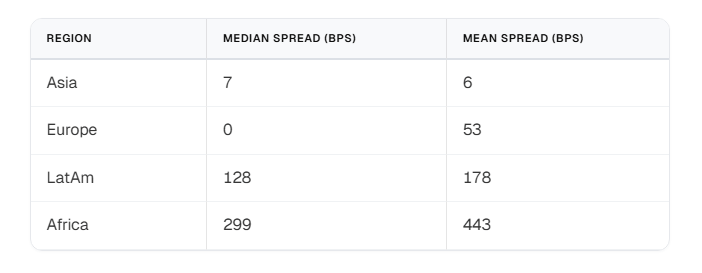
Average regional spreads for stablecoin transactions. Source: Borderless.xyz

Competition And Liquidity Shape Rates

The numbers point to a simple takeaway: who sits between the stablecoin and the local cash matters. Where multiple payment providers operate, conversion costs generally sit between about 1.5% and 4%.

Where a single outfit dominates, spreads can top 13%. The “spread” here is the gap between what a provider will buy and sell a stablecoin for — like a bid-ask gap in traditional markets — and it is the execution cost a sender ultimately pays.

Based on reports, it appears these frictions come from local market structure and liquidity more than from the underlying blockchain tech.
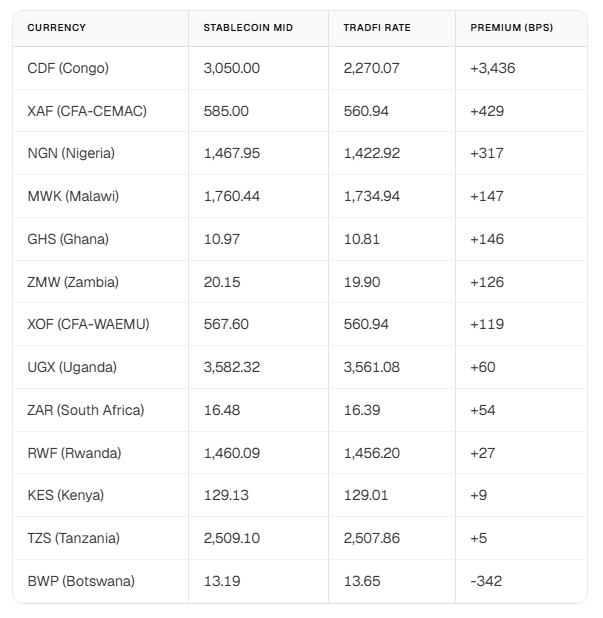
Table shows mid-market stablecoin rates, local Tradfi rates, and the resulting BPS premium per currency. Source: Borderless.xyz

Stablecoins Compared With Traditional FX

Borderless.xyz also measured how stablecoin mid-rates stack up against interbank FX mid-market rates, a metric the company calls the TradFi premium.

Across 33 currencies globally, the median difference was about five basis points, or 0.05%, meaning stablecoins and traditional mid-market rates were largely aligned in many places.

In Africa, however, the median gap widened to close to 120 basis points, or about 1.2%. That larger premium helps explain why stablecoins do not automatically translate into big savings for every corridor.

BTCUSD trading at $67,018 on the 24-hour chart: TradingView

What This Means For Senders And Markets

Economists say stablecoins are cutting remittance costs in Africa, noting that legacy services often charge around $6 for every $100 sent.

The recent data adds nuance: faster settlement and lower fees are possible, but only when local on-ramps and off-ramps work well. For consumers, that means potential savings in some corridors and frustratingly high costs in others.

For regulators and market entrants, the signal is clear — boosting competition and liquidity at the local level is as important as improving cross-border rails.

Stablecoins have opened a route that can be cheaper and quicker. Yet in practice, the last mile — turning crypto into local money — still depends on local players, pricing models, and market depth.

Featured image from andBeyond, chart from TradingView

Domande pertinenti

QWhich continent has the highest median spread for stablecoin-to-fiat conversions according to the research?

AAfrica has the highest median spread for stablecoin-to-fiat conversions at nearly 300 basis points (about 3%), which is far higher than Latin America's 1.3% and Asia's 0.07%.

QWhat factors are identified as the primary drivers of high conversion costs for stablecoins in certain African countries?

AThe primary drivers are local market structure and liquidity. High conversion costs occur where a single payment provider dominates, leading to spreads that can top 13%, whereas areas with multiple competing providers see lower costs between 1.5% and 4%.

QHow does the median TradFi premium for stablecoins in Africa compare to the global median?

AThe median TradFi premium in Africa is about 120 basis points (1.2%), which is significantly wider than the global median of approximately 5 basis points (0.05%).

QWhat was the median spread for stablecoin conversions in Botswana in January, according to the report?

ABotswana's median spread for stablecoin conversions climbed to almost 19.4% in January, although the pricing eased later that month.

QWhy don't stablecoins automatically translate into big savings for every remittance corridor despite their potential?

AStablecoins do not automatically translate into big savings because the final cost depends on the efficiency of local on-ramps and off-ramps. High spreads charged by local providers, due to lack of competition and liquidity, can erase the potential benefits of faster settlement and lower base fees.

Letture associate

You Bet on the News, the Pros Read the Rules: The True Cognitive Gap in Losing Money on Polymarket

The article explains that the key to profiting on Polymarket, a prediction market platform, lies not just predicting real-world events correctly, but in meticulously understanding the specific rules that govern how each market will be resolved. It illustrates this with examples, such as a market on Venezuela's 2026 leader, where the official rules defining "officially holds" the office overruled the intuitive answer of who was in practical control. Other examples include debates over the definition of a "token" or what constitutes an "agreement." The core argument is that a "reality vs. rules" gap creates pricing discrepancies that savvy traders ("车头" or "whales") exploit. The platform has a formal dispute resolution process managed by UMA token holders to settle ambiguous outcomes. This process involves proposal submission, a challenge window, a discussion period, and a final vote. However, the article highlights a critical flaw in this system compared to a traditional court: the lack of separation between the arbiters (UMA voters) and the interested parties (traders with financial stakes in the outcome). This conflict of interest undermines the discussion phase, leads to herd mentality, and results in opaque final decisions without explanatory rulings. Consequently, the system lacks a body of precedent, making it difficult for users to learn from past disputes. The ultimate takeaway is that success on Polymarket requires a lawyer-like scrutiny of the rules to identify and capitalize on the cognitive gap between how events appear and how they are contractually defined for settlement.

marsbit1 h fa

You Bet on the News, the Pros Read the Rules: The True Cognitive Gap in Losing Money on Polymarket

marsbit1 h fa

Trading

Spot
Futures
活动图片





