Stablecoin Yield ‘Effectively Off The Table’: White House Narrows Rewards Debate In Latest Meeting

bitcoinistPubblicato 2026-02-21Pubblicato ultima volta 2026-02-21

Introduzione

The White House took a more active role in the latest meeting between the crypto industry and banking sector to resolve the stablecoin yield dispute that has stalled the CLARITY Act. The meeting included representatives from Coinbase, Ripple, a16z, and crypto trade associations, while banks were represented through their industry groups. The White House presented a draft text addressing banking concerns, effectively ruling out earning yield on idle stablecoin balances. The debate now focuses on whether crypto firms can offer rewards linked to specific activities. Banking representatives argued that competitive pressures, rather than deposit flight, are their main concern. The White House also proposed anti-evasion measures, including significant penalties for violations. Further discussions are expected as both sides assess potential compromises.

The White House reportedly took the lead during the latest Crypto Council meeting, narrowing the stablecoin rewards dispute that has delayed progress in the long-awaited crypto market structure bill.

White House Steps In On CLARITY Act Dispute

On Thursday, the White House held another meeting between the crypto industry and the banking sector to negotiate the stablecoin yield dispute that has stalled the crypto market structure bill, known as the CLARITY Act, over the past month.

According to a report from journalist Eleanor Terret, the meeting was smaller than previous ones, with only a few representatives from each side. From the crypto sector, participants included representatives from Coinbase, Ripple, a16z, the Blockchain Association, and Crypto Council for Innovation (CCI).

Meanwhile, no individual bank representatives attended; bank voices were represented through trade associations, such as the American Bankers Association, the Banking Policy Institute (BPI), and the Independent Community Bankers of America (ICBA).

Terret sources affirmed that there was a notable difference in yesterday’s meeting as the White House “took the lead in driving the discussion, rather than letting crypto firms and bank trades steer the discussion, as in prior meetings.”

For context, banks have heavily criticized the landmark stablecoin legislation, the GENIUS Act, due to “loopholes” that could pose risks to the financial system. The framework prohibits interest payments on the holding or use of payment-purpose stablecoins, but it only addresses issuers.

The banking side argues that allowing issuers and platforms to offer interest payments on stablecoins could distort market dynamics and affect credit creation in the country, hurting small- and medium-sized financial institutions in the sector.

To address these concerns, banking associations across the US urged senators to include language in the CLARITY Act that also bans digital asset exchanges, brokers, dealers, and related entities from offering yield on stablecoins.

The Senate Banking Committee’s draft proposed that issuers offer rewards for specific actions, such as account openings and cashback. However, it also prohibited issuers from providing interest payments to passive token holders.

The crypto side criticized the proposed measures, with some industry leaders publicly opposing the draft and withdrawing their support. As a result, a markup session on the Senate Banking Committee’s portion of the bill has been delayed.

Stablecoin Yield Out Of The Picture

At the Thursday meeting, Patrick Witt, executive director of the US President’s Council of Advisors on Digital Assets, reportedly brought a draft text that served as the anchor for the discussion. Sources in the room told Terret that the draft’s language acknowledged banks’ concerns raised in last week’s “Yield and Interest Prohibitions Principles” document.

Based on this, “earning yield on idle balances (...) is effectively off the table,” the journalist affirmed. The draft also clarified that any future restrictions on rewards would be narrow in scope. Therefore, the debate has now narrowed to whether crypto firms can offer rewards linked to specific activities.

An attendee from the crypto industry side reportedly said that banks’ concerns “appear to stem more from competitive pressures than from deposit flight.” Meanwhile, someone from the banking industry told Terret that they are still pushing to include a study examining the growth of payment stablecoins and their potential impact on bank deposits in the draft.

They also noted that the White House proposed anti-evasion language. The measure would give the Securities and Exchange Commission (SEC), the Commodity Futures Trading Commission (CFTC), and the Department of the Treasury authority to enforce a ban on paying yield on idle stablecoin balances, and penalties of up to $500,000 per violation, per day, against companies that breach the ban.

Now, the banking industry representatives “will brief their members on today’s discussions and gauge whether there’s room to compromise on allowing crypto firms to offer stablecoin rewards,” Terret noted, adding that some attendees believe an end-of-month deadline isn’t unrealistic as talks are set to continue in the coming days.
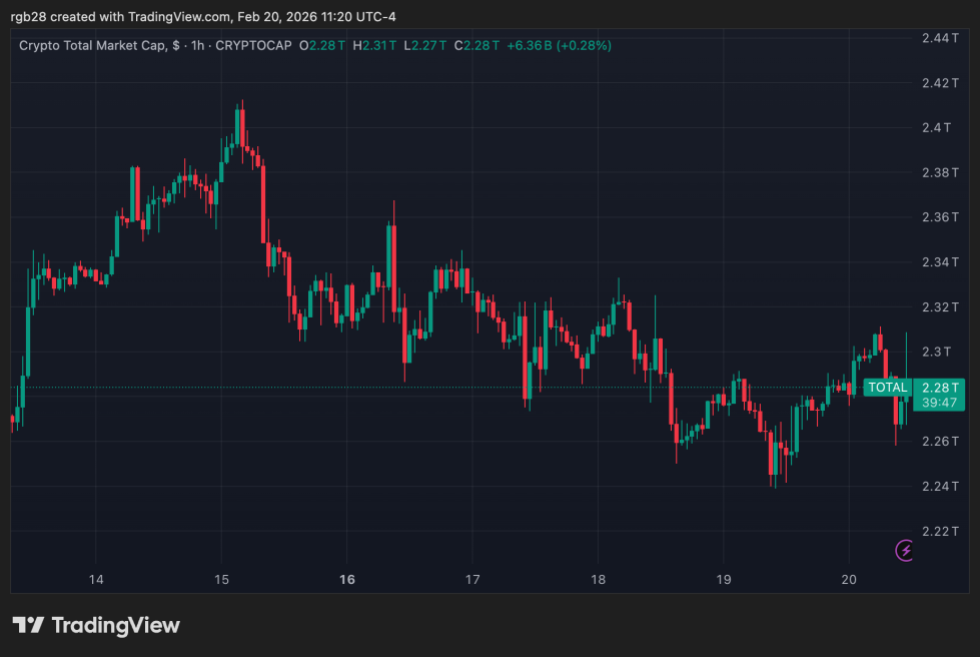
The total crypto market capitalization sits at $2.28 trillion on the one-week chart. Source: TOTAL on TradingView


Domande pertinenti

QWhat was the main role of the White House in the latest Crypto Council meeting according to the article?

AThe White House took the lead in driving the discussion, rather than letting crypto firms and bank trades steer it as in prior meetings.

QWhich major crypto industry representatives attended the meeting?

ARepresentatives from Coinbase, Ripple, a16z, the Blockchain Association, and Crypto Council for Innovation (CCI) attended.

QWhat is the primary concern of the banking sector regarding stablecoin legislation?

ABanks argue that allowing interest payments on stablecoins could distort market dynamics, affect credit creation, and hurt small- and medium-sized financial institutions.

QWhat was the key outcome regarding 'yield on idle stablecoin balances' from the meeting?

AEarning yield on idle balances is effectively off the table, meaning it is prohibited.

QWhat enforcement measures did the White House propose for violations of the yield ban?

AThe White House proposed giving the SEC, CFTC, and Treasury the authority to enforce the ban with penalties of up to $500,000 per violation, per day.

Letture associate

U.S.-Iran Ceasefire: How Much of a Bitcoin Rally Can a Truce Agreement Support?

Headline: "U.S.-Iran Truce: How Much Can a Ceasefire Agreement Propel Bitcoin's Rebound?" On June 15th, Bitcoin rebounded to around $67,255, marking its first return to the $67,000 level since falling below $60,000 earlier in June. Ethereum and Solana also saw significant gains. The immediate driver for this market-wide recovery in crypto and global risk assets was the signing of a U.S.-Iran ceasefire memorandum, with a formal ceremony scheduled for June 19th. The agreement, which includes reopening the Strait of Hormuz, caused oil prices to plunge roughly 5%, easing inflation expectations and boosting prospects for Federal Reserve rate cuts. This macroeconomic shift fueled a rally in U.S. equities, with the Dow Jones hitting a record high. SpaceX's spectacular post-IPO performance further energized market sentiment. However, on-chain and derivatives data from Glassnode suggest this move is more indicative of a technical rebound from deeply oversold conditions rather than a confirmed trend reversal. The crypto market is undergoing noticeable capital rotation. While Bitcoin ETFs recently saw their worst outflows on record, the bleeding has slowed significantly. Meanwhile, new altcoin ETFs for assets like XRP and Solana are attracting substantial inflows, causing Bitcoin's market dominance to drop to 58%. Despite the rebound, the Crypto Fear & Greed Index remains in "Extreme Fear" territory at 22. The price quickly retreated after touching the $67,000 resistance level, indicating selling pressure persists. Analysis shows short-term speculative supply has been heavily washed out, with holder structure shifting toward a more long-term profile. While panic is subsiding and some on-chain metrics point to accumulation at lower prices, the market currently lacks the strong, sustained institutional buying needed to establish a new bullish trend.

Foresight News17 min fa

U.S.-Iran Ceasefire: How Much of a Bitcoin Rally Can a Truce Agreement Support?

Foresight News17 min fa

Copper, the Gold of 2026

Copper: The New Gold for 2026? Market focus has shifted from AI chips to underlying infrastructure, with copper emerging as a key narrative. Its role is evolving beyond "Dr. Copper"—a traditional indicator of economic cycles—due to structural demand growth from AI data centers (requiring massive electrical infrastructure), grid expansion, EVs, and re-industrialization. Estimates suggest data centers alone could require 300,000 tons of copper by 2050. The core bullish thesis is not just demand but a severe supply constraint. New copper mines take ~17 years to develop, while ore grades are declining and new discoveries are scarce, potentially leading to a 30% supply deficit by 2035. This supply rigidity, coupled with strategic importance, is giving copper a "gold-like" scarcity narrative. Major macro investors, including Stanley Druckenmiller, are allocating to copper as a hedge against dollar weakness and for its exposure to energy transition and geopolitics. Traders like Pierre Andurand have projected prices could reach $40,000/ton. Capital inflows are visible in surging futures trading volumes. Copper mining stocks act as leveraged plays on copper prices. Companies like Freeport-McMoRan (FCX) and Southern Copper (SCCO), as well as Chinese miners like CMOC, have seen significant volatility, offering high upside but also steep drawdowns, reflecting operational and geopolitical risks. While copper remains cyclical and won't fully replicate gold's monetary role, its long-term fundamentals have shifted. Its new scarcity premium, driven by a tightening supply structure and expanding electrical demand, suggests its "goldification" is just beginning.

marsbit24 min fa

Copper, the Gold of 2026

marsbit24 min fa

pump.fun's New Feature Brings 'Black Mirror' Into Reality

The article begins by recounting a dark fictional story from *Black Mirror* (Season 7, Episode 1 "Common People"), where a man is forced to perform humiliating tasks online to pay for his wife's life-sustaining medical subscription. It then draws a parallel to a new real-world feature on the crypto platform pump.fun called "Pump.fun Go," which allows users to post and complete paid bounty tasks. This feature gained mainstream attention, often negatively, through extreme examples. A prominent case involved a bounty of 40 SOL (~$2,600) offered to permanently tattoo "$bountywork" on one's forehead. An Indian man completed the task, stating the money "changed his life," and later earned significantly more from a related meme coin. Another bounty paid 200 SOL (~$14,000) for a "bounty.fun" forehead tattoo, with the participant simply stating, "We need the money." The article highlights how this system can amplify darkness, citing the dev behind $Bountywork who spent thousands on bounties for attention-grabbing stunts like eating bugs or drinking hot sauce for small sums. It compares this to past tragic live-streaming incidents where people harmed themselves for money, noting regulation cannot stop those in desperate need. However, it also points to positive, altruistic bounties that have emerged, such as organizing anti-work rallies in New York, performing random acts of kindness for strangers, organizing community food drives, or even helping an elderly person cross the street. The piece concludes by acknowledging the platform reflects both the dark and light sides of human nature when actions are given a price, hoping for more of the latter.

marsbit30 min fa

pump.fun's New Feature Brings 'Black Mirror' Into Reality

marsbit30 min fa

Trading

Spot
Futures

Articoli Popolari

Come comprare HOUSE

Benvenuto in HTX.com! Abbiamo reso l'acquisto di Housecoin (HOUSE) semplice e conveniente. Segui la nostra guida passo passo per intraprendere il tuo viaggio nel mondo delle criptovalute.Step 1: Crea il tuo Account HTXUsa la tua email o numero di telefono per registrarti il tuo account gratuito su HTX. Vivi un'esperienza facile e sblocca tutte le funzionalità,Crea il mio accountStep 2: Vai in Acquista crypto e seleziona il tuo metodo di pagamentoCarta di credito/debito: utilizza la tua Visa o Mastercard per acquistare immediatamente HousecoinHOUSE.Bilancio: Usa i fondi dal bilancio del tuo account HTX per fare trading senza problemi.Terze parti: abbiamo aggiunto metodi di pagamento molto utilizzati come Google Pay e Apple Pay per maggiore comodità.P2P: Fai trading direttamente con altri utenti HTX.Over-the-Counter (OTC): Offriamo servizi su misura e tassi di cambio competitivi per i trader.Step 3: Conserva Housecoin (HOUSE)Dopo aver acquistato Housecoin (HOUSE), conserva nel tuo account HTX. In alternativa, puoi inviare tramite trasferimento blockchain o scambiare per altre criptovalute.Step 4: Scambia Housecoin (HOUSE)Scambia facilmente Housecoin (HOUSE) nel mercato spot di HTX. Accedi al tuo account, seleziona la tua coppia di trading, esegui le tue operazioni e monitora in tempo reale. Offriamo un'esperienza user-friendly sia per chi ha appena iniziato che per i trader più esperti.

287 Totale visualizzazioniPubblicato il 2025.04.27Aggiornato il 2026.06.02

Come comprare HOUSE

Discussioni

Benvenuto nella Community HTX. Qui puoi rimanere informato sugli ultimi sviluppi della piattaforma e accedere ad approfondimenti esperti sul mercato. Le opinioni degli utenti sul prezzo di HOUSE HOUSE sono presentate come di seguito.

活动图片












