Stablecoin usage up 600% – Is USDC taking the lead from USDT?

ambcryptoPubblicato 2026-03-23Pubblicato ultima volta 2026-03-23

Introduzione

Stablecoin usage on the Ethereum network has grown significantly, with active addresses surging 600% from March 2025 to March 2026, indicating deeper integration beyond speculative trading into payments and cross-border transactions. A notable shift in market preference shows USD Coin (USDC) leading with a $4.5 billion supply increase, while Tether (USDT) experienced a $2 billion contraction, reflecting a move toward perceived regulatory clarity. Despite a slight decline in exchange reserves and net outflows of $485 million, the capital is being parked rather than fully exiting, reducing immediate sell pressure and supporting short-term market stability. Overall, stablecoin liquidity is consolidating rather than expanding, with total supply at $316.45 billion.

ERC20 stablecoin activity is undergoing a structural expansion, as active addresses surged from roughly 85,000 in March 2025 to nearly 600,000 in March 2026.

This 600% growth reflects more than temporary spikes, as activity has trended upward steadily since 2024. As participation broadens, the pattern shifts from isolated bursts to sustained usage, which suggests deeper integration across the network.
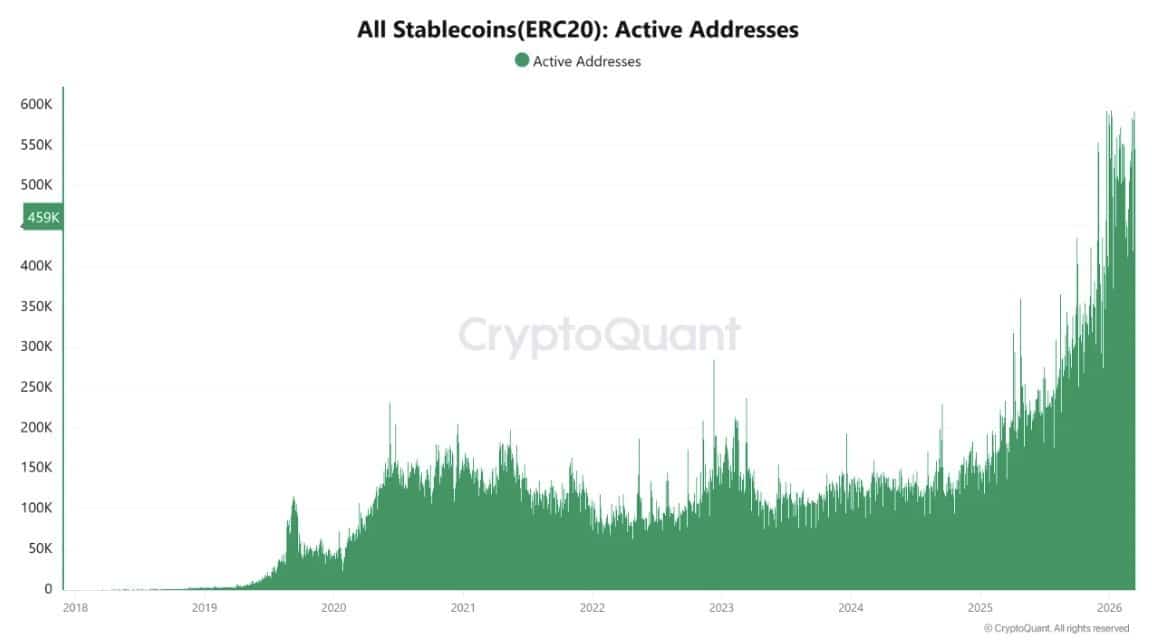
Source: CryptoQuant

At the same time, this rise signals a change in function.

Stablecoins are moving beyond DeFi trading pairs toward transactional infrastructure. As a result, flows increasingly reflect payments, settlements, and cross-border transfers rather than speculative positioning.

However, rising activity also implies higher dependency on stablecoin liquidity.

As usage concentrates around these assets, they become central to capital movement across markets. This dynamic suggests crypto liquidity is becoming more efficient, while also more sensitive to stablecoin-driven demand cycles.

Stablecoin flows shift as USDC gains dominance over USDT

Stablecoin flows show a clear rotation in market preference, as USD Coin [USDC] leads supply expansion year-to-date.

USDC added $4.5 billion, marking the largest increase across all tracked assets. This rise reflects strong inflows during a volatile period.

Tether [USDT] moved in the opposite direction, with its supply contracting by roughly $2 billion, signaling capital outflows. As this divergence forms, it highlights a shift toward perceived stability and regulatory clarity.
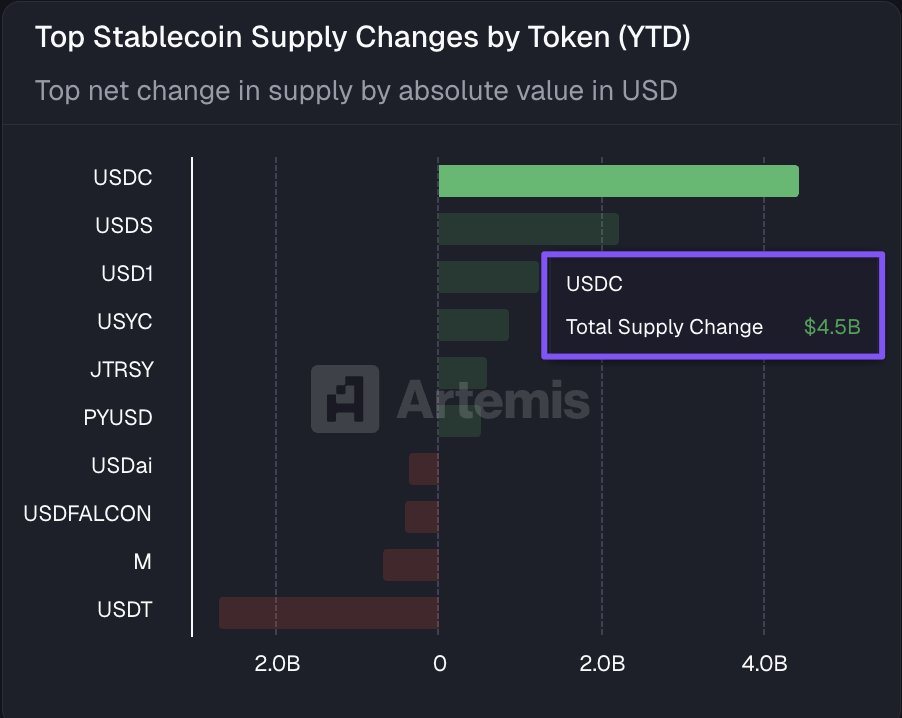
Source: Artemis

This gap suggests growing usage beyond simple liquidity storage. As volumes expand, USDC strengthens its role in DeFi and payments infrastructure.

However, this concentration also implies that liquidity is becoming more centralized. As capital rotates, market dependence on fewer stablecoins increases, shaping how liquidity flows across the broader ecosystem.

Stablecoin flows show consolidation, not capitulation

Stablecoin flows reflect a cautious but balanced shift, as liquidity moves away from exchanges without fully exiting the market. Exchange Reserves stand at $65.37 billion, down 0.72% in 24 hours.

Net Outflows reached over $485 million, signaling movement toward self-custody. This suggests capital is being parked rather than actively deployed. However, this shift also reduces immediate sell pressure on exchanges, which can support price stability.

Total stablecoin supply sits at $316.45 billion, rising just 0.17% weekly. USDT grew 0.08% to $184.1 billion, while USDC fell 0.22% to $79.1 billion, showing mixed demand.

This balance implies liquidity is rotating rather than expanding, keeping markets stable in the short term while leaving momentum dependent on renewed capital deployment.



Final Summary

Domande pertinenti

QWhat was the percentage growth in active addresses for ERC20 stablecoins from March 2025 to March 2026?

A600%

QWhich stablecoin led the supply expansion year-to-date and by how much?

AUSD Coin (USDC) led the supply expansion, adding $4.5 billion.

QWhat was the change in Tether's (USDT) supply during the same timeframe?

ATether's (USDT) supply contracted by roughly $2 billion.

QWhat is the new primary function that stablecoins are moving towards, according to the article?

AStablecoins are moving beyond DeFi trading pairs toward transactional infrastructure, such as payments, settlements, and cross-border transfers.

QWhat was the total stablecoin supply and the 24-hour change in Exchange Reserves mentioned in the article?

AThe total stablecoin supply was $316.45 billion, and Exchange Reserves were $65.37 billion, down 0.72% in 24 hours.

Letture associate

Huawei Cloud Rejects Token Price War, Zhou Yuefeng Seeks a New Winning Formula for AI Cloud

At the 2026 Huawei Cloud INSPIRE Creator Conference, CEO Zhou Yuefeng outlined Huawei Cloud's distinct strategy in the competitive AI cloud market. Instead of engaging in price wars based on token volume or Maas revenue—a common focus for rivals like Alibaba Cloud and ByteDance's Volcano Engine—Huawei Cloud is shifting the competition towards real-world productivity gains. Zhou highlighted three core differentiators: a fully domestic computing stack (Ascend, Kunpeng), a focus on government and enterprise clients rather than consumer internet, and a deep commitment to open-source ecosystems. To this end, Huawei Cloud launched a suite of new products under the "Agentic Infra" paradigm, including the AICS Lingqu computing cluster, AMS memory storage, and the ModelArts Next platform. These aim to solve enterprise challenges in deploying AI agents, such as latency, memory, scheduling, and security. The strategy further involves creating specialized industry zones ("AI Dream Factories") for sectors like healthcare and embodied intelligence. For example, a smart medical zone developed with Shanghai Ruijin Hospital aims to democratize expert-level diagnostic capabilities. In essence, Huawei Cloud is positioning itself not as a commodity token provider, but as the foundational infrastructure for industrial AI, leveraging its domestic supply chain and hybrid cloud solutions to serve sectors where productivity, not just scale, is the ultimate measure of value.

marsbit1 h fa

Huawei Cloud Rejects Token Price War, Zhou Yuefeng Seeks a New Winning Formula for AI Cloud

marsbit1 h fa

70% of the Public Opposes AI, Americans Hope the U.S. Loses the AI War

70% of Americans believe AI development is moving too fast, with growing public resistance evolving from online criticism to real-world protests and violence. This widespread anti-AI sentiment stems from fears of job losses, rising utility costs, environmental damage, threats to democracy, and financial instability. Key incidents illustrate the backlash: Google's former CEO Eric Schmidt was loudly booed at a graduation for promoting AI; AI company ads are vandalized; protests and even violent attacks target AI firms and data centers. Polls show deep public pessimism and strong local opposition to data center construction, often surpassing resistance to nuclear power plants. The core grievances are economic and practical: AI is seen as automating jobs, concentrating wealth, and increasing household electricity and water bills due to massive data center resource demands. Environmentalists also oppose AI's high energy use and carbon emissions. This opposition has turned AI into a major political issue in the US. While the Trump administration prioritizes AI innovation for global competition, bipartisan pushback is growing. Democrats and factions within the MAGA movement are forming temporary alliances to support stricter regulations and local bans on new data centers, pressuring the administration to choose between its tech industry backers and its voter base. The situation highlights a profound national divide over AI's future.

marsbit2 h fa

70% of the Public Opposes AI, Americans Hope the U.S. Loses the AI War

marsbit2 h fa

Trading

Spot
Futures
活动图片



