StableChain launches mainnet with USDT gas fees, dedicated governance token

cointelegraphPubblicato 2025-12-08Pubblicato ultima volta 2025-12-08

Introduzione

StableChain, a Tether-backed protocol, has launched its mainnet as a new layer-1 blockchain designed specifically for stablecoin transactions. It uses USDT for gas fees, eliminating the need for volatile assets. The launch includes a new governance foundation and a native STABLE token, separating network security from payment flows. The project follows a $28 million seed round and a pre-deposit campaign that attracted over $2 billion. This expansion is part of a broader trend of building dedicated blockchains for stablecoin payments, as seen with other projects like Plasma and Circle's upcoming Arc network, driven by the stablecoin market's growth to over $308 billion.

Tether-backed Stable protocol has launched its USDT-powered blockchain, StableChain, alongside a new governance foundation and a native token.

According to the protocol, the new layer-1 network is designed for stablecoin transactions and relies on Tether’s (USDT) for gas fees payments, removing the need for volatile assets to process payments.

Alongside the mainnet debut, Stable introduced the Stable Foundation and the STABLE governance token on Monday, separating network security from payment flows settled in USDT.

The rollout follows a pre-deposit campaign that drew more than $2 billion from over 24,000 wallets. It also comes on the heels of a $28 million seed round backed by crypto exchange Bitfinex, Hack VC and other investors, including Tether CEO Paolo Ardoino, who is also listed as an adviser to the project.

The launch expands the stablecoin infrastructure footprint of Bitfinex and Tether, which share the iFinex parent company, and extends USDT’s utility as a core element of the network’s design.

Brian Mehler, CEO of Stable, told Cointelegraph that the company has “maintained frequent contact with governing bodies overseeing the implementation of stablecoin and payments guardrails worldwide.”

Related: Circle and Bybit deepen USDC partnership as stablecoin nears $80B

Stablecoins’ role in digital payments continues to expand

The rise of stablecoins — digital tokens designed to maintain a steady value, often pegged to the US dollar — has pushed banks, payment companies and remittance providers such as Western Union to explore new strategies.

However, most stablecoins still run on blockchains that were not built for fast, low-cost payments. For example, Ethereum, home of the majority of the stablecoin supply, can take around three minutes to finalize transactions.

These constraints have helped drive interest in blockchains engineered specifically for stablecoin settlement.

In February, stablecoin startup Plasma raised $24 million to build a new blockchain for USDT in a funding round led by Framework Ventures and backed by Bitfinex, Peter Thiel and Tether CEO Paolo Ardoino. Plasma’s mainnet beta went live on Sept. 25, launching alongside its native XPL token

In August, Circle announced plans to launch Arc, an EVM-compatible layer-1 blockchain designed for enterprise-grade stablecoin payments, FX and capital markets, later this year.

The following month, payment giant Stripe disclosed plans to launch a new layer-1 network called Tempo, after CEO Patrick Collison said that existing blockchains are “not optimized” to handle the growing stablecoin and crypto activity moving through Stripe’s platform.

According to DefiLlama data, the stablecoin market capitalization has grown to about $308.45 billion from $198.76 billion a year ago, a roughly 55% increase over the period.
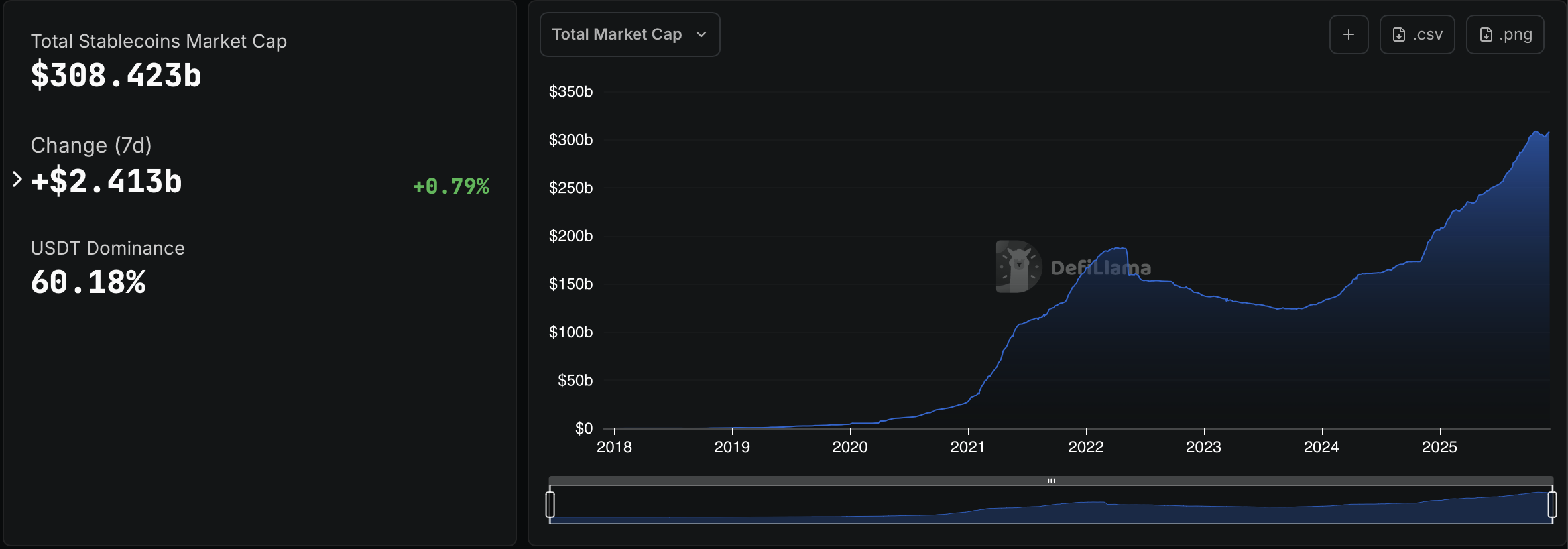
Stablecoin market capitalization. Source: DefiLlama

Magazine: 6 reasons Jack Dorsey is definitely Satoshi... and 5 reasons he’s not

Letture associate

Arbitrum Pretends to Be the Hacker, 'Steals' Back the Money Lost by KelpDAO

Title: Arbitrum Poses as Hacker to Recover Stolen Funds from KelpDAO Last week, KelpDAO suffered a hack resulting in nearly $300 million in losses, marking the largest DeFi security incident this year. Approximately 30,765 ETH (worth over $70 million) remained on an Arbitrum address controlled by the attacker. In an unprecedented move, Arbitrum’s Security Council utilized its emergency authority to upgrade the Inbox bridge contract, adding a function that allowed them to impersonate the hacker’s address and initiate a transfer without access to its private key. The council’s action, approved by 9 of its 12 members, moved the stolen ETH to a frozen address in a single transaction before reverting the contract to its original state. The operation was coordinated with law enforcement, which attributed the attack to North Korea’s Lazarus Group. Community reactions are divided: some praise the recovery of funds, while others question the centralization of power, as the council can upgrade core contracts without governance votes. However, such emergency mechanisms are common among major L2s. Despite the partial recovery, over $292 million was stolen in total, with more than $100 million in bad debt on Aave and remaining funds scattered across other chains. The incident highlights escalating security challenges in DeFi, with state-sponsored hackers employing advanced tactics and L2s responding with elevated countermeasures.

marsbit10 min fa

Arbitrum Pretends to Be the Hacker, 'Steals' Back the Money Lost by KelpDAO

marsbit10 min fa

iQiyi Is Too Impatient

The article "iQiyi Is Too Impatient" discusses the controversy surrounding the Chinese streaming platform IQiyi's recent announcement of an "AI Actor Library" during its 2026 World Conference. IQiyi claimed over 100 actors, including well-known names like Zhang Ruoyun and Yu Hewei, had joined the initiative. CEO Gong Yu suggested AI could enable actors to "star in 14 dramas a year instead of 4" and that "live-action filming might become a world cultural heritage." The announcement quickly sparked backlash. Multiple actors named in the list issued urgent statements denying they had signed any AI-related authorization agreements. This forced IQiyi to clarify that inclusion in the library only indicated a willingness to *consider* AI projects, with separate negotiations required for any specific role. The incident, which trended on social media with hashtags like "IQiyi is crazy," is presented as a sign of the company's growing desperation. Facing intense competition from short-video platforms like Douyin and Kuaishou, as well as Bilibili and Xiaohongshu, IQiyi's financial performance has weakened, with revenues declining for two consecutive years. The author argues that IQiyi is "too impatient" to tell a compelling AI story to reassure the market, especially as it pursues a listing on the Hong Kong stock exchange. The piece concludes by outlining three key "AI questions" IQiyi must answer: defining its role as a tool provider versus a content creator, balancing the "coldness" of AI with the human element audiences desire, and properly managing the interests of platforms, actors, and viewers. The core dilemma is that while AI can reduce costs and increase efficiency, it risks creating homogenized, formulaic content and devaluing human performers.

marsbit1 h fa

iQiyi Is Too Impatient

marsbit1 h fa

Trading

Spot
Futures

Articoli Popolari

Come comprare GAS

Benvenuto in HTX.com! Abbiamo reso l'acquisto di GAS (GAS) semplice e conveniente. Segui la nostra guida passo passo per intraprendere il tuo viaggio nel mondo delle criptovalute.Step 1: Crea il tuo Account HTXUsa la tua email o numero di telefono per registrarti il tuo account gratuito su HTX. Vivi un'esperienza facile e sblocca tutte le funzionalità,Crea il mio accountStep 2: Vai in Acquista crypto e seleziona il tuo metodo di pagamentoCarta di credito/debito: utilizza la tua Visa o Mastercard per acquistare immediatamente GASGAS.Bilancio: Usa i fondi dal bilancio del tuo account HTX per fare trading senza problemi.Terze parti: abbiamo aggiunto metodi di pagamento molto utilizzati come Google Pay e Apple Pay per maggiore comodità.P2P: Fai trading direttamente con altri utenti HTX.Over-the-Counter (OTC): Offriamo servizi su misura e tassi di cambio competitivi per i trader.Step 3: Conserva GAS (GAS)Dopo aver acquistato GAS (GAS), conserva nel tuo account HTX. In alternativa, puoi inviare tramite trasferimento blockchain o scambiare per altre criptovalute.Step 4: Scambia GAS (GAS)Scambia facilmente GAS (GAS) nel mercato spot di HTX. Accedi al tuo account, seleziona la tua coppia di trading, esegui le tue operazioni e monitora in tempo reale. Offriamo un'esperienza user-friendly sia per chi ha appena iniziato che per i trader più esperti.

215 Totale visualizzazioniPubblicato il 2024.12.12Aggiornato il 2025.03.21

Come comprare GAS

Discussioni

Benvenuto nella Community HTX. Qui puoi rimanere informato sugli ultimi sviluppi della piattaforma e accedere ad approfondimenti esperti sul mercato. Le opinioni degli utenti sul prezzo di GAS GAS sono presentate come di seguito.

活动图片