Stable TGE Tonight, Will the Market Still Buy into the Stablecoin Public Chain Narrative?

marsbitPubblicato 2025-12-08Pubblicato ultima volta 2025-12-08

Introduzione

Stable, a Layer 1 blockchain supported by Bitfinex and Tether, is set for its mainnet launch on December 8th. It is designed with a focus on stablecoin infrastructure, using USDT as the native gas token to enable sub-second settlements and feeless peer-to-peer transfers. The native token, STABLE, has a fixed supply of 100 billion and is not used for gas fees but for governance, staking, and ecosystem incentives. Token allocation includes 10% for Genesis Distribution (fully unlocked at launch), 40% for ecosystem and community growth, and 25% each for the team and investors (with a 1-year cliff and linear release). The network uses a DPoS consensus model where users stake STABLE to participate in validation and governance. Prior to launch, Stable conducted two pre-deposit phases, which saw massive demand and technical issues, raising concerns over fairness and KYC delays. The project raised $28 million in seed funding at a $300 million valuation. Market expectations are mixed. Pre-launch perpetual trading suggests an FDV around $3 billion, while prediction markets indicate an 85% probability of FDV exceeding $2 billion post-launch. Pre-depositors may see returns between 7% to 16.9% based on current estimates. Exchanges like Bitget and Bybit have announced support, but major platforms like Binance and Coinbase have not.

At 21:00 Beijing time on December 8, the Stable mainnet will officially launch. Stable, a Layer 1 blockchain supported by Bitfinex and Tether, focuses on stablecoin infrastructure. Its core design involves using USDT as the native gas fee, achieving sub-second settlement and gas-free peer-to-peer transfers. As of the time of writing, including Bitget, Backpack, and Bybit have announced they will list STABLE spot trading. Additionally, Binance, Coinbase, and Korean exchanges have not yet announced listings for STABLE spot trading.

Total Supply of 100 Billion, Token Not Used for Gas Fees

The project team has released the whitepaper and tokenomics details before the mainnet launch. Its native token, STABLE, has a total fixed supply of 100 billion tokens. Transfers, payments, and transactions on the Stable network are settled in USDT. STABLE is not used for gas fees but is instead used to coordinate incentive mechanisms between developers and ecosystem participants. The STABLE token allocation is as follows: Genesis Distribution accounts for 10% of the total supply, supporting initial liquidity, community activation, ecosystem activities, and strategic distribution efforts at launch. The genesis distribution portion will be fully unlocked at the mainnet launch.

The Ecosystem & Community fund accounts for 40% of the total supply, allocated to developer grants, liquidity programs, partnerships, community initiatives, and ecosystem growth; the Team allocation accounts for 25% of the total supply, allocated to the founding team, engineers, researchers, and contributors; Investors & Advisors account for 25% of the total supply, allocated to strategic investors and advisors supporting network development, infrastructure construction, and promotion.
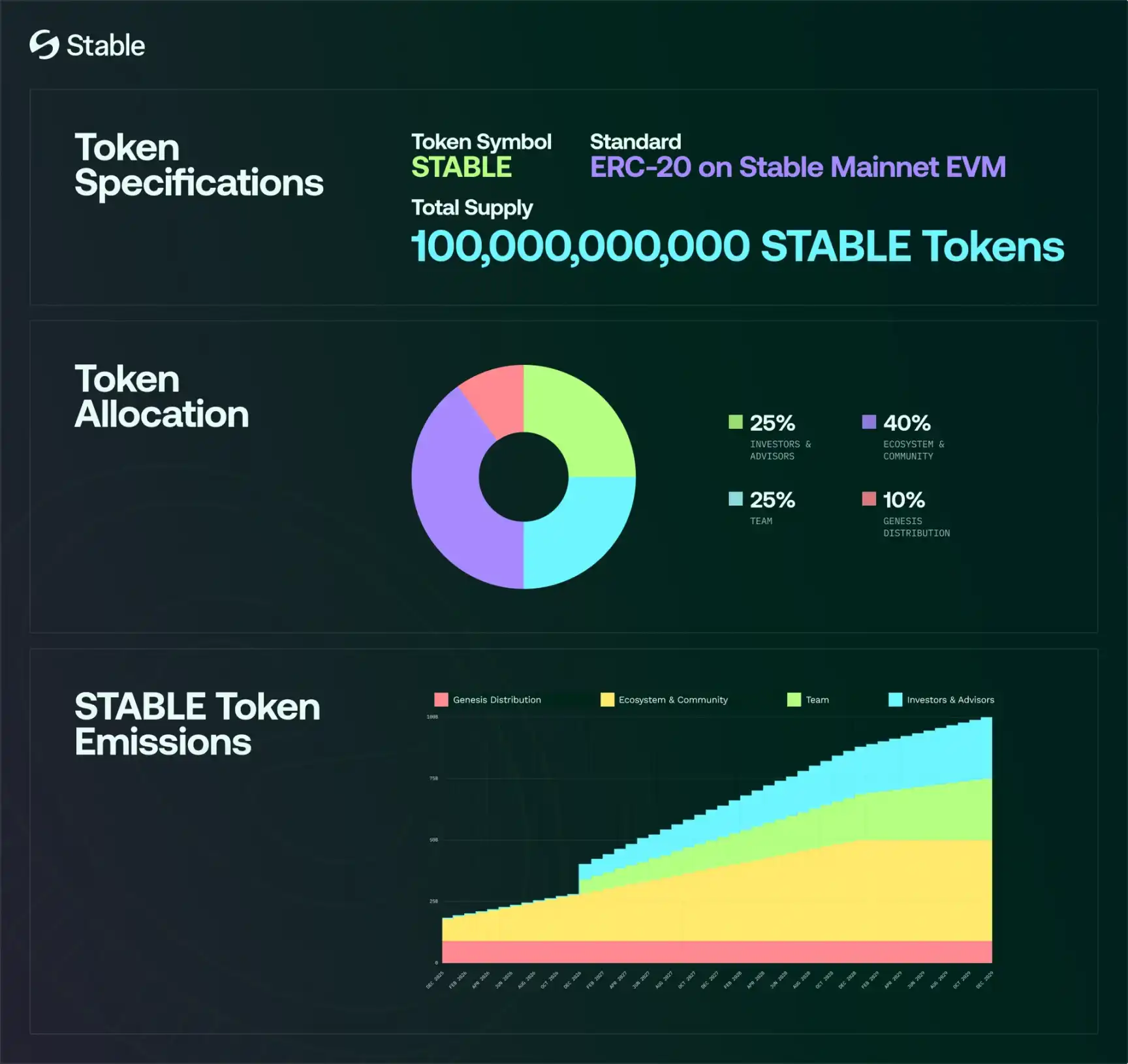
Team and investor allocations are subject to a one-year cliff, meaning zero unlocking for the first 12 months, followed by linear vesting. The Ecosystem & Community fund allocation is 8% unlocked at launch, with the remaining portion vested linearly to incentivize developers, partners, and user growth.

Stable utilizes a DPoS (Delegated Proof-of-Stake) model through its StableBFT consensus protocol. This design supports high-throughput settlement while maintaining the economic security required for a global payment network. Staking STABLE tokens is the mechanism for validators and delegators to participate in consensus and earn rewards. The primary roles of the STABLE token are governance and staking: holders can stake tokens to become validators, participate in network security maintenance, and vote in DAO governance to influence protocol upgrades, such as adjusting fee rates or introducing new stablecoin support.

Additionally, STABLE can be used for ecosystem incentives, such as liquidity mining or cross-chain bridging rewards. The project claims that this separated design can attract institutional capital because USDT's stability is much higher than that of volatile governance tokens.

Pre-deposit Controversy: Front-running, KYC Delays

Like Plasma, Stable also opened two deposit periods before the mainnet launch. The first phase of pre-deposits started in late October with an upper limit of $825 million, which was filled within minutes of the announcement. The community questioned potential front-running by some players. The top-ranked wallet deposited hundreds of millions of USDT 23 minutes before the deposit window opened.

The project team did not directly respond and opened a second pre-deposit event on November 6 with an upper limit of $500 million.

However, Stable underestimated the market's enthusiasm for deposits. The moment the second phase opened, massive traffic surge caused its website to slow down and become unresponsive. Consequently, Stable updated the rules, allowing users to deposit via the Hourglass frontend or directly on-chain; the deposit function was reopened for 24 hours, with a maximum of $1 million per wallet and a minimum deposit amount still set at $1,000.
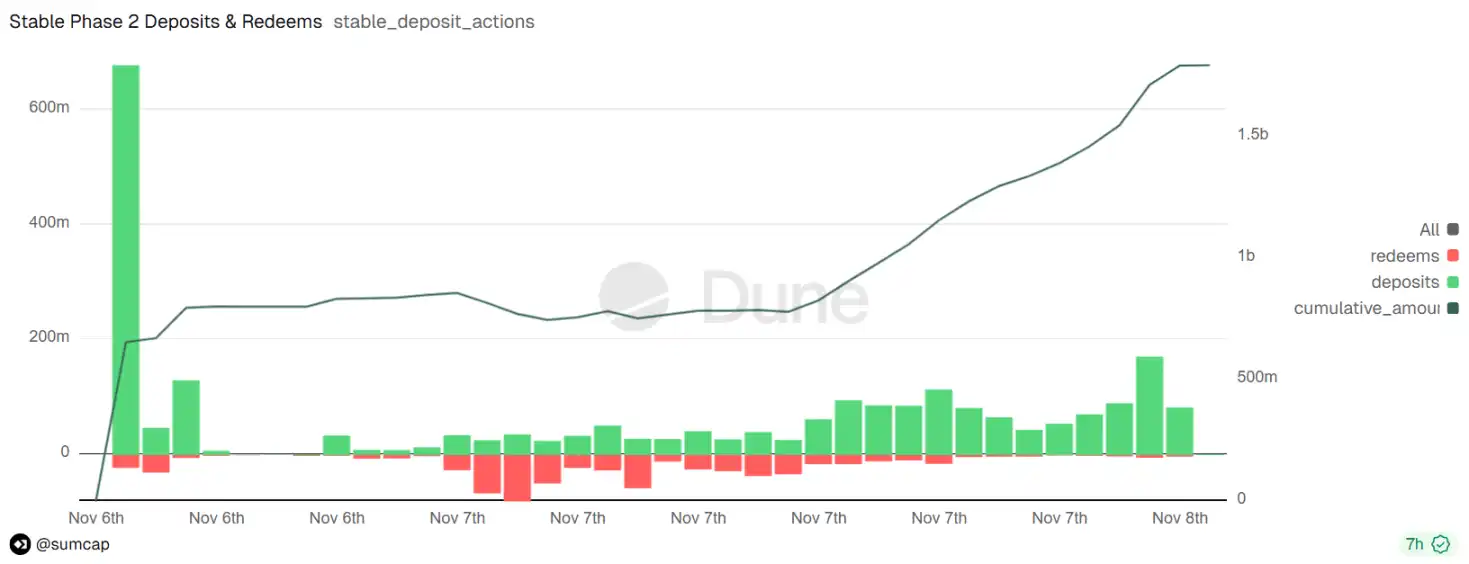
Ultimately, the total deposits in the second phase reached approximately $1.8 billion, with about 26,000 wallets participating.

The review time ranged from a few days to a week, with some users in the community complaining about system lag or repeated requests for additional materials.

Over 85% Probability of $2 Billion FDV

In late July this year, Stable announced the completion of a $28 million seed round led by Bitfinex and Hack VC, bringing its market valuation to around $300 million.

For comparison, Plasma's current market cap is $330 million, with an FDV of $1.675 billion.

Some optimists believe that the stablecoin narrative, Bitfinex's backing, and Plasma's initial price surge followed by a drop might indicate there is still some hype and potential for price appreciation in the near term. However, pessimistic voices are stronger: since gas is not paid in STABLE, its utility is limited, especially as the market has entered a bear cycle and liquidity has become tight, its token value may decline rapidly.

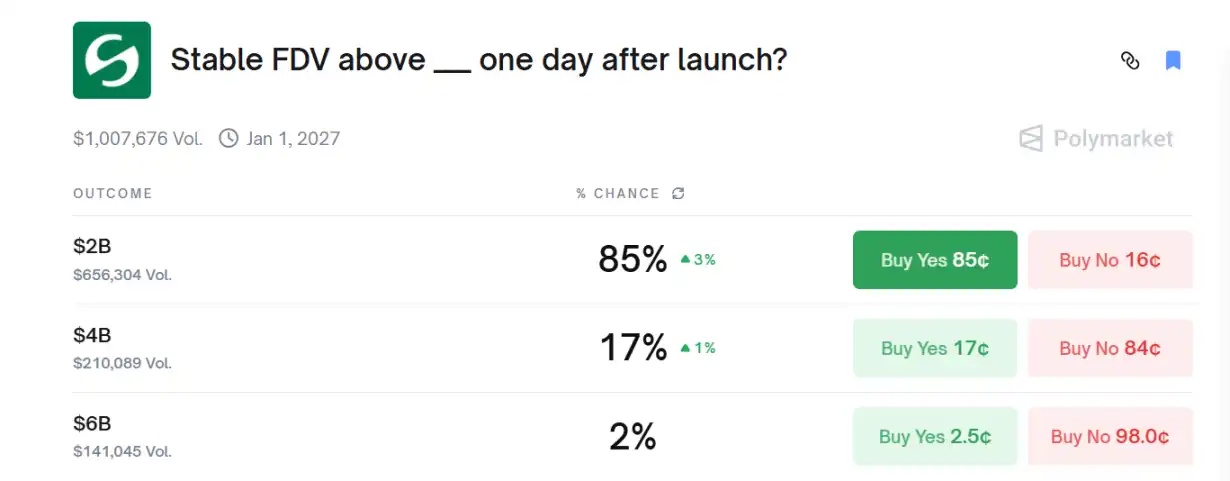
Current Polymarket data shows that the market is betting with an 85% probability that its FDV will exceed $2 billion the day after launch. Calculating conservatively at $2 billion, the STABLE token price would correspond to $0.02.
In the perpetual futures market, according to Bitget行情 data, STABLE/USDT is currently quoted at $0.032, implying an anticipated FDV rising to around $3 billion.

Stable's first pre-deposit phase reached $825 million, and the second phase actually contributed over $1.1 billion, but after proportional allocation, only $500 million was actually pooled. The total pre-deposit size is $1.325 billion. The tokenomics disclose an initial allocation of 10% (for pre-deposit incentive rewards, exchange campaigns, initial on-chain liquidity, etc.). Assuming Stable ultimately airdrops 3%-7% of the supply to pre-depositors, and based on the pre-listing price of $0.032, the corresponding returns would be approximately 7% to 16.9%, meaning every $10,000 deposit corresponds to $700 to $1,690.


Domande pertinenti

QWhat is the core design feature of the Stable Layer 1 blockchain regarding transaction fees?

AThe core design feature is that it uses USDT as the native gas fee, enabling sub-second settlements and gas-free peer-to-peer transfers.

QWhat is the total supply of the STABLE token and what is its primary use, since it is not used for gas?

AThe total supply of the STABLE token is 100 billion. Its primary uses are for governance, staking to become a validator, and participating in ecosystem incentives, rather than paying for gas fees.

QWhat controversy surrounded the pre-deposit events for the mainnet launch?

AThe controversy involved allegations of 'rat trading' where a top wallet deposited hundreds of millions of USDT 23 minutes before the first pre-deposit phase officially opened. The second phase also experienced website slowdowns and crashes due to overwhelming traffic.

QAccording to the market data on Polymarket, what is the probability that Stable's FDV will exceed $2 billion after its first day of trading?

AAccording to Polymarket data, the probability that Stable's Fully Diluted Valuation (FDV) will exceed $2 billion after its first day of trading is 85%.

QWhich major cryptocurrency exchanges have announced plans to list the STABLE token for spot trading, and which have not as of the article's publication?

AAs of the article's publication, Bitget, Backpack, and Bybit have announced they will list STABLE spot trading. Binance, Coinbase, and Korean exchanges have not made such announcements.

Letture associate

Stuck Polymarket: The Real Test After Riding the Traffic Boom Has Arrived

Polymarket, a leading prediction market platform, is facing significant technical challenges as its growth outpaces its current infrastructure on Polygon. Users are experiencing laggy transactions, unresponsive orders, and delayed confirmations, severely impacting the trading experience. In response, DeFi Engineering VP Josh Stevens outlined a comprehensive engineering overhaul. The plan includes reducing on-chain data delays, fixing order cancellation issues, rebuilding the central limit order book (CLOB), improving website performance, and developing a unified SDK and API. A major revelation was the ongoing "chain migration," indicating a potential move away from Polygon. The core issue is that Polymarket has evolved from a simple prediction market into a high-frequency trading platform, making Polygon's limitations—such as block space, gas fees, and block time—a ceiling for further growth. The migration is not just a simple chain switch but a fundamental rebuild of its trading system to support more complex products like perpetual contracts (Perps). This announcement has sparked competition among chains like Solana, Sui, and Algorand, all vying to host Polymarket. For Polygon, losing this key application, which contributes significantly to its gas fee revenue, would be a major setback. The real test for Polymarket is no longer attracting users but proving it can provide a stable, reliable trading environment that retains them.

Odaily星球日报1 h fa

Stuck Polymarket: The Real Test After Riding the Traffic Boom Has Arrived

Odaily星球日报1 h fa

Lowering Expectations for BTC's Next Bull Market

The author, Alex Xu, explains his decision to significantly reduce his Bitcoin holdings (from full to ~30% of his portfolio) during the current bull cycle, citing a lowered long-term outlook for BTC's price appreciation in the next cycle. He outlines six key reasons for this reduced expectation: 1. **Diminished Growth Drivers:** The narrative of exponential user adoption has largely played out with institutional ETF adoption. The next major growth phase—adoption by sovereign national reserves or central banks—seems unlikely in the near future. 2. **Personal Opportunity Cost:** More attractive investment opportunities have emerged in other assets, such as undervalued companies. 3. **Industry-Wide Contraction:** The broader crypto industry is struggling, with most Web3 business models (SocialFi, GameFi, DePIN) failing. This overall萧条 (depression) reduces the fundamental demand and consensus for Bitcoin. 4. **Strain on Major Buyer:** MicroStrategy, a major corporate buyer of BTC, faces rising financing expenses for its debt, which could slow its purchasing rate and create significant marginal pressure on the market. 5. **Increased Competition from Gold:** The emergence of "tokenized gold" has closed the functional gap (portability, divisibility) between physical gold and Bitcoin, offering a strong competitor in the non-sovereign store-of-value space. 6. **Security Budget Concerns:** The block reward halving continues to exacerbate the long-standing issue of funding Bitcoin's network security, with new fee source explorations like Ordinals and L2s largely failing. The author's decision to hold a significant (though reduced) position reflects a cautious, not bearish, outlook. He remains open to increasing his exposure if the fundamental reasons for his skepticism change or if new positive catalysts emerge.

marsbit1 h fa

Lowering Expectations for BTC's Next Bull Market

marsbit1 h fa

Trading

Spot
Futures
活动图片




