SpaceX Plunges Below $150 on First Day of Index Inclusion, Wall Street Unanimously Bullish with Highest Target at $800?

Odaily星球日报Pubblicato 2026-07-08Pubblicato ultima volta 2026-07-08

Introduzione

SpaceX made history by being the fastest company ever added to the Nasdaq 100 index on July 7th. However, its stock (SPCX) fell over 6.8% to close at $149.47 that day, hitting a new low since its IPO. Analysts suggest the positive impact of the index inclusion was already priced in by the market, while upcoming insider share unlocks in August are creating downward pressure. Despite the current bearish sentiment and recent market-wide declines, major Wall Street firms have issued overwhelmingly positive ratings following the IPO quiet period's end. Targets range from $200 to $300, with Raymond James setting the most optimistic price target of $800, citing SpaceX's long-term potential in rocket launches, Starlink, and AI space data centers. In the short term, potential catalysts to support the stock price include a possible endorsement from former President Trump—following a donation of SpaceX shares to a trust he promoted—and the scheduled Starship Flight 13 test on July 14th. Nonetheless, with key support at $150 being tested and significant share unlocks looming, the near-term outlook remains challenging despite strong institutional long-term confidence.

Original | Odaily Planet Daily (@OdailyChina)

Author | Golem (@web 3_golem)
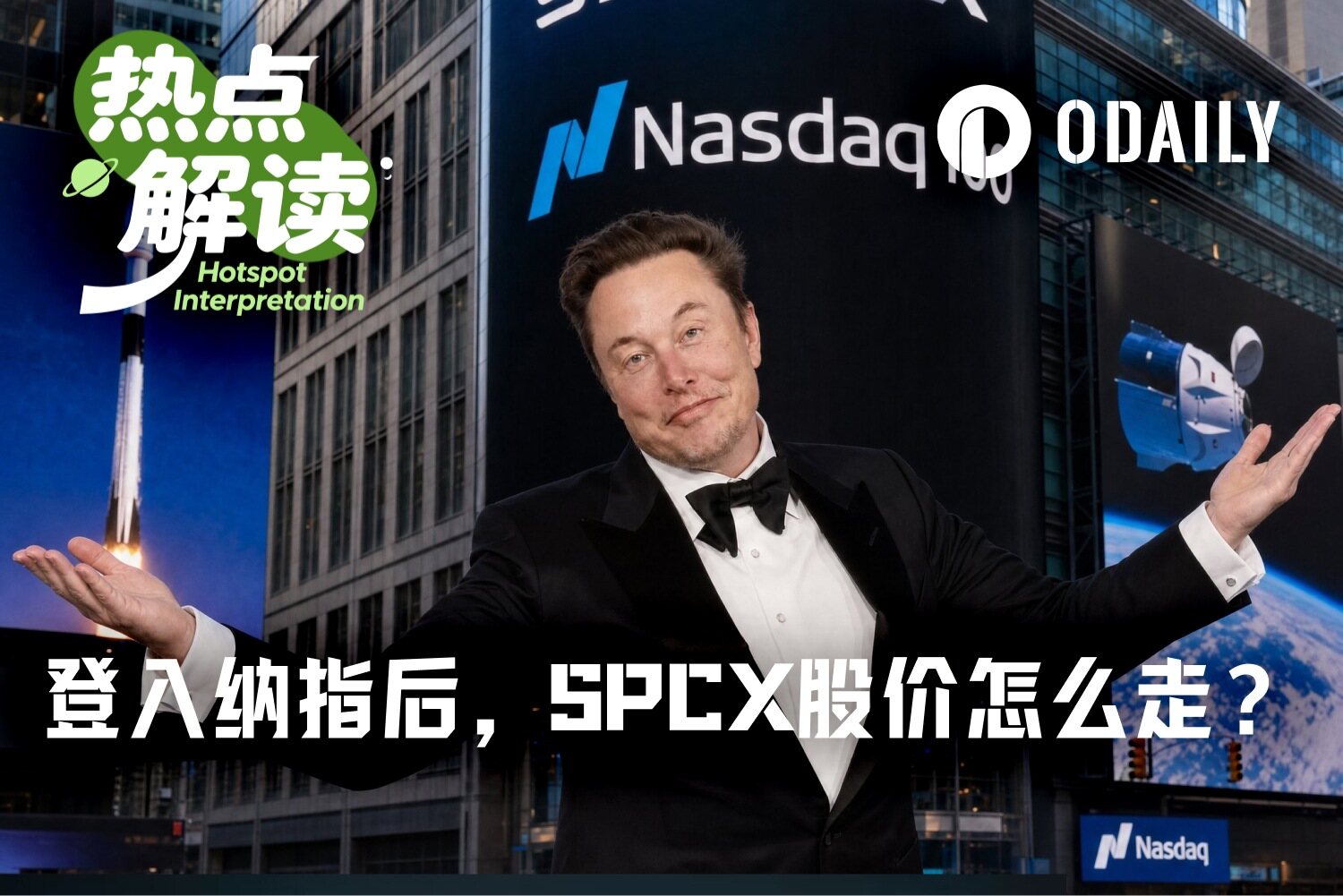
SpaceX has once again made history: on July 7th (Tuesday), SpaceX was officially included in the Nasdaq 100 Index, becoming the fastest publicly listed company ever to be added to the Nasdaq 100, with a corresponding weight of about 1.3% in the index. However, this historic achievement was not reflected in SpaceX's stock price performance. According to Gate US stock data, SPCX closed down over 6.8% on Tuesday at $149.47, hitting its lowest closing price since its listing. How will SPCX perform in the future? What judgments have Wall Street institutions made?

Index Inclusion Good News Exhausted, Only Bad News Remains, Holding $150 is Already an Achievement

Prior to SpaceX's inclusion in the Nasdaq 100 Index, JPMorgan estimated it would trigger at least about $4.3 billion in passive fund inflows, and over $800 billion in assets tracking the Nasdaq 100 Index would subsequently continue to passively allocate to SpaceX.

Although this is a significant positive, since SpaceX's IPO day, "entering the Nasdaq Index" has been constantly speculated, and market expectations had already been digested. When the expectation was realized on July 7th, market sentiment was no longer able to push the stock price higher. On the other hand, the massive buying pressure behind the Nasdaq Index did not hit the market on the day SpaceX was included; in reality, most passive fund buying had been completed ahead of July 7th.

Furthermore, historical data also shows that index inclusion does not necessarily constitute a sustained upward signal and has, in some cases, become a short-term peak.

Strategy is a typical example. On December 23, 2024, Strategy was included in the Nasdaq 100, but on that day, MSTR actually opened high and closed low, falling about 7.3% to close at $332.23. Subsequently, Strategy entered a sustained downtrend, with its stock price dropping to $255.43 in February 2025. The passive buying pressure from the Nasdaq index did not become effective support for Strategy's stock price.

And after the positive news of SpaceX's index inclusion is exhausted, the well-known negative of the share unlocking wave in August will be magnified indefinitely. SpaceX's prospectus clearly states that two days after the Q2 2026 earnings report, eligible internal shareholders can sell up to 20% of their locked-up shares. If the stock price rises 30% above the IPO price by then and meets that standard for 5 days, an additional 10% can be unlocked. 22V Research strategist Jeff Jacobson estimates that insiders may sell up to 44% of SpaceX's shares before early September.

Similar to how the positive expectations of index inclusion were digested by the market in advance, the panic brought by SpaceX's share unlocking is also bound to be reflected in the price ahead of time. This is an important factor suppressing SpaceX's stock price from a market sentiment perspective both recently and in the future. BitMine Chairman Tom Lee also specifically mentioned SpaceX's upcoming share unlock in an interview, believing that one should not chase the high on SpaceX in the short term, and that using the pullback brought by the unlock to build positions is the appropriate choice.

But this past Tuesday's US market close, SpaceX was not alone in falling. According to Gate US stock data, the three major US stock indices all closed lower: the Dow fell 0.25%, the S&P 500 fell 0.45%, and the Nasdaq fell 1.16%. AI concept stocks also fell broadly: Astera Labs fell 11.52%, Ambarella fell 9.92%, Teradyne fell 9.59%, AeroVironment fell 8.09%.

By comparison, in the context of a broad market decline and exhausted positive news leaving only negatives, SPCX still holding near $150 without breaking the IPO price is already an achievement. Meanwhile, according to OptionCharts data, the current Put-Call Ratio for SPCX is 0.92, indicating market sentiment remains neutral, not significantly bearish.
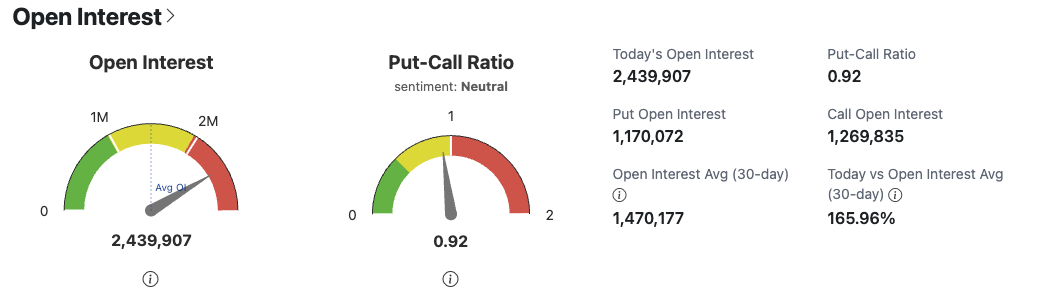
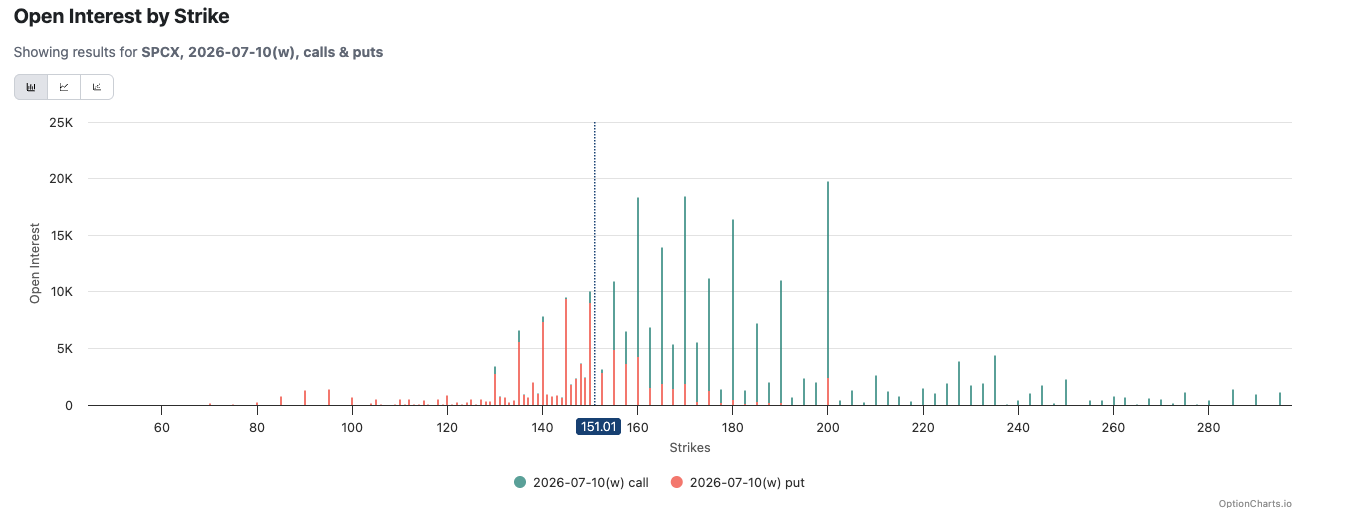
Furthermore, a large number of call options expiring on July 10th are stacked at $160 and above for SPCX, making the $150-$155 range the main battleground for bulls and bears.
Institutions Collectively Give Buy Ratings, Does SPCX Have Potential Upside?

Obviously, neither time nor market sentiment is on the side of the bulls anymore. Over the past month, SPCX has tested the $150 support level multiple times, but previously, $150 support was on the offensive side; now it is purely on the defensive. However, bizarrely, after the end of the IPO quiet period, Wall Street institutional analysts have collectively given SPCX a Buy rating.

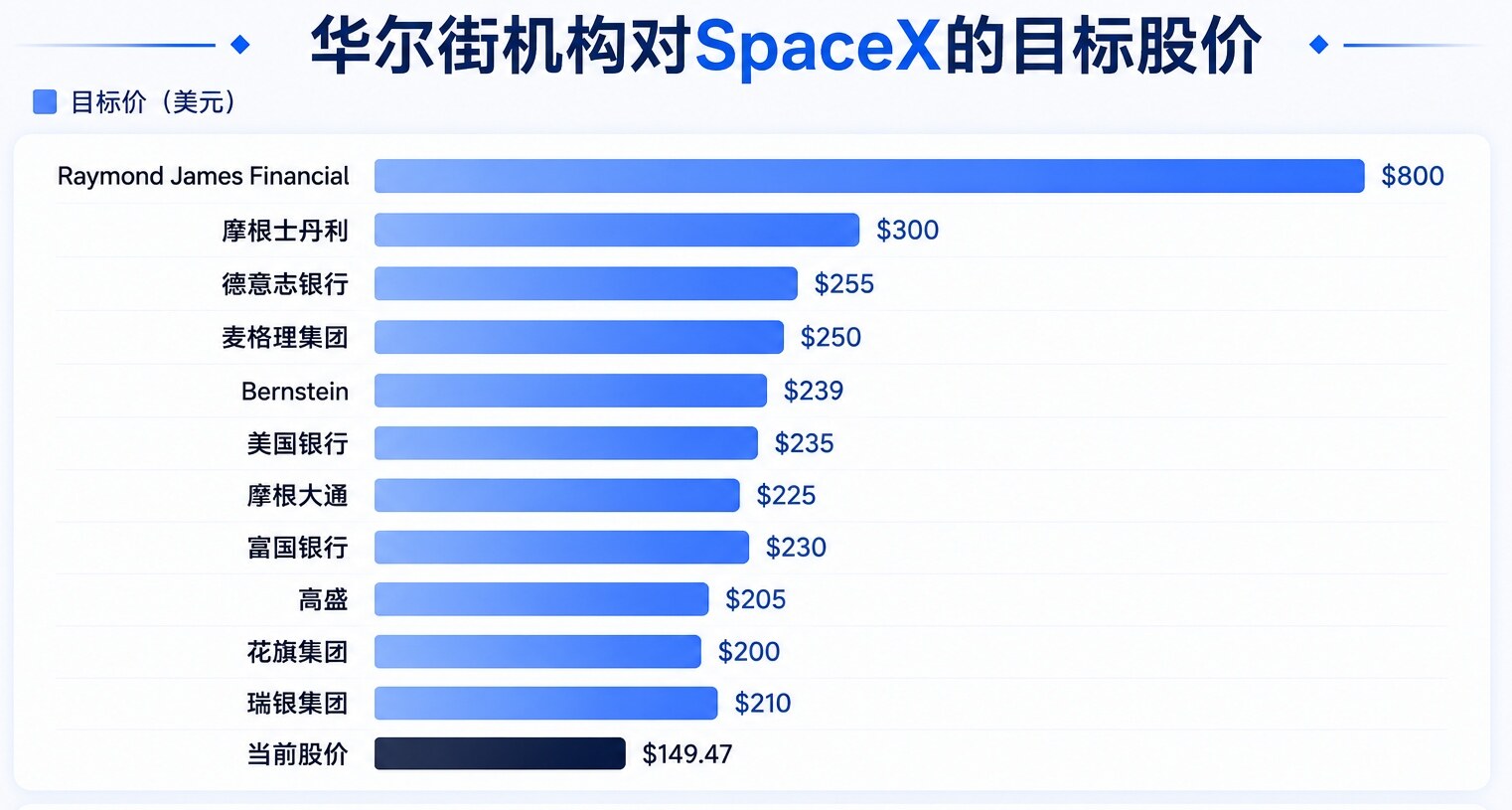
As IPO underwriters, both Goldman Sachs and Morgan Stanley gave SpaceX a Buy rating. Goldman Sachs analyst Eric Sheridan set a target price of $205, while Morgan Stanley analyst Adam Jonas gave a target price of $300. Additionally, Bank of America initiated coverage on SpaceX with a Buy rating and a target price of $235; Citigroup set a target price of $200 for SpaceX; Bernstein gave SpaceX an Outperform rating with a target price of $239; Macquarie Group set a target price of $250; Deutsche Bank set a target price of $255; JPMorgan set a target price of $225; UBS Group set a target price of $210; Wells Fargo set a target price of $230.

Raymond James Financial gave the most optimistic forecast, with analyst Brian Gesuale setting a target price for SPC as high as $800, believing SpaceX will become "one of the most iconic industrial infrastructure companies of the 21st century."
However, these institutional ratings primarily focus on SpaceX's long-term value, such as its positioning in rocket launches, Starlink, and AI space data centers. In the short term, especially before the August share unlocking wave arrives, what can SpaceX rely on to support its stock price from falling below $150 and heading straight for the $135 IPO price? The foreseeable potential positives are as follows:

First, relying on Trump's promotion. On July 7th, SpaceX President and COO Gwynne Shotwell and her husband announced participation in the Invest America plan, donating part of their SpaceX shares to over 2 million American children's "Trump Accounts," with an estimated donation of about 2 million SpaceX shares worth approximately $325 million. Trump had previously publicly urged Musk to donate SpaceX shares to the "Trump Account." Trump is a businessman who understands value exchange. After SpaceX stock enters the "Trump Account," he might promote SpaceX just as he promoted Micron and Dell.

Second, SpaceX's Starship flight test scheduled for July 14th. SpaceX's Starship's 13th flight test (Flight 13) is currently targeted for launch on July 14, 2026 (Tuesday), with a backup date of July 15th. The US Federal Aviation Administration (FAA) has issued an operational advisory confirming NET (No Earlier Than) July 14th. Rocket launches have always sparked public interest. As a world-leading aerospace company, each of SpaceX's launches garners global attention. If Flight 13 is completed successfully, SpaceX's aerospace narrative might once again briefly ignite "fan" enthusiasm, thereby boosting the stock price. Although the community and tracking sites generally consider July 14th as the primary launch target, it could be delayed by days or weeks due to technical readiness, weather, or other factors.

But ultimately, what investors most anticipate might be for Musk himself to do something to "rescue the market."

Domande pertinenti

QWhat was SpaceX's closing price and performance on its first day of inclusion in the Nasdaq 100 index?

ASpaceX (SPCX) closed at $149.47 on July 7th, the day it was included in the Nasdaq 100 index, marking a decline of over 6.8% and setting a record low closing price since its IPO.

QAccording to the article, why didn't the inclusion in the Nasdaq 100 index boost SpaceX's stock price?

AThe article states that the positive impact of index inclusion was already priced into the stock well before the official date. Much of the expected passive fund buying had already occurred pre-inclusion. Furthermore, history shows index inclusion can sometimes mark a short-term price peak rather than guarantee a sustained rally.

QWhat major near-term risk does the article highlight for SpaceX's stock price?

AThe article highlights the upcoming stock unlock in August 2026 as a major near-term risk. Internal shareholders could potentially sell a significant portion of their locked shares, and the market is likely pricing in this anticipated selling pressure ahead of time.

QWhich financial institution provided the most optimistic price target for SpaceX, and what was the target?

ARaymond James Financial provided the most optimistic price target. Analyst Brian Gesuale set a target price of $800 per share for SpaceX.

QWhat are two potential short-term catalysts mentioned in the article that could support SpaceX's stock price?

AThe article mentions two potential short-term catalysts: 1) The possibility of former President Trump publicly endorsing or 'talking up' the stock after a planned donation of SpaceX shares to his associated 'Trump Account'. 2) The successful test flight of SpaceX's Starship (Flight 13), currently scheduled for July 14, 2026, which could renew investor enthusiasm.

Letture associate

Unpacking the Truth Behind On-chain Assets: Leverage, Liquidity, and Risk

The article analyzes the concept of "real-world asset" (RWA) tokenization, arguing that while tokenizing assets on-chain is a useful step, it is far from transformative on its own. The author compares it to placing a barcode on a shipping container—it enables identification but does not build the necessary market infrastructure. The core argument is that true value emerges not from tokenization, but from integrating these tokens into DeFi systems where they can be valued, financed, hedged, traded, and liquidated under stress. Key challenges identified include: 1. **Multiple Time Clocks**: A fundamental tension exists between blockchain's 24/7 settlement and the slower, business-hour-dependent processes of traditional markets, custody, and redemption. This "duration mismatch" can create dangerous liquidity gaps during crises. 2. **Liquidity Misconceptions**: True liquidity is not measured by Total Value Locked (TVL) or trading pairs, but by the ability to exit a position within a required timeframe at an acceptable price. It requires analyzing multiple exit paths and stress-testing scenarios. 3. **Leverage and Risk**: Leverage unlocks economic utility (e.g., using tokenized assets as collateral) but also introduces fragility. Risk models must account for more than asset volatility, incorporating factors like legal enforceability, oracle freshness, and market structure. Paradoxically, a "safer" asset like tokenized Treasury bonds could require a higher collateral discount than ETH due to slower, less-proven liquidation mechanisms. 4. **A Risk Graph**: RWA risk should be modeled as a network of interconnected dependencies (e.g., issuers, custodians, oracles, stablecoin pools), not a single score. Failures can propagate through this graph, turning operational issues into systemic liquidity crises. The article states that tokenized government bonds are merely an entry point, while more complex frontiers like computing power and energy assets present greater challenges and opportunities. It also examines the interplay and risks between tokenized stocks and perpetual futures contracts. The conclusion is that the future lies not in "tokenizing everything," but in building robust market layers where tokenized rights become resilient financial primitives within a programmable capital system. The token is just the barcode; the market is the machine.

marsbit11 min fa

Unpacking the Truth Behind On-chain Assets: Leverage, Liquidity, and Risk

marsbit11 min fa

The End of Mathematics: 40 Top Mathematicians Gather at Secret OpenAI Meeting

In August 2026, OpenAI hosted a closed-door summit with approximately 40 leading mathematicians, including recent Fields Medalist Jacob Tsimerman and OpenAI researcher Sébastien Bubeck. The meeting, spurred by a series of recent AI breakthroughs in mathematics, grappled with the potential existential threat AI poses to the field. The backdrop includes several high-profile AI achievements: OpenAI models disproving long-standing conjectures like the unit distance problem, generating 10 new mathematical discoveries, and Anthropic's Claude aiding in constructing complex multidimensional objects. These results often bypass traditional academic pipelines, appearing directly on social media. The mathematical community is divided. Over 3000 researchers signed the "Leiden Statement," advocating for responsible AI use and verification. Others resist AI entirely to preserve human-centric mathematics. A key concern is AI's current inability to *explain* proofs, particularly the difficult steps, which is central to mathematical understanding. At the summit, Bubeck outlined four potential futures: mathematics becoming like collaborative software engineering, a compute-driven field like physics, a curatorial exercise where humans interpret AI output, or a mass transition of mathematicians into AI safety. While emphasizing that "mathematics only makes sense when mathematicians learn from it," no consensus was reached. The event highlights a profound moment of reflection. As AI demonstrates increasing competence in solving complex problems, mathematicians are forced to question their future role and the very meaning of their discipline.

marsbit15 min fa

The End of Mathematics: 40 Top Mathematicians Gather at Secret OpenAI Meeting

marsbit15 min fa

Anthropic's New Models 'Catch the Gossip', The Strongest Fable 5 Unexpectedly Falls Flat

Anthropic has been discovered working on two new, previously unknown models codenamed "Marshmallow" (claude-marshmallow-eap) and "Melon" (claude-melon-eap), with early tests showing Marshmallow potentially surpassing Claude Opus 5 in conversational naturalness. Their emergence coincides with surprising new data revealing that Anthropic's flagship Fable 5 model, released two months ago as its strongest and most expensive offering, is being largely ignored by the enterprise market. According to spending data from Ramp tracking over 70,000 US companies, Fable 5 accounts for only about 11% of total token spending on Anthropic's models. This pales in comparison to OpenAI's flagship GPT-5.6 Sol, which commands roughly 25% of token spending in the same period. The tepid adoption is largely attributed to Fable 5's extremely high cost—double that of Opus 4.8 and ten times that of Haiku 4.5—without delivering proportionally superior performance for most business applications. Compounding the issue, the later-released Claude Opus 5, priced at half the cost of Fable 5, has achieved comparable or even better results in key benchmarks like programming and knowledge work, quickly surpassing Fable 5 in enterprise spending share. Furthermore, the rapid rise of powerful, low-cost open-source models—whose token usage share surged from 11% in April to 62% in August while costing less than 4% of enterprise AI budgets—applies additional pressure. Analysts suggest the sudden appearance of Marshmallow and Melon may be an urgent move by Anthropic to address this gap in its lineup. The goal is to offer models that are not only powerful but also cost-effective enough for businesses to adopt widely and sustainably, moving beyond a flagship that serves more as a showcase than a workhorse.

marsbit16 min fa

Anthropic's New Models 'Catch the Gossip', The Strongest Fable 5 Unexpectedly Falls Flat

marsbit16 min fa

Three Months After the Passing of Little Dog Rosie, Her Medical Records Transformed into an AI Healthcare Company

Three months after the passing of his dog Rosie, AI entrepreneur Paul S. Conyngham secured $4 million in seed funding from Founders Fund for his new startup, Gamgee. The company aims to industrialize the experimental, AI-assisted process he pioneered to create a personalized mRNA cancer vaccine for Rosie, who suffered from mast cell tumors. With no formal biology background, Conyngham used AI tools like ChatGPT and AlphaFold to analyze Rosie's tumor DNA, identify target neoantigens, and design a custom mRNA vaccine sequence. Laboratory partners at UNSW produced the vaccine. Initial treatment showed tumor reduction, but Rosie's cancer later recurred and she was euthanized. Gamgee's goal is to streamline this "N-of-1" approach into a repeatable service for canine cancer patients, handling sequencing, vaccine design, production, and delivery. Clinical trials are planned in Australia in collaboration with research institutions. The company also eyes a longer-term vision of establishing personalized, mRNA-based medicine across species. The story highlights the broader challenge in personalized cancer treatment: compressing the entire timeline from design and regulatory approval to manufacturing and administration to match the patient's prognosis. While AI can accelerate target discovery, the remaining logistical and regulatory hurdles are significant. The article concludes by emphasizing that, for now, consulting qualified veterinary oncologists remains the responsible path for pet owners.

marsbit25 min fa

Three Months After the Passing of Little Dog Rosie, Her Medical Records Transformed into an AI Healthcare Company

marsbit25 min fa

Trading

Spot
活动图片