SpaceX IPO Creates Trillion-Dollar Billionaire: Musk's Wealth Equals Half of Crypto Market

Foresight NewsPubblicato 2026-06-15Pubblicato ultima volta 2026-06-15

Introduzione

SpaceX's record-breaking IPO has propelled Elon Musk to become the first modern billionaire with a personal net worth exceeding $1 trillion, reaching $1.11 trillion according to Bloomberg. This staggering wealth surpasses the total market capitalization of all cryptocurrencies excluding Bitcoin and equals roughly half of the entire crypto market's value. The milestone highlights extreme wealth concentration and the significant devaluation of the altcoin market, whose total cap has nearly halved since late 2025 as capital flows into large tech stocks. SpaceX's Nasdaq debut saw its valuation hit $2.2 trillion, with shares soaring from a $135 offer price to close at $161. Its first-day trading volume of $85 billion set a new global IPO record. Musk owns 42% of the company. Despite his wealth dwarfing the altcoin sector, Musk maintains deep ties to digital assets. He personally holds Bitcoin, Ethereum, and Dogecoin, while his companies, SpaceX and Tesla, collectively hold over 30,000 Bitcoin, ranking among the top corporate BTC holders globally. His acquisition and integration of financial data tools into X (formerly Twitter) further connect his ecosystem to the markets. Ultimately, Musk's trillion-dollar status underscores the immense wealth controlled by tech founders, though this fortune remains largely tied to volatile stock prices rather than liquid assets.


Author: Oluwapelumi Adejumo

Compiled by: Saoirse, Foresight News


Key Takeaways


  • After SpaceX's public listing, Elon Musk becomes the first person in modern history with a personal net worth exceeding $1 trillion.
  • His total wealth of $1.11 trillion already surpasses the total market capitalization of all cryptocurrencies excluding Bitcoin, highlighting extreme wealth concentration and the ongoing valuation contraction of altcoins.
  • This wealth milestone remains highly dependent on stock price volatility; meanwhile, several of Musk's companies hold Bitcoin, and he himself remains an active, public figure in the digital asset space.


Elon Musk has become the first person in modern history with a personal net worth exceeding the $1 trillion mark. Last week's record-breaking public listing of SpaceX propelled him past this historic wealth threshold.


According to the Bloomberg Billionaires Index, the total wealth of this tech entrepreneur now stands at $1.11 trillion.


To put the unprecedented scale of this capital into perspective: Musk's personal net worth is already higher than the total market capitalization of the global cryptocurrency market excluding Bitcoin. If the world's largest digital asset, Bitcoin, is included in the statistics, his wealth is exactly equal to half the total market capitalization of the entire crypto industry.
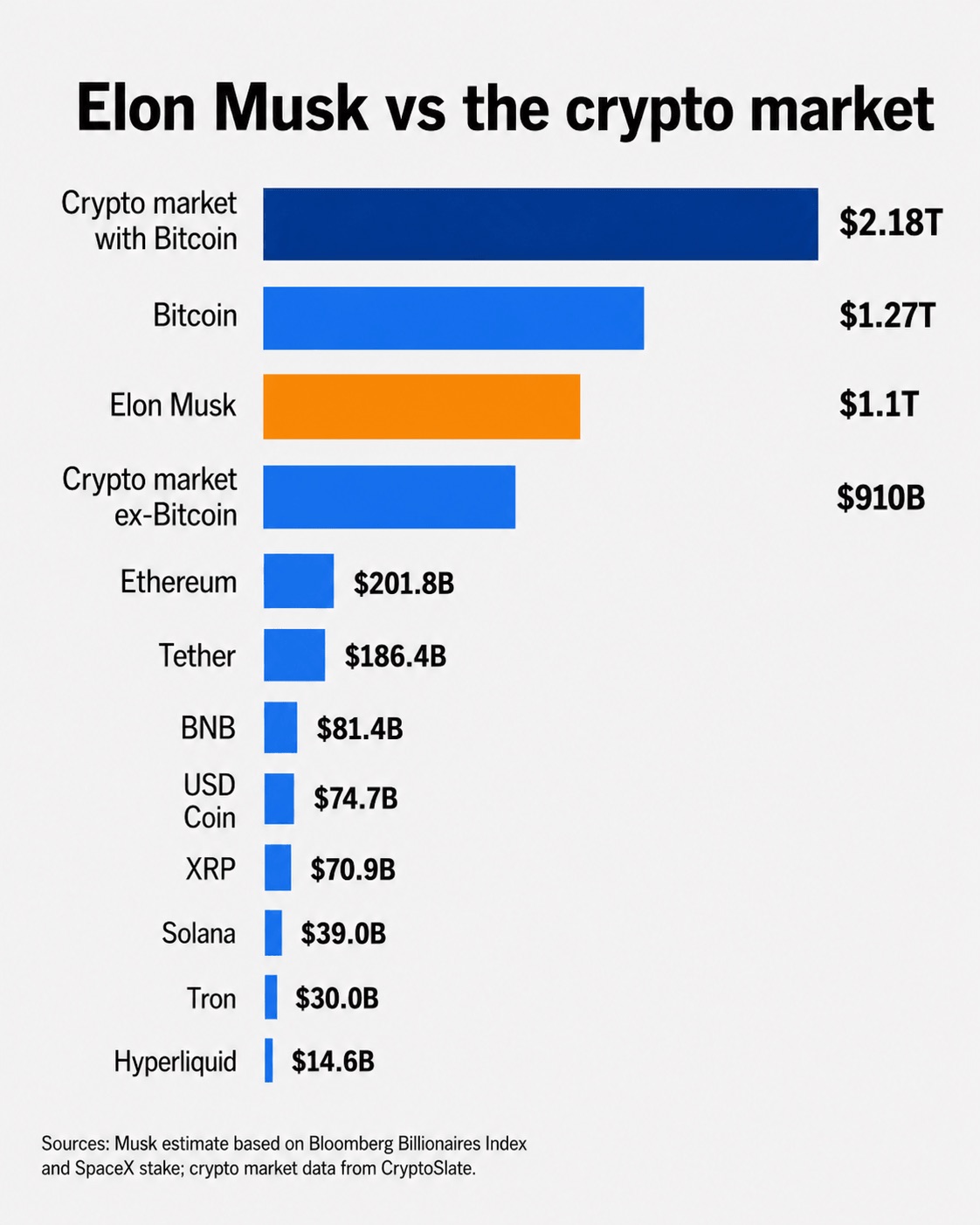


This wealth milestone quickly sparked global discussions about wealth concentration, with the scale of Musk's controlled wealth even exceeding the gross domestic product of several developed nations.


SpaceX IPO Shatters Multiple Records


The direct catalyst for Musk's wealth surge was the highly anticipated Nasdaq listing of SpaceX.


The company, which focuses on rocket development, communication services, and artificial intelligence, reached a staggering valuation of $2.2 trillion post-listing.


Underwriters initially set the offering price at $135 per share, successfully raising $75 billion before trading began.


However, market enthusiasm for the commercial space sector and Musk-related companies was unprecedented. The stock opened at $150, surged to a session high of $176.50 during the day, and ultimately closed at $161 last Friday.


Market observers noted that the stock listing brought unprecedented market liquidity.


Bloomberg ETF analyst Eric Balchunas pointed out that the stock's trading volume on its first day reached $85 billion. This figure set a new global record for single-day IPO trading volume and ranked among the top ten historical single-day trading volumes for any individual stock, surpassing Apple's highest daily trading volume over the past 40 years.
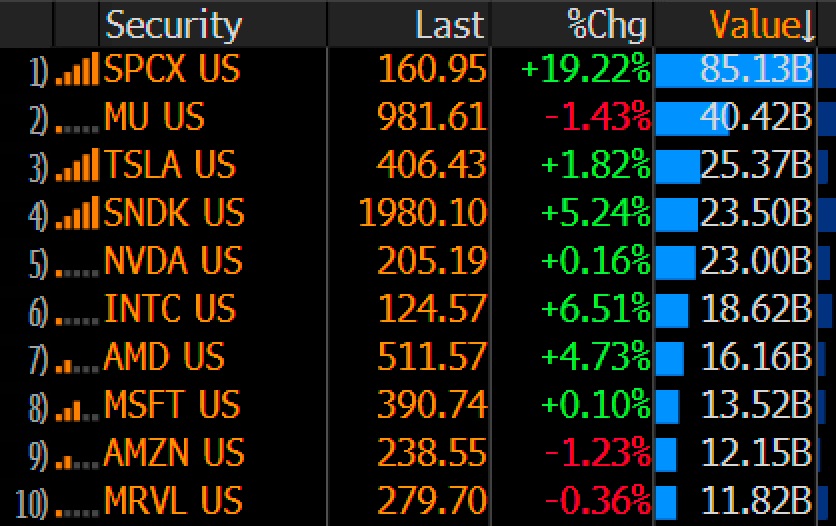

SpaceX Initial Public Offering Trading Volume (Source: Eric Balchunas)


Musk holds a 42% stake in the Hawthorne, California-based company, granting him near-unilateral voting control over its operations and strategic decisions.


Musk's Connection to Cryptocurrency


Comparing Musk's wealth scale to the digital asset market clearly reveals the significant shift in global capital allocation over the past year.


Data from the TradingView TOTAL2 index shows that the total market capitalization of all altcoins (excluding stablecoins) is approximately $880 billion. Musk's $1.11 trillion paper wealth easily surpasses this figure.


Even using the broader statistical scope of data platform CoinGecko—which puts the total global crypto market cap at about $2.27 trillion, with Bitcoin's market cap at $1.28 trillion—the combined value of all remaining altcoins after excluding Bitcoin still falls short of the personal net worth of the SpaceX CEO.


This market cap gap intuitively reflects the significant valuation contraction of mainstream altcoins compared to previous cycles. Data from Tradingview shows that in October 2025, the total market cap of crypto assets excluding Bitcoin once exceeded $1.7 trillion.
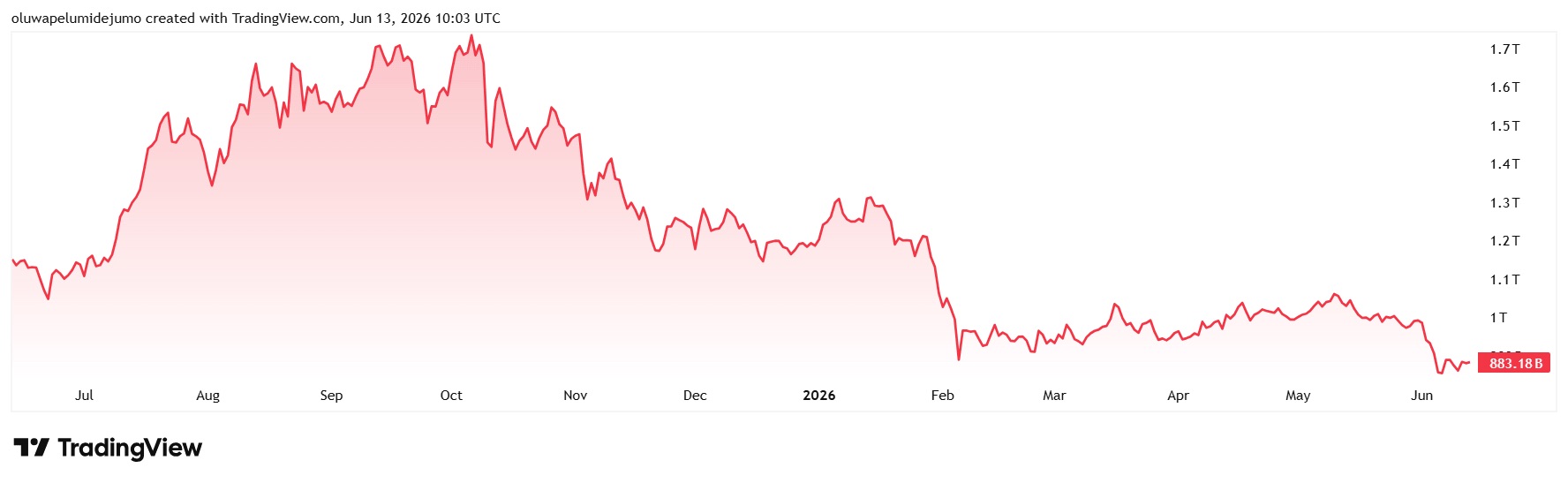

Total Cryptocurrency Market Cap Excluding Bitcoin (Source: Tradingview)


Today, that value has nearly halved. Behind this is the continued liquidity drain in the digital asset market, with institutional capital broadly exiting the crypto sector and flowing into large-cap tech stocks and artificial intelligence-related equities.


Despite his personal wealth now dwarfing the entire altcoin market, Musk remains deeply intertwined with the digital asset ecosystem, both in terms of personal holdings and corporate balance sheets.


Musk has publicly confirmed that he holds Bitcoin, Ethereum, and Dogecoin. Apart from mentioning a gift of 0.25 Bitcoin in 2018, he has never disclosed his full personal portfolio. However, several of his companies hold institutional-scale positions in the crypto market.


Post-listing regulatory filings show that SpaceX's corporate treasury holds 18,712 Bitcoin, with a market value exceeding $1.3 billion. His electric vehicle company Tesla follows a similar strategy, maintaining a long-term holding of 11,509 Bitcoin as part of its corporate liquid reserves.


If the holdings of both companies were combined, the total Bitcoin held would rank fifth globally among listed companies.
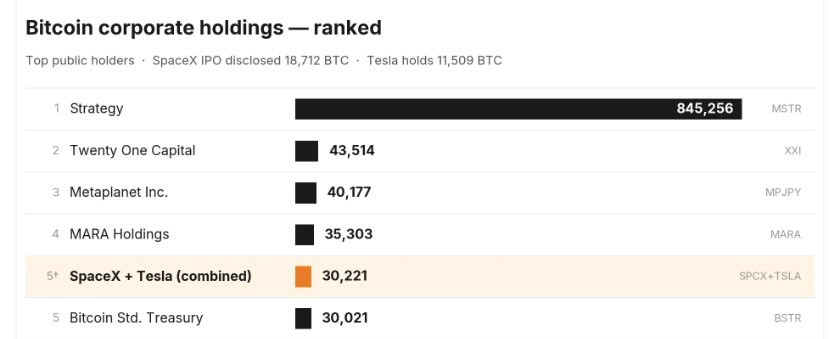

Bitcoin Holdings of SpaceX and Tesla (Source: Bitcoin Treasuries)


Furthermore, Musk's $44 billion acquisition of the social platform X (formerly Twitter) and the embedding of financial data tools within the platform have integrated financial markets directly into the public information stream. The platform's built-in cash tag function displays real-time prices for traditional stocks and various digital assets.


X's official statement clarifies that the platform serves solely as a market data tool and does not directly act as a securities broker or cryptocurrency exchange. Nonetheless, this feature further intertwines Musk's media and commercial ecosystem with the daily operations of financial markets.


Ultimately, Musk's staggering wealth scale reveals the severe concentration of private wealth within founder-controlled tech giants; it is also important to note that this trillion-dollar fortune is essentially tied to stock market prices and is not freely accessible cash assets.

Domande pertinenti

QWhat event made Elon Musk the first person in modern history to surpass a $1 trillion net worth?

ASpaceX's record-breaking public listing (IPO) propelled Elon Musk's net worth to over $1 trillion.

QHow does Elon Musk's current wealth compare to the total market capitalization of the cryptocurrency market excluding Bitcoin?

AElon Musk's net worth of $1.11 trillion is greater than the total market capitalization of all cryptocurrencies excluding Bitcoin, which is approximately $880 billion.

QWhich of Elon Musk's companies hold Bitcoin on their balance sheets, and what are their approximate holdings?

ABoth SpaceX and Tesla hold Bitcoin. SpaceX holds 18,712 BTC and Tesla holds 11,509 BTC, giving them a combined holding of over 30,000 BTC.

QWhat was the remarkable trading volume statistic for SpaceX's stock on its first day of public trading?

AOn its first day of public trading, SpaceX's stock reached a trading volume of $85 billion, setting a new record for IPO trading volume.

QWhat broader societal and market trend is highlighted by the comparison between Musk's wealth and the altcoin market's value?

AIt highlights both the extreme concentration of private wealth in founder-led tech giants and the significant valuation decline/contraction (nearly halved) in the altcoin market as capital has flowed towards large-cap tech and AI stocks.

Letture associate

M&A Deals in the Crypto Market Are Unusually Active

Title: M&A Activity in Crypto Market Becomes Unusually Active A rare signal is emerging in the crypto primary market: mergers and acquisitions (M&A) are nearing half of all financing deals. According to RootData, this month, M&A cases in the crypto industry reached 10, while financing rounds numbered only 14, meaning M&A accounts for approximately 42% of primary market transactions—the highest level in history. This does not signal a sudden industry boom. Instead, the rapid rise in M&A share primarily reflects the continued downturn in the financing market. Since November 2024, monthly crypto M&A deals have remained between 10-20, while financing deals have plummeted from around 100 to about 50, possibly hitting a new low this month. For project teams, this means the traditional path of relying on narratives, token expectations, and ecosystem subsidies to maintain valuations is narrowing. For leading companies, it presents a rare window to acquire teams, licenses, technology, liquidity, and market access at lower prices, with less competition and stronger bargaining power. Key active buyers include Coinbase, Kraken, Ripple, MoonPay, Polymarket, Kaiko, Sol Strategies, GSR, Keyrock, Jupiter, Paxos, and Ondo Finance. Their M&A logic is consistent: acquiring key capabilities at lower costs during the industry downturn. This is driven by more attractive valuations, reduced time and trial-and-error costs, the acquisition of licenses and compliance resources, and the integration of industry upstream and downstream segments. Current M&A focuses are concentrated in four areas: trading infrastructure (e.g., Coinbase acquiring Deribit, Kraken acquiring NinjaTrader), payments and stablecoins (e.g., MoonPay, Ripple expanding payment networks), compliance licenses, and asset issuance/distribution (e.g., acquisitions related to RWA and token issuance platforms like Coinbase's purchases of Liquifi and Echo). The rise in M&A is altering the primary market's exit logic. It provides an alternative path to the token-dependent model, encouraging teams to build tangible products, revenue, and strategic value that can be integrated. This could inject confidence into the market, showing that asset buyers and exit possibilities still exist, albeit with a stricter focus on real utility. However, this trend also indicates the crypto industry is becoming more centralized. As asset issuance, trading, market-making, custody, payments, and data gradually consolidate in the hands of a few major players, the industry's initial emphasis on openness and anti-monopoly is being reshaped by commercial realities. Coupled with rising compliance barriers, this signals the end of the low-barrier era for crypto entrepreneurship.

链捕手25 min fa

M&A Deals in the Crypto Market Are Unusually Active

链捕手25 min fa

M&A Deals Are Exceptionally Active in the Crypto Market

Mergers and acquisitions (M&A) activity in the cryptocurrency primary market has reached a historic high, accounting for approximately 42% of total deals in the current month, nearly matching the number of financing rounds. This shift does not signal a new boom cycle but rather reflects a severe contraction in the venture capital funding environment. As financing dwindles, established industry giants—including major exchanges, payment firms, and infrastructure providers—are seizing the opportunity to acquire strategic assets at lower valuations. Key drivers behind the surge in M&A include depressed project valuations, the need to quickly acquire talent and technology to capture short market windows, the pursuit of crucial regulatory licenses, and the strategic expansion into adjacent business verticals such as derivatives, payments, stablecoins, and real-world asset (RWA) issuance. Major acquisitions, like Coinbase's purchase of Deribit and Kraken's acquisition of NinjaTrader, exemplify the push to expand into high-margin areas like derivatives and multi-asset trading. This trend is reshaping the industry's exit landscape, offering an alternative to token-based exits and incentivizing startups to build tangible products and revenue streams with inherent strategic value for acquisition. However, it also points toward increasing centralization, as critical functions—trading, custody, payments, compliance—become concentrated within a few large, well-capitalized platforms, potentially raising barriers to entry for new ventures.

marsbit26 min fa

M&A Deals Are Exceptionally Active in the Crypto Market

marsbit26 min fa

Solana Privacy Ecosystem Panorama: A Complete Privacy Stack from Compute to AI

**Title: The Solana Privacy Ecosystem: A Full-Stack View from Compute to AI** **Summary:** This article provides a comprehensive overview of the emerging privacy landscape on the Solana blockchain, characterizing it as still in early development. It identifies two primary verticals—Neobanks and Private DeFi—as key drivers, while noting gaps in tooling and user experience. The discussion centers on two main approaches to private computation: Arcium, which utilizes Multi-Party Computation (MPC) networks (Multi-Party eXecution Environments) to process encrypted data with final settlement on Solana; and Magic Block, which leverages Trusted Execution Environments (TEEs) via its Private Ephemeral Rollup (PER). Both enable confidential applications like dark pools and private DeFi with minimal code changes. Building on this infrastructure, projects are creating privacy-focused applications. Umbra, built on Arcium, offers Encrypted Token Accounts (ETAs) for private balances, transfers, and selective disclosure for compliance. Other wallets like Privacy Cash and Hush provide mixer-like functionality for SOL. For private trading, encifherio uses TEEs to encrypt swap details routed through Jupiter, while VanishTrade and Darklake focus on shielding transaction intent and liquidity routing, with Darklake introducing a "blind slippage pool" to prevent front-running. Further applications include private prediction markets (e.g., Melee Markets using Arcium's encrypted order books) and private AI. Loyal exemplifies the latter, using both Magic Block and Arcium to enable decentralized AI agents that store user data, conversations, and transactions confidentially on-chain. The article concludes by framing privacy not as a single technology but as an evolving "ultimate privacy stack," with experts like Helius's Mert envisioning a future combination of Fully Homomorphic Encryption (FHE) and Zero-Knowledge proofs (ZK). Helius Privacy itself is developing a ZK-based UTXO privacy layer for Solana.

Foresight News31 min fa

Solana Privacy Ecosystem Panorama: A Complete Privacy Stack from Compute to AI

Foresight News31 min fa

Trading

Spot
Futures
活动图片