Space Review | 'Ecological Synthesis' Becomes the New Engine: Decoding the Value Creation Model Beyond Track Rotation

深潮Pubblicato 2025-12-17Pubblicato ultima volta 2025-12-17

Introduzione

"Crypto Market 2025: Decoding the 'Ecosystem Synthesis' Value Creation Engine" Amidst macroeconomic uncertainty and shifting monetary policy, the 2025 crypto market is witnessing a fundamental restructuring of value logic beyond mere sector rotation. Industry observers highlight that "smart money" is proactively positioning for the next bull cycle, seeking narrative anchors capable of absorbing future liquidity—before consensus forms and prices surge. True market leaders must demonstrate cross-cycle resilience, ecological scalability, and sustained liquidity accumulation. Unlike transient trends, enduring narratives leave behind functional infrastructure and economic systems. The TRON ecosystem emerges as a prime case study in synergistic value creation. Its high-throughput, low-cost base supports over 250 million accounts, while its status as a major stablecoin network ensures deep liquidity pools—evidenced by leading protocol revenues ($6.16M in 7 days). TRON’s "positive flywheel" integrates DeFi, AI, Memes, and cross-chain applications through composable protocols: users mint USDD, earn yield on JustLend, and provide liquidity on SunSwap in seamless cycles. Deflationary tokenomics (e.g., SUN/JST buybacks) and infrastructure expansion (like AI agent SunAgent and meme generator SunGenX) create a self-reinforcing loop—attracting developers, users, and capital while resisting cyclical volatility. This model exemplifies how integrated ecosystems may define the next paradi...

In 2025, the cryptocurrency market stands at a crossroads of dual variations in cycles and structures. The fog of the macro environment has not yet cleared, with the pace of interest rate cuts, the flow of global capital, and market risk preferences still swaying amidst macro policies. However, undercurrents have long been stirring beneath the surface. In this "new normal" of high interest rates but strong expectations for rate cuts, global capital is seeking new directions, and a battle for the narrative of the "bull market main theme" has already begun ahead of schedule. This is no longer merely a rotation of hotspots but a profound reconstruction of value logic.

Against this backdrop, this edition of the SunFlash roundtable aims to penetrate short-term fluctuations and dissect the internal logic of this "ultimate battle" from the higher dimensions of cycles and structures. This Space invited multiple industry observers to jointly explore: Why is the market already eager to compete for narrative dominance while the macro outlook remains unclear? Which types of tracks can truly traverse bull and bear markets, becoming the lasting main theme leading the market? And why is a continuously evolving, internally synergistic comprehensive ecosystem more likely to integrate liquidity, innovation, and network effects, ultimately defining the value growth paradigm for the next stage, compared to a single track?

Centering on these core issues, the following is a compilation of the most enlightening guest perspectives and market insights from this Space dialogue.
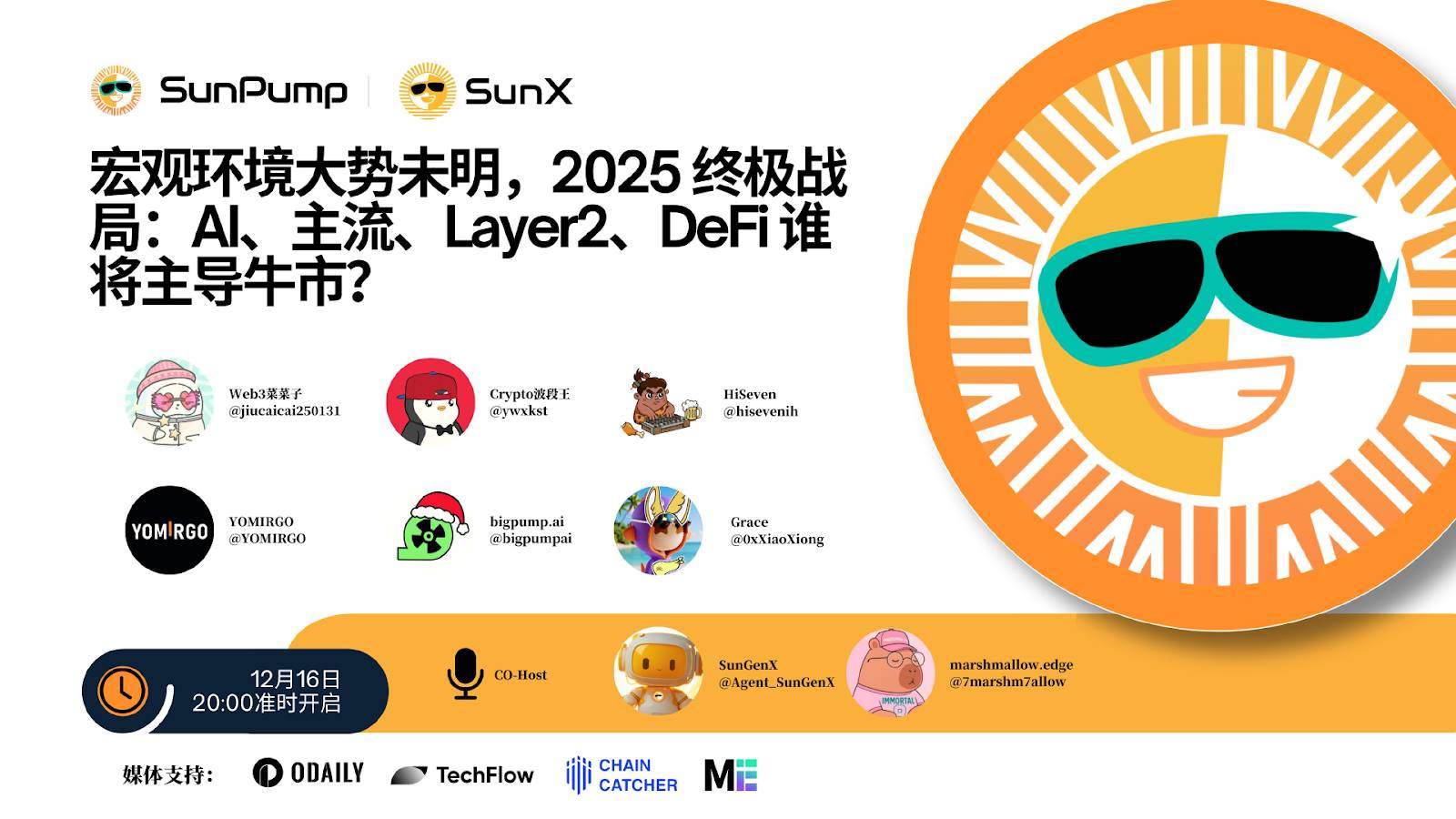
With the macro direction still unclear, what is the logic behind the market's "jumping the gun"?

Although the macro monetary policy and economic prospects for 2025 are still shrouded in uncertainty, pioneers in the cryptocurrency market have quietly launched a fierce competition for the main theme of the future bull market. The first core topic of this Space directly addresses this seemingly contradictory phenomenon: Why jump the gun when the signs are not yet clear?

Several guests unanimously pointed out that the core driving force of the cryptocurrency market does not stem from current data but from超前 expectations of the next stage's structure. HiSeven率先 noted that真正的 market pricing often occurs during the stage of greatest uncertainty. Macro variables (such as interest rate cuts and liquidity) are slow variables, while the market is a fast variable. The task of "smart money" is to predict, amidst the fog, which tracks are most likely to承接 the massive liquidity即将释放 when uncertainty dissipates.

bigpump.ai further explained the necessity of "jumping the gun": once market consensus forms, asset prices will be重新评估 in an instant, and it will be too late to布局 then. She pointed out that the funds currently being actively sought are a "story anchor" that can provide an explanation for the market direction in the next 6-18 months. This anchor is like a safe haven, allowing mainstream funds to first establish core positions and then configure弹性 assets around it.

Web3菜菜子 summarized the profit-seeking nature of capital with more straightforward logic: "Certainty is too expensive." He emphasized that the huge opportunities in the cryptocurrency market恰恰 lie within uncertainty. If one waits for all macro positive factors (such as clear interest rate cuts and clear regulations) to fully materialize, the prices of core assets will already be high, and cost advantages will be lost. Therefore, institutions and smart money must "bet before dawn," placing their bets提前 amidst分歧.

After clarifying the "jumping the gun" logic, the discussion in this Space naturally delved into specific tracks. Which types of tracks can truly traverse bull and bear markets, becoming the lasting main theme leading the market, rather than fleeting阶段性热点? The guests proposed clear筛选标准 for this and展望了 the possible new structure of the future market.

Several guests first drew the line between the main theme and hotspots. Crypto波段王 and Web3菜菜子 pointed out that阶段性热点 like the past metaverse often see their value归零 after情绪退潮. The true main theme must possess跨周期韧性, able to withstand macro fluctuations, regulatory pressure, and bear market洗礼; its value logic will not失效 due to market冷热. Grace's analogy was more vivid: after a wave of行情 ends, "hotspots" leave behind a mess, while the "main theme" should leave behind a set of new infrastructure or economic systems that can operate long-term, revealing that the core of the main theme lies in real value creation and沉淀.

Based on the above distinctions, the guests提炼出 the three core criteria for becoming a bull market main theme: namely,跨周期 survival and development capability, ecological scalability and innovation flywheel, and持续吸附 and沉淀 liquidity.

Dissecting the "Positive Flywheel": How Does the TRON Ecosystem Build an Endogenous Growth Engine?

Beyond the traditional思维 of寻找 a "single leader," this discussion put forward a前瞻性 view: the 2025 "main theme" might not be a single track but a协同共生 ecosystem. The evolution of the波场TRON ecosystem was regarded by several guests as a vivid case study of "main theme potential," its development path恰好映射了 the aforementioned key logics.

波场TRON demonstrates structural韧性 across cycles by building a庞大, active, and continuously evolving comprehensive ecosystem. The core advantages of this ecosystem are reflected in the following mutually supportive levels:

First, it has built high-performance underlying infrastructure, providing fertile ground for ecological prosperity. The high throughput and low transaction fees of the波场TRON network solve the core bottleneck for large-scale application落地. It is this foundation that supports its over 250 million total user accounts and持续增长的链上活跃度, forming a powerful network effect基本盘.

Second, it has successfully captured and沉淀巨量的现实世界 liquidity, establishing its position as a core financial layer.波场TRON is one of the world's largest stablecoin circulation networks. The continuous inflow of stablecoins provides a deep liquidity矿藏 for its upper-layer DeFi applications (such as JustLend DAO, SUN.io) and持续产生真实收益. This is strongly corroborated by on-chain data: on November 28, according to Nansen data, only 6 public chains had fee income exceeding $1 million in the past 7 days, with the波场TRON network ranking first with $6.16 million in fee income. This not only直观反映了 its旺盛 network activity and real demand but also means that massive liquidity within its ecosystem is being effectively transformed into sustainable协议收入 and value沉淀, perfectly诠释了 the "attract and retain funds" capability of a main theme.

Furthermore, its ecosystem demonstrates卓越的可扩展性 and internal innovation flywheel. The波场TRON ecosystem has衍生出 core protocols covering diverse application scenarios such as DeFi, AI, Meme, NFT, cross-chain, decentralized storage, and oracles. More importantly, these protocols are not simple application叠加 but form a self-reinforcing,持续增长的正向飞轮 through a set of精密 internal协作 and value反馈机制:

1. Composability between protocols: The composability between protocols within the波场TRON ecosystem builds a system-level协作 network where capital can flow seamlessly and收益 can be叠加多重. For example, users can mint the decentralized stablecoin USDD on the USDD platform, then deposit it into JustLend DAO to earn deposit interest, completing a smooth conversion from stablecoin generation to interest-bearing assets. Furthermore, users can also borrow流动资金 using抵押 assets in JustLend DAO and then invest it in SunSwap to provide liquidity, thereby simultaneously capturing multiple收益, greatly enhancing the capital efficiency of the entire ecosystem.

2. Deflationary models and feedback mechanisms: Key protocols within the ecosystem, through business model design, directly feed the captured value back to the ecosystem and token holders. This is the core动力 that allows the "flywheel" to turn. For example, the回购销毁机制 for SUN tokens and JST tokens directly reduces token circulation, providing endogenous support for token value and sharing growth红利 with participants.

3. Infrastructure expansion and narrative upgrade: BitTorrent Chain (BTTC), as the official跨链 solution, not only enables multi-chain interoperability of assets but also attracts反向流入 of projects and users from external ecosystems, achieving对外扩张 of the ecosystem. Meanwhile, the波场TRON ecosystem's strategic layout in the frontier field of AI has entered an加速阶段. Its official AI products such as SunAgent and SunGenX are building next-generation decentralized intelligent infrastructure for the ecosystem. SunAgent creates a decentralized AI agent and automated task execution platform aimed at lowering the operational threshold of DeFi. SunGenX, as a one-click, low-threshold Meme asset issuance tool, has empowered the community to create over 100,000 Meme coins on the SunPump platform, becoming an important创新实验 and liquidity启动 platform within the ecosystem.

In summary, the "positive flywheel" of the波场TRON ecosystem can be clearly outlined: Powerful infrastructure attracts users and capital inflow → Prosperous application scenarios generate real revenue and user stickiness → Protocols feed back part of the revenue through methods like回购销毁, enhancing the token economic model and participant confidence → Increased value and enhanced confidence further attract more developers and capital, and expand outward借助 AI and other frontier tracks → Ecological scale and vitality持续增强. This closed loop allows the ecosystem to摆脱 dependence on single hotspots and achieve endogenous, sustainable growth.

The practice of the波场TRON ecosystem provides a现实注脚 for the "combinatorial symbiosis" paradigm. It does not rely solely on a single hotspot but持续吸引 developers, users, and capital by building an internally synergistic, self-reinforcing value闭环. This effort dedicated to building a complete, sustainable economic system gives it the韧性 to resist周期性波动, standing out from the current market structure. This development path gives it the potential to lead the industry from single-asset speculation towards complex ecological value creation and is expected to occupy a key pole in the future market structure.


Domande pertinenti

QWhat is the core argument for why the crypto market is 'front-running' despite unclear macro conditions in 2025?

AThe core argument is that the crypto market is driven by超前预期 (forward-looking expectations) rather than current data. 'Smart money' seeks to predict which sectors are best positioned to capture massive liquidity once uncertainties (like interest rate cuts) resolve. Waiting for full macro clarity would mean entering at higher prices, so institutions must place bets early during periods of disagreement to capture cost advantages.

QAccording to the panelists, what are the three core criteria that define a lasting 'main narrative' in a bull market, as opposed to a short-lived hotspot?

AThe three core criteria are: 1)跨周期生存与发展能力 (Cross-cycle survival and development capability), 2) 生态可扩展性与创新飞轮 (Ecosystem scalability and an innovation flywheel), and 3) 持续吸附并沉淀流动性 (The ability to continuously attract and sediment liquidity).

QHow does the TRON ecosystem exemplify the 'positive flywheel' model of endogenous growth?

AThe TRON ecosystem builds a positive flywheel through: 1) High-performance infrastructure attracting users and capital, 2) Protocol composability allowing seamless capital flow and multi-layered yield (e.g., minting USDD, depositing on JustLend, providing liquidity on SunSwap), 3) Deflationary tokenomics (e.g., SUN/JST buyback and burn) that feed value back to the ecosystem, and 4) Infrastructure expansion (like BTTC for cross-chain and AI products like SunAgent) that drives external growth and innovation, creating a self-reinforcing cycle of growth.

QWhat key metric from Nansen is cited to demonstrate TRON's ability to capture and sediment real-world liquidity?

AThe key metric is that on November 28th, Nansen data showed TRON network generated $6.16 million in fee revenue over the past 7 days, ranking it first among all blockchains. This high fee income indicates旺盛的网络活动 (vibrant network activity), real demand, and the effective conversion of liquidity into sustainable protocol revenue.

QWhat is the 'narrative battle' that the article says is underway in the crypto market, and what is its ultimate goal?

AThe 'narrative battle' is an intense competition among market participants to define the next 'bull market main narrative' or dominant story that will explain market direction for the next 6-18 months. Its ultimate goal is not just to rotate through hot topics but to achieve a profound重构价值逻辑 (restructuring of value logic), establishing a new paradigm for value growth that integrates liquidity, innovation, and network effects within a cohesive ecosystem.

Letture associate

TechFlow Intelligence Bureau: Chip Stocks Lose Trillions in a Single Day, Bitcoin Falls Below $60,000, US-Iran Conflict Escalates

**Daily Tech & Markets Roundup: AI Advances, Market Turmoil, and Geopolitical Tensions** **AI / LLMs**: Anthropic's internal report on AI self-improvement sparked serious discussions about Recursive Self-Improvement (RSI). Meanwhile, debate continues on AI coding tools after Claude was accused of introducing bugs into the rsync codebase. In positive news, DeepSeek V4 Flash impressed in local deployment tests, and GitHub Copilot now supports custom endpoints for local models. A surprising research turn suggests removing chain-of-thought prompting can sometimes improve LLM performance. **Crypto / Web3**: Bitcoin plunged below $60,000, with its RSI hitting levels last seen during the COVID-19 crash, driven by strong U.S. jobs data reviving interest rate hike fears. Discussions highlight Ethereum DeFi's continued lack of a smooth consumer payment layer. **Chips / Hardware**: Chip stocks suffered a massive sell-off, with the Philadelphia Semiconductor Index posting its worst single-day drop in six years, erasing over a trillion dollars in value. Marvell, Micron, AMD, and Intel were among the biggest losers. **Tech Companies**: A leaked Microsoft document revealing goals to make Copilot "addictive" drew criticism. LinkedIn founder Reid Hoffman left Microsoft's board to focus full-time on his AI agent startup, Manus. Google was revealed to be paying SpaceX $920 million monthly for AI training compute. **Markets & Macro**: A blowout U.S. jobs report (172k vs. 80k expected) crushed hopes for near-term rate cuts, sending Treasury yields soaring and triggering a broad market sell-off. CEOs from Kraft, McDonald's, and Whirlpool simultaneously warned U.S. consumers are exhausting their savings. **Geopolitics**: U.S.-Iran tensions escalated with missile/drone interceptions and U.S. strikes on Iranian radar sites, keeping the critical Strait of Hormuz largely closed since late February and posing ongoing oil supply risks. **The Bottom Line**: The strong jobs data acted as a single trigger for correlated sell-offs across equities, crypto, and chips. Underlying the volatility is a stark contradiction between robust employment data and warnings of consumer weakness, alongside geopolitical risks that could reignite inflation, leaving markets to price in a fraught macro outlook with no clear "soft landing" path.

marsbit2 h fa

TechFlow Intelligence Bureau: Chip Stocks Lose Trillions in a Single Day, Bitcoin Falls Below $60,000, US-Iran Conflict Escalates

marsbit2 h fa

It Took Me a Year to See the Bitter Truth About Agent Payments

After a year building infrastructure for the Agent economy, engaging with major players like Stripe, Visa, and Coinbase, the author shares a sobering analysis of the current state of Agent payments. The core finding is a stark lack of genuine, immediate demand across most envisioned use cases. The article breaks down four key market segments: 1. **Agent-to-Merchant (Consumer Shopping):** For most product categories (e.g., clothing, electronics), conversational AI shopping is a step backwards from visual e-commerce interfaces. While agents excel at understanding needs, they can't replace side-by-side product comparison. Real merchant interest is defensive "Agent Engine Optimization," not driven by current customer demand. Potential exists for high-frequency, low-decision purchases (like food delivery) or navigating complex store UIs, but these require massive B2C distribution channels dominated by giants like Amazon. 2. **Agent-to-API (Developer Services):** Developers already have subscriptions and billing relationships for APIs (compute, data). Prepaid balances solve micro-payment issues for low transaction volumes. A deeper structural problem is that major SaaS vendors' business models rely on enterprise contracts, resisting granular pay-per-call pricing. While protocols like MPP and x402 serve the long tail of niche services, this market is small and developers are historically low-willingness-to-pay. 3. **Agent-to-Agent:** This remains largely theoretical with minimal transaction volume. While it represents a long-term bet on a fundamentally new transaction infrastructure (sub-second, micro-penny to million-dollar, multi-party settlements), it does not constitute a present market. 4. **Agent-to-Finance:** This is the only category with existing, paying demand. Integrating AI into financial workflows (trading, portfolio management) is a natural evolution and enables new capabilities like autonomous rebalancing. However, competition favors established, regulated institutions. The "real problem" is not moving money between agents, but the broader challenge of **coordination**—orchestrating work between agents and humans, verifying outcomes, and settling results. Payment is just one component of settlement, which is itself part of coordination. Companies that solve the coordination layer will subsume payment, not the other way around. While well-funded incumbents build defensively for a long-term future, startups must find where the market is today—which, for the author's team, lies outside these four categories in an area of real, growing, and underserved activity.

marsbit3 h fa

It Took Me a Year to See the Bitter Truth About Agent Payments

marsbit3 h fa

It Took Me a Year to See the Hard Truth About Agent Payments

**Title: It Took Me a Year to See the Hard Truth About Agent Payments** Over the past year, I've worked on infrastructure for the Agent economy, engaging with major players like Stripe, Visa, Coinbase, and numerous startups. The findings reveal a stark reality: genuine, widespread demand for Agent-based payments does not yet exist. **Key Observations:** * **Agent-to-Merchant (Shopping):** The user experience for AI shopping often falls short, especially for visual product discovery. While AI excels at understanding needs, conversational interfaces can't yet replace browsing and comparing multiple products visually. Current merchant interest is largely defensive ("Agent Engine Optimization") for a future that hasn't arrived. High-frequency, low-friction purchases (like food delivery) are potential fits, but lack open APIs and face high AI inference costs. Simpler, more affordable, or cross-language interactions for complex UIs are a niche opportunity but require massive consumer distribution to scale. * **Agent-to-API (Developer Tools):** Developer payment needs for APIs (computing, data, models) are already met through subscriptions and prepaid credits. The core challenge is not payment friction but supplier economics: most large SaaS providers prefer enterprise contracts over micropayments for API calls. Protocols like MPP and x402 suit the long-tail of smaller services but cater to a developer market historically reluctant to pay for these tools. Major infrastructure needs at the top of the stack are already being addressed. * **Agent-to-Agent (Machine Commerce):** This is a long-term vision with almost no current transaction volume. While a future with high-speed, high-frequency, multi-party machine-to-machine transactions would require novel infrastructure, it remains theoretical. The market is not here yet. * **Agent-to-Finance:** This is the only category with clear, present demand. Financial professionals and DeFi users already pay for tools, and AI augmentation is a natural evolution. Autonomous AI agents can enable entirely new financial strategies. However, competition is fierce from established, regulated incumbents who can more easily layer AI onto their existing products. **The Core Insight:** Companies, especially giants with long time horizons, are building defensively for a potential future of mass machine commerce. For them, early investment is a low-cost hedge. For startups, the current market reality is different. The primary challenge isn't just moving money between agents (payments). The larger, unsolved problem is **orchestration** – coordinating work between agents and humans, verifying outcomes, and then settling. Payment is just a part of settlement, which is just a part of orchestration. Companies that solve the orchestration problem will subsume payments, not the other way around. After a year of building, we see the real, growing, and underserved market opportunity lies in this broader domain of orchestration.

链捕手3 h fa

It Took Me a Year to See the Hard Truth About Agent Payments

链捕手3 h fa

Trading

Spot
Futures

Articoli Popolari

Come comprare BILL

Benvenuto in HTX.com! Abbiamo reso l'acquisto di Billions Network (BILL) semplice e conveniente. Segui la nostra guida passo passo per intraprendere il tuo viaggio nel mondo delle criptovalute.Step 1: Crea il tuo Account HTXUsa la tua email o numero di telefono per registrarti il tuo account gratuito su HTX. Vivi un'esperienza facile e sblocca tutte le funzionalità,Crea il mio accountStep 2: Vai in Acquista crypto e seleziona il tuo metodo di pagamentoCarta di credito/debito: utilizza la tua Visa o Mastercard per acquistare immediatamente Billions NetworkBILL.Bilancio: Usa i fondi dal bilancio del tuo account HTX per fare trading senza problemi.Terze parti: abbiamo aggiunto metodi di pagamento molto utilizzati come Google Pay e Apple Pay per maggiore comodità.P2P: Fai trading direttamente con altri utenti HTX.Over-the-Counter (OTC): Offriamo servizi su misura e tassi di cambio competitivi per i trader.Step 3: Conserva Billions Network (BILL)Dopo aver acquistato Billions Network (BILL), conserva nel tuo account HTX. In alternativa, puoi inviare tramite trasferimento blockchain o scambiare per altre criptovalute.Step 4: Scambia Billions Network (BILL)Scambia facilmente Billions Network (BILL) nel mercato spot di HTX. Accedi al tuo account, seleziona la tua coppia di trading, esegui le tue operazioni e monitora in tempo reale. Offriamo un'esperienza user-friendly sia per chi ha appena iniziato che per i trader più esperti.

203 Totale visualizzazioniPubblicato il 2026.05.07Aggiornato il 2026.06.02

Come comprare BILL

Cosa è ATWO

I. Introduzione al ProgettoArena Two è una piattaforma interattiva decentralizzata che consente ai fan di svolgere un ruolo attivo e tokenizzato nei risultati degli eventi in tempo reale. A differenza dei modelli di trasmissione tradizionali che riducono i fan a spettatori passivi, Arena Two sfrutta la tecnologia blockchain per consentire ai fan di votare direttamente in tempo reale e influenzare i risultati sul campo.II. Informazioni sul TokenNome del token: ATWO(Arena Two)III. Link CorrelatiSito web:https://arenatwo.com/Esploratori:https://basescan.org/token/0x499D35eBE6cEe9B2Ac35Fd003fcBbeeB9CFc7B32Twitter:https://x.com/arenatwoXNota: L'introduzione al progetto proviene dai materiali pubblicati o forniti dal team ufficiale del progetto, che è solo a scopo di riferimento e non costituisce consulenza sugli investimenti. HTX non si assume responsabilità per eventuali perdite dirette o indirette derivanti.

145 Totale visualizzazioniPubblicato il 2026.05.18Aggiornato il 2026.06.02

Cosa è ATWO

Come comprare ATWO

Benvenuto in HTX.com! Abbiamo reso l'acquisto di Arena Two (ATWO) semplice e conveniente. Segui la nostra guida passo passo per intraprendere il tuo viaggio nel mondo delle criptovalute.Step 1: Crea il tuo Account HTXUsa la tua email o numero di telefono per registrarti il tuo account gratuito su HTX. Vivi un'esperienza facile e sblocca tutte le funzionalità,Crea il mio accountStep 2: Vai in Acquista crypto e seleziona il tuo metodo di pagamentoCarta di credito/debito: utilizza la tua Visa o Mastercard per acquistare immediatamente Arena TwoATWO.Bilancio: Usa i fondi dal bilancio del tuo account HTX per fare trading senza problemi.Terze parti: abbiamo aggiunto metodi di pagamento molto utilizzati come Google Pay e Apple Pay per maggiore comodità.P2P: Fai trading direttamente con altri utenti HTX.Over-the-Counter (OTC): Offriamo servizi su misura e tassi di cambio competitivi per i trader.Step 3: Conserva Arena Two (ATWO)Dopo aver acquistato Arena Two (ATWO), conserva nel tuo account HTX. In alternativa, puoi inviare tramite trasferimento blockchain o scambiare per altre criptovalute.Step 4: Scambia Arena Two (ATWO)Scambia facilmente Arena Two (ATWO) nel mercato spot di HTX. Accedi al tuo account, seleziona la tua coppia di trading, esegui le tue operazioni e monitora in tempo reale. Offriamo un'esperienza user-friendly sia per chi ha appena iniziato che per i trader più esperti.

82 Totale visualizzazioniPubblicato il 2026.05.18Aggiornato il 2026.06.02

Come comprare ATWO

Discussioni

Benvenuto nella Community HTX. Qui puoi rimanere informato sugli ultimi sviluppi della piattaforma e accedere ad approfondimenti esperti sul mercato. Le opinioni degli utenti sul prezzo di A A sono presentate come di seguito.

活动图片