Space Recap | When a Weakening Dollar Meets a Resurgence in Liquidity: Crypto Market Trend Analysis and Tron TRON Ecosystem Strategy

深潮Pubblicato 2025-12-10Pubblicato ultima volta 2025-12-10

Introduzione

A review of a recent Space discussion explores the connection between a weakening US dollar, improving global liquidity, and potential trends in the cryptocurrency market. While recent market rebounds align with these macro shifts, analysts caution against declaring a definitive trend reversal, characterizing the current state as a "repair" phase following excessive pessimism. Key takeaway is that a true market inflection point requires sustained signals: confirmation of a Fed easing cycle with continuous rate cuts, a fundamental weakening of the US economy suppressing the dollar, and a synchronized rise in non-US currencies. Investors are advised to monitor the next 1-2 months for persistence in dollar weakness and concrete Fed action. The discussion also outlined a probable capital flow trajectory: liquidity would first enter core mainstream assets like Bitcoin and Ethereum. Assets with solid utility, like TRX with its payment demand and user base, are also positioned for early benefit. This would be followed by a rotation into higher-yield, narrative-driven sectors like RWA, AI, and Meme coins. The Tron (TRON) ecosystem was highlighted as a strategic entry point and hub for this potential capital rotation. Its position as a major network for stablecoin circulation (like USDT) offers a low-risk, non-volatile on-ramp. Users can then earn stable yields through its DeFi protocols (e.g., JustLend DAO, SUN.io) while awaiting clearer market trends. Finally, its native DEX, Sun...

As the global macroeconomic landscape quietly shifts, two signal lights gradually illuminate through the market fog: the U.S. dollar index retreating from its highs and signs of a resurgence in global liquidity. These changes are touching the sensitive nerves of the crypto market, with Bitcoin and major cryptocurrencies stabilizing and rebounding, seemingly resonating in sync with this macro warm current.

However, in the crypto space, a brief liquidity-driven rebound and a true trend reversal are often separated by a distance that requires careful discernment. The core confusion for investors is not the phenomenon itself, but its sustainability and depth: Is this merely short-term volatility due to adjusted policy rhythms, or the beginning of a longer cycle of dollar weakness and liquidity expansion? Will funds truly be systematically reallocated to crypto assets on a large scale? How will the path of market recovery unfold?

Against this backdrop, SunPump recently hosted a Space roundtable discussion focusing on the shift in macro liquidity and the prospects of the crypto market. It not only attempted to dissect the core proposition of "whether a weakening dollar and resurging liquidity constitute a trend inflection point for the crypto market" but also strived to translate the macro tidal changes into perceptible, executable fund allocation logic and phased strategies. This recap will梳理 (organize) the core insights from the discussion to help users more clearly discern direction amidst the changing tides of global capital.
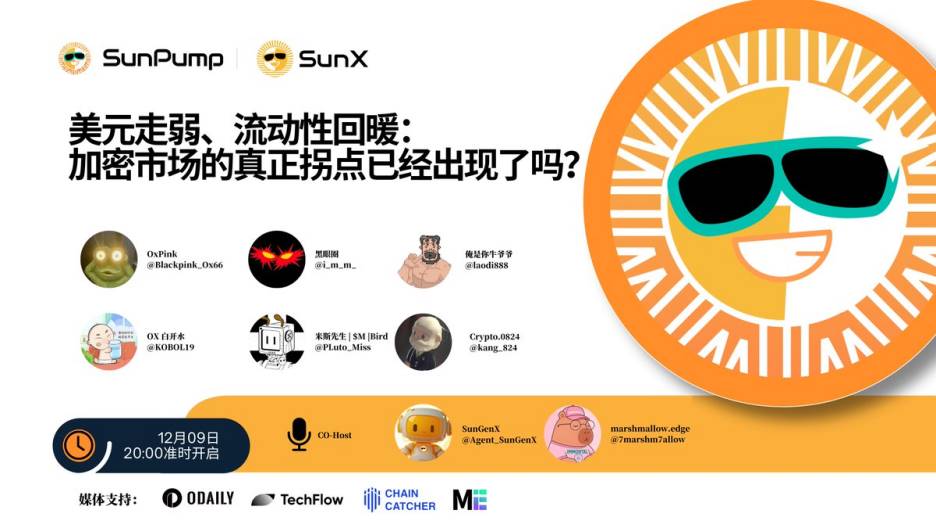
A Weakening Dollar + Resurging Liquidity: Do They Truly Constitute a Trend Inflection Point for the Crypto Market?

In the first segment of the Space discussion, several seasoned observers engaged in a deep and cautious analysis around the core question: "Does a weakening dollar and resurging liquidity constitute a trend inflection point?" Although market sentiment has shown warmth, the guests generally leaned towards defining it as a "repair" rather than a "reversal," emphasizing that confirming a true trend inflection point requires more time and validation through multi-dimensional signals.

Hei Yan Quan first set a high standard for judgment. He believes short-term data fluctuations are insufficient to support a trend argument; a true inflection point needs the support of long-term logic: first, confirmation of the Federal Reserve's easing cycle, entering a sustained rate-cutting channel and substantive relaxation of quantitative tightening; second, dollar weakness needs to be based on a weakening U.S. economic fundamentals, thereby long-term pressure on dollar credit; third, global non-U.S. currencies need to form a pattern of synchronized strengthening. He emphasized that only when liquidity shows the dual sustainability of "total expansion" and "qualitative inflow into the crypto market" can the market shift from repair to a trend upward.

@laodi888, drawing from market historical experience, reminded investors with the year's multiple instances of "dashed expectations" that a single data point or a few days of dollar decline are not enough to support a long-term bull market. She defined the current market as a "strong repair after a deep correction," a correction of the excessively pessimistic sentiment from before. Her practical advice was to treat the next 1-2 months as a critical observation period, focusing on whether dollar weakness can persist and whether Fed rate cuts can materialize. During this time, one can participate in the market but must remain vigilant, not equating a rebound with a reversal.

0xPink also reviewed history, pointing out that every major crypto cycle has occurred against a backdrop of a weakening dollar and loose liquidity, so it's natural for the market to associate this with "a big rally is coming." But he pointed out sharply that the market is such that "one data point changes sentiment, but sustained data determines the trend." He shared personal indicators for confirming an inflection point: a comprehensive rebound in risk appetite (broad rally across various risk assets), consecutive growth in stablecoin supply, and major coins breaking through key resistance levels. He concluded that if U.S. Treasury yields continue to fall over the next two months and the Fed releases clearer dovish signals, the possibility of a major cycle arriving will increase.

Before the Inflection Point Arrives, Position First: Deciphering Capital Rotation Patterns and the Certain Opportunities in the Tron TRON Ecosystem

After clarifying that the current market is in an "observation period for repair" rather than a "confirmed inflection point," a more practical question follows: If liquidity continues to recover, what path will funds follow in their layout within the crypto world? In the second segment of the Space, guests combined historical patterns with the current market structure to outline a clear capital rotation roadmap and provided a highly operational strategic framework for ordinary investors.

Regarding the sequence of liquidity injection, the guests showed a high degree of consensus on a gradual process from "core mainstream" to "peripheral innovation." 0xPink used a vivid metaphor to describe this process: liquidity is like filling water; it will inevitably fill "reservoirs" like Bitcoin and Ethereum first. He particularly pointed out that assets like TRX, which have solid payment demand, a large user base, and stable cash flow, due to their unique utility and stability, also fall within the scope of early beneficiaries. Subsequently, the market enters a second stage where funds seek higher returns, flowing into sectors with strong narratives and amplified sentiment like RWA, AI, and Meme coins. The final stage, where funds permeate to small projects, often signifies the cycle is entering a later phase, with returns and risks both sharply amplified.

Mr. Mi Si supplemented the discussion on fund flow, noting that besides deep liquidity mainstream assets like Bitcoin and Ethereum, funds are also attracted to compliant stable yield products. The massive stablecoin assets carried on the Tron TRON network and its rich DeFi ecosystem are becoming the first stop for many users entering the crypto world and seeking stable returns.

Specifically, the "stable yield path" provided by Tron TRON is clear and attractive:

1. Low-risk entry: As one of the world's largest stablecoin circulation networks, a large amount of USDT and other stablecoins are issued and circulated on the Tron TRON chain, providing a crypto entry point with zero price volatility risk for funds seeking safety and stability.

2. Stable DeFi yield: After holding stablecoins, funds can earn yield without taking risks through mature DeFi protocols on the Tron TRON network. For example, depositing stablecoins into the JustLend DAO lending platform to obtain stable annualized yield, or participating in liquidity mining on the SUN.io platform. Currently, the TRX/USDT liquidity pool on SUN.io has $129 million, with a 24-hour trading volume of $42.8 million. This model provides a "buffer" that generates cash flow for funds during the观望期 (observation period), balancing safety and yield.

3. Asset hub connecting stability and growth: When market risk appetite increases, stable funds settled in the Tron DeFi ecosystem can be easily exchanged for other tokens within the Tron TRON ecosystem via SunSwap to participate in subsequent sector rotations. For example, investors can quickly switch part of their stablecoin yield to ecosystem projects with strong narratives and high volatility, such as AI (e.g., AINFT) or Meme (e.g., SunPump), thereby capturing the excess return opportunities brought by sector rotations while controlling overall risk.

At the current juncture where macro signals are初步显现 (initially appearing) and market sentiment is cautiously repairing, the core conclusion of this roundtable is clear and prudent: confirming the trend takes time, but the framework for action can be established first. A true inflection point is not defined by a single data point but by the resonance and sustained validation of multiple signals (macro cycle, fund flow, market structure). For investors, more important than predicting the exact "inflection point" is building their own "certainty" amidst uncertainty. The path demonstrated by Tron TRON—from stablecoin entry, DeFi yield generation, to efficient rotation within the ecosystem—precisely provides an operable现实样板 (practical example) for this strategy of "participating while observing, advancing steadily while being aggressive."

Ultimately, when the direction of the global liquidity tide becomes truly clear, those investors who are well-prepared, have a solid asset structure, and understand fund flows will be more likely to become trend riders, rather than merely passive followers. Market cycles always advance amidst fluctuations, and rationality and strategy are the fundamentals for anchoring value in every ebb and flow.


Domande pertinenti

QAccording to the Space discussion, what are the key criteria for confirming a true trend reversal in the crypto market, rather than just a short-term rebound?

AThe key criteria include: 1) The Federal Reserve's easing cycle being confirmed, with sustained interest rate cuts and a substantial relaxation of quantitative tightening. 2) A weakening US dollar based on a疲软的 US economic fundamentals, which would suppress dollar credit long-term. 3) A synchronized strengthening of global non-US currencies. Additionally, liquidity must show both 'quantitative expansion' and 'qualitative inflow into the crypto market' with sustained momentum.

QHow do the panelists describe the typical path of capital flow when liquidity enters the crypto market?

AThe panelists describe a clear, gradual capital flow path: liquidity first fills 'reservoirs' like Bitcoin and Ethereum. Assets with solid utility, large user bases, and stable cash flows, such as TRX, also benefit early. In the second stage, capital seeks higher yields and flows into narrative-driven, high-sentiment sectors like RWA, AI, and Meme coins. The final stage involves capital trickling down to smaller projects, which is often a sign the cycle is in its later, riskier phase.

QWhat specific 'stable yield path' does the TRON network offer to investors during market uncertainty?

ATRON offers a three-part stable yield path: 1) A low-risk entry point as a major network for stablecoins like USDT, offering a crypto on-ramp with zero price volatility. 2) Stable DeFi yields by depositing stablecoins into protocols like JustLend DAO for fixed APY or providing liquidity on SUN.io. 3) An asset hub connecting stable holdings to growth, allowing users to swap stablecoin yields on SunSwap for higher-risk, higher-reward生态 tokens like those in the AI or Meme sectors.

QWhat was the general consensus among the panelists on the current state of the market: a 'repair' or a 'reversal'?

AThe general consensus among the panelists was that the current market state is a 'repair' or a 'powerful rebound after a deep correction,' not a confirmed 'reversal.' They emphasized that a true trend reversal requires more time and multi-dimensional signals for validation, advising caution and a 1-2 month observation period to see if the dollar's weakness persists and Fed rate cuts materialize.

QWhich specific metrics did the speaker 0xPink suggest watching to gauge a potential major cycle in the crypto market?

A0xPink suggested watching for: 1) A comprehensive rebound in risk appetite (a broad rally across various risk assets). 2) Consecutive growth in the stablecoin supply. 3) Major cryptocurrencies breaking through key resistance levels. He added that if US Treasury yields continue to fall and the Fed sends clearer dovish signals over the next two months, the possibility of a major cycle would increase.

Letture associate

Warsh's First Day in Office, Markets Deliver a 'Wake-up Call': Rate Hike Expected This Year

On his first day in office, newly inaugurated Federal Reserve Chairman Warsh received a stark market warning, with expectations now fully pricing in a 25-basis-point interest rate hike this year. The shift was triggered by hawkish remarks from Fed Governor Waller, who stated that inflation is now the key policy "driver" and that the odds of a hike or cut are evenly split. This sent short-term Treasury yields higher. Waller signaled a significant pivot in his stance, citing disappointing inflation and labor data. He suggested removing "easing bias" language from Fed statements and did not rule out future rate increases if inflation fails to recede, though he noted immediate action isn't warranted without signs of unanchored inflation expectations. Chairman Warsh faces immediate pressure at his first FOMC meeting in June. With the preferred inflation gauge at a three-year high, analysts warn that failing to hike could be interpreted as an implicit easing of policy. The geopolitical situation in the Middle East is adding to existing price pressures. The market's expectation for a hike contrasts sharply with earlier forecasts for multiple cuts. While long-term Treasury yields have been contained by lower energy prices recently, analysts note they remain under structural upward pressure. Warsh's swearing-in at the White House highlights political scrutiny over Fed independence. However, the market has made it clear that inflation is the most urgent challenge, leaving the new chairman little time to settle in.

marsbit1 h fa

Warsh's First Day in Office, Markets Deliver a 'Wake-up Call': Rate Hike Expected This Year

marsbit1 h fa

Has Microsoft Lost Its Way in the AI Race, and Can Copilot Bring It Back on Track?

Microsoft, once seen as an early AI frontrunner due to its investment in OpenAI, is navigating a strategic shift amid increased competition. Its initial reliance on OpenAI’s GPT models has been complicated by OpenAI’s growing ambitions as a direct competitor, rapid advancements from rivals like Claude and Gemini, and the disruptive rise of AI agents, which challenge its traditional SaaS business model. These factors contributed to stock declines and slower-than-expected adoption of its flagship Copilot products. In response, CEO Satya Nadella has taken a hands-on role in product development, signaling the urgency of change. Microsoft is pivoting from a model-centric strategy to a "model-agnostic" enterprise platform approach. It aims to become the foundational layer connecting various AI models—from OpenAI, Anthropic, or its own new "Superintelligence" team—with enterprise workflows, data, security, and cloud services. Recent organizational changes merged consumer and enterprise Copilot teams to accelerate innovation, exemplified by new products like Copilot Tasks and Copilot Cowork. However, this transformation comes at a high cost. Microsoft faces massive capital expenditures, potentially reaching ~$190 billion by 2026, to support AI infrastructure. While its platform strategy shows early signs of traction with growing Azure AI revenue, it must balance startup-like agility with the reliability expected by enterprise clients. The core challenge is no longer being the sole AI winner but defending its position as the essential enterprise software entry point amidst rapid technological commoditization and the shift towards always-on AI agents.

marsbit1 h fa

Has Microsoft Lost Its Way in the AI Race, and Can Copilot Bring It Back on Track?

marsbit1 h fa

Why Haven't Forex Stablecoins Taken Off?

Why FX Stablecoins Never Took Off: A Path Forward via Synthetic FX Despite the explosive growth of stablecoin-powered digital banking, which has seen ~$6B in VC investment and a 24x surge in crypto card spending in under a year, a major limitation persists: these banks are essentially dollar-only accounts. This leaves 95-99% of global accounts, which are denominated in non-USD currencies, underserved. Attempts to create native foreign currency (FX) stablecoins (like EURC) have largely failed, with total FX stablecoin TVL at ~$600M compared to $400B for USD stablecoins—a 700x gap. These FX tokens face critical challenges: fragile pegs due to low liquidity, limited exchange/FinTech acceptance, poor on/off-ramps, complex regional compliance, and a chicken-and-egg adoption problem. The article argues that the solution lies not in competing with entrenched USD stablecoin networks (USDT/USDC), but in adopting a synthetic FX model inspired by traditional finance. Specifically, it advocates for Mark-to-Market Non-Deliverable Forwards (NDFs)—cash-settled FX derivatives that allow users to maintain underlying USD stablecoin holdings while having their account balance and P&L denominated in a foreign currency. This approach offers key advantages: strong oracle-based pegs, retention of deep USD stablecoin liquidity and yield, superior on/off-ramps, scalability to any currency with a reliable feed, and capital efficiency. It mirrors how modern institutional FX markets operate. Primary use cases for on-chain NDFs include: 1. **Digital Banks/Wallets:** Enabling multi-currency accounts for international users without leaving the USD stablecoin ecosystem, boosting deposits and retention. 2. **FX Carry Trade Vaults:** Offering access to sovereign interest rate differentials (e.g., earning yield on BRL) in a more stable and scalable format than crypto-native products like Ethena. 3. **Global Enterprise Payments:** Allowing merchants to receive payments in local currency equivalents while settling in USD stablecoins, similar to services offered by Stripe for fiat. The conclusion is that synthetic FX, not native FX stablecoins, is the viable path to integrating foreign exchange into the growing stablecoin digital banking landscape, potentially unlocking the next phase of institutional DeFi and multi-trillion-dollar global adoption.

链捕手2 h fa

Why Haven't Forex Stablecoins Taken Off?

链捕手2 h fa

Trading

Spot
Futures

Articoli Popolari

Cosa è GENIUS

I. Introduzione al Progetto1. Cos'è Genius?Genius (GENIUS) si posiziona come il "terminal on-chain definitivo", una piattaforma di trading decentralizzata focalizzata sulla privacy e sulla velocità. Integrando tecnologie di privacy di alto livello, mira a costruire un'infrastruttura di trading privacy di nuova generazione attraverso reti come BNB Chain, consentendo agli utenti di interagire on-chain con un'esperienza fluida paragonabile a quella degli exchange centralizzati.2. Come Funziona Genius?L'architettura tecnica principale di Genius è strutturata come segue:(1) Invisibile alla catena: Gli utenti non devono gestire manualmente approvazioni a più passaggi per operazioni cross-chain, wrapping di asset o gestione complessa del gas.(2) Trading senza Firma: Attraverso integrazioni come Turnkey, Genius consente trading istantaneo senza conferme a comparsa o autorizzazione per transazione.(3) Aggregatore di Aggregatori: Genius è alimentato da uno stack di aggregazione di prima classe integrato con oltre 150 DEX, vantando un'efficienza di quotazione superiore rispetto ai prodotti concorrenti.(4) Gestione degli Account: La piattaforma adotta un'architettura non custodiale e sfrutta Turnkey e Lit Protocol per la gestione delle chiavi, consentendo agli utenti di accedere in modo sicuro ai propri account tramite passkey.3. Chi Ha Creato Genius?Secondo i suoi Termini di Servizio ufficiali, Genius è stato sviluppato da Shuttle Labs, Inc. Basandosi sull'account ufficiale X del progetto, Ryan Myher è uno dei principali contributori che guidano l'iterazione del prodotto, inclusi sviluppi come il lancio del protocollo Ghost, oltre a un coinvolgimento più ampio della comunità.Il fondatore di Binance CZ ha ufficialmente aderito al progetto come consulente, con l'obiettivo di aiutare il team a costruire un'esperienza di trading on-chain più veloce e rispettosa della privacy.Inoltre, il progetto ha ricevuto un forte sostegno da YZi Labs, che ha investito in Genius e collabora con la Genius Foundation, responsabile della manutenzione del core Genius Bridge Protocol (GBP).4. Tokenomics di GeniusGENIUS è il token nativo dell'ecosistema Genius. Ad oggi, il progetto non ha rilasciato un documento completo di tokenomics.Basandosi sulle ultime divulgazioni ufficiali, Genius incorpora un meccanismo deflazionistico, e il 4,6% dell'offerta totale di token era già stato bruciato durante la fase di lancio iniziale.Sistema di Genius Points (GP):(1) Trade-to-Earn: La piattaforma ha stabilito un pool di ricompensa di 200 milioni di Genius Points, e gli utenti guadagnano GP per ogni trade eseguito tramite il terminale.(2) Livelli e Badge: Genius presenta un sistema di badge basato sulla progressione che va da Smart a God, con livelli superiori che sbloccano vantaggi e benefici aggiuntivi.(3) Rendimento Nativo: Gli utenti che detengono asset designati come usdGG nel dashboard possono guadagnare rendimento nativo direttamente senza dover passare attraverso staking complessi.(4) Incentivi per Referral: I referenti possono guadagnare rimborsi sulle commissioni superiori al 45% pagati in USDC, insieme a GP aggiuntivi.5. Cronologia & Traguardi ChiaveMarzo 2020: È stato creato l'account ufficiale X del progetto, segnando l'inizio della sua fase di preparazione iniziale.13 gennaio 2026: Genius ha annunciato un investimento multimilionario da YZi Labs e ha contemporaneamente confermato CZ come consulente per accelerare lo sviluppo della sua infrastruttura di trading privacy.18 aprile 2026: Il progetto ha annunciato che il protocollo di privacy Ghost sarebbe stato lanciato a breve.29 aprile 2026: Il protocollo Ghost è stato ufficialmente aperto ai suoi primi 50 tester, segnando l'inizio di una nuova era per il trading privacy su BNB Chain. Allo stesso tempo, il team ha confermato che il 4,6% dei token è stato bruciato.​II. Informazioni sul Token1) Informazioni di BaseNome del token: GENIUS (Genius)III. Link CorrelatiSito web:https://www.tradegenius.com/homeEsploratori:https://bscscan.com/address/0x1f12b85aac097e43aa1555b2881e98a51090e9a6Social:https://x.com/GeniusTerminalNota: L'introduzione al progetto proviene dai materiali pubblicati o forniti dal team ufficiale del progetto, che è solo a scopo di riferimento e non costituisce consulenza per gli investimenti. HTX non si assume responsabilità per eventuali perdite dirette o indirette risultanti.

247 Totale visualizzazioniPubblicato il 2026.04.29Aggiornato il 2026.05.12

Cosa è GENIUS

Come comprare GENIUS

Benvenuto in HTX.com! Abbiamo reso l'acquisto di Genius (GENIUS) semplice e conveniente. Segui la nostra guida passo passo per intraprendere il tuo viaggio nel mondo delle criptovalute.Step 1: Crea il tuo Account HTXUsa la tua email o numero di telefono per registrarti il tuo account gratuito su HTX. Vivi un'esperienza facile e sblocca tutte le funzionalità,Crea il mio accountStep 2: Vai in Acquista crypto e seleziona il tuo metodo di pagamentoCarta di credito/debito: utilizza la tua Visa o Mastercard per acquistare immediatamente GeniusGENIUS.Bilancio: Usa i fondi dal bilancio del tuo account HTX per fare trading senza problemi.Terze parti: abbiamo aggiunto metodi di pagamento molto utilizzati come Google Pay e Apple Pay per maggiore comodità.P2P: Fai trading direttamente con altri utenti HTX.Over-the-Counter (OTC): Offriamo servizi su misura e tassi di cambio competitivi per i trader.Step 3: Conserva Genius (GENIUS)Dopo aver acquistato Genius (GENIUS), conserva nel tuo account HTX. In alternativa, puoi inviare tramite trasferimento blockchain o scambiare per altre criptovalute.Step 4: Scambia Genius (GENIUS)Scambia facilmente Genius (GENIUS) nel mercato spot di HTX. Accedi al tuo account, seleziona la tua coppia di trading, esegui le tue operazioni e monitora in tempo reale. Offriamo un'esperienza user-friendly sia per chi ha appena iniziato che per i trader più esperti.

123 Totale visualizzazioniPubblicato il 2026.04.29Aggiornato il 2026.05.12

Come comprare GENIUS

Come comprare MEGA

Benvenuto in HTX.com! Abbiamo reso l'acquisto di MegaETH (MEGA) semplice e conveniente. Segui la nostra guida passo passo per intraprendere il tuo viaggio nel mondo delle criptovalute.Step 1: Crea il tuo Account HTXUsa la tua email o numero di telefono per registrarti il tuo account gratuito su HTX. Vivi un'esperienza facile e sblocca tutte le funzionalità,Crea il mio accountStep 2: Vai in Acquista crypto e seleziona il tuo metodo di pagamentoCarta di credito/debito: utilizza la tua Visa o Mastercard per acquistare immediatamente MegaETHMEGA.Bilancio: Usa i fondi dal bilancio del tuo account HTX per fare trading senza problemi.Terze parti: abbiamo aggiunto metodi di pagamento molto utilizzati come Google Pay e Apple Pay per maggiore comodità.P2P: Fai trading direttamente con altri utenti HTX.Over-the-Counter (OTC): Offriamo servizi su misura e tassi di cambio competitivi per i trader.Step 3: Conserva MegaETH (MEGA)Dopo aver acquistato MegaETH (MEGA), conserva nel tuo account HTX. In alternativa, puoi inviare tramite trasferimento blockchain o scambiare per altre criptovalute.Step 4: Scambia MegaETH (MEGA)Scambia facilmente MegaETH (MEGA) nel mercato spot di HTX. Accedi al tuo account, seleziona la tua coppia di trading, esegui le tue operazioni e monitora in tempo reale. Offriamo un'esperienza user-friendly sia per chi ha appena iniziato che per i trader più esperti.

93 Totale visualizzazioniPubblicato il 2026.04.30Aggiornato il 2026.04.30

Come comprare MEGA

Discussioni

Benvenuto nella Community HTX. Qui puoi rimanere informato sugli ultimi sviluppi della piattaforma e accedere ad approfondimenti esperti sul mercato. Le opinioni degli utenti sul prezzo di A A sono presentate come di seguito.

活动图片