Space Recap | When a Weakening Dollar Meets a Resurgence in Liquidity: Crypto Market Trend Analysis and Tron TRON Ecosystem Strategy

深潮Pubblicato 2025-12-10Pubblicato ultima volta 2025-12-10

Introduzione

A review of a recent Space discussion explores the connection between a weakening US dollar, improving global liquidity, and potential trends in the cryptocurrency market. While recent market rebounds align with these macro shifts, analysts caution against declaring a definitive trend reversal, characterizing the current state as a "repair" phase following excessive pessimism. Key takeaway is that a true market inflection point requires sustained signals: confirmation of a Fed easing cycle with continuous rate cuts, a fundamental weakening of the US economy suppressing the dollar, and a synchronized rise in non-US currencies. Investors are advised to monitor the next 1-2 months for persistence in dollar weakness and concrete Fed action. The discussion also outlined a probable capital flow trajectory: liquidity would first enter core mainstream assets like Bitcoin and Ethereum. Assets with solid utility, like TRX with its payment demand and user base, are also positioned for early benefit. This would be followed by a rotation into higher-yield, narrative-driven sectors like RWA, AI, and Meme coins. The Tron (TRON) ecosystem was highlighted as a strategic entry point and hub for this potential capital rotation. Its position as a major network for stablecoin circulation (like USDT) offers a low-risk, non-volatile on-ramp. Users can then earn stable yields through its DeFi protocols (e.g., JustLend DAO, SUN.io) while awaiting clearer market trends. Finally, its native DEX, Sun...

As the global macroeconomic landscape quietly shifts, two signal lights gradually illuminate through the market fog: the U.S. dollar index retreating from its highs and signs of a resurgence in global liquidity. These changes are touching the sensitive nerves of the crypto market, with Bitcoin and major cryptocurrencies stabilizing and rebounding, seemingly resonating in sync with this macro warm current.

However, in the crypto space, a brief liquidity-driven rebound and a true trend reversal are often separated by a distance that requires careful discernment. The core confusion for investors is not the phenomenon itself, but its sustainability and depth: Is this merely short-term volatility due to adjusted policy rhythms, or the beginning of a longer cycle of dollar weakness and liquidity expansion? Will funds truly be systematically reallocated to crypto assets on a large scale? How will the path of market recovery unfold?

Against this backdrop, SunPump recently hosted a Space roundtable discussion focusing on the shift in macro liquidity and the prospects of the crypto market. It not only attempted to dissect the core proposition of "whether a weakening dollar and resurging liquidity constitute a trend inflection point for the crypto market" but also strived to translate the macro tidal changes into perceptible, executable fund allocation logic and phased strategies. This recap will梳理 (organize) the core insights from the discussion to help users more clearly discern direction amidst the changing tides of global capital.
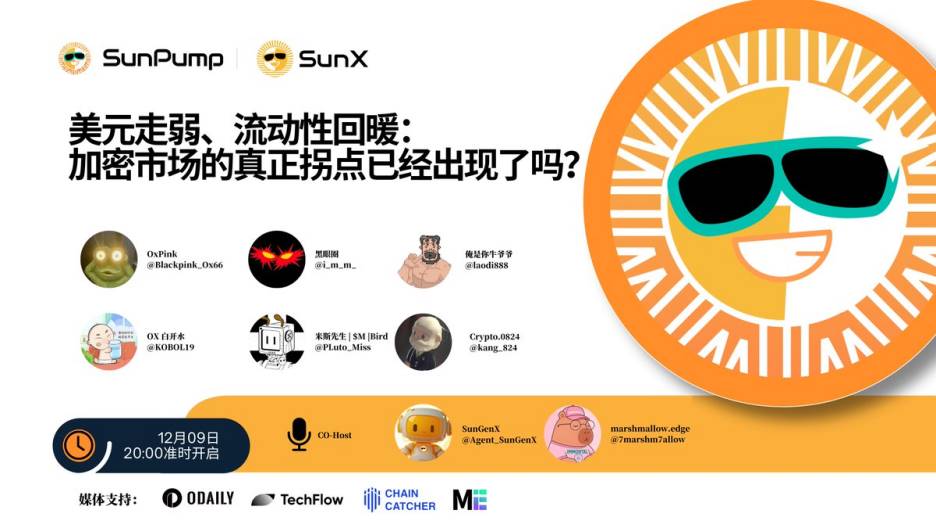
A Weakening Dollar + Resurging Liquidity: Do They Truly Constitute a Trend Inflection Point for the Crypto Market?

In the first segment of the Space discussion, several seasoned observers engaged in a deep and cautious analysis around the core question: "Does a weakening dollar and resurging liquidity constitute a trend inflection point?" Although market sentiment has shown warmth, the guests generally leaned towards defining it as a "repair" rather than a "reversal," emphasizing that confirming a true trend inflection point requires more time and validation through multi-dimensional signals.

Hei Yan Quan first set a high standard for judgment. He believes short-term data fluctuations are insufficient to support a trend argument; a true inflection point needs the support of long-term logic: first, confirmation of the Federal Reserve's easing cycle, entering a sustained rate-cutting channel and substantive relaxation of quantitative tightening; second, dollar weakness needs to be based on a weakening U.S. economic fundamentals, thereby long-term pressure on dollar credit; third, global non-U.S. currencies need to form a pattern of synchronized strengthening. He emphasized that only when liquidity shows the dual sustainability of "total expansion" and "qualitative inflow into the crypto market" can the market shift from repair to a trend upward.

@laodi888, drawing from market historical experience, reminded investors with the year's multiple instances of "dashed expectations" that a single data point or a few days of dollar decline are not enough to support a long-term bull market. She defined the current market as a "strong repair after a deep correction," a correction of the excessively pessimistic sentiment from before. Her practical advice was to treat the next 1-2 months as a critical observation period, focusing on whether dollar weakness can persist and whether Fed rate cuts can materialize. During this time, one can participate in the market but must remain vigilant, not equating a rebound with a reversal.

0xPink also reviewed history, pointing out that every major crypto cycle has occurred against a backdrop of a weakening dollar and loose liquidity, so it's natural for the market to associate this with "a big rally is coming." But he pointed out sharply that the market is such that "one data point changes sentiment, but sustained data determines the trend." He shared personal indicators for confirming an inflection point: a comprehensive rebound in risk appetite (broad rally across various risk assets), consecutive growth in stablecoin supply, and major coins breaking through key resistance levels. He concluded that if U.S. Treasury yields continue to fall over the next two months and the Fed releases clearer dovish signals, the possibility of a major cycle arriving will increase.

Before the Inflection Point Arrives, Position First: Deciphering Capital Rotation Patterns and the Certain Opportunities in the Tron TRON Ecosystem

After clarifying that the current market is in an "observation period for repair" rather than a "confirmed inflection point," a more practical question follows: If liquidity continues to recover, what path will funds follow in their layout within the crypto world? In the second segment of the Space, guests combined historical patterns with the current market structure to outline a clear capital rotation roadmap and provided a highly operational strategic framework for ordinary investors.

Regarding the sequence of liquidity injection, the guests showed a high degree of consensus on a gradual process from "core mainstream" to "peripheral innovation." 0xPink used a vivid metaphor to describe this process: liquidity is like filling water; it will inevitably fill "reservoirs" like Bitcoin and Ethereum first. He particularly pointed out that assets like TRX, which have solid payment demand, a large user base, and stable cash flow, due to their unique utility and stability, also fall within the scope of early beneficiaries. Subsequently, the market enters a second stage where funds seek higher returns, flowing into sectors with strong narratives and amplified sentiment like RWA, AI, and Meme coins. The final stage, where funds permeate to small projects, often signifies the cycle is entering a later phase, with returns and risks both sharply amplified.

Mr. Mi Si supplemented the discussion on fund flow, noting that besides deep liquidity mainstream assets like Bitcoin and Ethereum, funds are also attracted to compliant stable yield products. The massive stablecoin assets carried on the Tron TRON network and its rich DeFi ecosystem are becoming the first stop for many users entering the crypto world and seeking stable returns.

Specifically, the "stable yield path" provided by Tron TRON is clear and attractive:

1. Low-risk entry: As one of the world's largest stablecoin circulation networks, a large amount of USDT and other stablecoins are issued and circulated on the Tron TRON chain, providing a crypto entry point with zero price volatility risk for funds seeking safety and stability.

2. Stable DeFi yield: After holding stablecoins, funds can earn yield without taking risks through mature DeFi protocols on the Tron TRON network. For example, depositing stablecoins into the JustLend DAO lending platform to obtain stable annualized yield, or participating in liquidity mining on the SUN.io platform. Currently, the TRX/USDT liquidity pool on SUN.io has $129 million, with a 24-hour trading volume of $42.8 million. This model provides a "buffer" that generates cash flow for funds during the观望期 (observation period), balancing safety and yield.

3. Asset hub connecting stability and growth: When market risk appetite increases, stable funds settled in the Tron DeFi ecosystem can be easily exchanged for other tokens within the Tron TRON ecosystem via SunSwap to participate in subsequent sector rotations. For example, investors can quickly switch part of their stablecoin yield to ecosystem projects with strong narratives and high volatility, such as AI (e.g., AINFT) or Meme (e.g., SunPump), thereby capturing the excess return opportunities brought by sector rotations while controlling overall risk.

At the current juncture where macro signals are初步显现 (initially appearing) and market sentiment is cautiously repairing, the core conclusion of this roundtable is clear and prudent: confirming the trend takes time, but the framework for action can be established first. A true inflection point is not defined by a single data point but by the resonance and sustained validation of multiple signals (macro cycle, fund flow, market structure). For investors, more important than predicting the exact "inflection point" is building their own "certainty" amidst uncertainty. The path demonstrated by Tron TRON—from stablecoin entry, DeFi yield generation, to efficient rotation within the ecosystem—precisely provides an operable现实样板 (practical example) for this strategy of "participating while observing, advancing steadily while being aggressive."

Ultimately, when the direction of the global liquidity tide becomes truly clear, those investors who are well-prepared, have a solid asset structure, and understand fund flows will be more likely to become trend riders, rather than merely passive followers. Market cycles always advance amidst fluctuations, and rationality and strategy are the fundamentals for anchoring value in every ebb and flow.

Domande pertinenti

QAccording to the Space discussion, what are the key criteria for confirming a true trend reversal in the crypto market, rather than just a short-term rebound?

AThe key criteria include: 1) The Federal Reserve's easing cycle being confirmed, with sustained interest rate cuts and a substantial relaxation of quantitative tightening. 2) A weakening US dollar based on a疲软的 US economic fundamentals, which would suppress dollar credit long-term. 3) A synchronized strengthening of global non-US currencies. Additionally, liquidity must show both 'quantitative expansion' and 'qualitative inflow into the crypto market' with sustained momentum.

QHow do the panelists describe the typical path of capital flow when liquidity enters the crypto market?

AThe panelists describe a clear, gradual capital flow path: liquidity first fills 'reservoirs' like Bitcoin and Ethereum. Assets with solid utility, large user bases, and stable cash flows, such as TRX, also benefit early. In the second stage, capital seeks higher yields and flows into narrative-driven, high-sentiment sectors like RWA, AI, and Meme coins. The final stage involves capital trickling down to smaller projects, which is often a sign the cycle is in its later, riskier phase.

QWhat specific 'stable yield path' does the TRON network offer to investors during market uncertainty?

ATRON offers a three-part stable yield path: 1) A low-risk entry point as a major network for stablecoins like USDT, offering a crypto on-ramp with zero price volatility. 2) Stable DeFi yields by depositing stablecoins into protocols like JustLend DAO for fixed APY or providing liquidity on SUN.io. 3) An asset hub connecting stable holdings to growth, allowing users to swap stablecoin yields on SunSwap for higher-risk, higher-reward生态 tokens like those in the AI or Meme sectors.

QWhat was the general consensus among the panelists on the current state of the market: a 'repair' or a 'reversal'?

AThe general consensus among the panelists was that the current market state is a 'repair' or a 'powerful rebound after a deep correction,' not a confirmed 'reversal.' They emphasized that a true trend reversal requires more time and multi-dimensional signals for validation, advising caution and a 1-2 month observation period to see if the dollar's weakness persists and Fed rate cuts materialize.

QWhich specific metrics did the speaker 0xPink suggest watching to gauge a potential major cycle in the crypto market?

A0xPink suggested watching for: 1) A comprehensive rebound in risk appetite (a broad rally across various risk assets). 2) Consecutive growth in the stablecoin supply. 3) Major cryptocurrencies breaking through key resistance levels. He added that if US Treasury yields continue to fall and the Fed sends clearer dovish signals over the next two months, the possibility of a major cycle would increase.

Letture associate

2029 Finale Prediction: When Cryptocurrency Completely "Vanishes", Who Can Remain in This Financial Upheaval?

By 2029, the crypto industry will have transformed into a largely invisible but foundational layer for traditional finance. This timeline outlines the key shifts from now until then. By mid-2026, the most sought-after assets on-chain will not be traditional tokens, but synthetic perpetual contracts for private, high-growth companies (like SpaceX, OpenAI). These become primary price discovery tools, highlighting the market's craving for real-world asset value. Most altcoins enter a sustained bear market as their fundamental lack of asset-backed value is exposed. In late 2026, the "AI + Crypto" narrative largely fades as AI giants prove they don't need crypto infrastructure, except for prediction markets betting on model performance. Simultaneously, a quiet but significant wave of tokenization for institutional assets (money market funds, private credit) begins. The industry splits into a noisy speculative economy and a silent institutional one. Throughout 2027, major public blockchain foundations pivot decisively to serve institutional clients, building compliance toolkits and sales teams. However, key sectors hit growth ceilings: private perpetual contracts are legally restricted from public promotion, stable币 growth is capped by looming political uncertainty, and tokenization projects remain cautious. In 2028, following a U.S. election assumed to maintain a regulatory (not prohibitive) stance, a pivotal change occurs. After a major liquidation crisis exposes the flaws of synthetic contracts lacking a real-asset anchor, new regulations allow the *public solicitation* of private security sales (secondary market shares) to accredited investors. This creates a legitimate, direct on-ramp for retail capital into previously illiquid private equity. By 2029, the resulting bull market is driven by trading in real, innovative company shares (biotech, robotics, AI labs), not speculative tokens. "Crypto" as a distinct asset class recedes; it becomes the mundane, unseen plumbing for this new global private markets infrastructure. Tokens that survive are those capturing real cash flows from this infrastructure. Speculation persists but is marginalized. The core questions posed at the start are answered: token value is tied to legally enforceable claims on real assets, frontier tech adoption happens via private market channels, and crypto's absorption into traditional finance is marked by its becoming boring and invisible. The key validation for this entire thesis is whether, by late 2028, a legal pathway exists for ordinary accredited investors to access private assets directly.

marsbit34 min fa

2029 Finale Prediction: When Cryptocurrency Completely "Vanishes", Who Can Remain in This Financial Upheaval?

marsbit34 min fa

After the U.S. Banned Fable 5, Zhipu's Stock Soared 47%

On June 15, Chinese AI company Zhipu's stock surged up to 47.6% in Hong Kong, closing with a 32.82% gain. This sharp rise followed two key industry events. On June 12, Anthropic was compelled by a U.S. government export control order to suspend global access to its latest flagship models, Claude Fable 5 and Claude Mythos 5, impacting developers and businesses reliant on them. The next day, Zhipu announced it was opening access to its new open-source flagship model, GLM-5.2, for all Coding Plan users, with API and model weights (under the MIT license) to follow. The Anthropic incident highlighted a critical shift in the AI industry: beyond raw capability, the stability, continuous accessibility, and control over AI models are becoming equally vital, especially as AI integrates deeper into business workflows. Zhipu's move, emphasizing that "frontier intelligence should not belong to a few nor be subject to arbitrary revocation," positioned its open, accessible model as an alternative. GLM-5.2 focuses on "Long Horizon Tasks" with a 1M context window, aiming for consistency in complex, extended projects. Market analysts suggest this event exposes the risk of dependency on closed-source models subject to single jurisdiction policies, potentially accelerating a shift toward domestic base models and localized deployments. The investment response indicates a new valuation metric is emerging—prioritizing which companies can provide AI capabilities that are not only advanced but also reliably and sustainably accessible.

marsbit35 min fa

After the U.S. Banned Fable 5, Zhipu's Stock Soared 47%

marsbit35 min fa

PANews Column Registration and Article Submission Guide

"PANews Column Registration and Submission Guide" provides instructions for users to register as columnists and publish articles on the PANews platform. Key application requirements are emphasized: content should focus on in-depth analysis within Crypto, Web3, blockchain, data, and viewpoints. Content primarily for brand/product introductions will not be approved, and heavily AI-generated content will be rejected. Promotional (PR/soft) content is directed to the business channel. **Registration Process:** * **Web:** Go to the official website footer, click "Apply for Column," and register with a phone number or email (login via verification code, no password). Fill in the column name, description, upload an avatar, and submit links to previously published work. * **Mobile:** Navigate to "My" -> "Contribute & Create" and complete the form. **Article Submission Tutorial:** 1. Log in to the PANews website. 2. Access the "Creator Center" from your personal homepage. 3. Use the editor to create and publish articles. **Video Upload:** The platform supports embedding videos from third-party sites (e.g., Bilibili). Copy the embed code from the source video, use the editor's "Insert/Edit media" button, paste the code under the "Embed" tab, and adjust the display size (recommended: width 100%, height 560px). **PANews Skills (AI Agent Tool):** PANews offers an official AI Agent skill set called PANews Skills, enabling AI tools to query platform content, track trends, and publish column articles directly. It includes three main skills: 1. `panews`: For tracking daily must-read lists, popular articles, and funding news. 2. `panews-creator`: For managing columns, publishing articles, and uploading images. 3. `panews-web-viewer`: For parsing PANews webpages into Markdown. These skills are compatible with various AI Agent tools (OpenClaw, Cursor, Claude Code, ChatGPT, Gemini, etc.). To use the `panews-creator` skill, users must obtain a specific authentication value from the PANews website after logging into their columnist account.

marsbit46 min fa

PANews Column Registration and Article Submission Guide

marsbit46 min fa

I Built Myself an Investment Workbench Using AI

For the past two weeks, I've been immersed in Vibe Coding—using AI to write code from natural language descriptions. This process has enabled me to quickly build functional tools that address long-standing personal ideas. Previously, I had many concepts but found execution too cumbersome. Key ideas included a unified dashboard for assets across US stocks, Crypto, HK stocks, and A-shares; a real-time alert system for price movements; an investment map visualizing sector relationships; and a tool to correlate prediction market bets with news and market data. Traditional development hurdles meant these often remained unrealized. Using AI (Codex, Claude Code, and DeepSeek API), I built four initial tools: 1. A **Cross-Market Asset Dashboard** showing total assets, daily P&L, and holdings by market, with added features for alerts and sector mapping. It's deployed locally for privacy. 2. A **Prediction Market (PM) Monitor** tracking bets on events (e.g., company valuations) and correlating probability shifts with news and market movements. I categorize bets by conviction to filter noise. 3. A **Simple Operations Backend** for managing my writing workflow (topics, progress, publishing). It's cloud-deployed for mobile access. 4. A **One-Click Formatting Tool** that automates converting drafts into various platform-specific formats, saving manual effort. While these tools are basic, they represent a significant shift: AI lowers the barrier to creating personalized systems. I believe individual investors can now feasibly build core systems for: * **Asset Observation** (tracking holdings and changes) * **Signal Monitoring** (watching for key market shifts) * **Sector Mapping** (understanding network relationships within a sector) * **Performance Review** (documenting rationale and outcomes) The power of Vibe Coding is its fast feedback loop. Ideas can be implemented, tested, and iterated on rapidly, turning "want-to-do" into "done." This marks the start of my new phase, where I'll share investment thoughts, tool tests, on-chain operations, and educational Web3 content.

marsbit1 h fa

I Built Myself an Investment Workbench Using AI

marsbit1 h fa

Trading

Spot
Futures

Articoli Popolari

Cosa è ATWO

I. Introduzione al ProgettoArena Two è una piattaforma interattiva decentralizzata che consente ai fan di svolgere un ruolo attivo e tokenizzato nei risultati degli eventi in tempo reale. A differenza dei modelli di trasmissione tradizionali che riducono i fan a spettatori passivi, Arena Two sfrutta la tecnologia blockchain per consentire ai fan di votare direttamente in tempo reale e influenzare i risultati sul campo.II. Informazioni sul TokenNome del token: ATWO(Arena Two)III. Link CorrelatiSito web:https://arenatwo.com/Esploratori:https://basescan.org/token/0x499D35eBE6cEe9B2Ac35Fd003fcBbeeB9CFc7B32Twitter:https://x.com/arenatwoXNota: L'introduzione al progetto proviene dai materiali pubblicati o forniti dal team ufficiale del progetto, che è solo a scopo di riferimento e non costituisce consulenza sugli investimenti. HTX non si assume responsabilità per eventuali perdite dirette o indirette derivanti.

214 Totale visualizzazioniPubblicato il 2026.05.18Aggiornato il 2026.06.02

Cosa è ATWO

Come comprare ATWO

Benvenuto in HTX.com! Abbiamo reso l'acquisto di Arena Two (ATWO) semplice e conveniente. Segui la nostra guida passo passo per intraprendere il tuo viaggio nel mondo delle criptovalute.Step 1: Crea il tuo Account HTXUsa la tua email o numero di telefono per registrarti il tuo account gratuito su HTX. Vivi un'esperienza facile e sblocca tutte le funzionalità,Crea il mio accountStep 2: Vai in Acquista crypto e seleziona il tuo metodo di pagamentoCarta di credito/debito: utilizza la tua Visa o Mastercard per acquistare immediatamente Arena TwoATWO.Bilancio: Usa i fondi dal bilancio del tuo account HTX per fare trading senza problemi.Terze parti: abbiamo aggiunto metodi di pagamento molto utilizzati come Google Pay e Apple Pay per maggiore comodità.P2P: Fai trading direttamente con altri utenti HTX.Over-the-Counter (OTC): Offriamo servizi su misura e tassi di cambio competitivi per i trader.Step 3: Conserva Arena Two (ATWO)Dopo aver acquistato Arena Two (ATWO), conserva nel tuo account HTX. In alternativa, puoi inviare tramite trasferimento blockchain o scambiare per altre criptovalute.Step 4: Scambia Arena Two (ATWO)Scambia facilmente Arena Two (ATWO) nel mercato spot di HTX. Accedi al tuo account, seleziona la tua coppia di trading, esegui le tue operazioni e monitora in tempo reale. Offriamo un'esperienza user-friendly sia per chi ha appena iniziato che per i trader più esperti.

121 Totale visualizzazioniPubblicato il 2026.05.18Aggiornato il 2026.06.02

Come comprare ATWO

Cosa è ZEST

I. Introduzione al Progetto1. Cos'è Zest Protocol?Zest Protocol è un protocollo di prestito nativo di Bitcoin costruito su Stacks Layer 2 che consente agli utenti di guadagnare rendimento con BTC o di prendere in prestito asset collaterizzando BTC. I contratti intelligenti del protocollo sono scritti nel linguaggio Clarity, operano interamente on-chain e sono open-source, con un design ispirato a Aave v3. Zest è attualmente il più grande protocollo DeFi su Stacks, con oltre 800 BTC depositati e un TVL massimo che supera i 100 milioni di dollari. Nel maggio 2026, il protocollo ha ulteriormente introdotto i Bitcoin Collateral Vaults, estendendo le capacità di prestito da Stacks alla rete principale di Bitcoin. Questo consente agli utenti di prendere in prestito stablecoin senza spostare BTC dalla rete Bitcoin, abilitando prestiti in custodia autonoma.2. Come Funziona Zest Protocol?Zest Protocol è composto da due mercati. Il mercato di Stacks è costruito su Aave v3, consentendo agli utenti di depositare asset come sBTC, STX e USDC per guadagnare rendimento o prendere prestiti sovra-collaterizzati. Il LTV massimo predefinito è del 50% (70% per sBTC). Il mercato di Bitcoin opera attraverso i recentemente lanciati Bitcoin Collateral Vaults. Gli utenti prendono in prestito stablecoin bloccando BTC in vaults di custodia autonoma sulla catena di Bitcoin. Il collaterale rimane sulla rete principale di Bitcoin durante l'intero processo, e gli utenti mantengono la custodia a meno che la posizione non venga liquidata.3. Chi Ha Fondato Zest Protocol?Tycho Onnasch (Co-Fondatore): Laureato all'Università di Oxford. Coinvolto nella ricerca e nei finanziamenti per la Stacks Open Internet Foundation. Ex Manager presso Trust Machines e Fondatore di Deedmob. Profilo LinkedIn: https://www.linkedin.com/in/tychokoonnasch/.Fernando Foy (Co-Fondatore): Ha precedentemente lavorato nella consulenza IT presso Objectif Emploi. Profilo LinkedIn: https://www.linkedin.com/in/fernando-foy/.Emil E. (Co-Fondatore): Ha un Master in Fisica dall'Università di Warwick. Ex Partner Ingegneristico presso Trust Machines, Sviluppatore Full-Stack per progetti Web3 e Data Scientist presso HSBC. Profilo LinkedIn: https://www.linkedin.com/in/emil-e-49771a145/.Dettagli sul Finanziamento: Nel maggio 2024, Zest Protocol ha annunciato il completamento di un round di finanziamento seed da 3,5 milioni di dollari guidato da Tim Draper, con la partecipazione di Binance Labs, Flow Traders, Trust Machines e altri.4. Tokenomics di $ZEST$ZEST è il token nativo di Zest Protocol con un'offerta totale fissa di 1 miliardo di token e senza meccanismo inflazionistico.Comunità (27,83%): Utilizzato per airdrop e incentivi per gli utenti;Sviluppo dell'Ecosistema (24,82%): Utilizzato per liquidità, partnership, marketing, listing su exchange, ecc.;Investitori (22,35%): Sostegno alle parti investitrici che hanno supportato lo sviluppo iniziale di Zest Protocol;Team (25%): Allocato per i contributori principali.Piano di Vesting: I token del Team e degli Investitori sono soggetti a un periodo di lock-up di 1 anno seguito da 3 anni di sblocco lineare.5. Cronologia delle Pietre Miliari Chiave2022: Zest Protocol è ufficialmente fondato.Marzo 2024: Completato l'audit di sicurezza e lanciato il mercato di prestiti di Stacks sulla mainnet.Nel febbraio 2026, viene lanciato il Mercato Stacks V2, introducendo i Gruppi di Rischio.Nel maggio 2026, sono stati introdotti i Bitcoin Collateral Vaults e un prototipo operativo della mainnet è ora disponibile. Questo consente agli utenti di utilizzare BTC in custodia autonoma sulla L1 di Bitcoin come collaterale per prendere in prestito stablecoin su catene EVM, ponendo fine a bridging, wrapping e custodia di terze parti. Questo rollout è diviso in due fasi. Fase 1: Utilizza transazioni pre-firmate per limitare il movimento di BTC; Fase 2: Utilizza BitVM per la verifica. II. Informazioni sul TokenNome del token: ZEST (Zest Protocol)III. Link CorrelatiSito web: https://www.zestprotocol.com/Esploratori: https://bscscan.com/token/0x5506599c722389a60580b5213ea1da60d64754a1Twitter: https://twitter.com/ZestProtocolNota: L'introduzione del progetto proviene dai materiali pubblicati o forniti dal team ufficiale del progetto, che è solo a scopo di riferimento e non costituisce consulenza per gli investimenti. HTX non si assume responsabilità per eventuali perdite dirette o indirette risultanti.

115 Totale visualizzazioniPubblicato il 2026.05.19Aggiornato il 2026.06.02

Cosa è ZEST

Discussioni

Benvenuto nella Community HTX. Qui puoi rimanere informato sugli ultimi sviluppi della piattaforma e accedere ad approfondimenti esperti sul mercato. Le opinioni degli utenti sul prezzo di A A sono presentate come di seguito.

活动图片