South Korean Stocks Plunge, Global Funds Liquidate: Has the Semiconductor Fundamentals Really Changed?

marsbitPubblicato 2026-06-08Pubblicato ultima volta 2026-06-08

Introduzione

South Korean stocks experienced their sharpest decline of the year, with the KOSPI index plunging nearly 9% on Monday, triggering a market circuit breaker. Leading semiconductor firms Samsung Electronics and SK Hynix were heavily sold off, raising questions about whether the AI-driven bull market has reached an inflection point. This sell-off was largely triggered by a significant drop in the U.S. semiconductor sector late last week. Concurrently, NVIDIA CEO Jensen Huang visited Seoul over the weekend, meeting with top executives from SK Group, Samsung, LG, and NAVER. He announced a new multi-year partnership with SK Hynix to co-develop next-generation memory products for AI data centers. Huang emphasized that AI infrastructure build-out remains in its early stages, creating a stark contrast between market panic and ongoing, strengthened industry collaboration. The article argues that South Korea has become one of the most sensitive markets for global AI-related capital flows, functioning like a large AI memory ETF due to the heavy weighting of its chipmakers. The current market turmoil reflects a shift in investor focus: from simply betting on overall AI growth to scrutinizing which companies will actually capture the profits from that growth. This "profit pool reassessment" phase is causing high volatility based on supply chain news and earnings guidance. Ultimately, the direction of the Korean market will be determined by external factors—NVIDIA's orders, HBM supply-dem...

TL;DR

The South Korean stock market just experienced its sharpest drop this year.

After opening on Monday, the KOSPI fell nearly 9% intraday, triggering a circuit breaker. Both Samsung Electronics and SK Hynix plunged heavily, and the market began discussing whether the AI bull market has reached an inflection point.

But while the market panicked and sold off, another event was unfolding in Seoul.

Jensen Huang began his visit to South Korea over the weekend, not only meeting with SK Group Chairman Chey Tae-won but also announcing a new multi-year cooperation agreement between NVIDIA and SK Hynix to jointly develop next-generation memory products for AI data centers. Simultaneously, he held intensive meetings with South Korean tech giants like Samsung Electronics, LG, and NAVER, reiterating that AI infrastructure construction is still in its early stages.

Thus, a rather contrasting picture emerged in the market.

On one side, South Korea's AI leaders faced concentrated selling pressure; on the other, the most core customer in the AI supply chain was moving to strengthen its ties with Korean suppliers.

If AI demand was truly collapsing, Jensen Huang wouldn't have needed to fly to Seoul specifically to reinforce cooperation.

This is also why a new debate is emerging in the market today.

Is the Korean market preemptively signaling the peak of the AI cycle, or is it experiencing a typical high-leverage deleveraging event?

South Korea Becomes One of the Most Sensitive Markets for Global AI Trading

Although this decline occurred in South Korea, the trigger did not originate there.

Last Friday, the U.S. semiconductor sector faced a sharp sell-off. The Philadelphia Semiconductor Index recorded one of its worst single-day declines in recent years, with AI infrastructure-related companies like Broadcom and Micron also correcting. Subsequently, the market began to reassess the risk exposure of high-valuation tech stocks.

South Korea became the most directly affected market.

Over the past year, the core driver of the South Korean stock market's rise has not been its domestic economy, but rather AI data center construction, HBM demand growth, and the expansion of the NVIDIA supply chain.

Samsung Electronics and SK Hynix together account for an extremely high weighting in the Korean market. When global funds want to bet on AI infrastructure, South Korea is one of the most convenient entry points; and when funds begin to reduce their AI exposure, South Korea naturally becomes one of the easiest markets to sell.

As a result, the decline in the Korean market far exceeded that in the U.S. market itself.
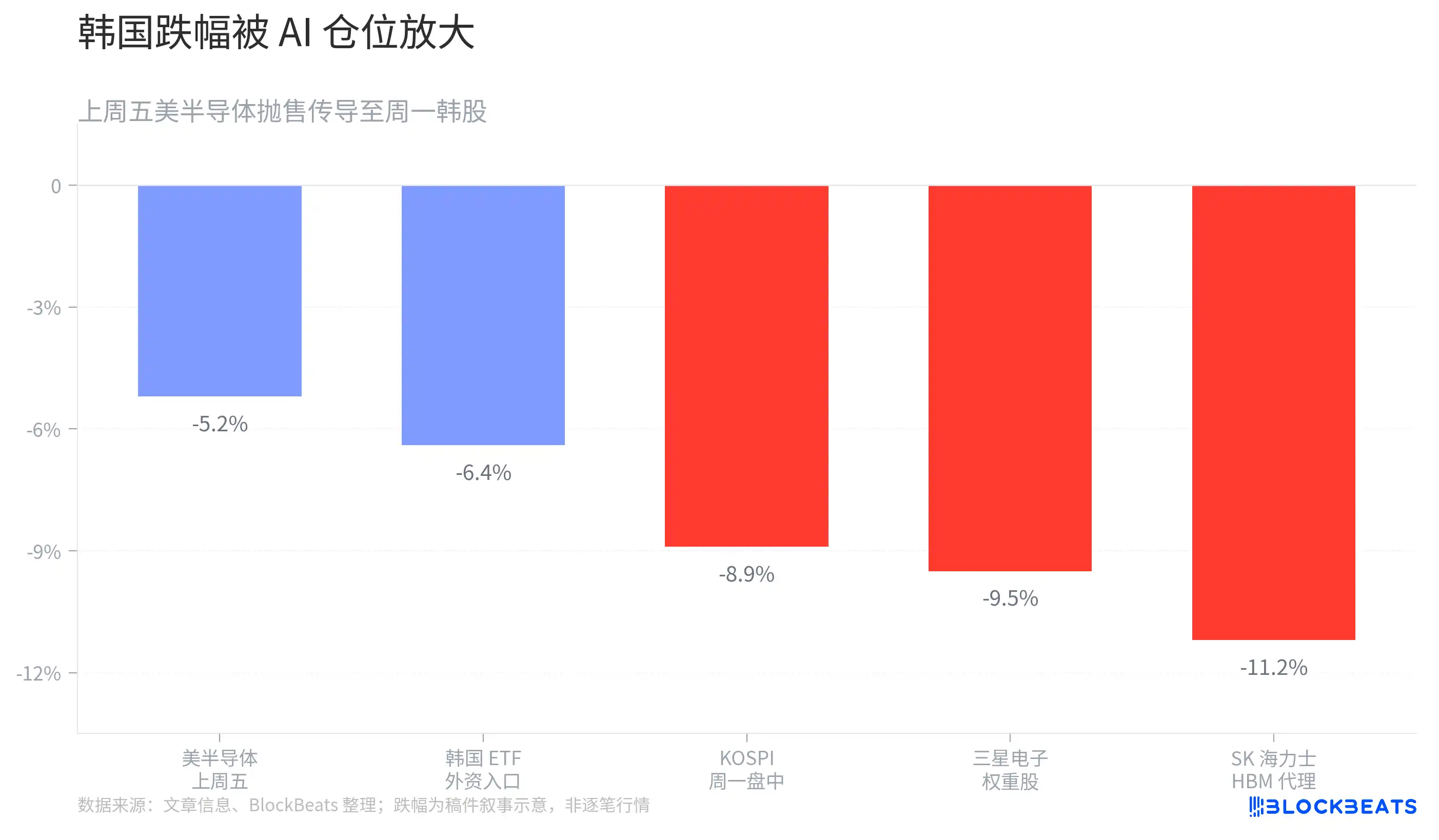
In a sense, South Korea is no longer just a national index, but more like a large AI memory ETF.

Jensen Huang's Visit to South Korea Presents a Stark Contrast to Market Panic

If market panic stems from valuations, then the biggest positive news over the weekend came from the supply chain itself.

The core objective of Jensen Huang's visit to South Korea was very clear: to further strengthen the cooperative relationship between NVIDIA and the Korean AI supply chain. The most notable development was the announcement of a new multi-year cooperation agreement between NVIDIA and SK Hynix. Over the past two years, HBM has become one of the most critical components in AI servers, and SK Hynix is one of the biggest beneficiaries of this trend.

This is also why the market highly anticipated this cooperation.

In recent months, as the scale of AI infrastructure construction continues to expand, the market began to worry about whether HBM demand growth would gradually peak. However, Jensen Huang's visit to South Korea at this time actually sends the opposite signal. If NVIDIA believed that AI data center construction was nearing its end, it wouldn't need to reinforce long-term cooperative relationships with suppliers at this point.
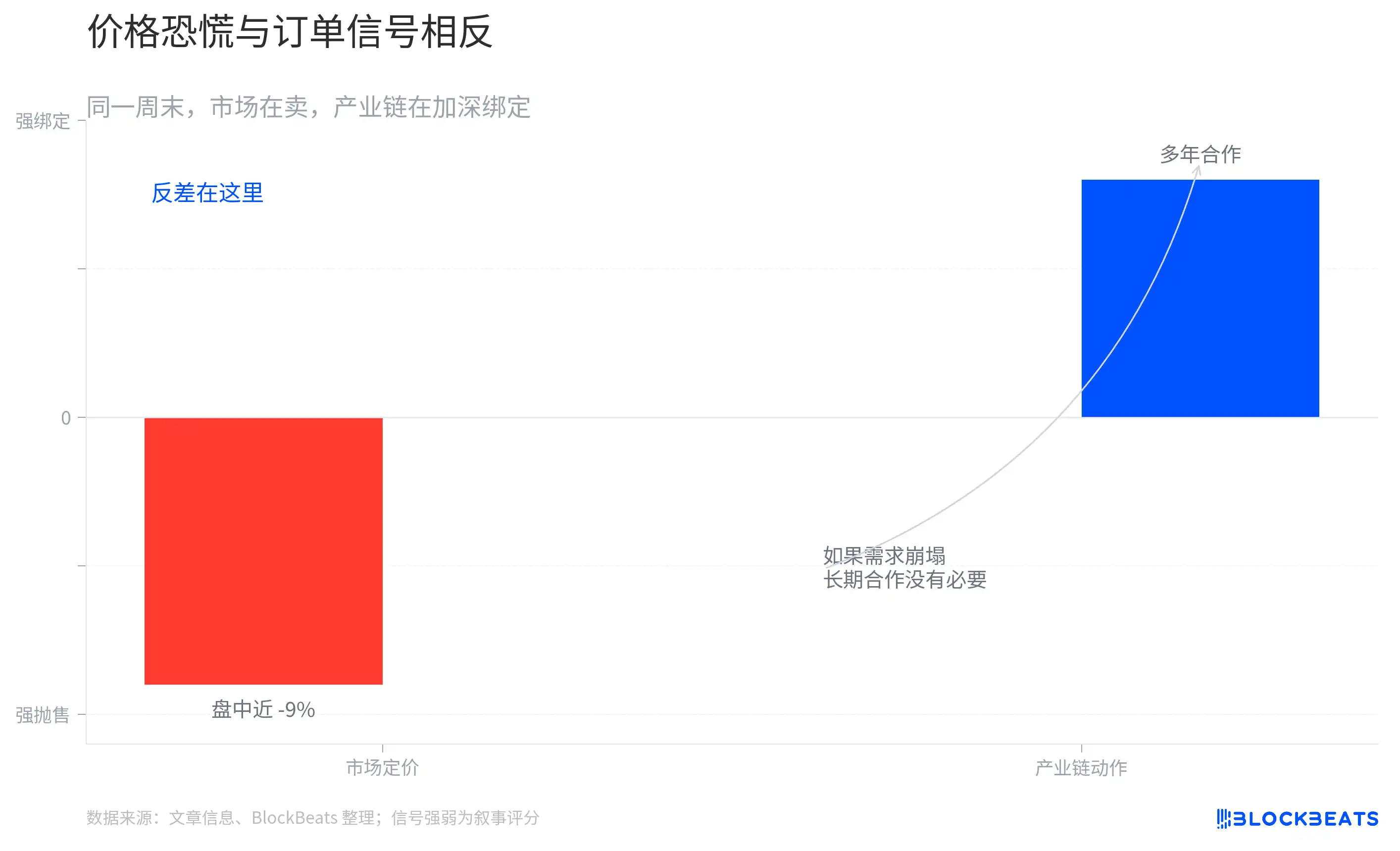
From a supply chain perspective, there is no evidence yet of a sudden disappearance of AI demand.

The most interesting part of the past two days lies right here. The capital market is using stock prices to express concerns about AI sector valuations, while the core enterprises in the supply chain are still discussing expansion and cooperation plans for the coming years. A significant temperature gap remains between the price signaled by the market and the signal released by the industry.

The AI Bull Market Begins Entering the Profit Pool Reassessment Stage

This is also the core of the current major divergence.

Over the past year, the market traded a very simple logic: AI demand growth. Therefore, NVIDIA rose, Micron rose, SK Hynix rose, Samsung Electronics rose—almost any company related to AI received a valuation boost.

But as the sector's gains continued to expand, the market has entered a second stage.

Investors are no longer satisfied with the story of 'AI will grow,' and have begun to ask another question: Who will ultimately capture the profits created by AI growth? In recent months, from the Rubin rack system memory adjustments, to the market reaction following Broadcom's earnings, to this Korean market crash, they all essentially reflect the same thing—the market is beginning to deconstruct the AI profit pool.

SK Hynix benefits from HBM, Samsung Electronics positions itself across HBM, DRAM, and advanced packaging, while Micron benefits more from the overall AI server memory upgrade. Although they all belong to the AI supply chain, their respective profit sources and pricing power are not the same.
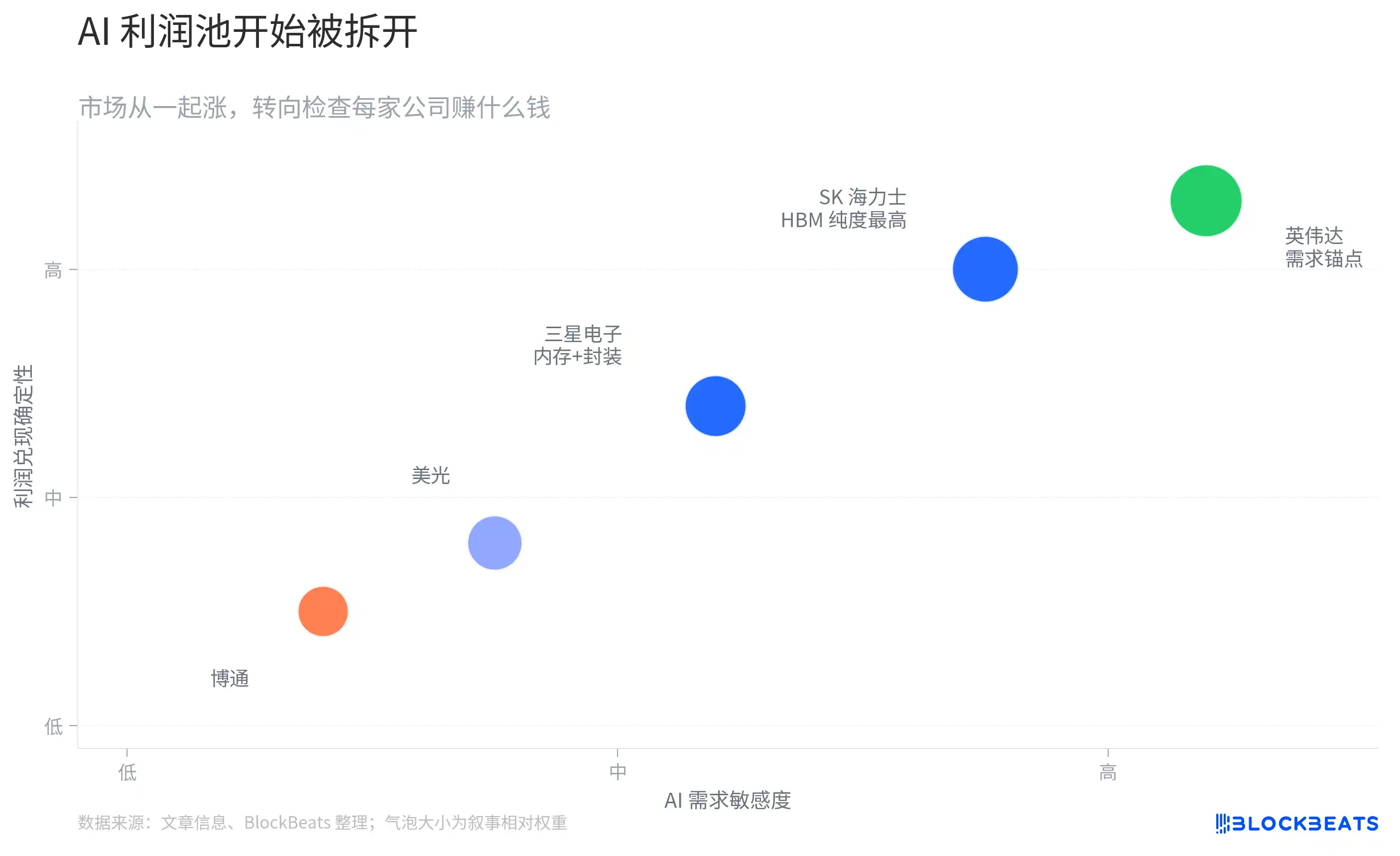
Previously, the market was willing to collectively expand valuations for the entire sector. Now, capital is beginning to examine, one by one, whether these profits can truly be realized.

This is also why a supply chain update, an earnings guidance, or even a capital expenditure adjustment can trigger significant volatility across the entire sector. The focus of market trading has shifted: rather than whether AI will continue to grow, investors are more concerned about whose financial statements the growth will ultimately land on.

What Decides South Korean Stocks is Not South Korea

In the coming weeks, what will truly determine the direction of the South Korean market remains NVIDIA's orders, HBM supply and demand, and capital expenditures from cloud service providers.
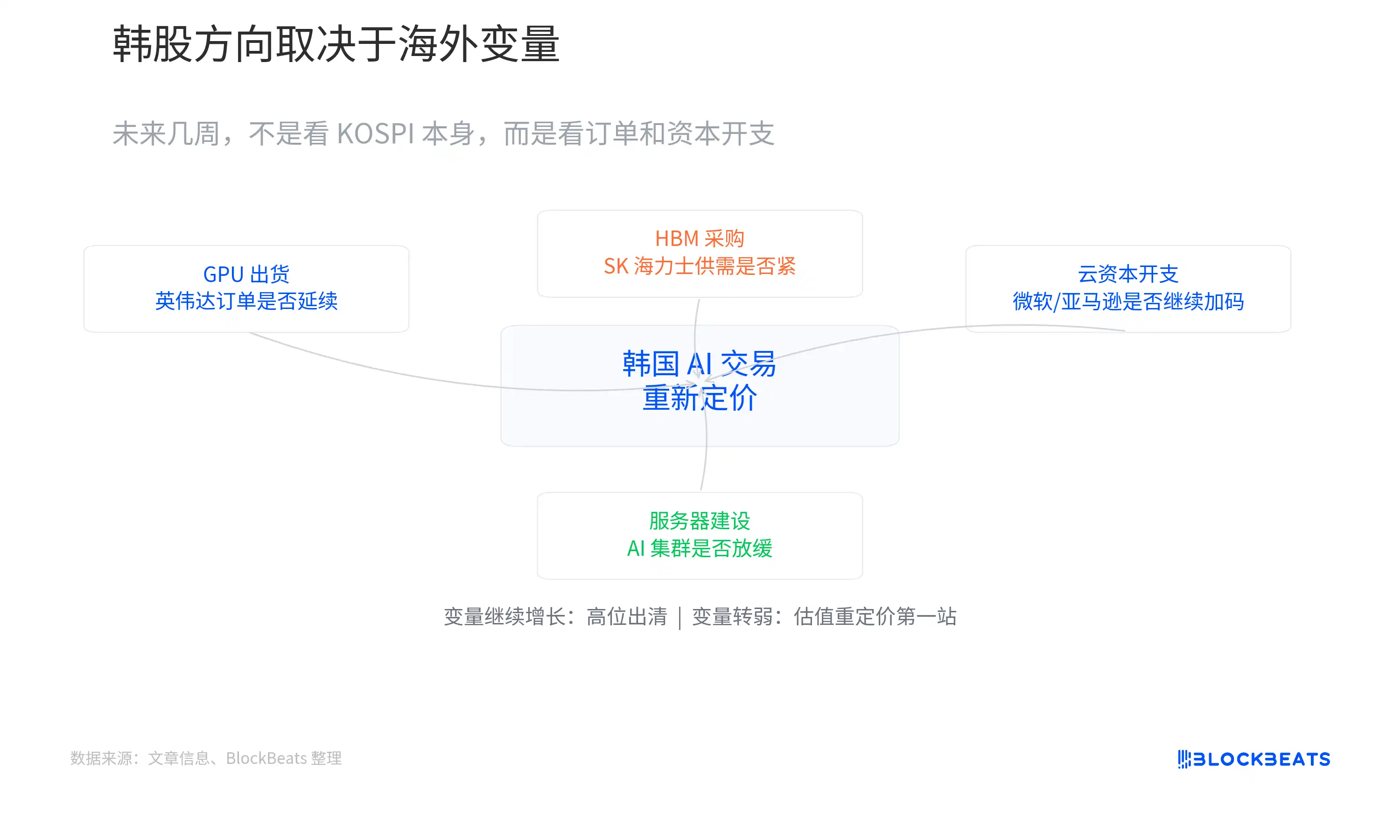
If this data begins to weaken, then this crash may be just the beginning of a larger-scale valuation adjustment.

But if data center construction, GPU shipments, and HBM procurement continue to maintain high growth, then Monday's circuit breaker looks more like a concentrated liquidation of a crowded trade.

At least from the current vantage point, the price signaled by the market and the signal released by the industry are not entirely aligned.

On one side, South Korea's AI leaders are facing the most severe selling pressure in years; on the other, Jensen Huang is in Seoul discussing the next generation of AI infrastructure with supply chain partners.

Whose judgment is closer to reality? Perhaps we will have an answer soon.

Domande pertinenti

QAccording to the article, what event triggered the sharp decline in the South Korean stock market (KOSPI), and which two companies were most affected?

AThe sharp decline in the South Korean stock market was triggered by a significant sell-off in the U.S. semiconductor sector on the previous Friday. The two most affected companies were Samsung Electronics and SK Hynix, both of which are major players in the AI supply chain and carry high weightings in the Korean market index.

QDespite the market panic, what significant business activity did Jensen Huang's recent visit to Seoul indicate about the AI industry's future?

AJensen Huang's visit to Seoul involved strengthening partnerships with key South Korean AI suppliers. The highlight was the announcement of a new multi-year cooperation agreement between NVIDIA and SK Hynix to jointly develop next-generation memory products for AI data centers. This activity indicates that core players in the AI infrastructure chain remain committed to long-term collaboration and expansion, suggesting they believe AI demand is still in its early stages and not collapsing.

QHow does the article describe the current main focus of investors in the AI sector, shifting from the initial investment phase?

AThe article states that the market has entered a second stage where the main focus of investors has shifted. Initially, investors broadly valued any company related to AI growth. Now, they are scrutinizing the 'profit pool,' asking which specific companies will actually capture and realize the profits generated by AI growth, leading to a re-evaluation based on individual profit sources and pricing power rather than sector-wide optimism.

QWhat key factors does the article identify as ultimately determining the future direction of the South Korean stock market?

AThe article identifies that the future direction of the South Korean stock market will be determined by external, global factors related to AI infrastructure demand, not domestic Korean issues. The key factors are: NVIDIA's orders, the supply and demand dynamics for HBM (High Bandwidth Memory), and the capital expenditure plans of major cloud service providers.

QWhat contrasting views does the article present regarding the nature of the South Korean market crash?

AThe article presents two contrasting interpretations of the market crash. One view is that it signals an early peak in the AI cycle, reflecting a fundamental change in demand prospects. The other view is that it represents a typical 'high-leverage unwinding' or a concentrated sell-off in a crowded trade, driven more by valuation concerns and position adjustments than by a sudden disappearance of underlying AI demand.

Letture associate

Bitcoin Mining Farms Are Becoming AI Factories

Bitcoin mines are transforming into AI factories. This shift is driven by the convergence of three key assets from the previous crypto cycle: infrastructure, talent, and capital. Crypto mining companies like Crusoe, CoreWeave, and Bitdeer are repurposing their core competency—securing power, land, and grid connections in remote locations—to build data centers for AI clients. These firms are signing multi-billion dollar, long-term contracts with companies like Anthropic, AWS, and Microsoft, as AI's demand for reliable, high-capacity compute surpasses the profitability of Bitcoin mining. Simultaneously, crypto entrepreneurs and engineers are applying their skills to new AI ventures. Examples include OpenSea's co-founder launching OpenRouter (an AI model aggregator), and former Coinbase engineers building Fal.ai (a generative media infrastructure platform). Their experience in building scalable, global software networks translates effectively to the AI space. Furthermore, capital accumulated during the crypto boom is now fueling AI. Figures like Jed McCaleb (co-founder of Ripple) funded Voltage Park, a large-scale GPU cloud provider. Notably, some crypto investments, like FTX's early bets on Anthropic and Cursor, have generated astronomical paper returns, demonstrating how high-risk crypto capital flowed into AI before it became mainstream. The transition is not just about repurposing hardware, but about redirecting critical resources—power infrastructure, distributed systems expertise, and venture funding—to the next technological frontier: artificial intelligence.

链捕手1 h fa

Bitcoin Mining Farms Are Becoming AI Factories

链捕手1 h fa

Morpho Launches Fixed-Rate Product Midnight: Lenders and Borrowers Set Their Own Rates, Ending the Era of Interest Rate Models

Morpho Launches Fixed-Rate Product Midnight: Lenders and Borrowers Set Their Own Rates, Ending the Era of Algorithmic Interest Models On-chain lending has grown to $60 billion but remains minuscule compared to traditional finance's $200 trillion annual credit volume. Morpho identifies the lack of fixed rates and maturity dates as key bottlenecks. Institutions need predictability, not the passive floating rates set by algorithmic models. Midnight allows lenders and borrowers to directly quote rates, set terms, and become price makers, not takers. Fixed-rate lending is now viable due to cheaper, faster blockchains and the entry of institutions demanding control and certainty over returns, costs, and duration. Morpho Blue previously gave users control over risk; Midnight adds control over interest rates. Past attempts at on-chain fixed-rate lending failed primarily because they were built on top of floating-rate pools (creating unpredictability) or lacked sufficient active participants. Midnight avoids these pitfalls as a standalone primitive with fixed rates at its core, built upon Morpho Blue's existing large and active user base. Midnight offers distinct value: institutions gain predictable term structures and full control; fintech companies can offer tailored fixed-rate products; lenders/borrowers achieve predictability and efficiency; and curators can now differentiate by configuring both risk and interest rates. Morpho Midnight is not a replacement for Morpho Blue. The Morpho network will now feature two complementary market structures: floating-rate/open-term (Blue) for flexibility and fixed-rate/fixed-term (Midnight) for predictability. Liquidity can flow between them. The launch will be gradual, prioritizing security. Initially, it will support direct lending on Base network with one trading pair (cbBTC/USDC) and limited maturity dates. Advanced features like auto-rollovers will be introduced later.

marsbit1 h fa

Morpho Launches Fixed-Rate Product Midnight: Lenders and Borrowers Set Their Own Rates, Ending the Era of Interest Rate Models

marsbit1 h fa

Trading

Spot
活动图片