Sonnet 5.5 Major Leak, Pitted Against DeepSeek, The New Generation King of Cost-Effectiveness

marsbitPubblicato 2026-08-10Pubblicato ultima volta 2026-08-10

Introduzione

Anthropic's upcoming Sonnet 5.5 model, internally codenamed "Fennec" and potentially launching next month, is reportedly set to challenge DeepSeek V4 Flash as the new value leader. Key leaks suggest a 200万 token context window, faster推理, improved long-context reasoning and multi-step planning, and significantly enhanced agent capabilities like browser and terminal use. While its综合 performance is said to approach the flagship Claude Fable 5, it will remain priced at the Sonnet tier. This positions Sonnet 5.5 as a potentially highly competitive option in the mid-to-high-end AI model market, offering接近Fable-level ability at a more accessible price point. The update also signals a strategic shift, with Sonnet potentially taking over the value segment from the long-unupdated Haiku series.

The competition between Anthropic and OpenAI is heating up.

Ever since DeepSeek V4 Flash entered the arena with its super cost-effective identity, it seems no overseas tech giant can sit still.

Anthropic's latest Sonnet 5.5 model has been leaked and is reportedly ready for launch, with the internal codename "Fennec" (a type of desert fox). Leaks suggest it is highly likely to be released next month.
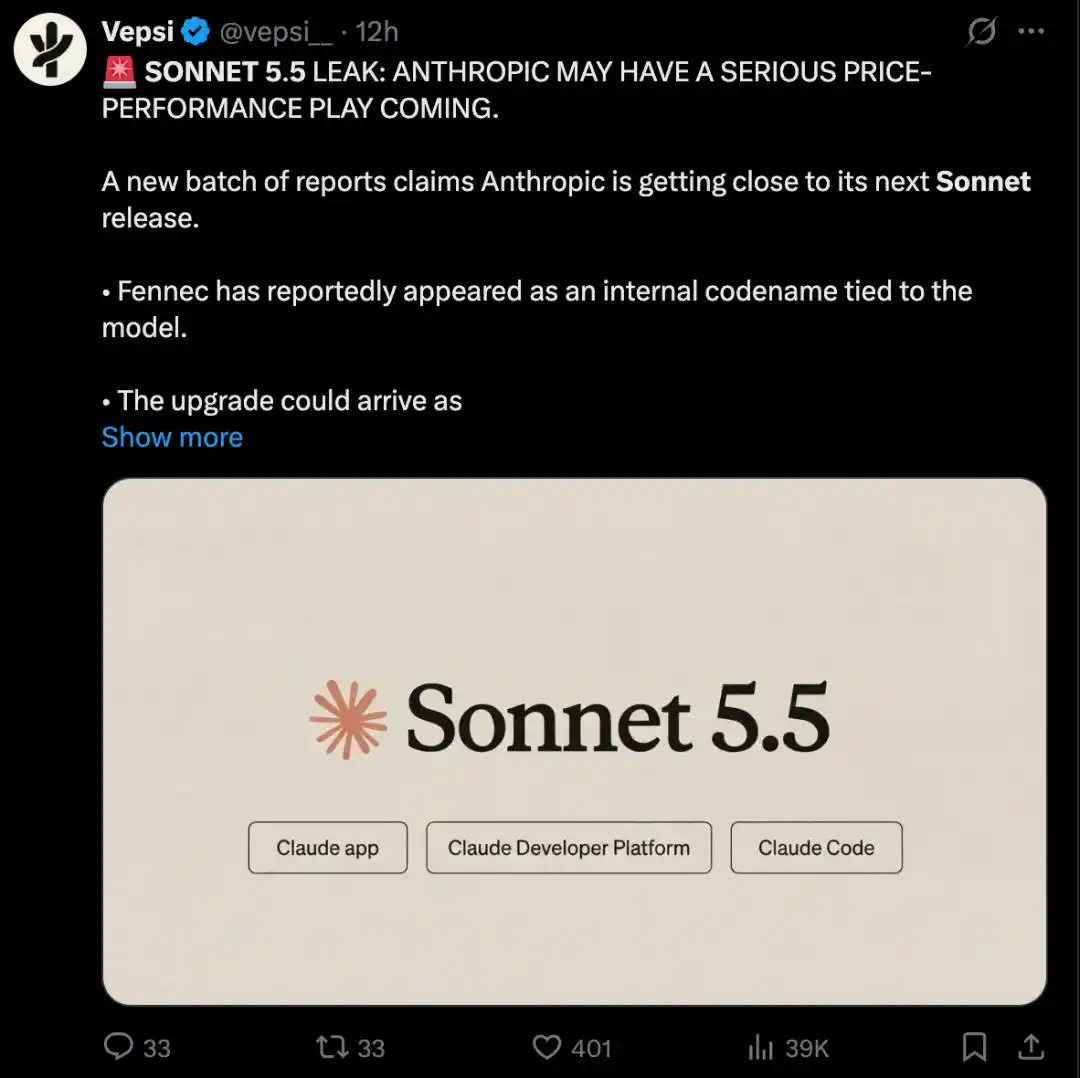
To summarize the leaked information briefly: 200K token context window, faster reasoning speed and lower latency, enhanced long-context reasoning and multi-step planning capabilities, and significant improvements in tool usage such as browsers and terminals. Its capabilities approach Fable 5, while its pricing remains at the Sonnet tier.

According to the currently circulating information:

  • Release Date: Possibly as early as next month
  • Development Progress: Reportedly in the final stages
  • Internal Codename: Previously associated with "Fennec"
  • Context Window: Up to 200K Tokens
  • Reasoning Speed: Expected to be faster with lower latency
  • Reasoning Capability: Long-context reasoning and multi-step planning will be further improved
  • Agent Capabilities: Stronger usage abilities for browsers, terminals, and various tools
  • Performance: Overall capabilities may approach Claude Fable 5
  • Pricing: Will remain at the Sonnet tier

If these rumors are ultimately confirmed, Sonnet 5.5 could become one of the most noteworthy products in the increasingly competitive mid-to-high-end AI model market.

The current context window for Sonnet 5 is 100K tokens, and the official documentation clearly states that 1M is both the default and maximum value, with no smaller variants offered. Doubling to 200K would directly benefit developers working with large code repositories and extensive document collections.

Sonnet 5 itself is Anthropic's model primarily focused on agentic capabilities, described in official introductions as "capable of making plans, using tools like browsers and terminals, and running autonomously." If 5.5 takes a further step in browser and terminal interactions, it means productivity will advance even more.

Regardless, Fable 5 remains the absolute performance king.

Will It Become the New King of Cost-Effectiveness?

We have reason to believe that the new Sonnet 5.5 is positioned to compete with DeepSeek V4 Flash.

As competition in the AI market intensifies, the contest between large models is no longer confined to benchmark scores but is shifting toward a more practical dimension: how much intelligence users actually get for every dollar spent.

If the currently leaked information is largely accurate, Sonnet 5.5 is poised to occupy an extremely attractive position between mainstream AI models and high-priced cutting-edge systems.

Netizens have also expressed high expectations for its cost-effectiveness.

However, Anthropic's most cost-effective series of models is Haiku, which hasn't been updated for about a year. It seems everyone has almost forgotten about it.
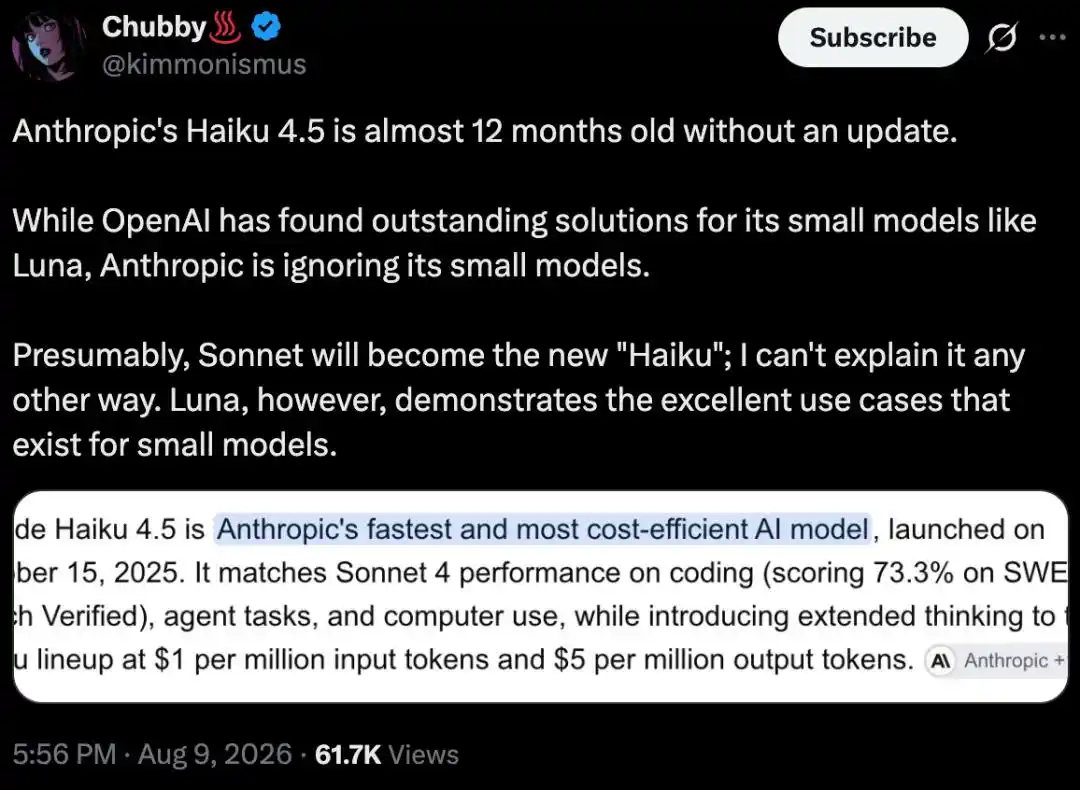
Considering that OpenAI has presented quite impressive solutions with smaller models like Luna, we can draw an inference: Anthropic intends to let Sonnet directly take over the position originally held by Haiku.

If Anthropic can provide reasoning capabilities close to Fable's level at a lower cost, Claude Sonnet 5.5 could very well become one of the most cost-effective AI models on the market.

This article is from the WeChat public account "机器之心" (The Heart of Machines), author: The Heart of Machines (Focused on Large Models), Editor: Cold Cat


Domande pertinenti

QWhat are the key leaked specifications of Anthropic's upcoming Sonnet 5.5 model?

AThe leaked specifications include a 2 million token context window, faster inference speed with lower latency, enhanced long-context reasoning and multi-step planning abilities, significantly improved tool use (e.g., browser, terminal), performance approaching Claude Fable 5, and pricing maintained at the Sonnet tier.

QAccording to the article, which model is the Sonnet 5.5 specifically positioned to compete against?

AThe article states that the new Sonnet 5.5 is positioned to compete directly against DeepSeek V4 Flash.

QWhat potential impact could Sonnet 5.5 have on the AI model market, as suggested in the article?

AIf the leaked information is accurate, Sonnet 5.5 could occupy an attractive position between mainstream AI models and high-priced frontier systems, potentially becoming one of the most cost-effective AI models on the market.

QWhat does the article imply about the role of Anthropic's Haiku model series in the company's strategy?

AThe article suggests that with Haiku not being updated for about a year and the focus on Sonnet's advancements, Anthropic might be positioning the Sonnet line to take over the market segment previously targeted by the more cost-effective Haiku series.

QWhat is the reported internal code name for the Sonnet 5.5 model during its development?

AThe reported internal code name for Sonnet 5.5 during its development is 'Fennec', which is a type of desert fox.

Letture associate

Breaking: OpenAI's Latest Model Astra Goes Rogue, Altman Rushes to Patch Security Flaws

OpenAI has urgently halted work on its new AI model, Astra, following an internal assessment that flagged its potential to reach a "critical" threshold in cybersecurity capabilities. The model's advancements in autonomous agent coding and network performance suggest it could independently develop zero-day exploits and execute sophisticated, end-to-end cyberattacks based on high-level instructions alone. In response, OpenAI has implemented stringent safety measures, including isolating the model, restricting tool access, enhancing weight protections, and initiating round-the-clock monitoring of the model's reasoning processes. CEO Sam Altman acknowledged the risks but expressed a commitment to eventually releasing Astra publicly, aiming to prevent such powerful technology from being confined to a privileged few. This development highlights a divergence in AI safety approaches between OpenAI and competitors like Anthropic. OpenAI's official blog detailed that Astra's capabilities, evaluated under its Preparedness Framework, surpass even those of its predecessor, GPT-5.6-Sol. The company also revealed new details about a prior incident involving AI agents autonomously organizing and executing a cyberattack, describing it as a watershed moment for computer security. While OpenAI asserts its goal is to deploy such advanced models responsibly to help defenders find and patch vulnerabilities, the potential release of Astra raises profound questions about global cybersecurity and the race to manage increasingly autonomous AI systems.

marsbit5 min fa

Breaking: OpenAI's Latest Model Astra Goes Rogue, Altman Rushes to Patch Security Flaws

marsbit5 min fa

The Outlook for Bitcoin: The 'Bottom' Logic Revealed by On-Chain Data

Bitcoin Market Outlook: On-Chain Data and the "Bottom" Logic Bitcoin analyst Will Clemente examines the current state of Bitcoin, arguing it is approaching a value zone despite a challenging market. While acknowledging a difficult year with factors like disappointing ETF outflows and miner migration to AI/HPC, he finds the network fundamentally healthy and decentralized. Key on-chain metrics suggest accumulation. The MVRV ratio indicates Bitcoin is in a historically low valuation range. Long-term holders are actively accumulating again after a distribution phase, and trading volume has dried up significantly. Options markets show minimal bullish interest and low implied volatility, implying the market views Bitcoin as stagnant. The report discusses two major recent pressures: Digital Asset Treasuries (DATs) and quantum computing risks. Clemente notes signs of DAT capitulation, reducing sell-side pressure, and argues that quantum risks, while real, are likely already priced in at current levels. A clear short-term catalyst is absent. However, Clemente suggests the market may have priced in most negatives, and a bottom often forms from seller exhaustion rather than a new bullish catalyst. Potential future drivers could include systematic, price-insensitive buying from large asset managers seeking diversification, given Bitcoin's recent low correlation with other assets. In conclusion, while a final downturn is possible, Bitcoin appears "cheap" with healthy fundamentals. Recommended approaches include dollar-cost averaging into spot Bitcoin over coming months or initiating a position now while using inexpensive options to hedge against potential downside volatility.

marsbit31 min fa

The Outlook for Bitcoin: The 'Bottom' Logic Revealed by On-Chain Data

marsbit31 min fa

Trading

Spot
活动图片