Solana Price Rallied 2,000% The Last Time This Happened, And It Just Triggered Again

bitcoinistPubblicato 2026-06-12Pubblicato ultima volta 2026-06-12

Introduzione

The Solana (SOL) price is garnering renewed attention as it trades near a key historical Fibonacci zone ($40-$60), which previously triggered a massive 2,200% rally in 2023. Analyst Crypto Patel suggests this could signal a breakout from its prolonged slump, potentially leading to new highs and even a challenge of the $1,000 mark if market conditions align, especially during an altcoin season. However, not all outlooks are bullish. Another expert, 'The Martini Guy', warns of near-term downside risks, noting SOL has broken down on weekly charts and entered an illiquid zone. He cautions it could retest $40 or even $25 if sentiment worsens. SOL is currently trading around $65, down significantly over recent weeks amid bearish market structure and a lack of bullish catalysts.

The Solana price is drawing renewed attention after months of declines, selling pressure, and mixed performance. Market analyst Crypto Patel highlighted in a recent X post that SOL is currently trading near a historical price level that previously triggered a massive 2,000% rally during the 2023 cycle. He emphasized that if history were to play out as expected, Solana could finally break out of its prolonged price slump and consolidation phase, potentially paving the way for new all-time highs.

Solana Price Reenters Zone That Triggered Explosive Past Rally

Crypto Patel is reminding investors to remember Solana’s past price behavior and its tendency to execute sharp moves. He pointed out that the last time Solana traded within the 0.5 to 0.618 Fibonacci Retracement zone, it rallied over 2,200%.

According to Patel, Solana is once again trading inside this key Fibonacci zone around the $40 to $60 range. Sharing a chart, the analyst noted that this range has historically acted as a major accumulation area for traders, with SOL’s price surging rapidly once buying pressure builds.

Given how fast the cryptocurrency tends to move, Crypto Patel has suggested that investors who position themselves strategically in this zone could benefit significantly once the market enters another bullish phase. The analyst also indicated that if the highly anticipated altcoin season finally unfolds, Solana would be among the cryptocurrencies leading the rally with a substantial upside.
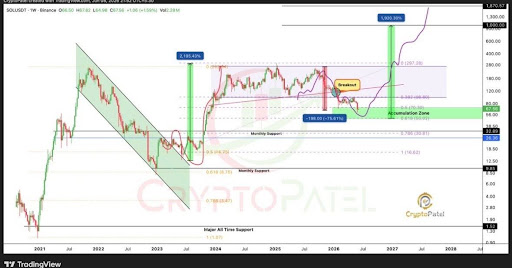
Source: Chart from Crypto Patel on X

Notably, Crypto Patel hinted that SOL might even challenge the $1,000 mark if market conditions align. However, he acknowledged that the real question is not whether Solana can hit $1,000 during this cycle, but whether investors will have enough exposure to the asset if the price actually goes parabolic. As a result, the analyst has cautioned that maintaining proper market positioning during these consolidation phases could yield higher returns for investors during a potential price breakout.

SOL Faces Fresh Downside Risk After Major Breakdown

Not all analysts are optimistic about Solana’s near-term trajectory. A well-known crypto expert, identified as ‘The Martini Guy’ on X, has warned that Solana’s price faces a serious risk of a decline. He noted that the cryptocurrency has broken down on the weekly chart and is now trading within a highly illiquid price zone, which could accelerate downward movement.

The Martini Guy explained that historically, Solana tends to move very quickly through the $40 to $80 range. If history repeats itself, SOL could dip toward the lower end of this spectrum, potentially testing $40. In more extreme scenarios, he added, a backtest toward $25 cannot be ruled out if market sentiment deteriorates further.

Notably, SOL is currently trading above $65 after declining by roughly 20% this last week and a staggering 32% over the past month. The cryptocurrency’s price structure remains inherently bearish as broader market sentiment, volatility, and a lack of sustainable bullish catalysts continue to weigh on price.

SOL trading at $65 on the 1D chart | Source: SOLUSDT on Tradingview.com

Domande pertinenti

QAccording to the article, what specific technical zone is Solana currently trading in, and what historical precedent is associated with it?

AAccording to analyst Crypto Patel, Solana is currently trading within the 0.5 to 0.618 Fibonacci Retracement zone, specifically around the $40 to $60 range. Historically, the last time Solana traded in this zone, it rallied over 2,200% during the 2023 cycle.

QWhat is the optimistic long-term price target for Solana mentioned by Crypto Patel?

ACrypto Patel hinted that if market conditions align, Solana (SOL) might even challenge the $1,000 mark during this cycle.

QWhich analyst presents a bearish view for Solana's near-term price, and what is the key risk they identify?

AA crypto expert identified as 'The Martini Guy' presents a bearish view. He warns that Solana's price faces a serious risk of a decline because it has broken down on the weekly chart and is trading within a highly illiquid price zone, which could accelerate downward movement.

QWhat are the potential downside price levels mentioned by The Martini Guy?

AThe Martini Guy suggested that Solana could dip toward $40, and in more extreme scenarios, a backtest toward $25 cannot be ruled out if market sentiment deteriorates further.

QWhat is the current price and recent performance of Solana as reported in the article?

ASolana (SOL) is currently trading above $65. It has declined by roughly 20% in the last week and approximately 32% over the past month. The broader market sentiment and a lack of bullish catalysts are weighing on its price.

Letture associate

Podcast Notes | Conversation with GSR Asset Management Head: To Determine if This Crypto Rally is Real, Just Watch the Lending Rates on Aave

Podcast Summary: Dialogue with GSR's Head of Asset Management: To Determine if This Crypto Rally is Real, Just Check Lending Rates on Aave Andy Baehr, Managing Director of Asset Management at GSR, discusses the current crypto market, characterizing it as stuck in a state of "ambivalence" with short-lived, unsustainable rallies. He outlines a simple framework: the market moves between "ambivalence" and "conviction" (sustained upward momentum). Currently, every rally resembles a single-stage rocket booster that quickly fizzles out. Baehr identifies three key signals to watch: 1) DeFi lending rates, 2) the potential passage of the CLARITY Act, and 3) the market forming a consensus on the "Fed hawkish peak." He emphasizes that the most immediate indicator for the sustainability of the recent CPI-triggered rally is the USDC borrowing rate on Aave, currently around 3.75%—close to U.S. Treasury yields. The absence of a credit spread indicates low leverage demand and a lack of market energy. He explains that a healthy, sustained rally requires layered buying pressure. Last year's rally progressed from an ETH short squeeze to crypto-native trader influx and finally to ETF inflows. Currently, this structure is missing. Other potential structural buyers like Digital Asset Treasury (DAT) companies are absent, and ETF flows have proven transient. Baehr notes that while small-cap crypto tokens outperformed large caps in Q2—a potential sign of capitation in major assets—capital is also flowing to more exciting opportunities like AI stocks and tech IPOs, leaving crypto sidelined. Regarding DeFi, he highlights that platforms like Aave provide a clear, real-time signal of leverage demand through their supply/demand-driven interest rates. A significant, sustained rate increase would signal genuine market conviction. He also observes the quiet emergence of fixed-income-like products and vaults in DeFi. On regulation, the probability of the CLARITY Act passing before the August 7th deadline has dropped linearly from 75% to below 40% on Polymarket. Baehr suggests its passage would be treated as a bullish surprise, a potent driver for price movement. However, political hurdles, including ethical clause debates and disclosures about the First Family's crypto profits, remain significant obstacles. Ultimately, the market awaits clarity on the Fed's terminal rate under Chair Warsh. Until the "Fed Solstice"—the point where the market collectively understands the peak of hawkish policy—sustained conviction will be difficult to achieve.

marsbit28 min fa

Podcast Notes | Conversation with GSR Asset Management Head: To Determine if This Crypto Rally is Real, Just Watch the Lending Rates on Aave

marsbit28 min fa

7 Months After the Collapse of Huiwang, Southeast Asia's Escrow Platforms Undergo a Major Reshuffle

Following the collapse of Huione Pay—dubbed the "Alipay of Southeast Asia"—seven months ago, the region's underground financial guarantee platform sector is undergoing a significant reshuffle. This power vacuum has been swiftly filled by emerging platforms such as XinBi, Tiger/Navigator, JinBei (renamed JinBo), Dali/Tiancheng, and FullyLight. These platforms, operating largely via Telegram and offering services like escrow for illicit transactions, have absorbed the vast user base and markets left behind by Huione. While positioning themselves as "trust intermediaries," their primary clientele consists of networks involved in online scams, money laundering, illegal gambling, and even human trafficking. For instance, the Tiger/Navigator platform explicitly provides "escrow" services for kidnapping-for-ransom operations ("强押车交易"). Data underscores the immense scale: Huione alone processed over $103 billion in cryptocurrency payments and facilitated over $31 billion through its escrow market before its downfall, linking it to Cambodia's notorious Prince Group. Since its collapse, competitors have seen explosive growth. For example, the XinBi platform has accumulated over $1.6 billion in total USDT revenue, while platforms like NewPay, OkPay (under Dali), and FullyLight Wallet collectively processed over $4.8 billion in USDT in a single year. This ecosystem thrives in regions like Cambodia and Myanmar, where regulatory gaps allow these platforms to act as critical financial infrastructure for sprawling cybercrime industries, from scam compounds to online casinos. The article concludes that the moniker "Southeast Asian Alipay" is a misnomer, obscuring the platforms' fundamental role in enabling serious criminal enterprises rather than representing legitimate financial innovation.

Odaily星球日报1 h fa

7 Months After the Collapse of Huiwang, Southeast Asia's Escrow Platforms Undergo a Major Reshuffle

Odaily星球日报1 h fa

Trading

Spot
活动图片





