Solana Price Rallied 2,000% The Last Time This Happened, And It Just Triggered Again

bitcoinistPubblicato 2026-06-12Pubblicato ultima volta 2026-06-12

Introduzione

The Solana (SOL) price is garnering renewed attention as it trades near a key historical Fibonacci zone ($40-$60), which previously triggered a massive 2,200% rally in 2023. Analyst Crypto Patel suggests this could signal a breakout from its prolonged slump, potentially leading to new highs and even a challenge of the $1,000 mark if market conditions align, especially during an altcoin season. However, not all outlooks are bullish. Another expert, 'The Martini Guy', warns of near-term downside risks, noting SOL has broken down on weekly charts and entered an illiquid zone. He cautions it could retest $40 or even $25 if sentiment worsens. SOL is currently trading around $65, down significantly over recent weeks amid bearish market structure and a lack of bullish catalysts.

The Solana price is drawing renewed attention after months of declines, selling pressure, and mixed performance. Market analyst Crypto Patel highlighted in a recent X post that SOL is currently trading near a historical price level that previously triggered a massive 2,000% rally during the 2023 cycle. He emphasized that if history were to play out as expected, Solana could finally break out of its prolonged price slump and consolidation phase, potentially paving the way for new all-time highs.

Solana Price Reenters Zone That Triggered Explosive Past Rally

Crypto Patel is reminding investors to remember Solana’s past price behavior and its tendency to execute sharp moves. He pointed out that the last time Solana traded within the 0.5 to 0.618 Fibonacci Retracement zone, it rallied over 2,200%.

According to Patel, Solana is once again trading inside this key Fibonacci zone around the $40 to $60 range. Sharing a chart, the analyst noted that this range has historically acted as a major accumulation area for traders, with SOL’s price surging rapidly once buying pressure builds.

Given how fast the cryptocurrency tends to move, Crypto Patel has suggested that investors who position themselves strategically in this zone could benefit significantly once the market enters another bullish phase. The analyst also indicated that if the highly anticipated altcoin season finally unfolds, Solana would be among the cryptocurrencies leading the rally with a substantial upside.
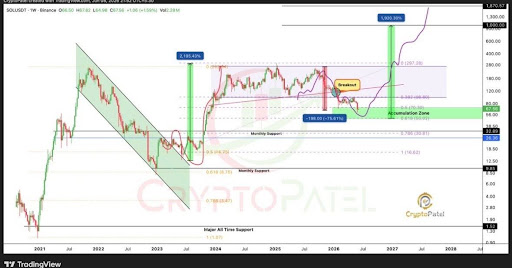
Source: Chart from Crypto Patel on X

Notably, Crypto Patel hinted that SOL might even challenge the $1,000 mark if market conditions align. However, he acknowledged that the real question is not whether Solana can hit $1,000 during this cycle, but whether investors will have enough exposure to the asset if the price actually goes parabolic. As a result, the analyst has cautioned that maintaining proper market positioning during these consolidation phases could yield higher returns for investors during a potential price breakout.

SOL Faces Fresh Downside Risk After Major Breakdown

Not all analysts are optimistic about Solana’s near-term trajectory. A well-known crypto expert, identified as ‘The Martini Guy’ on X, has warned that Solana’s price faces a serious risk of a decline. He noted that the cryptocurrency has broken down on the weekly chart and is now trading within a highly illiquid price zone, which could accelerate downward movement.

The Martini Guy explained that historically, Solana tends to move very quickly through the $40 to $80 range. If history repeats itself, SOL could dip toward the lower end of this spectrum, potentially testing $40. In more extreme scenarios, he added, a backtest toward $25 cannot be ruled out if market sentiment deteriorates further.

Notably, SOL is currently trading above $65 after declining by roughly 20% this last week and a staggering 32% over the past month. The cryptocurrency’s price structure remains inherently bearish as broader market sentiment, volatility, and a lack of sustainable bullish catalysts continue to weigh on price.

SOL trading at $65 on the 1D chart | Source: SOLUSDT on Tradingview.com

Domande pertinenti

QAccording to the article, what specific technical zone is Solana currently trading in, and what historical precedent is associated with it?

AAccording to analyst Crypto Patel, Solana is currently trading within the 0.5 to 0.618 Fibonacci Retracement zone, specifically around the $40 to $60 range. Historically, the last time Solana traded in this zone, it rallied over 2,200% during the 2023 cycle.

QWhat is the optimistic long-term price target for Solana mentioned by Crypto Patel?

ACrypto Patel hinted that if market conditions align, Solana (SOL) might even challenge the $1,000 mark during this cycle.

QWhich analyst presents a bearish view for Solana's near-term price, and what is the key risk they identify?

AA crypto expert identified as 'The Martini Guy' presents a bearish view. He warns that Solana's price faces a serious risk of a decline because it has broken down on the weekly chart and is trading within a highly illiquid price zone, which could accelerate downward movement.

QWhat are the potential downside price levels mentioned by The Martini Guy?

AThe Martini Guy suggested that Solana could dip toward $40, and in more extreme scenarios, a backtest toward $25 cannot be ruled out if market sentiment deteriorates further.

QWhat is the current price and recent performance of Solana as reported in the article?

ASolana (SOL) is currently trading above $65. It has declined by roughly 20% in the last week and approximately 32% over the past month. The broader market sentiment and a lack of bullish catalysts are weighing on its price.

Letture associate

M&A Deals in the Crypto Market Are Unusually Active

Title: M&A Activity in Crypto Market Becomes Unusually Active A rare signal is emerging in the crypto primary market: mergers and acquisitions (M&A) are nearing half of all financing deals. According to RootData, this month, M&A cases in the crypto industry reached 10, while financing rounds numbered only 14, meaning M&A accounts for approximately 42% of primary market transactions—the highest level in history. This does not signal a sudden industry boom. Instead, the rapid rise in M&A share primarily reflects the continued downturn in the financing market. Since November 2024, monthly crypto M&A deals have remained between 10-20, while financing deals have plummeted from around 100 to about 50, possibly hitting a new low this month. For project teams, this means the traditional path of relying on narratives, token expectations, and ecosystem subsidies to maintain valuations is narrowing. For leading companies, it presents a rare window to acquire teams, licenses, technology, liquidity, and market access at lower prices, with less competition and stronger bargaining power. Key active buyers include Coinbase, Kraken, Ripple, MoonPay, Polymarket, Kaiko, Sol Strategies, GSR, Keyrock, Jupiter, Paxos, and Ondo Finance. Their M&A logic is consistent: acquiring key capabilities at lower costs during the industry downturn. This is driven by more attractive valuations, reduced time and trial-and-error costs, the acquisition of licenses and compliance resources, and the integration of industry upstream and downstream segments. Current M&A focuses are concentrated in four areas: trading infrastructure (e.g., Coinbase acquiring Deribit, Kraken acquiring NinjaTrader), payments and stablecoins (e.g., MoonPay, Ripple expanding payment networks), compliance licenses, and asset issuance/distribution (e.g., acquisitions related to RWA and token issuance platforms like Coinbase's purchases of Liquifi and Echo). The rise in M&A is altering the primary market's exit logic. It provides an alternative path to the token-dependent model, encouraging teams to build tangible products, revenue, and strategic value that can be integrated. This could inject confidence into the market, showing that asset buyers and exit possibilities still exist, albeit with a stricter focus on real utility. However, this trend also indicates the crypto industry is becoming more centralized. As asset issuance, trading, market-making, custody, payments, and data gradually consolidate in the hands of a few major players, the industry's initial emphasis on openness and anti-monopoly is being reshaped by commercial realities. Coupled with rising compliance barriers, this signals the end of the low-barrier era for crypto entrepreneurship.

链捕手24 min fa

M&A Deals in the Crypto Market Are Unusually Active

链捕手24 min fa

M&A Deals Are Exceptionally Active in the Crypto Market

Mergers and acquisitions (M&A) activity in the cryptocurrency primary market has reached a historic high, accounting for approximately 42% of total deals in the current month, nearly matching the number of financing rounds. This shift does not signal a new boom cycle but rather reflects a severe contraction in the venture capital funding environment. As financing dwindles, established industry giants—including major exchanges, payment firms, and infrastructure providers—are seizing the opportunity to acquire strategic assets at lower valuations. Key drivers behind the surge in M&A include depressed project valuations, the need to quickly acquire talent and technology to capture short market windows, the pursuit of crucial regulatory licenses, and the strategic expansion into adjacent business verticals such as derivatives, payments, stablecoins, and real-world asset (RWA) issuance. Major acquisitions, like Coinbase's purchase of Deribit and Kraken's acquisition of NinjaTrader, exemplify the push to expand into high-margin areas like derivatives and multi-asset trading. This trend is reshaping the industry's exit landscape, offering an alternative to token-based exits and incentivizing startups to build tangible products and revenue streams with inherent strategic value for acquisition. However, it also points toward increasing centralization, as critical functions—trading, custody, payments, compliance—become concentrated within a few large, well-capitalized platforms, potentially raising barriers to entry for new ventures.

marsbit25 min fa

M&A Deals Are Exceptionally Active in the Crypto Market

marsbit25 min fa

Solana Privacy Ecosystem Panorama: A Complete Privacy Stack from Compute to AI

**Title: The Solana Privacy Ecosystem: A Full-Stack View from Compute to AI** **Summary:** This article provides a comprehensive overview of the emerging privacy landscape on the Solana blockchain, characterizing it as still in early development. It identifies two primary verticals—Neobanks and Private DeFi—as key drivers, while noting gaps in tooling and user experience. The discussion centers on two main approaches to private computation: Arcium, which utilizes Multi-Party Computation (MPC) networks (Multi-Party eXecution Environments) to process encrypted data with final settlement on Solana; and Magic Block, which leverages Trusted Execution Environments (TEEs) via its Private Ephemeral Rollup (PER). Both enable confidential applications like dark pools and private DeFi with minimal code changes. Building on this infrastructure, projects are creating privacy-focused applications. Umbra, built on Arcium, offers Encrypted Token Accounts (ETAs) for private balances, transfers, and selective disclosure for compliance. Other wallets like Privacy Cash and Hush provide mixer-like functionality for SOL. For private trading, encifherio uses TEEs to encrypt swap details routed through Jupiter, while VanishTrade and Darklake focus on shielding transaction intent and liquidity routing, with Darklake introducing a "blind slippage pool" to prevent front-running. Further applications include private prediction markets (e.g., Melee Markets using Arcium's encrypted order books) and private AI. Loyal exemplifies the latter, using both Magic Block and Arcium to enable decentralized AI agents that store user data, conversations, and transactions confidentially on-chain. The article concludes by framing privacy not as a single technology but as an evolving "ultimate privacy stack," with experts like Helius's Mert envisioning a future combination of Fully Homomorphic Encryption (FHE) and Zero-Knowledge proofs (ZK). Helius Privacy itself is developing a ZK-based UTXO privacy layer for Solana.

Foresight News30 min fa

Solana Privacy Ecosystem Panorama: A Complete Privacy Stack from Compute to AI

Foresight News30 min fa

Trading

Spot
Futures
活动图片