Solana Price Prediction: ETF Inflows Fuel SOL Push Toward $90 Barrier

bitcoinistPubblicato 2026-02-26Pubblicato ultima volta 2026-02-26

Introduzione

Solana (SOL) is stabilizing after recent selling pressure, with its price rebounding from the $75–$76 support level and climbing back above $80. A key catalyst for this recovery is renewed institutional interest, as U.S. spot Solana ETFs recorded $3.78 million in net inflows on February 24, bringing cumulative inflows to over $900 million. Derivatives markets also show improving sentiment, with rising open interest and long positions outweighing shorts. Despite this positive momentum, SOL faces significant resistance between $85 and $88. A break above this zone could push the price toward $90–$94. However, risks remain due to declining on-chain activity, reduced network engagement, and recent ecosystem concerns, including a major hack. The outlook depends on whether institutional inflows and technical stability can offset these weaknesses. Holding the $80–$83 support level is crucial for further gains.

Solana (SOL) is attempting to stabilize after weeks of selling pressure, with price action now centered around a critical technical zone that could determine its next directional move.

Related Reading: MoneyGram Joins Cardano’s Midnight As Federated Mainnet Validator

After falling from recent highs near $86, the Solana price rebounded from support around $75–$76 and climbed back above $80, drawing renewed attention from traders and institutional investors watching for signs of a broader recovery.

Recent market data shows Solana price in a consolidation phase, where improving derivatives positioning and fresh ETF inflows are beginning to offset weak sentiment caused by declining network activity and external market shocks.
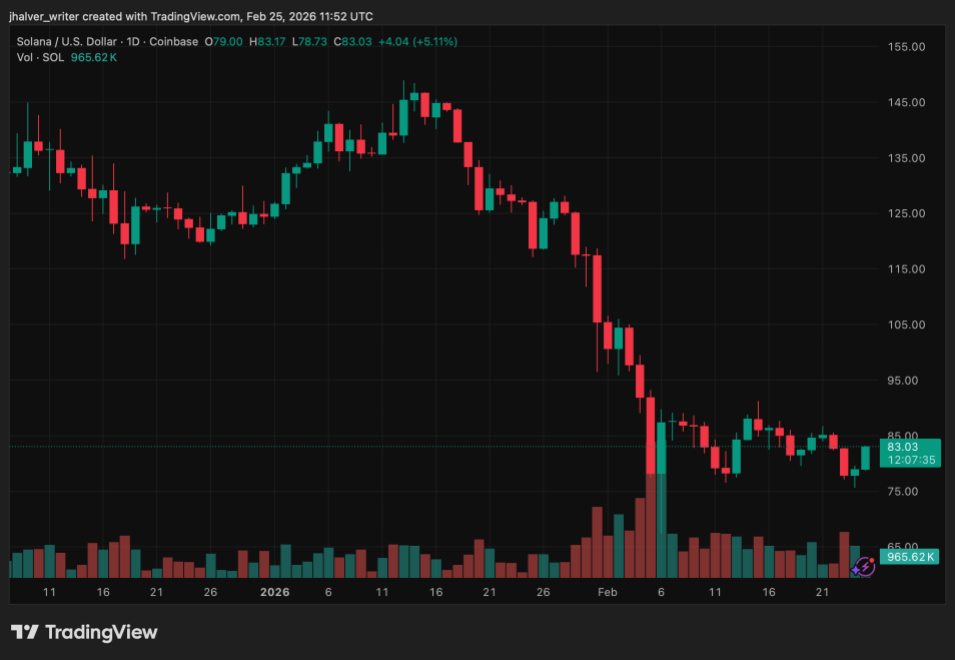
SOL's price trends to the downside on the daily chart. Source: SOLUSD on Tradingview

ETF Inflows Signal Institutional Re-Engagement

A key catalyst behind the latest recovery has been renewed institutional demand. U.S. spot Solana ETFs recorded approximately $3.78 million in net inflows on February 24, reversing a stretch of outflows that had coincided with price weakness.

Cumulative inflows into Solana-linked ETFs have now surpassed $900 million, suggesting continued interest from regulated market participants despite volatility.

Derivatives markets also show improving sentiment. OI has risen while long positions increasingly outweigh shorts, indicating traders are adding exposure rather than exiting positions. Short liquidations following the rebound from $76 helped remove near-term selling pressure, allowing price to reclaim the $80 region.

Technically, SOL is holding above key short-term averages and the 50% Fibonacci retracement of its recent decline. Momentum indicators such as the RSI moving above neutral levels suggest buyers are regaining control in the short term.

Solana Price Key Resistance Levels Between $85 and $90

Despite improving momentum, resistance remains concentrated between $85 and $88, a zone that previously rejected multiple recovery attempts. A confirmed close above this band could open a path toward $90–$94, where higher-timeframe resistance and trend indicators converge.

Chart patterns are also drawing attention. Analysts point to a potential triple-bottom formation near $75, often interpreted as a reversal structure if followed by strong volume. However, failure to maintain support above $79–$80 could expose Solana price downside levels near $77 and potentially $74 again.

Risks Persist After Ecosystem and Activity Declines

The recovery comes amid ongoing ecosystem concerns, including a platform shutdown following a major hack and declining on-chain activity. Falling active addresses and total value locked signal weaker engagement.

Related Reading: Odds Of Crypto Market Structure Bill Passing This Year Fall To 40% On Polymarket

Currently, Solana’s outlook now depends on whether institutional inflows and technical stability can offset soft network metrics. Holding $80–$83 as support could open a move toward $90, while failure may keep price consolidation in place.

Cover image from ChatGPT, SOLUSD chart from Tradingview

Domande pertinenti

QWhat is the key catalyst behind Solana's latest price recovery mentioned in the article?

ARenewed institutional demand, particularly U.S. spot Solana ETFs recording approximately $3.78 million in net inflows on February 24, which reversed a stretch of outflows.

QWhat is the critical technical resistance zone for Solana's price according to the analysis?

AResistance remains concentrated between $85 and $88. A confirmed close above this band could open a path toward $90–$94.

QWhat potential bullish chart pattern are analysts pointing to for Solana near the $75 level?

AAnalysts point to a potential triple-bottom formation near $75, which is often interpreted as a reversal structure if followed by strong volume.

QWhat are some of the ecosystem concerns that persist for Solana despite the price recovery?

AOngoing ecosystem concerns include a platform shutdown following a major hack and declining on-chain activity, such as falling active addresses and total value locked, which signal weaker engagement.

QWhat is the significance of the $79–$80 level for Solana's price action?

AHolding above $79–$80 as support is crucial. It could open a move toward $90, while failure to maintain this support could expose downside levels near $77 and potentially $74 again.

Letture associate

Has Hook Summer Really Arrived? sato, Lo0p, FLOOD Ignite the New Narrative of Uniswap v4

"Hook Summer" Arrives? Sato, Lo0p, FLOOD Ignite Uniswap v4 Narrative Amidst a slight market recovery, attention within the Ethereum ecosystem has shifted to Meme coins built on Uniswap v4's Hook protocol. Following ASTEROID, tokens like sato, sat1, Lo0p, and FLOOD have become market focal points, with market caps ranging from millions to tens of millions, bringing concentrated liquidity to a narrative-dry market. Uniswap v4 Hooks are "plugin smart contracts" that allow developers to inject custom logic at key points in a liquidity pool's lifecycle (initialization, adding/removing liquidity, swaps, etc.), making the AMM programmable. Recent representative projects include: * **sato**: Market cap peaked over $38M; uses a v4 curve mechanism for minting/burning, locking ETH as reserve. * **sat1**: Market cap briefly exceeded $10M, positioning as an "optimized sato," but later declined significantly. * **Lo0p**: Market cap neared $6.6M; a "lending AMM protocol" allowing users to borrow ETH against deposited LO0P tokens without immediate selling pressure. * **FLOOD**: Market cap approached $6M; channels trading reserves into Aave v3 to generate yield, which is retained in the pool. The emergence of these Hook-based tokens could drive long-term growth for the Uniswap ecosystem by attracting users and liquidity to v4 pools. Combined with Uniswap's activated fee switch (partially used to burn UNI), the long-term outlook for UNI appears positive. However, short-term UNI price appreciation is not directly guaranteed. Factors include the sustainability and lifecycle of these new tokens, their price volatility, overall market conditions, and regulatory pressures. Currently, Uniswap v4's TVL ($595M) lags behind v3 and v2, indicating Hook adoption still requires time to mature. In summary, the Hook ecosystem serves as "long-term nourishment" for UNI, but acts more as a "catalyst" than a direct "booster" in the short term. Note: These are early-stage experimental tokens and may carry unknown risks.

marsbit23 min fa

Has Hook Summer Really Arrived? sato, Lo0p, FLOOD Ignite the New Narrative of Uniswap v4

marsbit23 min fa

Has Hook Summer Truly Arrived? sato, Lo0p, FLOOD Ignite the New Uniswap v4 Narrative

With the broader market showing signs of recovery, a new wave of interest has emerged around Ethereum-based meme coins. Following ASTEROID, tokens like sato, sat1, Lo0p, and FLOOD, built upon the Uniswap v4 Hook protocol, are capturing market attention. Their market capitalizations range from millions to tens of millions of dollars, injecting much-needed focused liquidity into a market lacking narratives. This article explores whether this trend signifies an incoming "Hook Summer" and its potential impact on UNI's price. Hooks are essentially plug-in smart contracts for Uniswap v4 liquidity pools, allowing developers to inject custom logic at key points in a pool's lifecycle (like initialization, adding/removing liquidity, swaps). This transforms the AMM into programmable building blocks. Key highlighted projects include: * **sato**: Peaked over $38M market cap. It utilizes a v4 curve for minting/burning; buying locks ETH as reserve to mint new tokens, while selling redeems ETH from the reserve and burns tokens. * **sat1**: Market cap briefly exceeded $10M, promoted as an "optimized sato," but later declined significantly. * **Lo0p**: Reached nearly $6.6M. It's a lending AMM protocol where buying LO0P tokens locks them as collateral, allowing users to borrow ETH from the pool reserve at 40% LTV, aiming to improve capital efficiency for idle ETH in LPs. * **FLOOD**: Peaked near $6M. Its mechanism directs asset reserves from buys into Aave v3 to generate yield, with fees and interest retained in the pool to potentially influence the token's price long-term. In the long term, the development of the Hook ecosystem can attract users and liquidity to Uniswap v4, benefiting UNI's fundamentals—especially combined with the recent activation of the protocol fee switch, where a portion of fees is used to burn UNI. However, in the short term, these Hook-based tokens are unlikely to directly drive significant UNI price appreciation. Their impact is moderated by factors like token sustainability, price volatility, and broader market and regulatory conditions. Currently, Uniswap v4's TVL ($595M) still trails behind v2 and v3, indicating adoption and growth will take time. The article concludes that while the Hook ecosystem provides long-term "nourishment" for UNI, its short-term role is more of a "catalyst" than a "booster." Readers are cautioned that these are early-stage experimental tokens and may carry unknown risks.

Odaily星球日报36 min fa

Has Hook Summer Truly Arrived? sato, Lo0p, FLOOD Ignite the New Uniswap v4 Narrative

Odaily星球日报36 min fa

Interview with Michael Saylor: I Did Say I Would Sell Bitcoin, But Never a Net Sale

Interview with Michael Saylor: I Said We'd Sell Bitcoin, But Never Be a Net Seller In a recent podcast, MicroStrategy Executive Chairman Michael Saylor clarified the company's stance on potentially selling Bitcoin. Following MicroStrategy's earnings call statement about being prepared to sell BTC to fund dividends for its STRC (Strategic) credit product, Saylor emphasized the distinction between selling and being a "net seller." Saylor explained the core business model: MicroStrategy sells credit instruments like STRC and uses the proceeds to buy Bitcoin, which is viewed as "digital capital" expected to appreciate around 30-40% annually. A portion of these capital gains can then be used to pay the dividends on the credit products. He stressed that even if the company sells some Bitcoin for dividends, it simultaneously buys much more with new credit issuance. For example, after raising $3.2 billion from STRC sales in April, the dividend obligation was only $80-90 million, making the company a net buyer. The clarification aims to counter market narratives questioning the value of Bitcoin on MicroStrategy's balance sheet if it were never sold, and to dismiss claims of a "Ponzi scheme." Saylor reiterated his personal philosophy for investors: "Don't be a net seller of bitcoin" and ensure your Bitcoin holdings increase each year. Saylor also discussed Bitcoin's role as the foundation for "digital credit," noting that STRC has become the largest and most liquid preferred stock issue in the U.S., offering high risk-adjusted returns (Sharpe ratio). He highlighted Bitcoin's deep liquidity, stating that even large purchases by MicroStrategy do not move the market significantly, which is driven by macro factors, geopolitical tensions, and capital flows from ETFs and credit products. Finally, Saylor reflected on his early inspiration from sci-fi books, which motivated his path to MIT, and maintained his fundamental thesis on Bitcoin remains unchanged: it is superior digital capital enabling superior digital credit.

链捕手40 min fa

Interview with Michael Saylor: I Did Say I Would Sell Bitcoin, But Never a Net Sale

链捕手40 min fa

Trading

Spot
Futures

Articoli Popolari

Come comprare PUSH

Benvenuto in HTX.com! Abbiamo reso l'acquisto di Push Protocol (PUSH) semplice e conveniente. Segui la nostra guida passo passo per intraprendere il tuo viaggio nel mondo delle criptovalute.Step 1: Crea il tuo Account HTXUsa la tua email o numero di telefono per registrarti il tuo account gratuito su HTX. Vivi un'esperienza facile e sblocca tutte le funzionalità,Crea il mio accountStep 2: Vai in Acquista crypto e seleziona il tuo metodo di pagamentoCarta di credito/debito: utilizza la tua Visa o Mastercard per acquistare immediatamente Push ProtocolPUSH.Bilancio: Usa i fondi dal bilancio del tuo account HTX per fare trading senza problemi.Terze parti: abbiamo aggiunto metodi di pagamento molto utilizzati come Google Pay e Apple Pay per maggiore comodità.P2P: Fai trading direttamente con altri utenti HTX.Over-the-Counter (OTC): Offriamo servizi su misura e tassi di cambio competitivi per i trader.Step 3: Conserva Push Protocol (PUSH)Dopo aver acquistato Push Protocol (PUSH), conserva nel tuo account HTX. In alternativa, puoi inviare tramite trasferimento blockchain o scambiare per altre criptovalute.Step 4: Scambia Push Protocol (PUSH)Scambia facilmente Push Protocol (PUSH) nel mercato spot di HTX. Accedi al tuo account, seleziona la tua coppia di trading, esegui le tue operazioni e monitora in tempo reale. Offriamo un'esperienza user-friendly sia per chi ha appena iniziato che per i trader più esperti.

527 Totale visualizzazioniPubblicato il 2024.12.13Aggiornato il 2025.03.21

Come comprare PUSH

Discussioni

Benvenuto nella Community HTX. Qui puoi rimanere informato sugli ultimi sviluppi della piattaforma e accedere ad approfondimenti esperti sul mercato. Le opinioni degli utenti sul prezzo di PUSH PUSH sono presentate come di seguito.

活动图片













