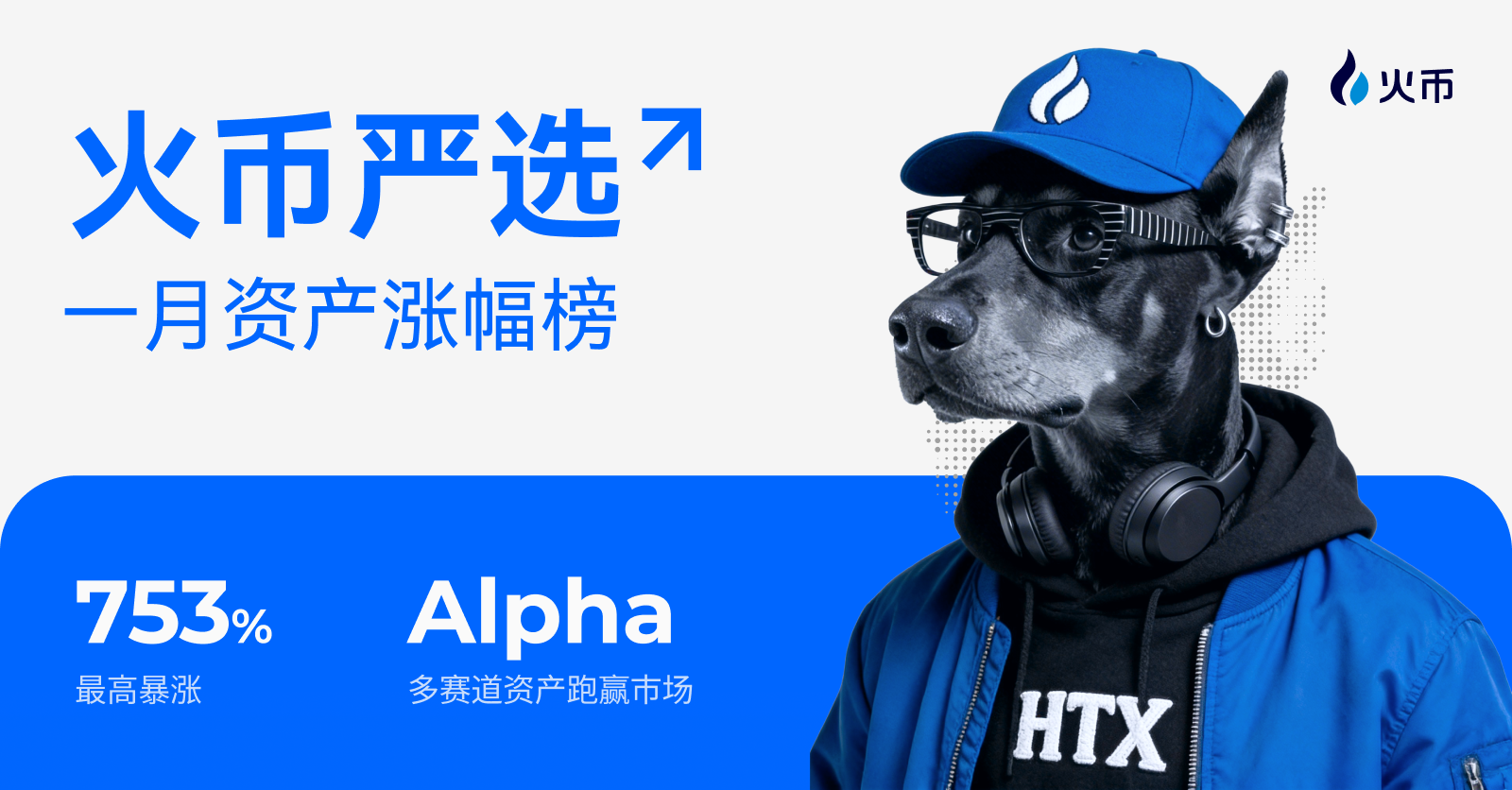
Soaring Up to 753%! Huobi HTX Releases 'Huobi's Top Picks' January Asset Gains List: Capturing Alpha Against the Trend, Multi-Sector Assets Outperform the Market

marsbitPubblicato 2026-02-06Pubblicato ultima volta 2026-02-06

Introduzione

Huobi HTX, a major cryptocurrency exchange, has released its "Huobi Selected" list of top-performing assets for January 2026, highlighting significant gains across multiple sectors despite a generally bearish and uncertain market. In a challenging environment with declining liquidity and falling mainstream crypto prices, the exchange's curated selection strategy focused on assets with strong community backing and clear narratives. New listings like RIVER and DUSK saw massive gains, with RIVER surging 422.4% and DUSK skyrocketing 753.3% after listing. Meme coins were a standout sector. PEPE rose 82.1%, BONK increased 78.1%, and BROCCOLI (CZ’s Dog) jumped 188.6%. Huobi HTX also gained an edge by listing Chinese meme coins like "币安人生" and "我踏马来了" weeks ahead of competitors, which saw gains of 172.7% and 441.7%, respectively. The AI and cross-chain sectors also performed well. VIRTUAL, an AI Agent protocol, grew 90.3%, while RIVER, a cross-chain stablecoin system, was a top performer. In privacy and DeFi, DUSK's 753% surge led the way, followed by ZKP (up 103.7%) and GWEI (up 157.9%). The report concludes that even in a bear market, alpha opportunities exist. Huobi HTX emphasizes its commitment to a professional, long-term asset selection strategy to help users identify high-potential projects across emerging narratives.

In January 2026, amid macroeconomic uncertainty and shrinking market liquidity, the mainstream crypto market experienced a downward trend with declining risk appetite. In such a severe bearish environment, the question of "whether one can still find assets that are rising" became a challenging problem for all trading platforms and investors.

Huobi HTX adheres to a core philosophy of long-termism and professional screening, quickly responding to genuine market demands while executing a stringent asset selection strategy. It filters high-quality projects with real attention, community consensus, and periodic narratives from various sectors including Meme, AI, Privacy, Public Chains, and DeFi. Platform data from January shows that numerous assets still achieved impressive gains despite the sluggish overall market, capturing alpha against the trend.

The "Not Easy" in a Bear Market:"List what's hot," with strictly selected assets outperforming the market average

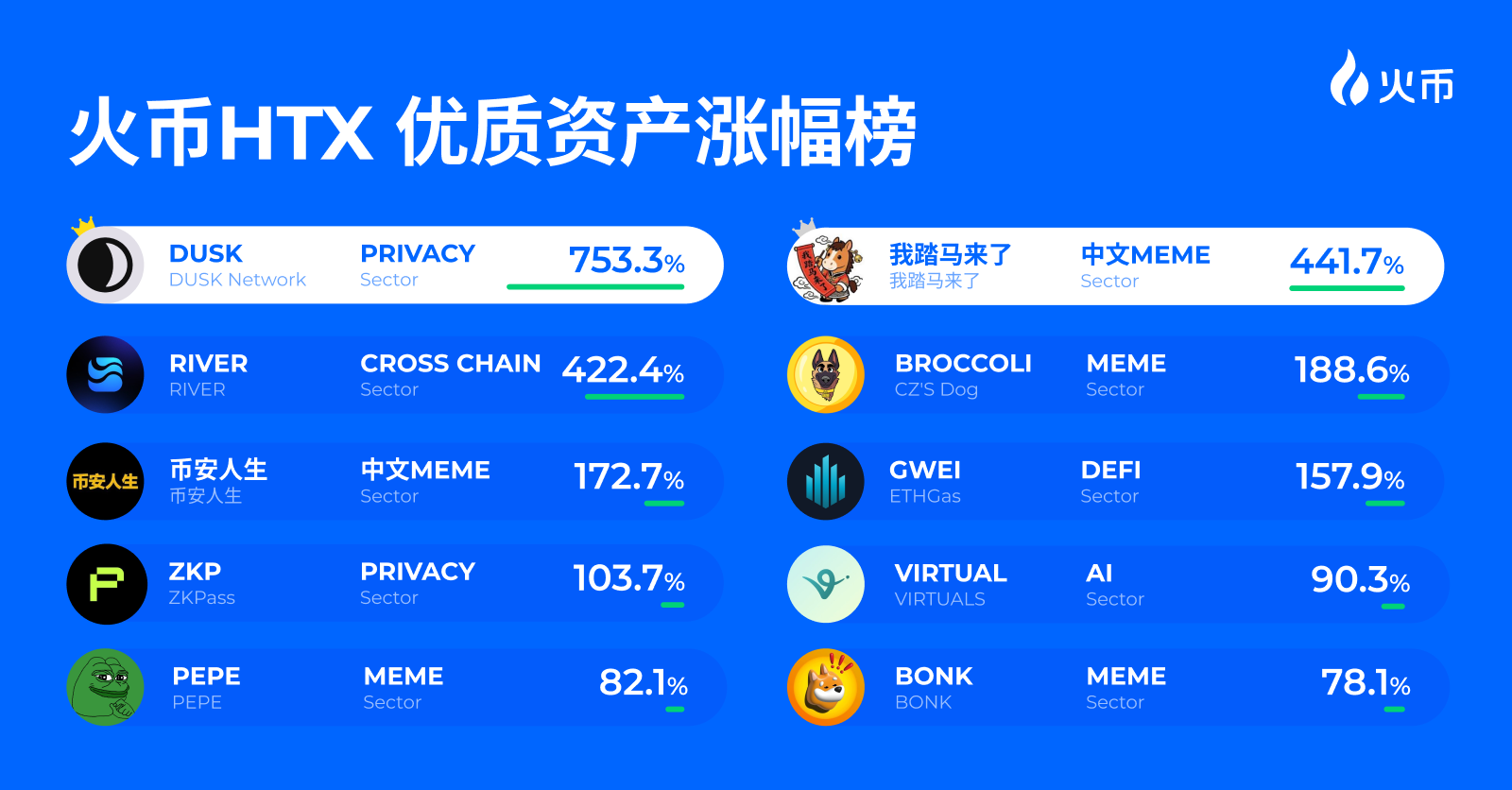
A market downturn does not mean opportunities disappear; it means the difficulty of screening multiplies. As Justin Sun, Global Advisor to Huobi HTX, stated: "List hot assets, list what's hot." Among the assets listed by Huobi HTX in January, it maintained adherence to long-term sectors while also responding swiftly to genuine market demands when short-term hotspots emerged, providing users with more choices under controllable risks, demonstrating significant wealth effects. Among them, the newly listed project RIVER saw its price rise from a low of 17 USDT to a high of 88.8 USDT since its listing on January 16, with a maximum increase of 422.4%;DUSK rose from 0.0375 USDT to 0.32 USDT, with a monthly surge of 753.3%.

In an environment where the overall market is under pressure, the fact that new coins can achieve multiple-fold growth in a short cycle is itself a rare phenomenon. Behind this is Huobi HTX's continuous tracking and rapid response to market sentiment, capital flows, and narrative rhythms.
Meme Sector: Structural Opportunities in Emotional Games

The Meme sector remained one of the most active directions in the January market. In an environment with limited liquidity, projects with high consensus and topical attributes can still attract concentrated capital for gaming.

PEPE once rose to 0.0000071 USDT, with a monthly increase of 82.1%, becoming one of the representative assets leading the rebound in the Meme sector.BONK (Bonk), the first community-led dog coin on the Solana blockchain, saw a monthly increase of 78.1%, showing that established Meme projects still have the ability to attract capital in a bear market.NEIRO (Neiro) achieved a steady performance with a maximum increase of 66.3% after listing.BROCCOLI (CZ’s Dog),凭借强话题属性与社区关注度 (Relying on strong topical attributes and community attention), saw its price rise from 0.0149 USDT to 0.043 USDT, a surge of 188.6%.

Furthermore, Huobi HTX's early layout in the Chinese Meme direction was particularly notable. Huobi HTX was the first to list "币安人生 (Binance Life)" and "我踏马来了 (I'm F*cking Coming)", with monthly increases of 172.7% and 441.7% respectively, and its listing time was 83 days ahead of Binance.

AI and Cross-Chain: Deterministic Increments Driven by Narratives

The AI and Cross-Chain sectors remain directions with relatively medium to long-term logic in the market.VIRTUAL (Virtuals Protocol) is an "AI Character Economy" ecological protocol that allows developers to create autonomous, interactive, tradable, and evolvable AI Agents. With the explosion of the x402 ecosystem, the community and developer ecosystem continue to expand, making it one of the representative assets in the AI sector, with a monthly increase of 90.3%, showing an independent trend amidst market fluctuations.

RIVER (River) is building a chain-abstract stablecoin system, connecting assets, liquidity, and yields across multiple blockchains. As one of the most outstanding performers in the cross-chain sector, River, with its clear technical positioning and capital backing, quickly gained market attention after listing, achieving a maximum increase of over 422%, becoming one of the most representative Alpha projects in January's "Huobi's Top Picks".

Privacy and DeFi: Undervalued Value Recovery Rallies

The privacy sector maintained热度 (heat) for a relatively long time, showing obvious hotspot rotation from large coins like ZEC and XMR to small-cap ones like DUSK.DUSK (Dusk Network) is a blockchain platform designed for regulation and decentralized finance, serving as Europe's first blockchain-based stock exchange focused on the issuance of digital securities. DUSK's price rose from 0.0375 USDT to 0.32 USDT, a monthly surge of 753.3%, as the long-term narrative of the privacy sector gradually returned to focus.ZKP (zkPass) is an oracle network based on zkTLS, rising 103.7% monthly, showing continuous progress in the zero-knowledge and privacy direction at the infrastructure level.GWEI (ETHGas) is an Ethereum infrastructure protocol focused on reducing transaction latency. As a DeFi-related asset, GWEI rose 157.9% in January, representing a structural opportunity in a niche sector.

A bear market does not mean there are no opportunities; it just means opportunities are scarcer. Huobi HTX will continue to use its professional, prudent, and forward-looking asset screening system to help users capture truly Alpha-quality projects in a complex and changing market environment. In the future, Huobi HTX will also continue to cover more new sectors and narratives, working with users to navigate cycles and welcome the next market recovery.

About Huobi HTX

Huobi HTX was founded in 2013. After 12 years of development, it has evolved from a cryptocurrency exchange into a comprehensive blockchain business ecosystem covering digital asset trading, financial derivatives, research, investment, incubation, and other businesses.

As a leading global Web3 gateway, Huobi HTX adheres to a development strategy of global expansion, ecological prosperity, wealth effect, and security and compliance, providing comprehensive, secure, and reliable value and services to virtual currency enthusiasts worldwide.

To learn more about Huobi HTX, please visithttps://www.htx.com/ orHTX Square, and follow us onX,Telegram, andDiscord. For further inquiries, please contact[email protected].


Domande pertinenti

QWhat was the highest monthly price increase percentage among the assets listed in the Huobi HTX 'Huobi Selected' January report, and which asset achieved it?

AThe highest monthly price increase was 753.3%, achieved by DUSK (Dusk Network).

QAccording to the article, which two Chinese Meme tokens did Huobi HTX list ahead of Binance, and by how many days?

AHuobi HTX listed '币安人生' (Binance Life) and '我踏马来了' (I'm Coming) 83 days ahead of Binance.

QWhich asset, described as a chain-abstract stablecoin system, saw a maximum price increase of over 422% after its listing on Huobi HTX?

ARIVER (River), which is building a chain-abstract stablecoin system, saw a maximum price increase of over 422%.

QIn the AI sector, which protocol focusing on 'AI character economy' saw a monthly increase of 90.3%?

AVIRTUAL (Virtuals Protocol), an ecosystem protocol for 'AI character economy', saw a monthly increase of 90.3%.

QWhat overarching strategy does Huobi HTX's global advisor, Justin Sun, advocate for in selecting which assets to list on the exchange?

AJustin Sun advocates for the strategy of '要上火的资产,什么火就上什么', which translates to 'list assets that are trending, list whatever is hot'.

Letture associate

GitHub, Transfixed by AI

On the night of February 9th, GitHub suffered a major outage caused by a simple configuration change—reducing a cache refresh interval from 12 to 2 hours—that triggered a cascade of failures. This was not an isolated event, but part of a broader pattern. In early 2026, GitHub experienced at least 8 major incidents, failing to meet its promised 99.9% availability. These outages stemmed from structural issues: explosive growth in load, tight service coupling, and insufficient protection against abnormal traffic. This unprecedented load is driven by AI Agents. In 2025, GitHub handled ~1 billion commits. By 2026, weekly commits reached 275 million, projecting to ~14 billion for the year—a 14x increase. AI tools like Claude Code now contribute 4.5% of all public repository commits, with weekly submissions surging 25x in just three months. AI-generated pull requests jumped from 4 million to 17 million per month in half a year. Unlike human developers, AI Agents work continuously, generating commits at a scale that overwhelms infrastructure designed for human rhythms. The surge also shattered GitHub's business model. Copilot's flat-rate pricing, based on assisting human developers, became unsustainable as Agentic AI sessions consumed resources worth hundreds of dollars for a few dollars in fees. In response, GitHub imposed usage limits and, by June 1st, shifted to a pay-per-use "AI Credits" system. Facing this new reality, GitHub realized a 10x scaling plan was insufficient. It announced a need to *redesign* its architecture for 30x current scale—decoupling services, adding fault isolation, and improving change management to prevent cascading failures. Other platforms like Stripe and AWS are facing similar challenges with AI Agents. Fundamentally, GitHub is transitioning from a human collaboration platform to an "exhaust pipe" for automated AI workflows. Its detailed post-mortem reports aim to maintain trust during this turbulent rebuild. The February outage was not just a technical glitch, but a signal of the software industry's entry into a new, AI-driven era.

marsbit19 min fa

GitHub, Transfixed by AI

marsbit19 min fa

Both Suffer Massive Losses Exceeding $90 Billion, Which Is in Greater Peril: Strategy or Bitmine?

Facing massive paper losses exceeding $90 billion each amidst a sharp market downturn, "Digital Asset Treasury" (DAT) giants Strategy and Bitmine find themselves in a precarious position, but with different underlying risks. Strategy, heavily invested in Bitcoin (BTC), faces significant financial strain. Its strategy relies heavily on debt, including convertible notes and preferred stock (STRC) requiring substantial dividend payments. With its cash reserves dwindling and BTC offering no staking yield for cash flow, Strategy's high leverage makes it vulnerable. A continued price decline could force asset sales to meet obligations, potentially creating a negative feedback loop. Its market value has already fallen sharply. In contrast, Bitmine, an Ethereum (ETH) holder, appears on firmer financial ground. It primarily funds its purchases through equity offerings (like ATM programs), avoiding debt pressure. It also generates income by staking a large portion of its ETH holdings. While not immune to market drops and shareholder dilution concerns, Bitmine maintains more flexibility, recently announcing a new preferred share offering to raise further capital. The core divergence lies in their financing: Bitmine uses equity (investor money), while Strategy uses debt (borrowed money). Consequently, Bitmine currently faces less immediate liquidity pressure than Strategy, which must navigate the dual challenge of servicing debt/dividends and a declining core asset (BTC) price.

marsbit26 min fa

Both Suffer Massive Losses Exceeding $90 Billion, Which Is in Greater Peril: Strategy or Bitmine?

marsbit26 min fa

Where the AI Bubble Really Is: Which Layer of Players Are Naked

AI Bubble: Where It Really Is and Who's Swimming Naked This analysis dissects the AI industry not as a single entity but as a five-layer pyramid, arguing that bubbles are concentrated in specific tiers, not uniformly distributed. **Key Distinction from the 2000 Dot-com Bubble:** Unlike 2000, where companies had stock prices before revenue, today's leading AI players have massive, contract-backed revenue driving their valuations. Core infrastructure demand is real, with every GPU running at full capacity for paying customers. **The Five-Layer Pyramid & Bubble Assessment:** * **L0 (Fab/Manufacturing) & Top L4 (Leading AI Apps): NO BUBBLE.** Companies like TSMC, NVIDIA, major cloud providers (Microsoft, Google, Meta, Amazon), and top AI labs have real revenues and orders. Supply is tightly constrained by TSMC's disciplined capacity control and physical limits like power/land for data centers, preventing a supply glut. * **L1 (Memory): BATTLEGROUND.** Sky-high HBM margins could signal a new structural cycle or a classic "boom before bust." The oligopoly of three major players may enforce supply discipline, making this a high-stakes bet. * **L2 (Interconnect/Optical Modules): BUBBLE TERRITORY.** Companies like Lumentum and AAOI have seen stock surges (4-10x) far outpacing revenue growth. This hardware segment has lower physical barriers to expansion than fabs, allowing speculation. It mirrors the 2000 bubble's epicenter—optics. * **L3 (Infrastructure/"GPU Landlords"): VULNERABLE.** GPU leasing companies profit from the current compute shortage but own no long-term moat. Their business model relies on a temporary bottleneck that will ease as big tech expands and new tech (e.g., potential space-based data centers) emerges. * **L4 Long Tail (VC-backed Startups): STRONG BUBBLE SIGNALS.** VC funding concentration in AI is twice that of the 1999 peak. Many startups with little revenue use the valuation logic of successful giants to justify their own, creating high risk of a "valuation crunch" when funding dries up. **Critical Risks to Monitor:** 1. **GPU Depreciation & Accounting:** Companies extending the assumed useful life of GPUs artificially boost profits. The true economic life depends on future generational leaps from NVIDIA. 2. **"GPU Credit" & Off-Balance-Sheet Leverage:** Emerging structures where shell companies borrow to buy GPUs and lease them out (with chipmakers sometimes investing) move debt off major balance sheets. This echoes the "vendor financing" of 2000 and the securitization risks of 2008, though currently small-scale. 3. **TSMC Abandoning Caution:** If the primary supply bottleneck (TSMC's conservative capacity planning) breaks, runaway supply could trigger a bust. 4. **Algorithmic Efficiency Breakthrough:** A major leap in software efficiency could drastically reduce the need for raw compute hardware, undermining the investment thesis. **Conclusion:** The AI boom is expensive and has frothy areas, but its core is underpinned by real demand and physical supply constraints. The bubble risk is layered: most present in optical components, GPU leasing, and the long-tail startup ecosystem, while the foundational chip manufacturing and leading application layers remain relatively solid—for now.

marsbit38 min fa

Where the AI Bubble Really Is: Which Layer of Players Are Naked

marsbit38 min fa

Trading

Spot
Futures

Articoli Popolari

Come comprare TOP

Benvenuto in HTX.com! Abbiamo reso l'acquisto di TOP AI Network (TOP) semplice e conveniente. Segui la nostra guida passo passo per intraprendere il tuo viaggio nel mondo delle criptovalute.Step 1: Crea il tuo Account HTXUsa la tua email o numero di telefono per registrarti il tuo account gratuito su HTX. Vivi un'esperienza facile e sblocca tutte le funzionalità,Crea il mio accountStep 2: Vai in Acquista crypto e seleziona il tuo metodo di pagamentoCarta di credito/debito: utilizza la tua Visa o Mastercard per acquistare immediatamente TOP AI NetworkTOP.Bilancio: Usa i fondi dal bilancio del tuo account HTX per fare trading senza problemi.Terze parti: abbiamo aggiunto metodi di pagamento molto utilizzati come Google Pay e Apple Pay per maggiore comodità.P2P: Fai trading direttamente con altri utenti HTX.Over-the-Counter (OTC): Offriamo servizi su misura e tassi di cambio competitivi per i trader.Step 3: Conserva TOP AI Network (TOP)Dopo aver acquistato TOP AI Network (TOP), conserva nel tuo account HTX. In alternativa, puoi inviare tramite trasferimento blockchain o scambiare per altre criptovalute.Step 4: Scambia TOP AI Network (TOP)Scambia facilmente TOP AI Network (TOP) nel mercato spot di HTX. Accedi al tuo account, seleziona la tua coppia di trading, esegui le tue operazioni e monitora in tempo reale. Offriamo un'esperienza user-friendly sia per chi ha appena iniziato che per i trader più esperti.

155 Totale visualizzazioniPubblicato il 2024.12.10Aggiornato il 2026.06.02

Come comprare TOP

Discussioni

Benvenuto nella Community HTX. Qui puoi rimanere informato sugli ultimi sviluppi della piattaforma e accedere ad approfondimenti esperti sul mercato. Le opinioni degli utenti sul prezzo di TOP TOP sono presentate come di seguito.

活动图片