Smart Money Is Moving Back Into Bitcoin — What’s Driving The Surge?

bitcoinistPubblicato 2026-05-13Pubblicato ultima volta 2026-05-13

Introduzione

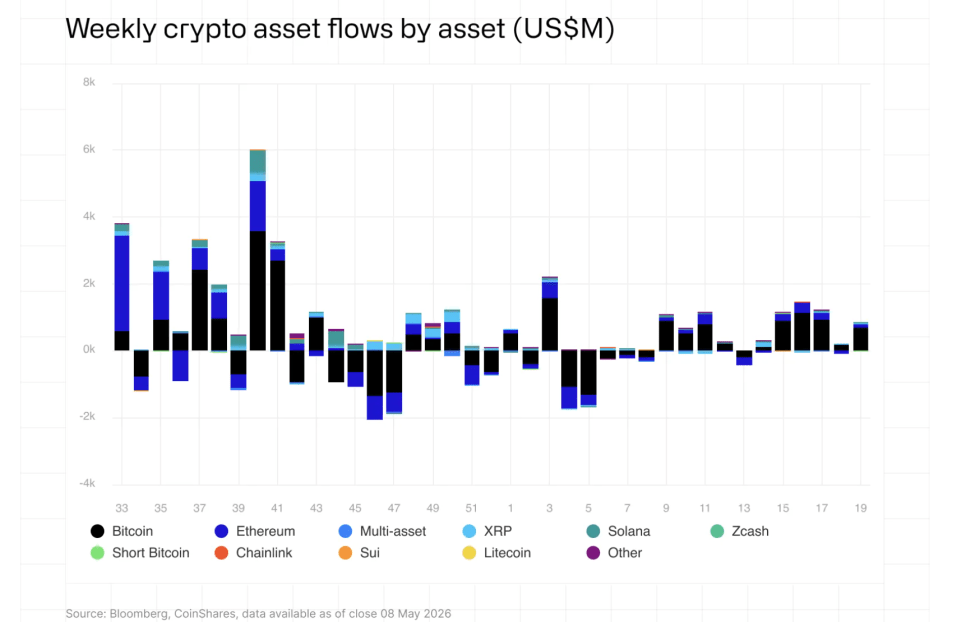
Bitcoin and crypto investment products recorded a significant $857.9 million in net inflows for the week ending May 11, marking the sixth consecutive week of positive flows and the strongest weekly total since late April, according to CoinShares. This surge, a sevenfold increase over the prior week, is seen as a potential structural reset in institutional demand. Bitcoin products attracted the majority at $706.1 million, but inflows were broad-based, with Ethereum, Solana, and XRP products also seeing substantial investments. Short-Bitcoin products experienced their largest outflow of 2026, indicating a reversal of bearish bets. Geographically, the United States led with $776.6 million in inflows, with European markets like Germany and Switzerland also contributing steady participation. Analysts attribute Bitcoin's climb above $80,000 to ETF inflows, corporate treasury buying, and regulatory optimism around stablecoin legislation. The sustained inflow streak presents a pivotal shift, challenging traditional allocators to reconsider the asset class.

Global crypto investment products recorded $857.9 million in net inflows for the week ending May 11 with Bitcoin capturing a big portion of the increase. This marked the sixth consecutive week of positive flows and the strongest weekly total since April 24, according to CoinShares’ latest Digital Asset Fund Flows report — a streak that analysts are increasingly reading as a structural reset in institutional demand rather than a temporary bounce.

The weekly figure represents a more than sevenfold increase over the prior week’s $117.8 million, per CoinShares’ data, underscoring how sharply sentiment shifted as Bitcoin climbed back above the $80,000 threshold. Total assets under management across digital asset investment products rose to $160 billion on the back of the inflows, according to the report.

Bitcoin Leads, But The Breadth Is Notable

Bitcoin products captured the dominant share of last week’s flows, attracting $706.1 million and bringing year-to-date inflows to $4.9 billion, per CoinShares. The directional shift extended well beyond Bitcoin. Ethereum products recorded $77.1 million in inflows, reversing the prior week’s $81.6 million outflow. Solana drew $47.6 million. XRP products attracted $39.6 million.
Crypto ETF inflows on the rise over the past week. Source: CoinShares

The breadth of positive flows across major assets signals a broader improvement in institutional risk appetite rather than Bitcoin-specific positioning, per the report’s geographic and asset-level breakdown. Short-Bitcoin products — instruments used to bet against the asset — posted their largest outflow of 2026, according to CoinShares, a signal that bearish institutional positioning is unwinding alongside the inflow surge.

The US Led, But Europe Held Firm

Geographically, the United States dominated with $776.6 million in inflows, recovering sharply from $47.5 million the prior week, per CoinShares. Germany followed at $50.6 million, Switzerland at $21.1 million, and the Netherlands at $5 million — a distribution that, according to analysis by TradingNews, points to European institutional participation holding steady even as Washington’s regulatory progression has emerged as the dominant catalyst driving sentiment.
BTC's price trends to the upside on the daily chart. Source: BTCUSD on Tradingview

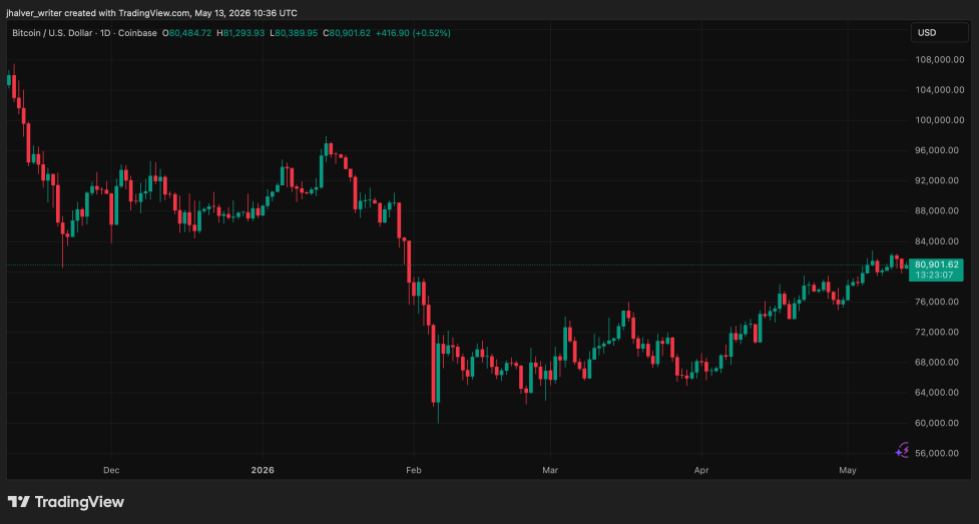
Laser Digital’s derivatives desk attributed Bitcoin’s move above $80,000 to the combination of ETF inflows, anticipated purchases by digital asset treasury companies, and growing optimism surrounding a compromise on the CLARITY Act related to stablecoins, as reported by Bloomingbit citing market commentary from the week.

Six consecutive weeks of positive inflows into crypto investment products marks a pivotal shift in the nascent sector’s institutional demand profile. Whether the streak extends into a sustained re-rating of crypto as an institutional asset class — or fades as macro uncertainty reasserts itself — the $857.9 million weekly figure is the kind of number that makes it increasingly difficult for traditional allocators still sitting on the sidelines to justify staying there.

Cover image from Grok, BTCUSD chart from Tradingview

Crypto di tendenza

Domande pertinenti

QAccording to the CoinShares report, how much net inflow did global crypto investment products record for the week ending May 11, and what was the key trend?

AGlobal crypto investment products recorded $857.9 million in net inflows for the week ending May 11, marking the sixth consecutive week of positive flows.

QWhich cryptocurrency investment products attracted the most inflows last week, and what was the amount?

ABitcoin products attracted the most inflows last week, capturing $706.1 million of the total.

QWhat geographic region dominated the weekly inflows into crypto investment products, and what was the approximate amount?

AThe United States dominated the weekly inflows with approximately $776.6 million.

QWhat are the three factors that Laser Digital's derivatives desk attributed to Bitcoin's move above $80,000?

ALaser Digital's derivatives desk attributed Bitcoin's move above $80,000 to a combination of ETF inflows, anticipated purchases by digital asset treasury companies, and growing optimism surrounding a compromise on the CLARITY Act related to stablecoins.

QWhat does the report suggest the sustained inflow streak signals about institutional demand, as opposed to being a temporary event?

AThe report suggests analysts are increasingly reading the six-week inflow streak as a structural reset in institutional demand rather than a temporary bounce.

Letture associate

Bitcoin Shifts Towards Consolidation, Long-Term Holder Selling Pressure Significantly Eases

Bitcoin's Bottoming Process Shows Signs of Shifting Dynamics Bitcoin's bottom formation is ongoing, but key characteristics are changing. The capitulation selling by long-term holders (LTHs), a primary source of selling pressure this cycle, has begun to cool from its recent peak. Buyers successfully absorbed the selling at the June lows, and price is now recovering to challenge overhead resistance. The market is testing higher resistance levels. Bitcoin reacted more strongly to soft inflation data than major equity indices, signaling sellers may be exhausted and buyers are waiting for a catalyst. Its correlation with stocks is weakening while its inverse relationship with the USD is deepening, suggesting liquidity dynamics are now more influential than risk sentiment. On-chain, price sits between the network's Realized Price (a historical bear market floor) and the Short-Term Holder (STH) cost basis near $69k, a key resistance level where recent buyers break even. LTH profit-taking has largely dried up, and losses now dominate realized on-chain volume—a typical late bear market signal. Crucially, the pace of LTH capitulation has started to decline. Derivatives markets show bearish positions are being unwound, with put/call ratios falling and crash protection costs moderating. However, this derisking hasn't been accompanied by significant spot buying, a missing link for sustained recovery. US spot ETF outflows have slowed but not reversed. In conclusion, foundational elements for a bottom are forming: LTH selling is easing, low-point selling was absorbed, and the market is responding to positive macro cues. The next critical test is whether spot-driven buying can push price through and hold above the STH cost basis near $69k. The follow-through is not yet confirmed.

marsbit3 min fa

Bitcoin Shifts Towards Consolidation, Long-Term Holder Selling Pressure Significantly Eases

marsbit3 min fa

Defending Champions or New Kings? World Cup Final Sees All AIs Backing the Same Side

Will the 2026 World Cup final see Argentina successfully defend their title or a new champion crowned? AI models from various platforms have made their prediction. The final in Buenos Aires pits defending champions Argentina against a resilient Spanish side that has reached this stage with a record of exceptional defensive solidity, conceding only one goal in seven matches. Argentina's path was dramatically different, filled with late comebacks and narrow victories, including a semi-final win over England secured by late goals assisted by the 39-year-old Lionel Messi. A poignant subplot adds narrative weight: a nearly 20-year-old photo shows a young Messi bathing an infant Lamine Yamal, who is now a 19-year-old key player for Spain, symbolizing a potential passing of the torch. In the semi-finals, most AI models incorrectly predicted a French victory over Spain, with only Google's Gemini correctly picking Spain's advancement and also accurately forecasting Argentina's win over England. For the final, however, all six surveyed AIs—ChatGPT, Claude, Gemini, Grok, DeepSeek, and Qwen—unanimously predict a Spanish victory. Their reasoning centers on Spain's superior defense, midfield control, and better physical preparedness after a less strenuous knockout stage journey. While consensus favors Spain as champions, five of the six AIs believe the match will be tightly contested, predicting a draw (1-1 or 0-0) within regular time, with Spain's advantage potentially telling in extra time or even a penalty shootout. Only DeepSeek forecasts a clear Spanish victory within 90 minutes. The stage is set for a clash between Argentina's legendary fighting spirit and Spain's machine-like consistency, with artificial intelligence firmly backing the latter to lift the trophy.

Odaily星球日报20 min fa

Defending Champions or New Kings? World Cup Final Sees All AIs Backing the Same Side

Odaily星球日报20 min fa

From a Loss of 19.2 Billion to a Profit of 7.1 Billion, ChangXin Technology States 'Downturn Cycle Remains a Concern'

Changxin Technology, China's leading domestic DRAM manufacturer, is nearing its IPO on the STAR Market. After reporting significant net losses of -192.25 billion yuan and -90.51 billion yuan in 2023 and 2024 respectively, the company achieved a net profit of 71.44 billion yuan in 2025. This turnaround is attributed to an AI-driven surge in DRAM demand and tight industry supply, leading to a 33.69% increase in average selling prices alongside reduced unit costs. Despite the improved profitability, with gross margins rising from -1.93% in 2023 to 40.99% in 2025, Chairman Zhu Yiming cautions that the strongly cyclical DRAM industry remains vulnerable. Risks include potential macroeconomic shifts, uncertain AI demand, and new capacity expansions that could trigger another downturn. The company still faces high fixed costs, with depreciation reaching 246.8 billion yuan in 2025. Changxin plans to raise 29.5 billion yuan through its IPO to fund technology upgrades, DRAM advancement, and R&D. While its capacity ranks fourth globally, its 7.67% Q4 2025 market share lags behind leaders Samsung, SK Hynix, and Micron. Analysts note the company must now prove its ability to achieve stable mass production with high yields and low cost-per-bit, especially for advanced products. Its growth currently relies on transitioning from DDR4/LPDDR4X to DDR5/LPDDR5X and increasing domestic substitution. Successfully developing and commercializing high-value AI products like HBM is seen as crucial for future competitiveness and closing the gap with international giants.

marsbit49 min fa

From a Loss of 19.2 Billion to a Profit of 7.1 Billion, ChangXin Technology States 'Downturn Cycle Remains a Concern'

marsbit49 min fa

Stop Writing Prompts: Claude’s Official Guide to 4 Types of Loops That Automate Work

The article discusses a shift in AI development from manually crafting prompts to designing "loops"—systems where AI agents autonomously perform tasks until a defined stopping condition is triggered. Inspired by figures like Peter Steinberger and Boris Cherny, this approach, termed "loop engineering," focuses on creating self-running systems rather than one-off interactions. Claude Code's team formally defines a loop as an agent repeatedly executing work until a stop condition is met and categorizes four primary loop types based on their stopping mechanisms: 1. **Turn-based loops:** Human-controlled, step-by-step execution for short, discrete tasks. 2. **Goal loops (/goal):** An evaluator model checks outputs against predefined, quantifiable objectives (e.g., a performance score), forcing retries until the goal is met or a limit is reached. 3. **Time loops (/loop and /schedule):** Time-triggered, like cron jobs, for recurring tasks (e.g., daily summaries) or monitoring external systems. 4. **Proactive loops:** Event or time-triggered, fully automated workflows for ongoing, bounded tasks like bug triage, running until manually stopped. The core shift is from designing prompt content to designing the behavioral system—its triggers, verification mechanisms, and termination rules. Effective verification, where the agent can self-check its output, is highlighted as crucial for loop efficiency. The article warns that uncontrolled loops risk high costs and getting stuck in unproductive cycles. It recommends implementing essential "gates": machine-verifiable completion conditions, hard limits on iterations/cost, and stagnation detection. Best practices include using smaller models where possible, testing on small scales first, and automating deterministic parts with scripts. In summary, AI programming is evolving from prompt engineering to system design, where the skill lies in architecting loops that can autonomously execute, validate, and decisively conclude their work.

marsbit49 min fa

Stop Writing Prompts: Claude’s Official Guide to 4 Types of Loops That Automate Work

marsbit49 min fa

Trading

Spot

Articoli Popolari

Cosa è BITCOIN

Comprendere HarryPotterObamaSonic10Inu (ERC-20) e la sua posizione nel mondo delle criptovalute Negli ultimi anni, il mercato delle criptovalute ha assistito a un aumento della popolarità delle meme coin, catturando l'interesse non solo dei trader, ma anche di coloro che cercano coinvolgimento comunitario e valore di intrattenimento. Tra questi token unici c'è HarryPotterObamaSonic10Inu (ERC-20), un progetto intrigante che mescola riferimenti culturali nel tessuto delle criptovalute. Questo articolo esplora gli aspetti chiave di HarryPotterObamaSonic10Inu, analizzando i suoi meccanismi, l'etica guidata dalla comunità e il suo coinvolgimento con il panorama crittografico più ampio. Che cos'è HarryPotterObamaSonic10Inu (ERC-20)? Come suggerisce il suo nome, HarryPotterObamaSonic10Inu è una meme coin costruita sulla blockchain di Ethereum, classificata secondo lo standard ERC-20. A differenza delle criptovalute tradizionali che possono enfatizzare l'utilità pratica o il potenziale investimento, questo token prospera grazie al valore di intrattenimento e alla forza della sua comunità. Il progetto mira a creare un ambiente in cui gli utenti coinvolti possono riunirsi, condividere idee e partecipare ad attività ispirate a diversi fenomeni culturali. Una caratteristica notevole di HarryPotterObamaSonic10Inu è la zero tassa sulle transazioni. Questo elemento allettante tende a incoraggiare il trading e il coinvolgimento della comunità, privo di costi aggiuntivi che possono scoraggiare i trader di piccole dimensioni. L'offerta totale della moneta è fissata a un miliardo di token, un numero che segna la sua intenzione di mantenere una circolazione sostanziale all'interno della comunità. Creatore di HarryPotterObamaSonic10Inu (ERC-20) Le origini di HarryPotterObamaSonic10Inu sono avvolte in un certo mistero; i dettagli sul creatore rimangono sconosciuti. Lo sviluppo di questo token non presenta un team identificabile o un piano esplicito, cosa non rara nel settore delle meme coin. Invece, il progetto è emerso organicamente, con il suo progresso fortemente dipendente dall'entusiasmo e dalla partecipazione della sua comunità. Investitori di HarryPotterObamaSonic10Inu (ERC-20) Per quanto riguarda investimenti esterni e finanziamenti, HarryPotterObamaSonic10Inu rimane ambiguo. Il token non elenca alcuna fondazione di investimento conosciuta o un sostegno organizzativo significativo. Invece, la linfa vitale del progetto è la sua comunità di base, che informa la sua crescita e sostenibilità attraverso azioni collettive e coinvolgimento nello spazio crittografico. Come funziona HarryPotterObamaSonic10Inu (ERC-20)? In quanto meme coin, HarryPotterObamaSonic10Inu opera principalmente al di fuori delle strutture tradizionali che governano spesso il valore degli asset. Ci sono diversi aspetti distintivi che definiscono il funzionamento del progetto: Transazioni senza tasse: Senza costi fiscali sulle transazioni, gli utenti possono comprare e vendere liberamente il token senza preoccuparsi di costi nascosti. Coinvolgimento della comunità: Il progetto prospera sull'interazione della comunità, sfruttando le piattaforme social per creare entusiasmo e facilitare il coinvolgimento. Discussioni, condivisione di contenuti e coinvolgimento sono elementi cruciali che aiutano ad espandere la sua portata e a favorire la lealtà tra i sostenitori. Nessuna utilità pratica: Va notato che HarryPotterObamaSonic10Inu non offre un'utilità concreta all'interno dell'ecosistema finanziario. Piuttosto, è classificato come un token principalmente per attività di intrattenimento e comunitarie. Riferimento culturale: Il token incorpora astutamente elementi della cultura pop per attirare interesse, collegandosi a appassionati di meme e seguaci delle criptovalute. HarryPotterObamaSonic10Inu esemplifica come le meme coin operino in modo diverso rispetto ai progetti di criptovalute più tradizionali, entrando nel mercato come costrutti sociali innovativi piuttosto che come asset utilitari. Cronologia di HarryPotterObamaSonic10Inu (ERC-20) La storia di HarryPotterObamaSonic10Inu è segnata da diversi traguardi notevoli: Creazione: Il token è emerso da un meme virale, catturando l'immaginazione di molti appassionati di criptovalute. Le date di creazione specifiche non sono disponibili, sottolineando la sua crescita organica. Inserimento negli scambi: HarryPotterObamaSonic10Inu ha fatto il suo ingresso in vari scambi, consentendo un accesso e un trading più facili da parte della comunità. Iniziative di coinvolgimento della comunità: Attività in corso volte a migliorare l'interazione della comunità, comprese gare, campagne sui social media e generazione di contenuti da parte di fan e sostenitori. Piani di espansione futura: La tabella di marcia del progetto include il lancio di una collezione NFT, merchandising e un sito di eCommerce relativo ai suoi temi culturali, coinvolgendo ulteriormente la comunità e cercando di aggiungere più dimensioni al suo ecosistema. Punti chiave su HarryPotterObamaSonic10Inu (ERC-20) Natura guidata dalla comunità: Il progetto dà priorità al contributo collettivo e alla creatività, garantendo che il coinvolgimento degli utenti sia al centro del suo sviluppo. Classificazione come meme coin: Rappresenta l'epitome delle criptovalute basate sull'intrattenimento, distinguendosi dai veicoli d'investimento tradizionali. Nessuna affiliazione diretta con Bitcoin: Nonostante la somiglianza nel nome del ticker, HarryPotterObamaSonic10Inu è distintivo e non ha alcuna relazione con Bitcoin o altre criptovalute consolidate. Focus sulla collaborazione: HarryPotterObamaSonic10Inu è progettato per creare uno spazio per la collaborazione e la condivisione di storie tra i suoi detentori, fornendo un canale per la creatività e il legame comunitario. Prospettive future: L'ambizione di espandersi oltre il suo presupposto iniziale verso NFT e merchandising delinea un percorso per il progetto per potenzialmente entrare in strade più mainstream all'interno della cultura digitale. Poiché le meme coin continuano a catturare l'immaginazione della comunità crittografica, HarryPotterObamaSonic10Inu (ERC-20) si distingue per i suoi legami culturali e il suo approccio centrato sulla comunità. Anche se potrebbe non adattarsi al modello tipico di un token orientato all'utilità, la sua essenza risiede nella gioia e nella camaraderia coltivate tra i suoi sostenitori, evidenziando la natura in evoluzione delle criptovalute in un'epoca sempre più digitale. Con la continuazione dello sviluppo del progetto, sarà importante osservare come le dinamiche della comunità influenzano la sua traiettoria nel panorama in continuo cambiamento della tecnologia blockchain.

1.8k Totale visualizzazioniPubblicato il 2024.04.01Aggiornato il 2024.12.03

Cosa è BITCOIN

Come comprare BTC

Benvenuto in HTX.com! Abbiamo reso l'acquisto di Bitcoin (BTC) semplice e conveniente. Segui la nostra guida passo passo per intraprendere il tuo viaggio nel mondo delle criptovalute.Step 1: Crea il tuo Account HTXUsa la tua email o numero di telefono per registrarti il tuo account gratuito su HTX. Vivi un'esperienza facile e sblocca tutte le funzionalità,Crea il mio accountStep 2: Vai in Acquista crypto e seleziona il tuo metodo di pagamentoCarta di credito/debito: utilizza la tua Visa o Mastercard per acquistare immediatamente BitcoinBTC.Bilancio: Usa i fondi dal bilancio del tuo account HTX per fare trading senza problemi.Terze parti: abbiamo aggiunto metodi di pagamento molto utilizzati come Google Pay e Apple Pay per maggiore comodità.P2P: Fai trading direttamente con altri utenti HTX.Over-the-Counter (OTC): Offriamo servizi su misura e tassi di cambio competitivi per i trader.Step 3: Conserva Bitcoin (BTC)Dopo aver acquistato Bitcoin (BTC), conserva nel tuo account HTX. In alternativa, puoi inviare tramite trasferimento blockchain o scambiare per altre criptovalute.Step 4: Scambia Bitcoin (BTC)Scambia facilmente Bitcoin (BTC) nel mercato spot di HTX. Accedi al tuo account, seleziona la tua coppia di trading, esegui le tue operazioni e monitora in tempo reale. Offriamo un'esperienza user-friendly sia per chi ha appena iniziato che per i trader più esperti.

4.1k Totale visualizzazioniPubblicato il 2024.12.12Aggiornato il 2026.06.02

Come comprare BTC

Cosa è $BITCOIN

ORO DIGITALE ($BITCOIN): Un'Analisi Completa Introduzione all'ORO DIGITALE ($BITCOIN) L'ORO DIGITALE ($BITCOIN) è un progetto basato su blockchain che opera sulla rete Solana, con l'obiettivo di combinare le caratteristiche dei metalli preziosi tradizionali con l'innovazione delle tecnologie decentralizzate. Sebbene condivida un nome con Bitcoin, spesso definito “oro digitale” a causa della sua percezione come riserva di valore, l'ORO DIGITALE è un token separato progettato per creare un ecosistema unico all'interno del panorama Web3. Il suo obiettivo è posizionarsi come un asset digitale alternativo valido, anche se i dettagli riguardanti le sue applicazioni e funzionalità sono ancora in fase di sviluppo. Cos'è l'ORO DIGITALE ($BITCOIN)? L'ORO DIGITALE ($BITCOIN) è un token di criptovaluta esplicitamente progettato per l'uso sulla blockchain di Solana. A differenza di Bitcoin, che fornisce un ruolo di stoccaggio di valore ampiamente riconosciuto, questo token sembra concentrarsi su applicazioni e caratteristiche più ampie. Aspetti notevoli includono: Infrastruttura Blockchain: Il token è costruito sulla blockchain di Solana, nota per la sua capacità di gestire transazioni ad alta velocità e a basso costo. Dinamiche di Offerta: L'ORO DIGITALE ha un'offerta massima fissata a 100 quadrilioni di token (100P $BITCOIN), sebbene i dettagli riguardanti la sua offerta circolante siano attualmente non divulgati. Utilità: Sebbene le funzionalità precise non siano esplicitamente delineate, ci sono indicazioni che il token potrebbe essere utilizzato per varie applicazioni, potenzialmente coinvolgendo applicazioni decentralizzate (dApp) o strategie di tokenizzazione degli asset. Chi è il Creatore dell'ORO DIGITALE ($BITCOIN)? Attualmente, l'identità dei creatori e del team di sviluppo dietro l'ORO DIGITALE ($BITCOIN) rimane sconosciuta. Questa situazione è tipica tra molti progetti innovativi nel settore blockchain, in particolare quelli allineati con la finanza decentralizzata e i fenomeni delle meme coin. Sebbene tale anonimato possa favorire una cultura guidata dalla comunità, intensifica le preoccupazioni riguardo alla governance e alla responsabilità. Chi sono gli Investitori dell'ORO DIGITALE ($BITCOIN)? Le informazioni disponibili indicano che l'ORO DIGITALE ($BITCOIN) non ha alcun sostenitore istituzionale noto o investimenti di venture capital prominenti. Il progetto sembra operare su un modello peer-to-peer incentrato sul supporto e sull'adozione della comunità piuttosto che su percorsi di finanziamento tradizionali. La sua attività e liquidità si trovano principalmente su exchange decentralizzati (DEX), come PumpSwap, piuttosto che su piattaforme di trading centralizzate consolidate, evidenziando ulteriormente il suo approccio di base. Come Funziona l'ORO DIGITALE ($BITCOIN) Le meccaniche operative dell'ORO DIGITALE ($BITCOIN) possono essere elaborate in base al suo design blockchain e alle caratteristiche della rete: Meccanismo di Consenso: Sfruttando il proof-of-history (PoH) unico di Solana combinato con un modello di proof-of-stake (PoS), il progetto garantisce una validazione efficiente delle transazioni contribuendo all'alta performance della rete. Tokenomics: Sebbene meccanismi deflazionistici specifici non siano stati dettagliati ampiamente, l'ampia offerta massima di token implica che potrebbe soddisfare microtransazioni o casi d'uso di nicchia che devono ancora essere definiti. Interoperabilità: Esiste il potenziale per l'integrazione con l'ecosistema più ampio di Solana, inclusi vari piattaforme di finanza decentralizzata (DeFi). Tuttavia, i dettagli riguardanti integrazioni specifiche rimangono non specificati. Cronologia degli Eventi Chiave Ecco una cronologia che evidenzia traguardi significativi riguardanti l'ORO DIGITALE ($BITCOIN): 2023: Il dispiegamento iniziale del token avviene sulla blockchain di Solana, contrassegnato dal suo indirizzo di contratto. 2024: L'ORO DIGITALE guadagna visibilità poiché diventa disponibile per il trading su exchange decentralizzati come PumpSwap, consentendo agli utenti di scambiarlo contro SOL. 2025: Il progetto assiste a un'attività di trading sporadica e a un potenziale interesse per impegni guidati dalla comunità, sebbene non siano state documentate partnership significative o avanzamenti tecnici fino ad ora. Analisi Critica Punti di Forza Scalabilità: L'infrastruttura sottostante di Solana supporta alti volumi di transazioni, il che potrebbe migliorare l'utilità di $BITCOIN in vari scenari di transazione. Accessibilità: Il potenziale basso prezzo di trading per token potrebbe attrarre investitori al dettaglio, facilitando una partecipazione più ampia grazie a opportunità di proprietà frazionata. Rischi Mancanza di Trasparenza: L'assenza di sostenitori, sviluppatori o di un processo di audit pubblicamente noti potrebbe generare scetticismo riguardo alla sostenibilità e all'affidabilità del progetto. Volatilità del Mercato: L'attività di trading è fortemente dipendente dal comportamento speculativo, il che può comportare una significativa volatilità dei prezzi e incertezze per gli investitori. Conclusione L'ORO DIGITALE ($BITCOIN) emerge come un progetto intrigante ma ambiguo all'interno dell'evolvente ecosistema di Solana. Sebbene tenti di sfruttare la narrativa dell'“oro digitale”, la sua partenza dal ruolo consolidato di Bitcoin come riserva di valore sottolinea la necessità di una chiara differenziazione della sua utilità e struttura di governance. L'accettazione e l'adozione future dipenderanno probabilmente dall'affrontare l'attuale opacità e dalla definizione più esplicita delle sue strategie operative ed economiche. Nota: Questo rapporto comprende informazioni sintetizzate disponibili a ottobre 2023, e potrebbero essersi verificati sviluppi oltre il periodo di ricerca.

142 Totale visualizzazioniPubblicato il 2025.05.13Aggiornato il 2025.05.13

Cosa è $BITCOIN

Discussioni

Benvenuto nella Community HTX. Qui puoi rimanere informato sugli ultimi sviluppi della piattaforma e accedere ad approfondimenti esperti sul mercato. Le opinioni degli utenti sul prezzo di BTC BTC sono presentate come di seguito.

活动图片