Silicon Valley Godfather Naval Takes the Helm, AngelList Packs Pre-IPO Growth Companies into USVC Fund

marsbitPubblicato 2026-04-24Pubblicato ultima volta 2026-04-24

Introduzione

This article discusses the USVC Venture Capital Access Fund (USVC), a new investment vehicle co-founded by prominent Silicon Valley investor Naval Ravikant through AngelList. The fund's core mission is to provide retail investors access to high-growth, pre-IPO companies—a segment of the market traditionally reserved for venture capitalists and accredited investors. USVC invests in a portfolio of late-stage private companies, including notable names like xAI, Anthropic, and OpenAI. Its key selling point is allowing ordinary investors to gain exposure to the significant value creation that occurs before a company goes public, as the average age of companies at IPO has increased from 6 years in 1980 to 13 years today. However, the article highlights several important constraints: investors buy fund shares, not direct stock; the fund carries a net annual fee of 2.5%; it offers limited liquidity through quarterly share repurchases; and investments are long-term with no fixed end date. The fund has also garnered attention in the Web3 community due to Naval’s and AngelList’s history of supporting crypto and blockchain projects, positioning USVC at the intersection of traditional venture capital and emerging digital asset investment trends.

Author: KarenZ, Foresight News

In Silicon Valley, the name Naval Ravikant is synonymous with credibility.

He is the co-founder of AngelList and one of the most representative early-stage investors of the past decade, having backed companies like Uber, Twitter, and Notion. Now, in the new USVC Venture Capital Access Fund (USVC), Naval is not just a symbolic figure. According to the fund's April 2026 supplemental disclosure document, he serves as the Chairman of the Investment Committee, responsible for portfolio construction and strategy oversight.

This arrangement is significant because USVC is not merely selling the concept of a "low-threshold fund." What it is truly attempting to package and offer is a capability that was previously available only to a select few: earlier access to pre-IPO growth-stage companies.

On the surface, USVC is most easily understood as a "venture capital fund for retail investors." But when viewed together—the official website, the prospectus, and the portfolio page—the core story AngelList wants to tell becomes clearer and more pointed: the most imaginative companies today are taking longer to go public; IPOs are increasingly becoming exit points rather than entry points; what ordinary investors are shut out of is not just the risk, but also the most "lucrative" period of growth.

The significance of USVC lies in its attempt to pry that door open a little.

The Core of USVC: Not a Fund, But Selling 'Pre-IPO' Access

The USVC homepage states the problem bluntly: The next wave of growth is happening in the private markets. The website also provides a telling comparison: in 1980, the median age of a U.S. company at IPO was 6 years; today, it's 13 years. Those extra 7 years mean a massive amount of value creation is occurring outside the public markets.

This is the crucial product logic behind USVC. The USVC prospectus clearly states that USVC primarily invests in VC funds, SPVs, and private, pre-IPO growth-oriented companies. The most easily overlooked, yet most critical term here is "pre-IPO growth-oriented companies." The definition in the document is equally direct: private companies that the investment adviser believes "have significant growth potential at the time of investment."

In other words, USVC's selling point is not the abstract "allocation to venture capital," but rather bringing ordinary investors face-to-face with the truly most attractive segment of assets in the private markets. It aims to sell a channel for accessing pre-IPO growth companies.

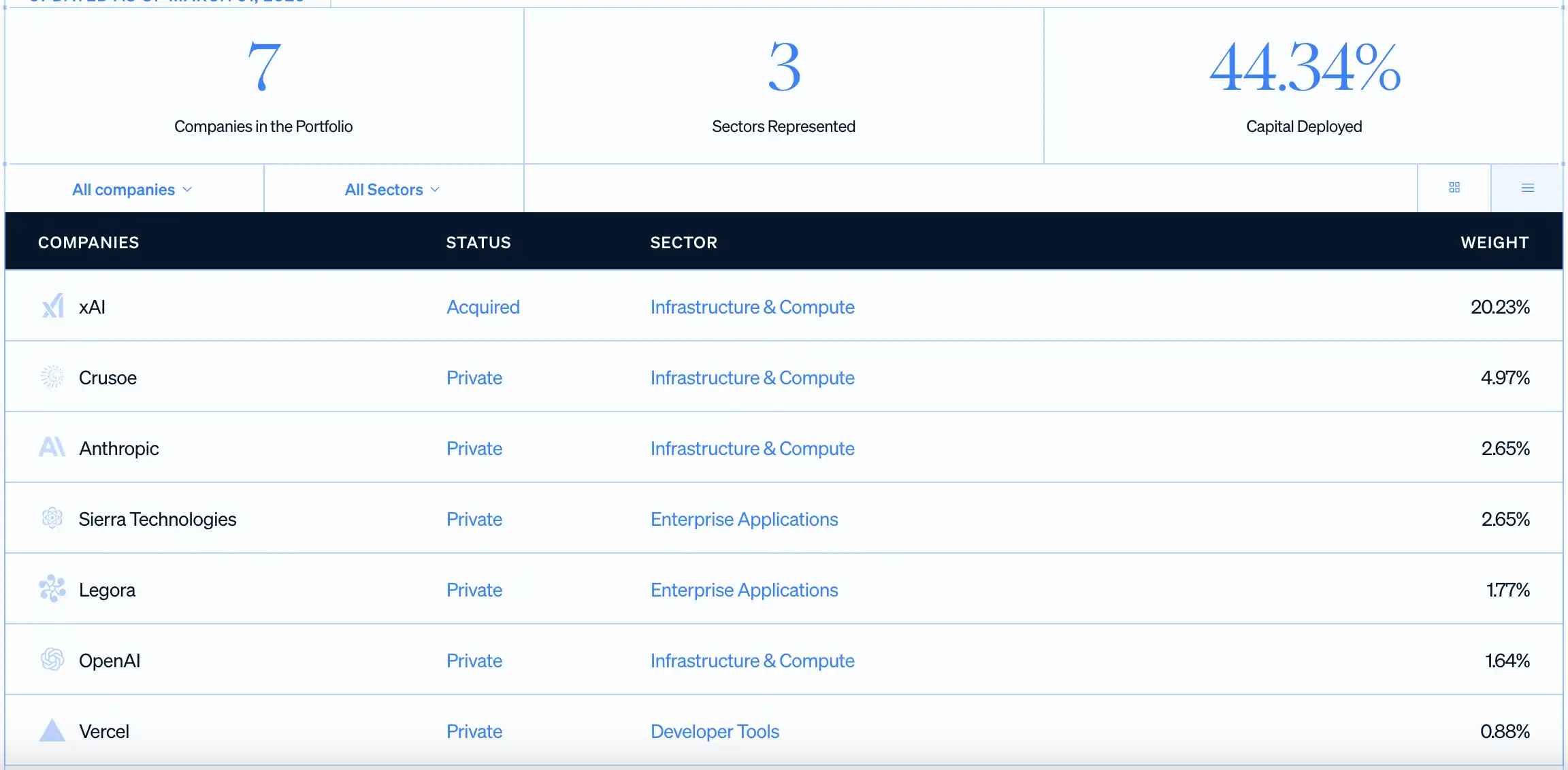
This is also why it consistently emphasizes names like OpenAI, Anthropic, xAI, and Vercel. The portfolio page on the website shows that as of March 31, 2026, USVC had deployed 44.34% of its capital, with 7 companies in its portfolio. The largest single holding is xAI, followed by Crusoe, Anthropic, Sierra, Legora, OpenAI, and Vercel. Regardless of the eventual performance of these positions, the message AngelList wants to send investors is clear enough: companies you once only read about in the news, you can now gain some exposure to *before* they go public, through a single fund.
This is highly attractive to ordinary investors. Because under the traditional path, they typically only get the chance to buy in *after* a company's IPO. And by that point, the earliest, most explosive growth has likely already been captured by the founding team, employees, early-stage funds, and institutional shareholders.

Legally, this fund is registered as a closed-end management investment company under the U.S. Investment Company Act of 1940. It was initially established on April 8, 2021, converted to a Delaware statutory trust on August 7, 2025, and is currently raising capital through a continuous offering. The initial investment threshold is $500, with no minimum for subsequent additions; the website even supports monthly dollar-cost averaging.

This packaging is clever. It retains the core attraction of the private markets—pre-IPO growth companies—while making the purchase process resemble a retail financial product as much as possible. U.S. users don't need to first become accredited investors, enter high-net-worth circles, or deal with the complex tax forms typical of traditional private funds. At the point of purchase, at least, AngelList tries to make it seem simple enough.

Access to Pre-IPO Companies Does Not Mean a Simple Investment

Precisely because USVC's narrative is so enticing, it's the constraints behind it that need to be clearly spelled out.

First, investors are buying a share of a fund. The fund holds these pre-IPO growth companies indirectly or directly through VC funds, SPVs, and direct investments. This means investors get *access* to pre-IPO growth companies, not the clear, readily realizable ownership experience of buying a stock.

Second, this access comes at a cost, and it's not low. The fee table on page 20 of the Prospectus shows that USVC has a management fee of 1.00%, a shareholder servicing fee of 0.25%, underlying fund fees and expenses of 0.95%, other expenses of 1.41%, resulting in a total annual expense ratio of 3.61%. After fee waivers (in place at least until October 29, 2026), the net annual expense ratio is 2.50%. After accounting for the underlying VC vehicle and operational costs, investors are facing a product with a current net expense ratio that is not insignificant.
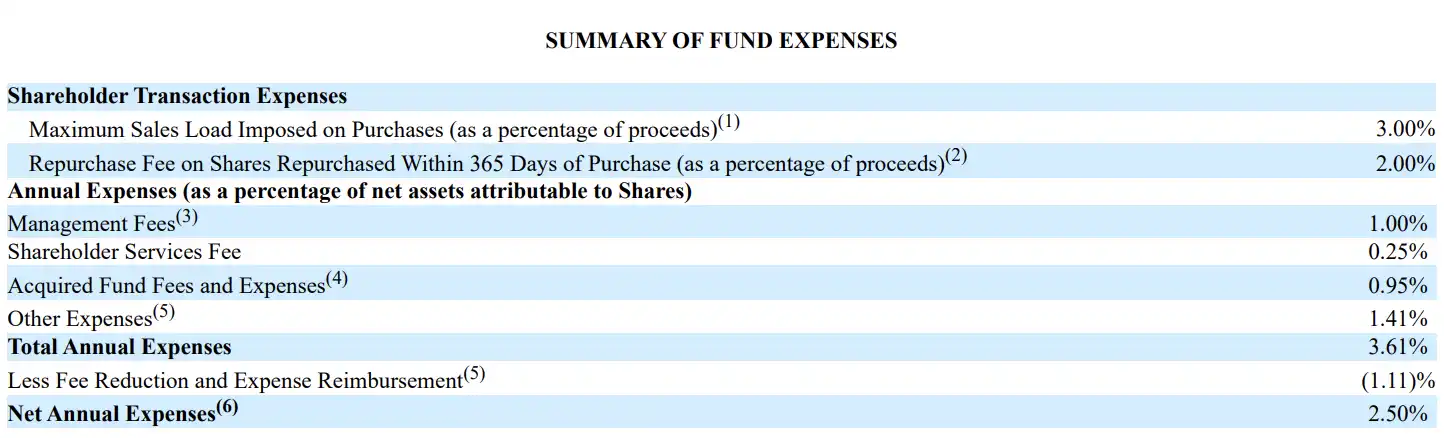
Third, this fund does not provide ordinary investors with a truly high-liquidity exit path. USVC is not listed on an exchange, has no public trading market, and liquidity primarily depends on whether the Board of Directors initiates quarterly share repurchases, which typically will not exceed 5% of net assets. The documents originally included a 2% repurchase fee for shares held less than a year, but the Board has currently decided to waive it (subject to modification or termination). This means it offers slightly more flexibility than a traditional VC fund, but is still far from "in and out anytime."

Fourth, USVC does not have a fixed termination/ liquidation date like a traditional 10+2 year venture capital fund, but it is still a long-term, closed-end structure with no defined end date. When the underlying assets realize their value still depends on liquidity events like IPOs, mergers and acquisitions, or private secondary transactions. The prospectus also clearly warns that many portfolio investments may take several years to appreciate significantly.

And even after a portfolio company goes public, it is often subject to lock-up restrictions, commonly for 180 days. During this period, the fund itself, or the managers of the underlying VC/SPV the fund invested in, may not be able to sell immediately.

Why is the Web3 Circle Paying Attention to This Fund?

The additional attention USVC is receiving from the Web3 circle is also related to Naval's and AngelList's sustained investment in the crypto industry over the years.

Naval has long been one of Silicon Valley's most publicly supportive investors of crypto assets and the Web3 narrative. In 2017, he told Laura Shin in an interview that his attention had largely shifted to Crypto; by 2021, he systematically discussed Web3, NFTs, and digital property rights with a16z partner Chris Dixon in a long conversation with Tim Ferriss.

On the platform side, AngelList has not treated Crypto as a fringe business in recent years, beginning to support investments in USDC on its platform in 2022. AngelList's website currently has a dedicated Crypto solutions page, explicitly stating its collaboration with CoinList to support Crypto SPVs and related fund vehicles.

Furthermore, on the other side, more and more cryptocurrency exchanges and Web3 projects are accelerating the launch of Pre-IPO products. USVC represents a slow-moving variable within the system, while most Web3 Pre-IPO products represent fast-moving variables driven by efficiency, often offering the ability to exit at any time.

These two worlds originally spoke different languages but are now competing for the same investors, the same narrative, and the same anxiety: If great companies are taking longer to go public, can ordinary people still get a share of the pie *before* the IPO?

Naval's name can push that door open. AngelList's platform network can bring pre-IPO companies closer. But the world behind the door hasn't necessarily become much easier because of it.


Domande pertinenti

QWhat is the primary investment focus of the USVC Venture Capital Access Fund (USVC)?

AThe USVC primarily invests in VC funds, SPVs, and private growth-oriented companies that are not yet publicly traded, aiming to provide access to high-growth potential companies before they IPO.

QWho is Naval Ravikant and what role does he play in the USVC fund?

ANaval Ravikant is the co-founder of AngelList and a prominent early-stage investor. In the USVC fund, he serves as the Chairman of the Investment Committee, responsible for portfolio construction and strategy oversight.

QWhat are some of the constraints or risks associated with investing in USVC?

AConstraints include high fees (a net annual fee rate of 2.50% after waivers), limited liquidity with no public trading market and reliance on quarterly share repurchases, no fixed expiration date, and underlying assets subject to lock-up periods post-IPO.

QWhy is the USVC fund particularly relevant to the Web3 and crypto community?

AIt is relevant because Naval Ravikant and AngelList have been strong supporters of crypto and Web3, with AngelList offering Crypto SPVs and fund vehicles. The fund also addresses the same narrative as Web3 Pre-IPO products: providing access to high-growth companies before public listing.

QHow does USVC lower the barrier to entry for average investors compared to traditional venture capital investments?

AUSVC lowers barriers by allowing an initial investment of just $500, supporting monthly investments, and not requiring investors to be accredited or high-net-worth individuals, while simplifying tax reporting compared to traditional私募 funds.

Letture associate

Annual Salary of Millions Competing for Electricians, Meta Rushes to Open Its Own Technical School

The AI boom is facing an unexpected bottleneck: a severe shortage of skilled construction workers and electricians. As tech giants like Meta, OpenAI, and Alphabet race to build massive data centers—such as OpenAI's $16 billion "Stargate" project—they are hitting a critical labor wall. The U.S. needs an estimated 130,000 more electricians, 240,000 construction workers, and 150,000 supervisors by 2030 for AI infrastructure alone, but tens of thousands of electrician jobs go unfilled each year. While AI companies offer high premiums, with electricians earning up to $280,000 annually, worker scarcity still causes massive losses—delays on a single project can cost $14.2 million per month. The complexity of building AI data centers, which require immense power (equivalent to powering hundreds of thousands of homes), sophisticated electrical systems, and advanced liquid cooling solutions, demands highly skilled technicians who are in short supply. To combat this, companies are investing heavily in training. Meta has committed $115 million to a free training school offering tuition, housing, and stipends, targeting 5,000 new workers. OpenAI is partnering with unions to secure skilled labor. These efforts are paying off, with a significant rise in Gen Z interest in trade schools over college. However, the power demands are staggering. AI data centers are driving a rapid surge in electricity consumption, projected to account for up to 12% of U.S. power use by 2028 and raising costs for consumers. Furthermore, the construction boom is project-based, leading to a potential future glut of trained workers once building peaks, which could depress wages industry-wide. The race for AI supremacy now depends as much on skilled hands as on advanced chips.

marsbit28 min fa

Annual Salary of Millions Competing for Electricians, Meta Rushes to Open Its Own Technical School

marsbit28 min fa

OpenAI No Longer Sells Its Most Expensive Model for Profit

OpenAI is shifting its business strategy away from promoting its most expensive, flagship models for every task. Recent price cuts—80% for GPT-5.6 Luna and 20% for Terra—signal a deeper change: the company now actively advises users that many tasks don't require the most powerful model. Instead, OpenAI recommends a tiered approach: use the high-end GPT-5.6 Sol for complex planning and analysis, then delegate execution to cheaper models like Luna. This mirrors moves by Anthropic, which recently launched Claude Opus 5 at half the price of its top model, Fable 5. Both companies are de-emphasizing flagship models as primary revenue drivers, using them instead for brand prestige and technological showcases. The industry is entering a "mass-market" phase, similar to automotive, where high-volume, cost-effective models handle daily operations and drive scale. OpenAI's price reductions are partly enabled by AI models themselves optimizing underlying code and infrastructure, creating a self-reinforcing cycle of efficiency gains and cost reduction. Competition is shifting from "who is smartest" to "who offers the best value." The goal is no longer selling individual models but fostering widespread API adoption and ecosystem lock-in. By making AI calls cheap and ubiquitous, companies like OpenAI aim to become the indispensable, utility-like infrastructure powering automated workflows—the "water and electricity" of software, quietly embedded everywhere.

marsbit28 min fa

OpenAI No Longer Sells Its Most Expensive Model for Profit

marsbit28 min fa

Will the Fed Definitely Raise Interest Rates in September? How Will Crypto and U.S. Stocks Withstand the Pressure?

The market's expectation for a September Fed rate hike surged dramatically in early August, jumping from under 50% to over 80% within a week. This shift followed a contentious July FOMC meeting, where a 9-3 vote to hold rates revealed growing dissent from hawkish members advocating for an immediate hike to combat persistent inflation. The primary catalyst for this repricing is rising oil prices, driven by renewed geopolitical tensions around the Strait of Hormuz, which threaten global supply. Energy costs directly influence inflation metrics, making the upcoming July CPI report (due August 12th) a critical data point. If it shows inflation reaccelerating, the probability of a September hike will solidify. For Bitcoin and crypto assets, this is typically bearish news. Bitcoin continues to behave as a high-beta, liquidity-sensitive risk asset. A rate hike raises the opportunity cost of holding non-yielding assets and could drive capital toward money markets, pressuring crypto prices in the short term. However, historical patterns suggest that if a hike is perceived as the end of a tightening cycle rather than the start, any negative price impact may be brief. U.S. stocks, particularly crypto-linked equities like Coinbase and growth-oriented tech stocks, are also vulnerable. Higher rates increase discount rates in valuation models, putting pressure on high-multiple companies. This coincides with a pivotal tech earnings season where investor focus has shifted from massive AI capital expenditure to tangible revenue and cash flow generation. Companies with negative cash flow and weak growth narratives could face heightened volatility if borrowing costs rise in September. In summary, a September Fed hike has evolved into a mainstream market scenario. Key factors to watch are oil prices, the July CPI report, and Fed communications, which will determine the final decision and its impact on volatile crypto and equity markets.

marsbit39 min fa

Will the Fed Definitely Raise Interest Rates in September? How Will Crypto and U.S. Stocks Withstand the Pressure?

marsbit39 min fa

Trading

Spot
活动图片




