Shielded Labs Warns Zcash Must Act Now To Win Long-Term Investors

bitcoinistPubblicato 2026-03-04Pubblicato ultima volta 2026-03-04

Shielded Labs is urging the Zcash community to move quickly on long-term sustainability changes, arguing that the network has a near-term opening to attract patient capital and should not wait for that window to close. The pitch is not just technical. In Shielded Labs’ telling, protocol-level clarity around future security and emissions could itself become an investment signal for ZEC.

The argument surfaced in a Zcash Community Forum discussion around the proposed Network Sustainability Mechanism, or NSM, where Shielded Labs pushed back on the idea that the work lacks short-term relevance.

“We believe there’s an opportunity right now to attract long-term investors. In conversations we’ve had over the past year, investors respond positively to the fact that we’re thinking about and actively addressing long-term sustainability. Broad consensus from the community and coinholders for implementing the NSM in the next network upgrade would send a clear signal that we have a credible path forward,” the group wrote.

Zcash Could Miss Its Moment Without Fast Action

That framing matters because the current debate is not simply about whether Zcash should strengthen its future security budget, but how. In a separate governance post, Shielded Labs said recent polling showed a split between support for the overall direction of the NSM and resistance to one of its more sensitive design choices, issuance smoothing.

According to the group, “There were two separate questions: one related to the NSM and issuance smoothing, and another focused on burning 60 percent of transaction fees to support network sustainability.” It added that the issuance-smoothing question won “broad support from panels but not from coinholders,” while the fee-burning component drew broad support from both panels and coinholders.

On that basis, Shielded Labs said it sees “clear support” for the elements that remove ZEC from circulation, including ZIP 233 and ZIP 235, and intends to push those parts toward the next network upgrade.

Shielded Labs also acknowledged that resistance from coinholders is not irrational. “For some coinholders, the existing emissions schedule is viewed as a defining part of Zcash’s monetary identity, similar in principle to the 21 million supply cap. That is a rational position,” the post said, adding that the team remains open to alternative designs that preserve the halving schedule while still improving sustainability.

Still, the core message from the newer forum exchange was unmistakably urgent. Shielded Labs argued that upcoming network developments could make the timing more consequential than it appears today.

“Tachyon could increase aggregate fees in the near term by allowing a much higher rate of transactions, which makes the timing especially important. NEAR Intents integrations and additional Maya DEX activity could also increase fee demand. If several of these developments gain traction at the same time, aggregate network usage could rise meaningfully. In that scenario, it would be better to already have the NSM in place rather than trying to introduce it later.”

The broader strategic claim is that Zcash can differentiate itself by confronting a question many proof-of-work networks still treat as a future problem. Shielded Labs explicitly tied the issue to the wider debate over Bitcoin’s long-term security budget, arguing that a mechanism “explicitly defined at the protocol level” could matter for how users and investors evaluate network durability.

Whether that case is enough to win over skeptical coinholders remains unresolved, but the direction of travel is clearer: Shielded Labs wants Zcash to present sustainability not as an abstract research topic, but as part of the asset’s investment thesis now.

At press time, ZEC traded at $216.59.
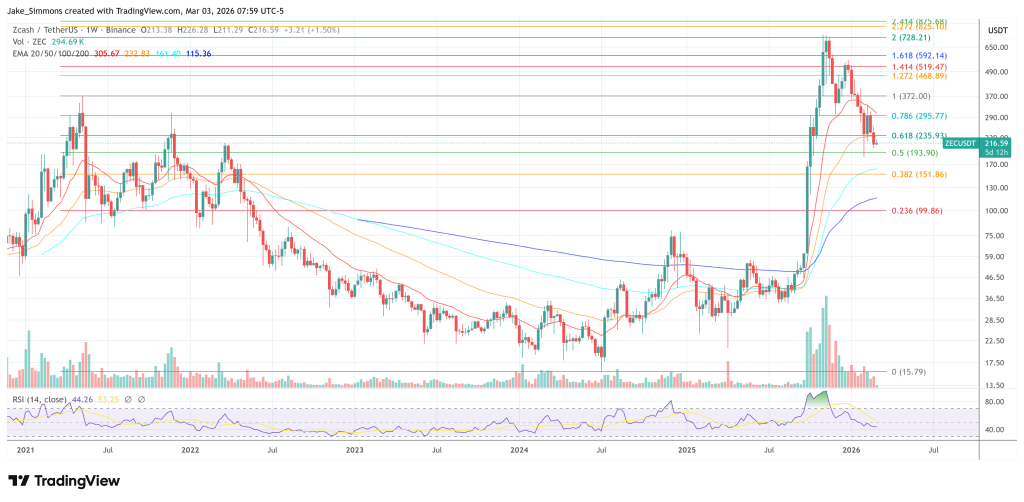
ZEC trades below the 0.618 Fib, 1-week chart | Source: ZECUSDT on TradingView.com

Letture associate

The AI Investment Landscape Is Being Reshaped: Beyond the 'Magnificent Seven', What Opportunities Lie in the Semiconductor Supply Chain?

AI Investment Map is Reshaping: Opportunities Beyond the 'Magnificent Seven' Since ChatGPT ignited the AI wave, investment initially focused on the "Magnificent Seven" tech giants dominating cloud infrastructure. However, the rise of DeepSeek and debates on AI capital expenditure effectiveness are shifting this dynamic. Investors now recognize opportunities deeper in the supply chain—the companies providing the essential "picks and shovels." Early concerns about an AI investment "arms race" and potential low returns were partly alleviated by strong Q1 earnings from cloud providers, validating robust compute demand. This has highlighted a more certain investment thesis: regardless of which AI applications ultimately win, massive capital expenditure will first fuel demand for semiconductors and related components. This "pick-and-shovel" logic has driven semiconductor ETFs to record highs. Key beneficiaries include: * **Memory Chipmakers (e.g., SK Hynix, Samsung, Micron)**: High Bandwidth Memory (HBM) is a critical bottleneck for AI training. * **Photonics Companies**: Crucial for high-speed data transfer within AI data centers. * **The Broader "AI-11" Semiconductor Ecosystem**: This encompasses foundries & lithography (TSMC, ASML), logic & custom chips (AMD, Broadcom, Intel, Marvell), and enterprise storage (SanDisk, Western Digital). Every dollar of AI infrastructure spending flows through this chain. While the "Magnificent Seven" remain dominant in market size, their earnings growth premium over the rest of the S&P 500 ("S&P 493") is narrowing. Market attention and marginal investment are shifting towards the expanding semiconductor supply chain. The investment narrative is evolving from "betting on the ultimate AI winner" to "investing in the certainty of the infrastructure build-out." Understanding this shift from the demand side to the supply side is key to identifying future AI investment opportunities.

marsbit19 min fa

The AI Investment Landscape Is Being Reshaped: Beyond the 'Magnificent Seven', What Opportunities Lie in the Semiconductor Supply Chain?

marsbit19 min fa

600 People, $66 Billion: The First Major Cash-Out in the Era of Large Models

The first systematic "big cash-out" of the AI era occurred in October 2025, when over 600 current and former OpenAI employees sold a total of $6.6 billion in shares via a secondary market. Approximately 75 individuals maxed out a $30 million per-person sale limit, while around 525 others cashed out an average of $8.3 million each. This event, exceeding the scale of any 2024 US IPO, functioned as a "shadow IPO." It marked a radical departure from the traditional Silicon Valley path of waiting for a public listing, instead allowing employees to convert equity to cash after just two years of tenure—a direct retention tool in a fiercely competitive talent market where rivals like Meta have offered packages worth hundreds of millions. This massive liquidity event presents a dual-edged sword for OpenAI. While it helps retain talent, it also risks triggering a brain drain as newly wealthy employees may depart. Furthermore, it creates a dilemma for those who sold: they forfeited potential future gains as the company's valuation soared from $400 billion to $852 billion within months. In stark contrast, employees at rival Anthropic demonstrated greater reluctance to sell during their own secondary offering. The financial narratives of the two labs also diverge sharply. OpenAI, while achieving over $20 billion in annualized revenue by 2025, faces massive projected losses (up to $14 billion in 2026), a long path to cash flow positivity, and significant revenue-sharing payments to Microsoft. Anthropic reports rapid revenue growth, improving gross margins, and a faster path to profitability. OpenAI's trajectory is thus balanced precariously between skyrocketing valuation based on funding narratives and the pressures of sustained financial losses post-cash-out. The event underscores that the AI race has evolved into a capital and human experiment, where immense wealth crystallizes the complex calculations of greed, fear, and ambition within the industry.

marsbit38 min fa

600 People, $66 Billion: The First Major Cash-Out in the Era of Large Models

marsbit38 min fa

NVIDIA Begins Adding Soap to the Bubble

NVIDIA is taking on a dual role: not just as a leading chip supplier, but as a massive capital allocator across the entire AI supply chain. In 2026, the company has committed over $40 billion in investments within five months, targeting everything from optical fiber manufacturing and data center operations to foundational AI model development. This investment spree, described as a systematic "sprinkler" approach, primarily funds companies that are major buyers of NVIDIA's own GPUs. Critics, including analysts from Goldman Sachs, label this a "circular revenue" loop—comparable to a supplier financing a customer to buy more of its products. A prominent example is NVIDIA's investment in OpenAI, which is expected to generate around $13 billion in revenue for NVIDIA, much of which may be reinvested back into OpenAI. While CEO Jensen Huang dismisses the "circular financing" critique as "absurd," arguing the investments are confidence votes in long-term generational shifts, some analysts express discomfort. They note that while investments in critical supply chain components like optics are strategically sound, funding new cloud providers like CoreWeave feels like "pre-paying for your own GPUs." The strategy carries significant risks. If the AI investment cycle turns, the market may question how much demand is genuine versus artificially sustained by NVIDIA's own balance sheet. Despite posting record-breaking earnings—$215.9 billion in annual revenue and $120 billion in net profit for FY2026—NVIDIA's stock fell after its report, signaling that "beating expectations" may no longer be enough to assure investors about the duration of the AI spending boom. The article concludes that while a bubble isn't necessarily a fraud, NVIDIA's actions resemble adding soap to a bubble—making it appear more robust and durable. This creates a complex scenario requiring extreme冷静 from investors to distinguish between real structural growth and financial engineering.

marsbit55 min fa

NVIDIA Begins Adding Soap to the Bubble

marsbit55 min fa

Short Positions Have Been Squeezed Out: Will the Next Leg of the U.S. Stock AI Rally Continue in Seoul?

"Short Squeeze Exhausted: Will the Next Leg of the AI Rally Continue in Seoul?" A Nomura report suggests the US AI stock rally, which saw the S&P 500 rise ~16.6% in 28 days largely driven by 10 key stocks, may be pausing. The fuel from short covering, CTA fund positioning, and volatility-control strategies is nearing its limit. For the rally to continue, new momentum from retail and sentiment-driven FOMO (Fear Of Missing Out) is needed. South Korea's market provided a potential answer on the very day the report was published. The KOSPI index surged 4.32%, triggering a buy-side circuit breaker, led by massive gains in chip giants SK Hynix (+11.98%) and Samsung. This surge is characterized by retail "hynix FOMO" and overseas funds precisely buying into AI themes via chip-focused ETFs, shifting from broad Korean market ETFs. The Korean rally is a high-beta extension of the US AI capital expenditure story, as major cloud providers plan massive infrastructure spending, directly benefiting memory chip leaders. However, this linkage also implies vulnerability. The sustainability of this next leg depends on whether US tech stocks correct, the trajectory of US inflation (with upcoming CPI data key), and geopolitical tensions around the Strait of Hormuz. Seoul has emerged as the new epicenter of the AI trade, but its fate remains tied to these broader macro and market dynamics.

marsbit1 h fa

Short Positions Have Been Squeezed Out: Will the Next Leg of the U.S. Stock AI Rally Continue in Seoul?

marsbit1 h fa

Trading

Spot
Futures
活动图片





