Shiba Inu Lead Dev Issues Must-Read Year-End Letter: What You Must Know

bitcoinistPubblicato 2025-12-30Pubblicato ultima volta 2025-12-30

Introduzione

Shiba Inu lead developer Kaal Dhairya published a year-end letter describing the project's most difficult period, marked by a hack and leadership departures. He confirmed engagement with federal law enforcement and outlined technical recovery steps, including reactivating the Plasma Bridge with enhanced security. Dhairya introduced the SOU ("Shib Owes You") system, an on-chain NFT-based claims process on Ethereum to track and repay affected users. He stressed that ecosystem revenue must be directed toward repayments as an obligation, not an option. The letter calls for a shift from hype to focused rebuilding and financial accountability in the year ahead.

Shiba Inu lead developer Kaal Dhairya published a year-end letter on Dec. 29 describing what he called the most difficult period in the project’s history, outlining post-hack recovery steps, law-enforcement engagement, and a proposed on-chain claims system meant to track repayment to affected users.

Shiba Inu’s Team Year-End Letter

“This year — especially the last few months — has been the hardest period in Shiba Inu’s history,” Dhairya wrote. “The hack happened. The leadership that was supposed to be here and help us through this difficult time — isn’t. They left, without accountability, and without looking back. I stayed.”

Dhairya said he is not writing as Shiba Inu’s “official ‘leader,’” but argued the community deserves a direct update on what has been done, what is still unresolved, and what changes internally. He described the team working “around the clock — all-nighters, weekends, holidays,” and positioned the letter as an accountability-driven reset focused on repayment and core infrastructure.

Addressing claims that the team failed to file official complaints, Dhairya said a formal process is underway and pushed back on demands for public proof. “I have personally been interviewed by not one, not two, but three federal agents,” he wrote. “I passed on everything I have — all the information, all the OSINT, all the details we gathered during and after the incident. The official process is happening. It has been happening.”

He declined to share a complaint ID and said he would not continue “defending” the response to opportunistic critics, arguing some are “looking to sell their snake oil and keep extracting from you.”

Dhairya said “the technical recovery is largely complete,” detailing changes made after the hack. He wrote that the Plasma Bridge is back online with new safeguards, including “blacklisting, 7-day withdrawal delays, and hardened contracts,” and said more than 100 critical contracts have been moved to hardware custody. Hexens reviewed “every major change,” he added, and the checkpoint system is functioning again.

He also flagged a longer-term architecture change: “We’re also decoupling the bridge from the validators,” describing it as foundational work intended to enable decentralization of Shibarium. Even with that, he cautioned that malicious validators remain a risk and decentralizing the chain “won’t be easy.” Dhairya drew a hard distinction between restoring infrastructure and repaying users. “But technical recovery is not the same as making people whole,” he wrote.

SOU: ‘Shib Owes You’ Claims Via NFT

To address repayment, Dhairya introduced SOU (“Shib Owes You”), a system he stressed is “not live yet” and likely to attract scammers pretending otherwise. Under the proposal, every affected user receives an “SOU NFT” that records what the ecosystem owes them as an on-chain claim on Ethereum.

“This isn’t a promise in a database somewhere,” Dhairya wrote. “It’s cryptographic proof that you own a claim, recorded permanently on the Ethereum blockchain where no one can manipulate it or make it disappear.”

Each SOU tracks a principal amount that declines as payouts occur or donations are applied, with progress visible “in real time” and verifiable. Dhairya said SOUs can be “merged, split, or transferred,” including the option to sell a claim for liquidity on supported marketplaces. He added that the system’s components—“minting, payouts, donations, transfers”—have been audited by Hexens.

Dhairya argued the system only works if cash flow is routed into it, and said that should be treated as an obligation for ecosystem participants, particularly those controlling official distribution channels. “For SOU to function — for affected users to actually get made whole — revenue has to flow into the system,” he wrote. “That means everyone who benefits from the Shiba Inu ecosystem needs to contribute back. Not optionally. As an obligation.”

He said he will pause or sunset projects that are not generating revenue or reaching break-even, and prioritize initiatives that can fund repayment. “Revenue flows to SOU. SOU pays back affected users. If a project doesn’t fit that chain, it waits,” Dhairya wrote. He also previewed potentially contentious changes, including revisiting tokenomics and restructuring or merging systems to redirect value “back to the network and to the users who were affected.”

In closing, Dhairya said he has personally committed significant time and funds to keep the ecosystem running, but cannot do so indefinitely. “I cannot keep doing this forever,” he wrote, calling for others to step up if they believe Shib should be “a decentralized network” rather than “a meme” or “a pump.”

“The year ahead won’t be about hype,” Dhairya added. “It will be about repair, focus, and building something that can actually last.”

At press time, Shiba Inu traded at $0.00000721.
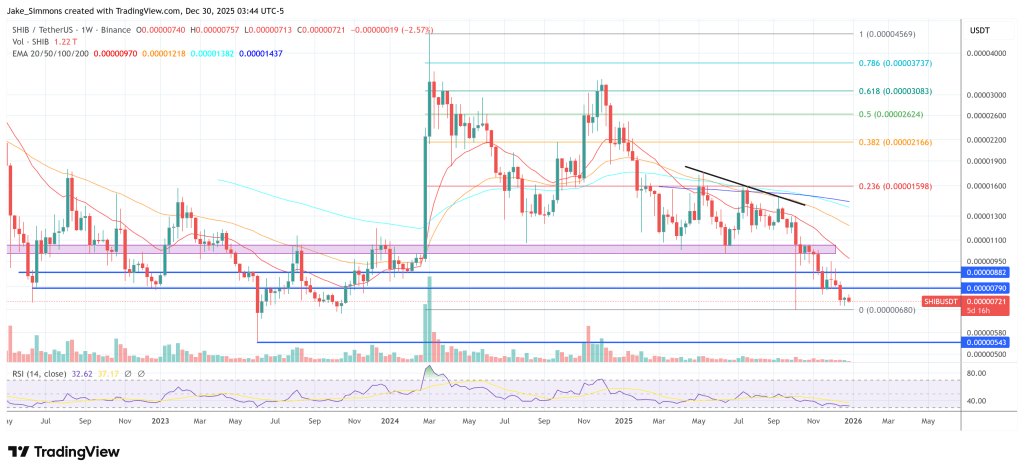
Shiba Inu remains in deep bearish territory, 1-week chart | Source: SHIBUSDT on TradingView.com

Crypto di tendenza

Letture associate

Global Stock Market's Storm Center: South Korea's Stock Market De-leveraging Is Largely Complete

Storm's Eye: South Korean Market De-leveraging Nears Completion The recent sharp correction in South Korean equities, with the KOSPI index dropping 32% from its June high, has been a key trigger for global tech stock volatility. The core driver was not a fundamental shift but a forced de-leveraging process within the market's unique structure, which is now largely complete. Two main leverage channels amplified the sell-off: 1. **Leveraged ETFs:** Their size, proportionally four times larger than in the U.S., peaked near $50 billion. Their mandatory daily rebalancing mechanism created a vicious cycle of "price drop → forced selling → further drop." Approximately 75% of this excess has been unwound, shrinking to $26 billion, with regulatory curbs now blocking new inflows. 2. **Hedge Fund Leverage:** Using swaps to magnify exposure, hedge funds saw their net long positioning fall by over 50% from peak levels. The most intense phase of this institutional de-leveraging is over. In contrast, **retail margin debt** poses minimal systemic risk. At 0.5% of market cap, it is far lower than in the U.S. or China, lacks automatic triggers, and is concentrated in smaller stocks. The conclusion: the high-leverage structures most prone to "chain-reaction selling" have been substantially cleared. The market is transitioning from a liquidity-driven crash to one priced more on fundamentals. The article argues that the AI trend—centered on Korean memory chips—remains intact. This episode represents a painful but necessary clearing of crowded trades, not the end of the AI revolution. For investors, the key question is conviction in the long-term AI direction; if the trend is real, current volatility is a cost of entry, not a terminal risk.

链捕手39 min fa

Global Stock Market's Storm Center: South Korea's Stock Market De-leveraging Is Largely Complete

链捕手39 min fa

The Eternal Fragments of Money: Third-Party Payment Has No First Principle

"The Enduring Fragments of Money: Third-Party Payments Lack a First Principle" Stripe is reportedly attempting to acquire PayPal, marking a significant shift reminiscent of PayPal's merger with the original X.com 30 years ago. The article analyzes Stripe's strategic challenges and the broader payments industry landscape. Despite its initial success with a developer-friendly API model, Stripe missed its optimal IPO window during the pandemic and has since seen its valuation decline. Its attempts to expand through acquisitions and new ventures, particularly in stablecoins (like its OUSD project) and Agent-focused payments (ACP/MPP protocols), have faced headwinds. The author argues that the payment industry remains highly fragmented and is ultimately an adjunct to the traditional banking system. This structure limits the potential for any single player, including Stripe, to achieve complete dominance. While stablecoins and the future rise of autonomous Agent economies present potential growth avenues, they are not yet mainstream and still require integration with the existing financial system. For now, Agent-based transactions are largely used for speculative "volume boosting" rather than substantive business applications. Stripe's current move to acquire PayPal is seen as an attempt to bolster its weak consumer-facing (C-side) business after its stablecoin-focused strategies faltered. Meanwhile, PayPal is described as structurally outdated, unable to revive itself through new products like Venmo or PYUSD. The future of payments may lie not in payments themselves but in value-added services like more efficient settlement networks. The author suggests that companies like Stripe and Circle, which are building their own blockchains (Tempo, Arc) and stablecoins, are positioning themselves to eventually profit from high-efficiency settlement systems. These new networks could potentially bypass some traditional banking layers. In conclusion, the article posits that third-party payment is a perpetually fragmented battlefield where scale alone cannot ensure victory. Players must find new models, focusing on efficiency to compete with the entrenched banking system. Stripe's acquisition of PayPal represents a bet on this uncertain future.

链捕手1 h fa

The Eternal Fragments of Money: Third-Party Payment Has No First Principle

链捕手1 h fa

Trading

Spot

Articoli Popolari

Come comprare O

Benvenuto in HTX.com! Abbiamo reso l'acquisto di O1 exchange (O) semplice e conveniente. Segui la nostra guida passo passo per intraprendere il tuo viaggio nel mondo delle criptovalute.Step 1: Crea il tuo Account HTXUsa la tua email o numero di telefono per registrarti il tuo account gratuito su HTX. Vivi un'esperienza facile e sblocca tutte le funzionalità,Crea il mio accountStep 2: Vai in Acquista crypto e seleziona il tuo metodo di pagamentoCarta di credito/debito: utilizza la tua Visa o Mastercard per acquistare immediatamente O1 exchangeO.Bilancio: Usa i fondi dal bilancio del tuo account HTX per fare trading senza problemi.Terze parti: abbiamo aggiunto metodi di pagamento molto utilizzati come Google Pay e Apple Pay per maggiore comodità.P2P: Fai trading direttamente con altri utenti HTX.Over-the-Counter (OTC): Offriamo servizi su misura e tassi di cambio competitivi per i trader.Step 3: Conserva O1 exchange (O)Dopo aver acquistato O1 exchange (O), conserva nel tuo account HTX. In alternativa, puoi inviare tramite trasferimento blockchain o scambiare per altre criptovalute.Step 4: Scambia O1 exchange (O)Scambia facilmente O1 exchange (O) nel mercato spot di HTX. Accedi al tuo account, seleziona la tua coppia di trading, esegui le tue operazioni e monitora in tempo reale. Offriamo un'esperienza user-friendly sia per chi ha appena iniziato che per i trader più esperti.

151 Totale visualizzazioniPubblicato il 2026.06.19Aggiornato il 2026.06.29

Come comprare O

Come comprare PROS

Benvenuto in HTX.com! Abbiamo reso l'acquisto di Pharos (PROS) semplice e conveniente. Segui la nostra guida passo passo per intraprendere il tuo viaggio nel mondo delle criptovalute.Step 1: Crea il tuo Account HTXUsa la tua email o numero di telefono per registrarti il tuo account gratuito su HTX. Vivi un'esperienza facile e sblocca tutte le funzionalità,Crea il mio accountStep 2: Vai in Acquista crypto e seleziona il tuo metodo di pagamentoCarta di credito/debito: utilizza la tua Visa o Mastercard per acquistare immediatamente PharosPROS.Bilancio: Usa i fondi dal bilancio del tuo account HTX per fare trading senza problemi.Terze parti: abbiamo aggiunto metodi di pagamento molto utilizzati come Google Pay e Apple Pay per maggiore comodità.P2P: Fai trading direttamente con altri utenti HTX.Over-the-Counter (OTC): Offriamo servizi su misura e tassi di cambio competitivi per i trader.Step 3: Conserva Pharos (PROS)Dopo aver acquistato Pharos (PROS), conserva nel tuo account HTX. In alternativa, puoi inviare tramite trasferimento blockchain o scambiare per altre criptovalute.Step 4: Scambia Pharos (PROS)Scambia facilmente Pharos (PROS) nel mercato spot di HTX. Accedi al tuo account, seleziona la tua coppia di trading, esegui le tue operazioni e monitora in tempo reale. Offriamo un'esperienza user-friendly sia per chi ha appena iniziato che per i trader più esperti.

145 Totale visualizzazioniPubblicato il 2026.06.22Aggiornato il 2026.06.29

Come comprare PROS

Cosa è VERONA

I. Introduzione al Progetto VERONA è una blockchain costruita per tutti, ovunque attraverso l'astrazione della catena. Utilizzando il suo livello di astrazione generalizzato, VERONA si distingue integrando funzionalità blockchain complesse, come conti, firme e interoperabilità, direttamente a livello di protocollo. Questo approccio consente di interagire con le applicazioni blockchain senza la necessità di comprendere le tecnologie sottostanti.1) Informazioni di Base Nome:VERONA(VERONA)III. Link Correlati Link al sito ufficiale:https://xion.burnt.com/ Whitepaper:https://xion.burnt.com/whitepaper.pdf Esploratori:https://explorer.burnt.com/ Social Media: https://x.com/burnt_xion Nota: L'introduzione al progetto proviene dai materiali pubblicati o forniti dal team ufficiale del progetto, che è solo a scopo di riferimento e non costituisce consulenza per investimenti. HTX non si assume responsabilità per eventuali perdite dirette o indirette risultanti.

163 Totale visualizzazioniPubblicato il 2026.06.22Aggiornato il 2026.06.22

Cosa è VERONA

Discussioni

Benvenuto nella Community HTX. Qui puoi rimanere informato sugli ultimi sviluppi della piattaforma e accedere ad approfondimenti esperti sul mercato. Le opinioni degli utenti sul prezzo di A A sono presentate come di seguito.

活动图片