"Shelling" Google Gemini, But Apple Hasn't Given Up on Its Own Model

marsbitPubblicato 2026-01-13Pubblicato ultima volta 2026-01-13

Introduzione

Apple has reportedly entered into a significant partnership with Google to integrate its Gemini AI model into Apple's ecosystem, as a "foundation" component for its future AI features, including a more personalized Siri expected later this year. The deal, estimated at around $1 billion annually, is not a direct replacement of Apple's own models but rather a strategic collaboration where Gemini will assist in training and enhancing Apple's proprietary on-device AI, with all processing occurring on Apple's private cloud servers to ensure user data privacy and isolation from Google. This move is seen as a tactical, transitional step for Apple to accelerate its AI capabilities and meet product launch timelines, especially after facing delays and setbacks with its in-house Apple Intelligence development and losing key AI talent to competitors like Meta. Despite this partnership, Apple continues its independent research and is reportedly developing its own trillion-parameter model, targeted for around 2027. The collaboration has drawn criticism, notably from Elon Musk, who raised concerns about the concentration of power with Google, which also controls Android and Chrome. For Google, the deal is a major win, boosting its market valuation, while OpenAI's existing partnership with Apple, which positions ChatGPT as a supplementary option for Siri, appears less central by comparison. The arrangement highlights Apple's pragmatic approach to bridging its AI gap while maintaining its l...

Written by: Xiaojinya, Zimu AI

Apple has "bowed its head".

On January 12 local time, Apple and Google issued a joint statement:

"After careful evaluation, Apple believes that Google's artificial intelligence technology provides the most robust foundation for the Apple base model, and is excited about the innovative experiences it will unlock for Apple users."
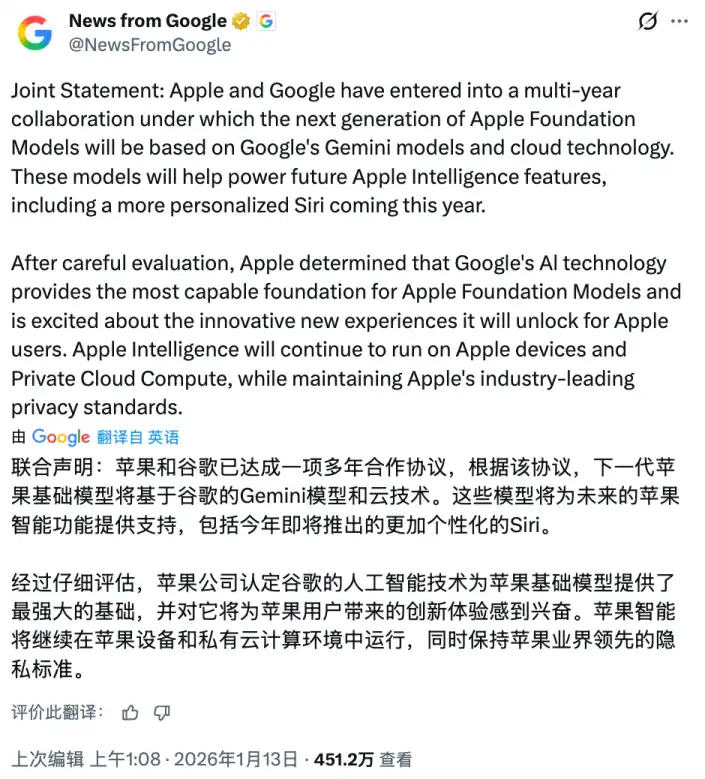
The two companies stated that these models will help support future Apple Intelligence features, including a more personalized Siri set to launch later this year.

As soon as the news broke, Musk was the first to express displeasure, commenting on X that this kind of "power concentration" is unreasonable, given that Google also owns Android and the Chrome browser.
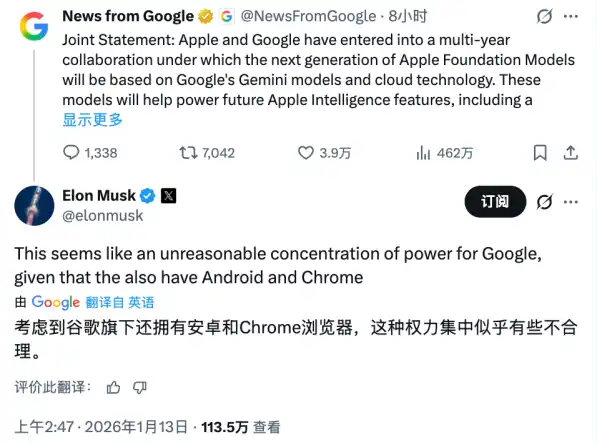
This is tantamount to saying that Google now controls Apple's AI as well. But Apple would certainly disagree with this statement.

For Apple, this is a temporary bowing of the head, but by no means an admission of defeat or surrender.

The introduction of Google Gemini is more like a temporary worker Apple has found for the transition period; it will not completely replace Apple's self-developed model. Moreover, Apple is still developing a trillion-parameter model.

Gemini Has Not Replaced Apple's Self-Developed Model

The statements released by Apple and Google are limited and deliberately vague, but one thing is clear: Gemini will participate in the construction of the new Apple base model.

This matter was reported by Bloomberg's Mark Gurman back in November last year, when he cited sources familiar with the matter saying that Apple would pay Google about $1 billion annually.

However, this is not a simple "one-for-one" swap of the Gemini model for the Apple base model, but rather a system architecture that allows Apple to continue using its own model while not providing any data to Google.

As the initial rumor pointed out, Gemini will not be directly embedded into Apple's operating system.

Instead, everything will still be presented externally with the Apple base model at its core, but at the underlying architectural level, Gemini will become its "foundation." In other words, Apple's use of Gemini falls somewhere between "shelling" and "distillation," and of course, given the cooperation between the two parties, this is certainly legal.

This is crucial; interpreting this news as "Apple's AI will be powered by Gemini" is inaccurate.

When you buy an iPhone, it internally uses chips manufactured by TSMC, displays from Samsung, and various components from all over the world. But no one would therefore claim that Samsung is "powering" the iPhone.

The on-device Apple Intelligence will still be powered by the Apple base model.

In other words, the Gemini model will serve as a tool to help train the Apple base model, enabling it to better perform the various tasks Apple sets for it.

Last year, Gurman's report mentioned that, according to the agreement between Google and Apple, Google's Gemini model would be responsible for Siri's summarization and planning functions—components that help the voice assistant synthesize information and decide how to execute complex tasks. Some of Siri's functions will continue to use Apple's self-developed model.

The report also stated that the model would run on Apple's own private cloud computing servers, ensuring user data is completely isolated from Google's infrastructure. Apple has allocated AI server hardware to support the operation of this model.

As the current public statements from both sides are ambiguous, the above content has not been refuted.

This deal is fundamentally different from the "Google Search" type of cooperation because it is completely invisible to the end user. When conversing with Siri, there will be no Gemini branding, nor should there be.

Apple Has Not Given Up

Further cooperation with Google is Apple's "transitional" choice.

Apple users have been looking forward to the new Siri since 2024, when Apple showcased it at WWDC and said it would be rolled out gradually. But since then, it has been repeatedly delayed, becoming a major embarrassment for Apple.

Currently, multiple media reports indicate that the new Siri will be released in March with iOS 26.4.

In addition, Apple Intelligence itself has not been progressing smoothly either; the initially launched features like "News Summaries" have been questioned for making errors.

Worse still, when Meta suddenly initiated a "war for AI talent" last year, Apple also suffered heavy losses. The most well-known case was the head of Apple's AI base model team at the time, Ruoming Pang, being poached, reportedly offered a sky-high compensation of $200 million by Meta.

In this situation, if delays continue, it would not only mean falling behind in the AI race for Apple but would also severely damage market trust.

At this point, turning to a third party to push forward the most urgent matters (like the new Siri) according to the schedule and deliver results to users is Apple's top priority.

And choosing Google is not surprising.

Apple and Google have a long-standing cooperative relationship; for example, Google has been paying Apple over $20 billion annually for years to remain the default search engine in Apple's Safari browser.

Their cooperation has attracted antitrust lawsuits, but the latest ruling only required adjustments to specific practices; the $20 billion cooperation between the two is still permitted.

Furthermore, Gemini is currently one of the strongest models. According to previous coverage, Apple tested several mainstream models including Gemini, GPT, and Claude, and ultimately selected Gemini.

As an aside, Apple's emphasis on "user privacy" in this new cooperation with Google Gemini, stressing that everything runs on the "Apple Private Cloud" and that no data will be shared with Google, is also a lesson learned from past collaborations with Google. In 2012, the "Safari tracking cookie scandal" occurred, where Google was accused of exploiting a privacy setting vulnerability in the Safari browser to place tracking cookies, bypassing the policy of blocking third-party cookies by default. Ultimately, Google was fined $22.5 million by the FTC and required to make changes. Additionally, Google reached a $17 million settlement with 37 states and the District of Columbia to resolve a class-action lawsuit.

In summary, this cooperation between Apple and Google can be called a temporary "bowing of the head," but by no means "admitting defeat" or "giving up."

Apple is still developing its own trillion-parameter model, expected to be launched around 2027.

Even when that model is released, Apple will likely still retain Gemini for reinforcement training, comparative analysis, and further optimization. Using it as a "tool" to strengthen itself is precisely what Apple expects from Google Gemini.

The One Who Benefits Most is Still Google

Although we just spent a long篇幅 trying to clarify what this deeper cooperation between Apple and Google is and is not.

But it can be foreseen that the perception that "Apple's AI relies on Gemini" will be difficult to eliminate.

Some can't help but imagine: Imagine if by March or April, Siri suddenly becomes super easy to use......
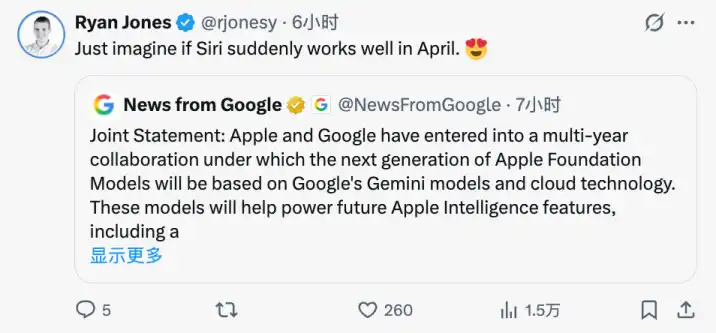
This isn't hard to imagine. The awkward situation Apple faces now is that if the introduction of Gemini indeed has an immediate effect and significantly accelerates the progress of Apple Intelligence and Siri, then the evaluation that "Apple really isn't up to it" would be confirmed.

In this case, even if Apple successfully develops its own trillion-parameter model and moves from the transition phase to self-reliance, Gemini would still be considered the功臣 (meritorious servant), not Apple itself.

As for Google, the market has already given it positive feedback.

After the joint statement from Apple and Google was released, Alphabet's stock price rose by up to 1.7%, and its market capitalization closed the day by breaking through the $4 trillion mark for the first time, setting a company record, while Apple's stock price rose by less than 1%.

This cooperation also puts other peers under pressure.

Elon Musk, who spoke out to express dissatisfaction, is one of them. He criticized Google, which controls Android and Chrome, for now also penetrating Apple, calling it an embodiment of "excessive concentration of power," hinting at monopolistic tendencies.

Another who might be uncomfortable is OpenAI's Sam Altman. OpenAI previously reached a cooperation agreement with Apple, where ChatGPT would serve as a "supplementary option" when Siri answers user questions. That is, just as Siri sometimes lists web search results now, it would, when necessary, provide answers from ChatGPT in the future.

This cooperation had previously brought glory to OpenAI, but now it pales in comparison to the new cooperation between Apple and Google.

Clearly, this cooperative status of being a "supplementary option" on the front stage is far inferior to Google Gemini's status as a "foundational helper" in the back stage. It's like the Apple club is putting on a show: OpenAI is performing on stage, but Google is working the lights backstage. Altman has not yet commented on this.

And in the Chinese market, whether Apple is also looking for a "transitional helper" before it builds its trillion-parameter self-developed model remains to be seen.


Crypto di tendenza

Domande pertinenti

QWhat is the nature of the partnership between Apple and Google regarding AI, as announced on January 12th?

AApple and Google announced a partnership where Google's Gemini AI technology will serve as the foundational base for Apple's on-device models. This is not a direct replacement but a system where Gemini helps train and support Apple's own models, with all processing occurring on Apple's private cloud servers to ensure data privacy and isolation from Google.

QAccording to the article, why did Apple choose to partner with Google's Gemini instead of relying solely on its own AI development?

AApple chose this partnership as a transitional solution to meet its deadlines, particularly for the launch of the new, more personalized Siri. The company has faced delays and setbacks with its own Apple Intelligence and Siri development, including the loss of key AI talent to competitors like Meta.

QHow does the article describe the potential market perception of this Apple-Google deal, and what is the risk for Apple?

AThe article states that the public perception will likely be that 'Apple AI is powered by Gemini,' which could solidify the view that 'Apple is not capable' on its own. Even if Apple later succeeds with its own trillion-parameter model, Gemini could still be seen as the功臣 (key contributor), damaging Apple's reputation.

QWhat was Elon Musk's reaction to the Apple-Google AI partnership, as mentioned in the article?

AElon Musk expressed dissatisfaction on X, criticizing the partnership as an unreasonable 'concentration of power' because Google already controls Android and Chrome, and this deal further expands its influence into Apple's ecosystem.

QHow does the status of OpenAI's partnership with Apple compare to Google's new role, according to the article?

AOpenAI's partnership with Apple is described as significantly less important. OpenAI's ChatGPT is a 'supplementary option' presented to users on the front end, similar to web search results, whereas Google's Gemini is a foundational 'helper' in the backend, akin to a backstage technician compared to a stage performer.

Letture associate

Strategy's Loss in the Second Quarter Reaches $8.22 Billion Amid Bitcoin Decline

Strategy, the largest corporate holder of Bitcoin, reported a net loss of $8.22 billion for the second quarter. This loss was primarily driven by an $8.32 billion unrealized loss on its Bitcoin holdings due to a decline in the asset's price during the period. Despite these paper losses, the company increased its Bitcoin holdings to 843,775 BTC, a 25% growth since the start of the year. As part of a new monetization strategy, Strategy sold approximately $218.4 million worth of Bitcoin, mainly to fund dividends for preferred shareholders, with $216 million of that sold after Q2 ended. The company also built a $3.75 billion cash reserve, which it claims is sufficient to cover over two years of dividend and interest payments, aiming to insulate itself from Bitcoin's volatility while meeting obligations. Following the earnings release, Strategy's stock (MSTR) rose 4.7% in regular trading but corrected slightly after-hours. This pattern reflects how the company's accounting results are heavily tied to Bitcoin's price swings, even as its long-term strategy remains unchanged. The report indicates that Strategy is maintaining its core strategy of accumulating Bitcoin while building a financial buffer. This quarterly loss follows a recognizable pattern, with the company posting significant unrealized losses in previous quarters (e.g., $12.4 billion in Q4 2025 and ~$12.5 billion in Q1 2026) due to fair-value accounting. A key technical shift is its new monetization program, which introduces periodic selling pressure on the market, transitioning Strategy from a pure accumulator to a participant that occasionally adds supply. A critical question remains: how long can the cash reserve cover dividend obligations if a Bitcoin price downturn persists beyond two years?

cryptonews.ru14 min fa

Strategy's Loss in the Second Quarter Reaches $8.22 Billion Amid Bitcoin Decline

cryptonews.ru14 min fa

Will Terrorist Durov Ban Russian Officials?

Telegram founder Pavel Durov publicly reacted to being labeled a "terrorist" by Russian authorities, stating the designation came after he refused demands for mass surveillance and censorship on the platform. In a Telegram post, he highlighted that this status formally bans him from "publishing information online." Durov concluded with a statement widely circulated: Russian officials "clearly don't understand who can ban whom on the internet." This remark suggests Durov could potentially restrict official Russian government and officials' channels on Telegram, which continue to operate on the platform despite its formal blocking in Russia. The situation parallels previous, slow-moving state directives, like switching officials to domestic cars, contrasted with the current push to migrate all government communication to the Russian-made messenger MAX by 2030. However, reports indicate many officials still use Telegram via workarounds, fearing surveillance on MAX, while alternatives like BiP and KakaoTalk recently became inaccessible in Russia without a VPN. Durov has not specified any immediate actions against state channels. His statement is an initial response, with further developments depending on the authorities' reaction. The dynamic differs from 2020 when Russian regulators lifted a block on Telegram; now, Durov implies control from within the platform itself over the official accounts that persisted through that earlier blockade.

cryptonews.ru14 min fa

Will Terrorist Durov Ban Russian Officials?

cryptonews.ru14 min fa

DeepSeek V4 Official Version Arrives, New Capabilities Emerge, Value-for-Money King Enters the Fray

On July 31st, DeepSeek officially launched the public API beta for its DeepSeek-V4-Flash model. A key highlight is its performance on multiple Agent benchmark tests, reportedly nearing or even surpassing the level of the V4-Pro preview version from three months ago. Notably, the Flash model achieves this with significantly smaller scale (130B active parameters vs. Pro's 490B), suggesting that post-training optimization and data quality may be as crucial as raw model size. DeepSeek emphasized that the V4-Flash-0731 uses the same model architecture and size as its preview version, with improvements attributed solely to "re-trained post-training." The update also marks the official debut of DeepSeek's self-developed Agent framework, "Harness." The move signals DeepSeek's strategic push to position its cost-effective Flash model as a competitive base for Agent applications—scenarios requiring autonomous planning, tool usage, and complex task execution—where inference speed and cost are critical. By natively supporting OpenAI's Responses API format and adapting for code-generation scenarios, DeepSeek aims not just to be a cheaper alternative but to establish its own ecosystem in the Agent era. This release follows DeepSeek's record-breaking ~$50 billion fundraising round roughly two months prior, underscoring market confidence in its technology and commercialization prospects. The company is reportedly preparing for another funding round at a valuation of approximately $71 billion. The Flash model's advancement represents a step in fulfilling the high expectations that come with this valuation, setting the stage for the impending release of the V4-Pro official version and intensifying competition in the global Agent landscape.

marsbit18 min fa

DeepSeek V4 Official Version Arrives, New Capabilities Emerge, Value-for-Money King Enters the Fray

marsbit18 min fa

Trading

Spot

Articoli Popolari

Come comprare T

Benvenuto in HTX.com! Abbiamo reso l'acquisto di Threshold Network Token (T) semplice e conveniente. Segui la nostra guida passo passo per intraprendere il tuo viaggio nel mondo delle criptovalute.Step 1: Crea il tuo Account HTXUsa la tua email o numero di telefono per registrarti il tuo account gratuito su HTX. Vivi un'esperienza facile e sblocca tutte le funzionalità,Crea il mio accountStep 2: Vai in Acquista crypto e seleziona il tuo metodo di pagamentoCarta di credito/debito: utilizza la tua Visa o Mastercard per acquistare immediatamente Threshold Network TokenT.Bilancio: Usa i fondi dal bilancio del tuo account HTX per fare trading senza problemi.Terze parti: abbiamo aggiunto metodi di pagamento molto utilizzati come Google Pay e Apple Pay per maggiore comodità.P2P: Fai trading direttamente con altri utenti HTX.Over-the-Counter (OTC): Offriamo servizi su misura e tassi di cambio competitivi per i trader.Step 3: Conserva Threshold Network Token (T)Dopo aver acquistato Threshold Network Token (T), conserva nel tuo account HTX. In alternativa, puoi inviare tramite trasferimento blockchain o scambiare per altre criptovalute.Step 4: Scambia Threshold Network Token (T)Scambia facilmente Threshold Network Token (T) nel mercato spot di HTX. Accedi al tuo account, seleziona la tua coppia di trading, esegui le tue operazioni e monitora in tempo reale. Offriamo un'esperienza user-friendly sia per chi ha appena iniziato che per i trader più esperti.

457 Totale visualizzazioniPubblicato il 2024.12.10Aggiornato il 2026.06.02

Come comprare T

Discussioni

Benvenuto nella Community HTX. Qui puoi rimanere informato sugli ultimi sviluppi della piattaforma e accedere ad approfondimenti esperti sul mercato. Le opinioni degli utenti sul prezzo di T T sono presentate come di seguito.

活动图片