Sequoia Capital: The Next Trillion-Dollar Company Doesn't Sell Software, It Sells Outcomes

marsbitPubblicato 2026-03-11Pubblicato ultima volta 2026-03-11

Introduzione

Sequoia Capital partner Julien Bek argues that the next trillion-dollar company will not sell software tools, but will instead sell outcomes directly. For every dollar spent on software, companies spend six dollars on services. As AI drives the cost of "doing" toward zero, the real opportunity lies not in Copilots (assistive tools) but in Autopilots (fully automated work delivery). The key distinction is between "intelligence" (rule-based tasks like coding or data translation) and "judgement" (tasks requiring experience and intuition). AI is increasingly capable of autonomous intelligence work, leaving judgement to humans. While Copilots sell tools to professionals, Autopilots sell the final result to the end customer. The optimal strategy is to target outsourced, intelligence-intensive tasks first. Outsourcing indicates a company is already comfortable with external party handling the work, has a dedicated budget, and buys results. Replacing an outsourced contract is a vendor change; replacing internal staff is a reorganization. The article maps high-opportunity verticals by their intelligence/judgement mix and outsourcing prevalence. Major opportunities include: - Insurance brokering ($140-200B): Highly standardized,智力-intensive. - Accounting & Auditing ($50-80B outsourced in US): Facing a structural labor shortage. - Medical billing ($50-80B outsourced): Rules-based medical coding. - Claims adjusting ($50-80B): Often outsourced to third-party administrators. - Tax prepa...

Author: Julien Bek

Compiled by: Deep Tide TechFlow

Deep Tide Intro: Sequoia Capital partner Julien Bek has written a clearly structured article, with the core thesis being: the next trillion-dollar company will not sell software tools, but will directly sell work outcomes. For every $1 spent on buying software, businesses spend $6 on services. When AI drives the cost of "doing things" close to zero, the real opportunity lies not in Copilots (assistive tools), but in Autopilots (automating the work).

He breaks down the automation opportunities in service industries like insurance, accounting, healthcare, law, IT, procurement, recruitment, and consulting one by one, including a matrix chart plotting opportunities along the dimensions of "Intelligence vs. Judgment" and "Outsourced vs. Internal." It offers reference value for both AI entrepreneurs and investors.

Full Text Below:

The next trillion-dollar company will be a software company disguised as a service company.

Every founder building an AI tool is asking the same question: what happens when the next version of Claude turns my product into a feature? This fear is justified. If you sell tools, you are racing against the models. But if you sell the work itself, every improvement in the model makes your service faster, cheaper, and harder to compete with. A company might spend $10,000 a year on QuickBooks, and then $120,000 on an accountant to close the books. The next legendary company will just close the books for you.

Intelligence vs. Judgment

Writing code is mostly "intelligence." Knowing what to do next is "judgment."

Translating a requirements document into code, testing, debugging: the rules are complex, but they are ultimately rules. Judgment is different. It requires experience and taste, an intuition built up through years of practice. Deciding what feature to build next, whether to take on technical debt, when to ship before it's perfect.

A year ago, most Cursor users used AI as autocomplete. Today, agent-initiated tasks outnumber human-initiated ones. Software engineering accounts for over half of all AI tool usage across professions, while all other categories are still in the single digits. The reason is that software engineering is primarily intelligence work. AI has crossed that line—it can autonomously perform most of the intelligence work, leaving judgment to humans. Software engineering got there first, but it will spread to every profession.
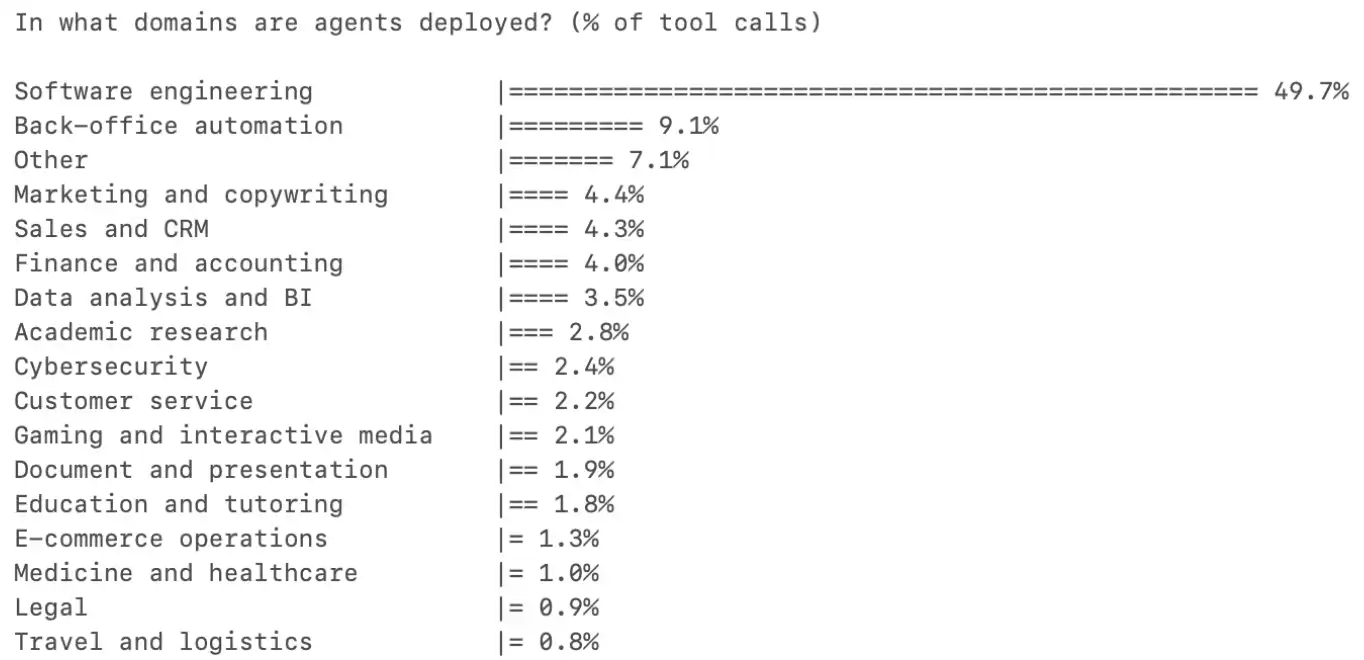
Caption: AI tool usage by profession, software engineering far exceeds other categories

Copilot and Autopilot

Copilot sells tools. Autopilot sells work.

Until recently, AI models were still developing in both intelligence and judgment, so the right path was to start with Copilot: put AI in the hands of professionals and let them decide how to use it. Harvey sells to law firms, Rogo sells to investment banks. The professionals are the customers; the tools make them more efficient, and they are responsible for the output.

Today, models are smart enough that in some categories the best starting point is to go straight to Autopilot. Crosby sells to companies that need to draft NDAs, not to external legal counsel. WithCoverage sells to CFOs who need insurance, not to insurance brokers. The customer is buying the outcome directly. In any profession, the work budget is much larger than the tool budget, and Autopilot can capture the work budget from day one.

The higher the proportion of intelligence in a field, the faster Autopilot wins.

Convergence

Today's judgment becomes tomorrow's intelligence. As AI systems accumulate proprietary data on "what good judgment looks like" in their respective fields, the frontier moves. Copilot and Autopilot will converge. The transition from Copilot to Autopilot has already begun in several categories. But the starting position matters because it determines where Autopilot can win customers now and start accumulating the data that will eventually allow it to handle judgment tasks as well.

The Autopilot Play: Outsourcing is the Entry Point

For every $1 spent on software, $6 is spent on services.

The TAM for Autopilot is all labor expenditure in a category, both internal and outsourced. But the right starting point is where outsourcing already exists.

If a task is already outsourced, it tells you three things. First, the company has already accepted that this work can be done externally. Second, there is an existing budget line item that can be cleanly replaced. Third, the buyer is already buying an outcome. Replacing an outsourcing contract with an AI-native service provider is a supplier swap. Replacing an internal employee is an organizational restructuring.

The play is: start with outsourced, intelligence-intensive tasks. Nail distribution. As the AI accumulates data, expand into internal, judgment-intensive work. Outsourced tasks are the wedge; internal work is the long-term TAM.

Crosby started with NDAs: a well-defined task, mostly intelligence work, that most companies already outsource to external counsel. The budget is ready, the scope is clear, ROI is immediate, replacement is frictionless.

Opportunity Map

Plotting each service vertical on a spectrum from "Intelligence to Judgment" and the ratio of "Outsourced to Insourced" yields a prioritization map, with the labor TAM in parentheses. The list below is not exhaustive.
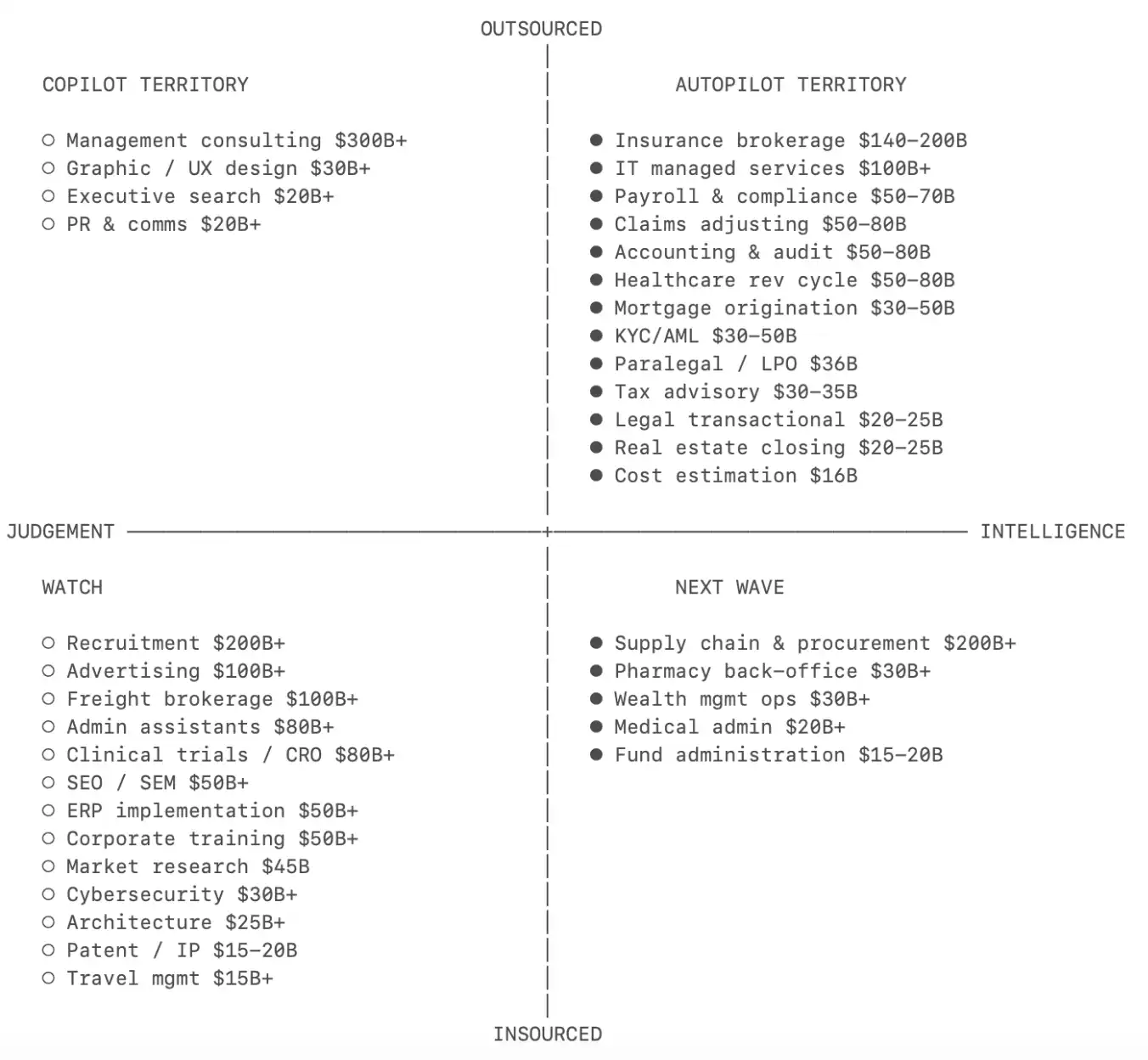
Caption: Autopilot opportunity matrix for various service verticals (distributed by Intelligence/Judgment ratio and Outsourced/Insourced ratio)

Insurance Brokerage ($140-200 Billion).

The largest market on this list. Standard commercial insurance is highly standardized: the broker's added value is essentially comparing prices and filling out forms between different underwriters, pure intelligence work. The distribution layer is extremely fragmented, with thousands of small brokers each running the same process, none controlling the customer relationship. WithCoverage and Harper are interesting new entrants.

Accounting & Auditing ($50-80 Billion outsourced in US alone).

The US has lost about 340,000 accountants in the last five years, while demand has grown. 75% of CPAs are nearing retirement, the licensure path is long, and starting salaries lag behind tech and finance. This structural shortage is driving accounting firms to adopt AI faster than almost any other profession. Rillet is building an AI-native ERP to close the books directly. Basis started as a Copilot for accountants.

Healthcare Revenue Cycle Management ($50-80 Billion outsourced in US).

Hearing "healthcare" makes one think judgment-intensive, but the billing layer is almost pure intelligence work. Medical coding is translating clinical notes into about 70,000 standardized ICD-10 codes. The rules are complex but ultimately rules. Outsourcing is already mature and billed on outcomes. Autopilot just needs to do the same thing at a lower cost. Anterior is the farthest along.

Claims Adjusting ($50-80 Billion including TPAs).

On the other side of the insurance policy, claims adjusting is another distinct Autopilot scenario. Adjusting claims for standard lines involves adjudicating against policy language and a list of damages, setting reserves with actuarial tables. The adjuster workforce is aging, with no one replacing them. The market is heavily outsourced to independent adjusters and TPAs like Crawford and Sedgwick. One industry, at least two different Autopilot opportunities. Pace is doing Autopilot for claims processing, Strala is building an AI-native TPA.

Tax Advisory ($30-35 Billion).

The CPA licensure system creates a regulatory moat, but 80%-90% of the underlying work is intelligence work. A Tax Autopilot's data moat deepens with each additional jurisdiction it covers. The complexity of multiple jurisdictions is precisely why SMBs outsource it, as no internal accountant can cover it all. TaxGPT is an early mover; in Europe, there's Skalar and Ravical.

Legal Transactional Work ($20-25 Billion).

Contract drafting, NDAs, regulatory filings: high intelligence share, routinely outsourced. The work product is standardized enough that quality is verifiable, so buyers can trust AI output without deep legal expertise. Harvey is the rising leader, quickly moving towards Autopilot; Crosby and Lawhive are Autopilot-native new entrants.

IT Managed Services ($100+ Billion).

Every SMB outsources IT. Patching, monitoring, user provisioning, alert triage: intelligence work run repeatedly across thousands of identical environments. Existing software layers (ConnectWise, Datto) sell tools to MSPs. No one yet sells "your IT is running" as an outcome directly to companies. Edra is automating IT processes, Serval is automating IT support.

Supply Chain & Procurement ($200+ Billion).

Most companies only seriously negotiate with their top 20% of suppliers. The long tail is completely unmanaged because it's not worth a person's time. Contract leakage accounts for 2%-5% of total procurement spend. The entry point is the abandoned work: no budget line to justify, no incumbent to displace, just found money. Magentic is doing AI for direct procurement, AskLio for indirect procurement. Tacto is building both the system of record and a Copilot for the mid-market.

Recruiting & Staffing ($200+ Billion).

The largest service market on this list. The top of the recruiting funnel (screening, matching, outreach) is pure intelligence work, but closing and assessing culture fit is judgment built on years of pattern recognition. The Autopilot entry point is high-volume, low-judgment roles where matching is standardized. Juicebox, Mercor, Jack & Jill are emerging leaders building across the spectrum.

Management Consulting ($300-400 Billion).

Huge market, but the work is mostly judgment. The interesting question is whether AI can unbundle consulting into intelligence components (data gathering, benchmarking) and judgment components (strategic advice), automating the intelligence layer and leaving the judgment to humans. Best candidates TBD.

The fastest-growing AI companies in 2025 were Copilots. In 2026, many will try to become Autopilots. They have product and customer awareness. But they also face the innovator's dilemma: selling work means kicking their own customers out of their jobs. This is the window of opportunity for pure Autopilot companies.


Domande pertinenti

QAccording to the article, what is the core argument about the next trillion-dollar company?

AThe next trillion-dollar company will not sell software tools, but will directly sell the outcome or the work itself. It will be a software company disguised as a service company.

QWhat is the key difference between 'Intelligence' and 'Judgement' as defined in the article?

A'Intelligence' refers to the application of complex but ultimately rule-based tasks, like translating requirements into code. 'Judgement' requires experience, intuition, and taste to decide what to do next, such as deciding on a product feature or when to launch.

QWhat is the financial ratio mentioned for software versus services spending?

AFor every $1 spent on buying software, $6 is spent on services.

QWhy does the author suggest that Autopilot companies should start by targeting outsourced tasks?

ATargeting outsourced tasks is ideal because the company has already accepted that the work can be done externally, there is an existing budget line item that can be cleanly replaced, and the buyer is already purchasing an outcome, making the switch frictionless.

QWhich service vertical is identified as having the largest total addressable market (TAM) for Autopilot opportunities?

ARecruitment and Staffing is identified as the largest service market, with a TAM of over $200 billion.

Letture associate

Must-Watch Events Next Week|CLARITY Act Could Face Senate Vote; SpaceX, Circle to Report Earnings (8.3-8.9)

**Summary: Key Events and Developments to Watch (August 3-9)** The upcoming week is marked by significant financial disclosures, key legislative deadlines, and notable product updates. **Major Financial Events:** Several companies are scheduled to release their Q2 2026 earnings. American Bitcoin (ABTC) will report on August 3, followed by SpaceX and Hut 8 Mining Corp. on August 4, and Circle on August 5. Notably, a significant portion of SpaceX shares (up to 12% of total shares) will be unlocked on August 6 following their earnings release. **Key Legislative Deadline:** The U.S. Senate faces an August 7 deadline to secure 60 votes for the CLARITY Act, a bipartisan bill aiming to establish a federal regulatory framework for cryptocurrencies. The Senate may hold a full vote on the bill during the week. **Economic Data:** The U.S. July Non-Farm Payrolls report will be released on August 7, providing crucial labor market data. **Technology & Product Updates:** * **Shutdowns:** DeFi portfolio tracker Zapper and wallet app Ctrl Wallet will cease operations on August 3. * **Upgrades:** LayerZero will deprecate its v1 relayers on August 3. XRP Ledger's new version 3.3.0, featuring five new functions, is expected next week. * **AI:** Elon Musk announced that the advanced Grok 4.6 AI model is set for release around August 7. * **Bitcoin:** The BIP-110 forced signaling for a potential Bitcoin network change is scheduled to begin around August 8. **Other Notable Events:** Chinese robotics firm Unitree Tech has set its preliminary price inquiry for its IPO for August 5. South Korean exchange Upbit will delist AQT and AERGO tokens on August 3.

marsbit5 min fa

Must-Watch Events Next Week|CLARITY Act Could Face Senate Vote; SpaceX, Circle to Report Earnings (8.3-8.9)

marsbit5 min fa

Stocks Are Plummeting More Sharply Than Cryptocurrencies. Where Has the Money Gone?

Stock Markets Plunge Deeper Than Cryptocurrencies: Where Did the Money Go? In late July, Seoul's Kospi index triggered circuit breakers for two consecutive days, plummeting over 40% from its June high. The collapse was led by heavyweight stocks like SK Hynix, whose record profits still disappointed investors, and devastating leveraged ETFs, with one major product losing over 83% of its value. This signaled a global, forced deleveraging targeting the most crowded trades. Interestingly, while stocks exhibited extreme volatility akin to crypto markets, Bitcoin rose nearly 15% in July after a prior steep drop. Analysis shows the money fleeing equities did not flow into Bitcoin. Instead, Bitcoin had already absorbed its sell-off in May-June, when U.S. spot Bitcoin ETFs saw historic outflows. The true safe-haven beneficiary was gold, whose price rose over 20% year-on-year, highlighting a decoupling between Bitcoin and gold as "digital gold." The sell-off was a targeted unwinding of leveraged positions in tech and semiconductors, accelerated by broker-dealer risk management and shifts in the AI narrative, including new competition from Chinese memory chipmakers. The retreat path was clear: from high-valuation tech stocks to cash and U.S. Treasuries, then to gold. For Bitcoin to attract sustained institutional inflows, conditions like eased global liquidity pressure, a "soft-landing" Fed rate cut, and U.S. regulatory clarity via legislation like the stalled CLARITY Act are needed. Currently, Bitcoin is not a safe haven but an already-cleared asset. Its low correlation with tech stocks, however, makes it a potential diversification play for institutional portfolios once the storm passes. The money isn't here yet, but the positioning is underway.

marsbit5 min fa

Stocks Are Plummeting More Sharply Than Cryptocurrencies. Where Has the Money Gone?

marsbit5 min fa

In Conversation with Ray Dalio: We Are Currently in an AI Bubble, with 1% of My Portfolio in Bitcoin

Ray Dalio, founder of Bridgewater Associates, warns in an interview that the current AI boom shows classic bubble characteristics, which could lead to significant economic downturns as seen in past cycles like 1929 or 2000. He explains that speculative enthusiasm, fueled by debt and overvaluation, often precedes a crash when rising rates or taxation force asset sales, causing widespread losses and recession. Dalio also outlines his "Big Cycle" theory, describing an approximate 80-year pattern where widening wealth gaps, massive government deficits, and shifting geopolitical power (like China's rise) create internal conflict and global instability. He emphasizes that we are in a late-cycle, transitional phase where traditional powers like the US and UK face decline. For personal wealth protection, Dalio advises diversification beyond cash into assets like stocks, bonds, real estate, and particularly gold, which he prefers over Bitcoin. While he holds about 1% of his portfolio in Bitcoin as a non-printable hard asset, he views gold as more secure from technological or governmental threats. Regarding AI's impact, Dalio believes it will disproportionately benefit capital owners, worsening inequality by replacing both physical and cognitive labor. He suggests that human intuition and emotional intelligence, combined with AI, will be key for future workers. On taxation, Dalio argues that wealth taxes are impractical and risk triggering asset sell-offs, reducing productive investment. He points to the UK as a cautionary example of debt, low productivity, and political strife. Geopolitically, Dalio foresees a more regionalized world, with the US showing weakness in prolonged conflicts like with Iran, akin to past imperial declines. The ideal outcome, he suggests, is coexisting powerful blocs (e.g., Americas, China-Asia Pacific) without major war.

marsbit3 h fa

In Conversation with Ray Dalio: We Are Currently in an AI Bubble, with 1% of My Portfolio in Bitcoin

marsbit3 h fa

Daily 7.2 Trillion KRW: Foreign Capital's Record Net Buying on Friday! Wall Street Says Headwinds for Korean Stock Fund Flows Have Subsided

South Korean stock market sees a dramatic shift in fund flows. On July 31, foreign investors made a record net purchase of approximately KRW 7.2 trillion in KOSPI stocks, marking a fundamental reversal from the persistent large-scale net outflows seen in previous months. This contributed to a significant narrowing of foreign net selling in July to KRW 9.8 trillion, down sharply from KRW 48.4 trillion in June and KRW 44.5 trillion in May. Simultaneously, domestic institutional pressure eased. South Korean pension funds and asset managers turned to a net buying position in July, purchasing KRW 1.0 trillion worth of KOSPI shares, contrasting with net sales in May and June. Market volatility is expected to be dampened by new financial regulations. Effective July 31, the Financial Services Commission tightened access for retail investors to single-stock leveraged ETFs by raising the minimum cash deposit requirement. Trading volumes for these products subsequently dropped to about 50% of their monthly average. Citigroup Research maintains its year-end KOSPI target of 10,000 points. The firm cites several supportive factors: the substantial easing of headwinds from capital outflows, a robust fundamental outlook for the semiconductor sector, historically low market valuations, strong economic fundamentals, and the potential for policy support from financial authorities if needed.

marsbit4 h fa

Daily 7.2 Trillion KRW: Foreign Capital's Record Net Buying on Friday! Wall Street Says Headwinds for Korean Stock Fund Flows Have Subsided

marsbit4 h fa

Trading

Spot
活动图片




