Sentient: Why $51K long liquidations put SENT’s $0.015 at risk

ambcryptoPubblicato 2026-03-28Pubblicato ultima volta 2026-03-28

Introduzione

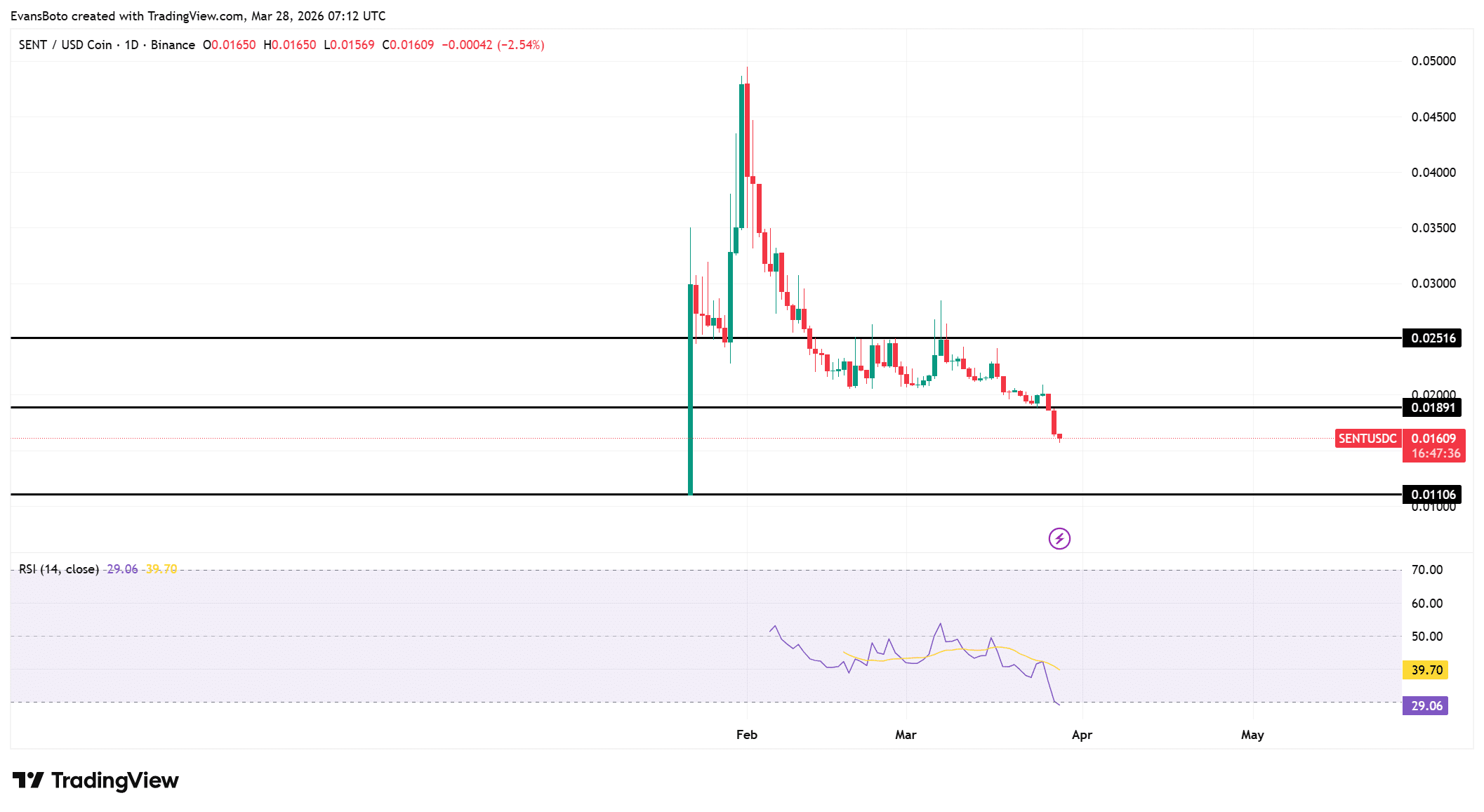
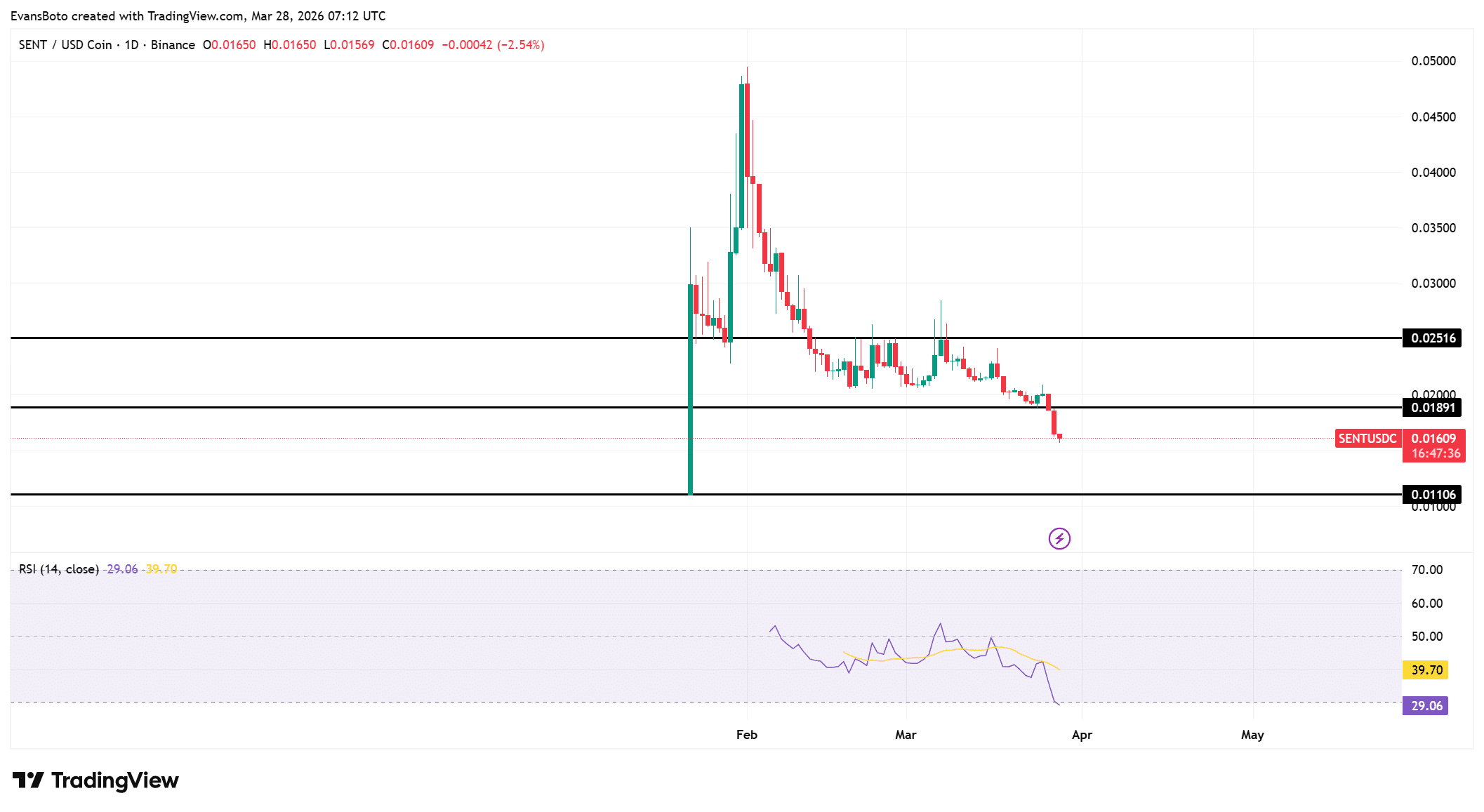
Sentient (SENT) dropped 14.3% to $0.01585 amid a 65% surge in trading volume, signaling strong sell-side pressure despite increased market activity. The price broke below the $0.01891 support level, indicating a continued bearish trend toward the $0.01106 demand zone. RSI fell to 29.06, confirming oversold conditions but suggesting persistent weakness rather than a short-term rebound. Open Interest declined by 16.30%, reflecting capital withdrawal and reduced participation from leveraged traders. Long liquidations dominated with $51K wiped out compared to only $96 in short liquidations, accelerating downward momentum. Current market structure, liquidations, and capital outflows align against recovery, indicating SENT may drift lower before stabilization attempts emerge.

Sentient [SENT] drops 14.3% to $0.01585 as volume surges 65% to $24.32 million at press time, reflecting aggressive sell-side activity despite rising market participation.

Sellers continue to dominate order flow, pushing price lower despite increased liquidity entering the market. Volume expansion under declining price conditions usually signals that participants are exiting positions rather than accumulating.

As a result, this structure shows clear sell-side control, where each attempt to stabilize gets absorbed quickly. The market reflects urgency from participants reducing exposure, which reinforces the ongoing SENT downside pressure.

SENT breakdown below support exposes

SENT price has broken below the $0.01891 support level and continues to extend lower toward the $0.01106 demand zone. This breakdown confirms that previous consolidation has failed to hold, shifting structure into a continuation phase.

Lower highs have remained intact across recent sessions, which reinforces bearish control over the trend. Attempts to reclaim the lost support have lacked follow-through, showing weak buyer commitment.

As price trades below key levels, market structure reflects continuation rather than reversal. This positioning suggests that sellers continue to dictate direction as the asset searches for a stronger demand base.

At press time, RSI dropped to 29.06, pushing Sentient into oversold territory and confirming the intensity of recent selling pressure. This reading reflects persistent downside strength rather than a temporary pullback.

While oversold conditions sometimes hint at short-term relief, the broader structure still aligns with continued weakness.
Source: TradingView

Falling OI signals capital withdrawal

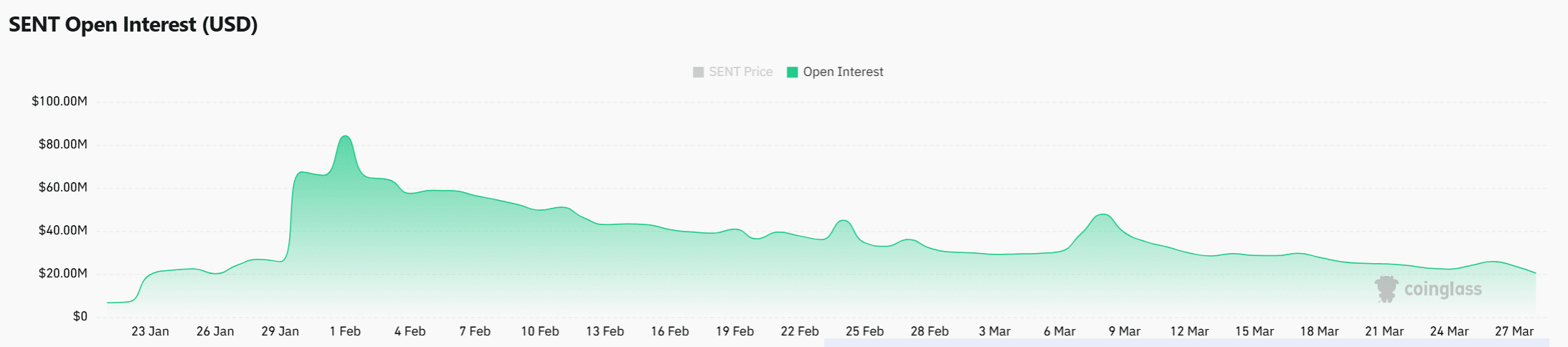
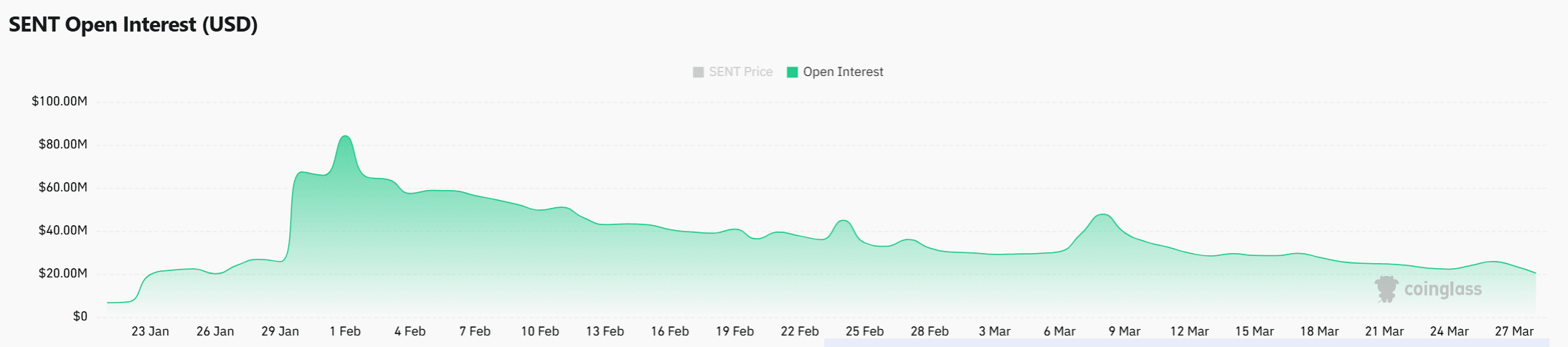
Open Interest (OI) has declined 16.30% to $19.76 million, indicating that leveraged traders are closing positions rather than opening new ones. This drop reflects a clear reduction in market participation from derivatives traders, especially those previously positioned on the long side.

As positions close, liquidity exits the market, which reduces the probability of immediate recovery. The decline in OI aligns closely with the price drop, confirming that traders are stepping away instead of defending positions. This behavior highlights a broader shift toward risk reduction across the market.
Source: CoinGlass

Long liquidations dominate across exchanges

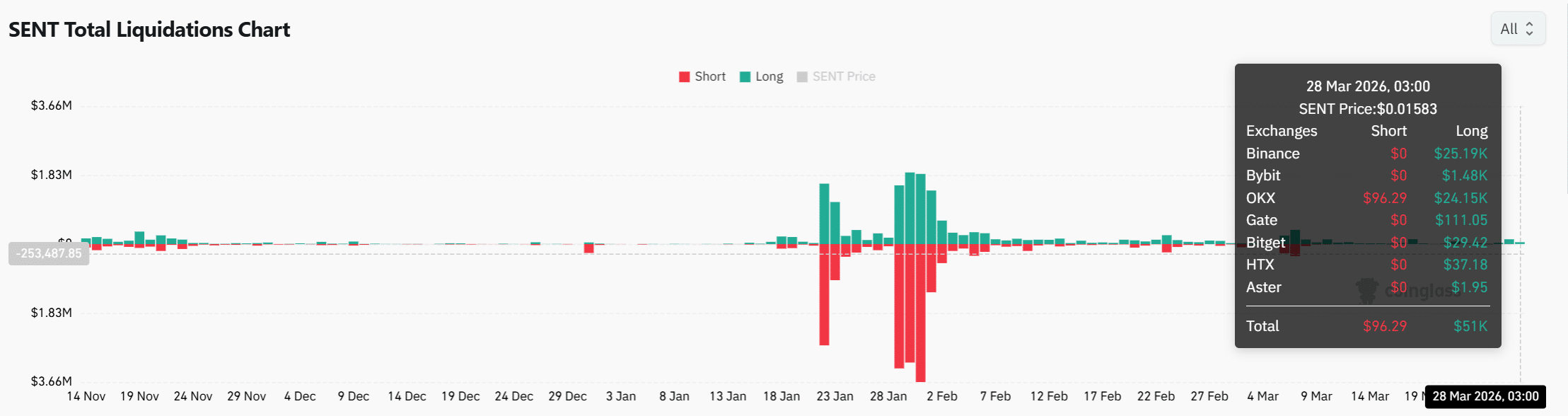
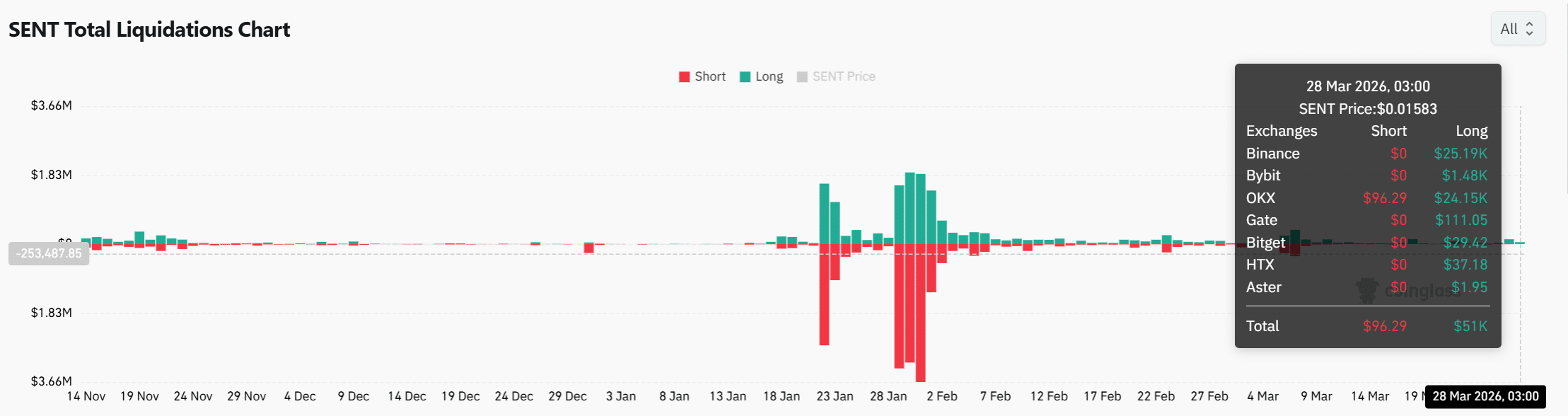
Liquidation data shows that long positions have faced heavy losses, with approximately $51K in longs wiped out compared to just $96 in short liquidations. This imbalance reflects aggressive forced exits, particularly across major exchanges like Binance and OKX.

When long positions get liquidated at this scale, they amplify downward pressure as positions close automatically. This cascade effect accelerates price declines and weakens bullish positioning further.

The dominance of long liquidations confirms that traders who expected upside continuation have exited under pressure, leaving the market tilted toward sellers.
Source: CoinGlass

Is SENT nearing stabilization or further downside?

SENT continues to face sustained downside pressure as structure, liquidations, and capital outflows align against recovery.

The breakdown below support, combined with the OI drop and dominant long liquidations, reflects a market still unwinding bullish exposure. Although RSI has entered oversold territory, current conditions do not support a stable rebound.

SENT would likely continue drifting lower toward the $0.01106 zone before any meaningful stabilization attempt emerges.


Final Summary

  • Sentient shows weakening structure as sellers maintain control and buyers fail to defend key levels effectively.
  • Market positioning reflects reduced confidence, suggesting price would continue drifting lower before any meaningful stabilization emerges.


Domande pertinenti

QWhat is the current price of Sentient (SENT) and how much has it dropped?

ASentient (SENT) is currently priced at $0.01585, representing a drop of 14.3%.

QWhat key support level did SENT break below, and what is the next potential demand zone?

ASENT broke below the $0.01891 support level and is extending lower toward the $0.01106 demand zone.

QWhat does the 16.30% decline in Open Interest (OI) to $19.76 million indicate?

AThe decline in Open Interest indicates that leveraged traders are closing their positions rather than opening new ones, signaling a reduction in market participation and capital withdrawal.

QHow did long liquidations compare to short liquidations, and what does this imbalance reflect?

ALong liquidations dominated with approximately $51,000 wiped out, compared to only $96 in short liquidations. This reflects aggressive forced exits of bullish positions, amplifying downward price pressure.

QDespite the RSI reading of 29.06 indicating oversold conditions, why does the article suggest further downside is likely?

AThe article suggests further downside is likely because the broader market structure, capital outflows, and dominant sell-side control align against recovery. Oversold conditions alone are not enough to support a stable rebound without a change in these underlying factors.

Letture associate

In Conversation with Ray Dalio: We Are Currently in an AI Bubble, with 1% of My Portfolio in Bitcoin

Ray Dalio, founder of Bridgewater Associates, warns in an interview that the current AI boom shows classic bubble characteristics, which could lead to significant economic downturns as seen in past cycles like 1929 or 2000. He explains that speculative enthusiasm, fueled by debt and overvaluation, often precedes a crash when rising rates or taxation force asset sales, causing widespread losses and recession. Dalio also outlines his "Big Cycle" theory, describing an approximate 80-year pattern where widening wealth gaps, massive government deficits, and shifting geopolitical power (like China's rise) create internal conflict and global instability. He emphasizes that we are in a late-cycle, transitional phase where traditional powers like the US and UK face decline. For personal wealth protection, Dalio advises diversification beyond cash into assets like stocks, bonds, real estate, and particularly gold, which he prefers over Bitcoin. While he holds about 1% of his portfolio in Bitcoin as a non-printable hard asset, he views gold as more secure from technological or governmental threats. Regarding AI's impact, Dalio believes it will disproportionately benefit capital owners, worsening inequality by replacing both physical and cognitive labor. He suggests that human intuition and emotional intelligence, combined with AI, will be key for future workers. On taxation, Dalio argues that wealth taxes are impractical and risk triggering asset sell-offs, reducing productive investment. He points to the UK as a cautionary example of debt, low productivity, and political strife. Geopolitically, Dalio foresees a more regionalized world, with the US showing weakness in prolonged conflicts like with Iran, akin to past imperial declines. The ideal outcome, he suggests, is coexisting powerful blocs (e.g., Americas, China-Asia Pacific) without major war.

marsbit2 h fa

In Conversation with Ray Dalio: We Are Currently in an AI Bubble, with 1% of My Portfolio in Bitcoin

marsbit2 h fa

Daily 7.2 Trillion KRW: Foreign Capital's Record Net Buying on Friday! Wall Street Says Headwinds for Korean Stock Fund Flows Have Subsided

South Korean stock market sees a dramatic shift in fund flows. On July 31, foreign investors made a record net purchase of approximately KRW 7.2 trillion in KOSPI stocks, marking a fundamental reversal from the persistent large-scale net outflows seen in previous months. This contributed to a significant narrowing of foreign net selling in July to KRW 9.8 trillion, down sharply from KRW 48.4 trillion in June and KRW 44.5 trillion in May. Simultaneously, domestic institutional pressure eased. South Korean pension funds and asset managers turned to a net buying position in July, purchasing KRW 1.0 trillion worth of KOSPI shares, contrasting with net sales in May and June. Market volatility is expected to be dampened by new financial regulations. Effective July 31, the Financial Services Commission tightened access for retail investors to single-stock leveraged ETFs by raising the minimum cash deposit requirement. Trading volumes for these products subsequently dropped to about 50% of their monthly average. Citigroup Research maintains its year-end KOSPI target of 10,000 points. The firm cites several supportive factors: the substantial easing of headwinds from capital outflows, a robust fundamental outlook for the semiconductor sector, historically low market valuations, strong economic fundamentals, and the potential for policy support from financial authorities if needed.

marsbit2 h fa

Daily 7.2 Trillion KRW: Foreign Capital's Record Net Buying on Friday! Wall Street Says Headwinds for Korean Stock Fund Flows Have Subsided

marsbit2 h fa

Thanks to Dice Rolls, Bitcoin Keys Are Stored Offline, But Not Everyone Will Do It

The article discusses using dice rolls to generate secure Bitcoin wallet seeds, providing entropy independent of potentially flawed hardware random number generators. It explains that each fair dice roll offers about 2.585 bits of entropy, with around 50 rolls needed for a standard 12-word seed phrase and 99+ recommended for higher security. This method gained attention after a vulnerability was revealed in some Coldcard hardware wallets, where a faulty firmware RNG (dating back to 2021) compromised generated keys. The analysis notes that while a dice-generated main seed was safe from this specific flaw, other Coldcard functions (like creating paper wallets, backup keys, or passwords) could still be vulnerable if they used the defective RNG. The piece argues that while dice-based entropy is technically robust, the manual process is error-prone, tedious, and unrealistic for most new users, who might make mistakes in recording or inputting rolls. It concludes that while manual entropy generation should remain an option for advanced users, the long-term goal is to develop reliable, user-friendly hardware and software that securely generates randomness without requiring specialized knowledge. Coldcard users are advised to check their firmware version and replace any secondary secrets (like paper wallet keys) created with vulnerable devices, while also considering multi-signature setups with devices from different manufacturers for added security.

cryptonews.ru7 h fa

Thanks to Dice Rolls, Bitcoin Keys Are Stored Offline, But Not Everyone Will Do It

cryptonews.ru7 h fa

Trading

Spot
活动图片




