Sentient Announces Token Economics, How Will the Market Price It?

marsbitPubblicato 2026-01-16Pubblicato ultima volta 2026-01-16

Introduzione

Sentient, an open-source AI platform focused on building an open, monetized, and verifiable Artificial General Intelligence (AGI) economy, has released the tokenomics for its native token SENT. The total supply is set at approximately 34.36 billion tokens (2³⁵), distributed across five categories: Community Initiatives & Airdrops (44%), Ecosystem & R&D (19.55%), Team (22%), Investors (12.45%), and Public Sale (2%). The SENT will be used for staking, model services, data-related functions, and payments within the platform's ecosystem, particularly for services powered by Artifacts. Unlock schedules vary: 30% of community and ecosystem allocations are unlocked at TGE, with the remainder linearly released over four years. Team and investor tokens are locked for one year post-TGE, then linearly vested over four and six years, respectively. The public sale portion is fully unlocked at TGE. Market expectations are high, with Polymarket prediction data indicating a 99% probability that Sentient’s fully diluted valuation (FDV) will exceed $200 million upon launch. Sentient aims to create a decentralized AGI economy where developers can monetize models, data, and innovations. Its core infrastructure, GRID (Global Research and Intelligence Directory), is a composable network of AI agents, models, and tools. The project has raised $85 million in seed funding from investors including Founders Fund, Pantera Capital, and Framework Ventures. Key advisors include Sandeep Nailwal (Polygon...

Original Title: 《Sentient Announces Token Economics, How Will the Market Price It?》

Original Author: ChandlerZ, Foresight News


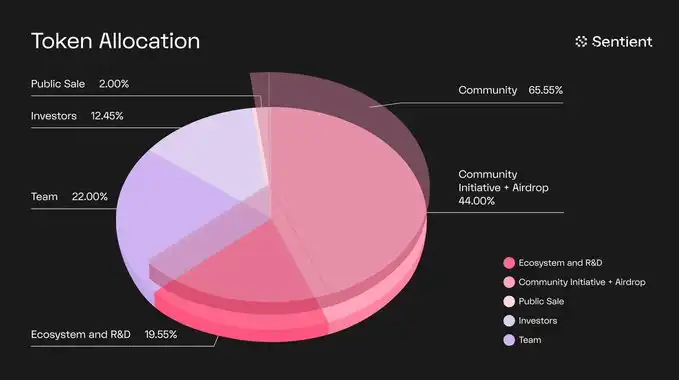
On January 16, the open-source AI platform Sentient announced the SENT token economics. The total supply of SENT tokens is approximately 34.3 billion, with 44% allocated to community incentives and airdrops, 19.55% to the ecosystem system and R&D, 2% to public sales, 22% allocated to the team, and 12.45% allocated to investors.
According to Polymarket data, the market's bet on the probability of Sentient's next-day FDV exceeding $200 million has risen to 99%, the probability of exceeding $400 million is 87%, and the probability of exceeding $600 million is 83%. The current trading volume of this prediction market is approximately $330,000.

Allocation Rules Details

Throughout the entire ecosystem, SENT is used for agents, models, data services, and other products driven by Artifacts. Artifacts can also use SENT for payments, thereby realizing composable on-chain value flows between services. The official set the total supply of SENT at 34,359,738,368, which is exactly 2³⁵. The official stated that the full story of how this number was chosen will be shared in the future; however, technically savvy readers might be able to deduce the reason.

SENT allocation is divided into five categories: Community Advocacy and Airdrops, Ecosystem System and R&D, Team, Investors, and Public Sale.

Community Activities and Airdrops ——44.00%

This portion of tokens accounts for 44% of the total supply and is specifically used for airdrops, community grants, bounties, and incentive programs to reward users and developers for their verifiable work on GRID. To ensure broad ownership, 30% of these tokens will be unlocked at TGE (approximately 13% of total supply), and the remaining 70% will be linearly unlocked over 4 years. According to the design, personnel who build, test, and share open-source intelligence and products will be eligible to receive the largest share of tokens. Airdrops will be fully unlocked at TGE.

Ecosystem System and R&D ——19.55%

This portion of tokens accounts for 19.55% of the total supply and will be used to promote ecosystem development, R&D, growth, infrastructure construction, and the operation of the Sentient Foundation. To ensure long-term stable supply, 30% will be unlocked at TGE (token issuance date), and the remaining 70% will be linearly unlocked over four years.

Team —— 22.00%

This funding pool accounts for 22% of the total supply and is exclusively for the team members of the Sentient Foundation and Sentient Labs, including employees, founders, and key contractors. At TGE, the team funding pool is locked for one year, after which the funds will be released linearly over 6 years, with a 1-year cliff period.

Investors ——12.45%

This portion of tokens accounts for 12.45% of the total supply and is allocated to investors who supported Sentient in private rounds. Investor tokens will be locked for one year and then linearly unlocked over four years. This structure aims to reward the confidence of early investors.

Public Sale ——2.00%

This public sale accounts for 2% of the total supply and aims to encourage broader participation from community members at the project's launch. This allocation will be fully unlocked at TGE. The specific public sale structure will be announced soon.

At the end of November 2025, Sentient opened airdrop registration for users, targeting four groups: community contributors, active Sentient Chat users, social platform Top Voices, and external open-source researchers.

The second season's activities will feature new roles based on contributions, clearer upgrade paths, and multiple reward mechanisms. Rewards will include SENT tokens, NFTs, and merchandise. Specific airdrop activity details have not yet been announced.

A New AI Star That Raised $85 Million

Sentient is an AI research organization dedicated to building an open artificial general intelligence (AGI) economy, developing a platform and protocol that allows open-source AI developers to monetize or tokenize their models, data, and other innovations. Here, developers can collaborate to build powerful AI agents and become key stakeholders in the new open AGI economy, driving AI transformation and prosperity.

Sentient proposed the "OML" (Open, Monetary, Loyal) model concept, hoping to promote the shared open AGI economy through the OML model, building a shared open AGI economic system involving millions of AI agents and billions of users, providing continuous momentum for the innovation and development of downstream applications.

At the product and architecture level, Sentient's main focus is its intelligent network called GRID (Global Research and Intelligence Directory). The official describes it as a collaborative system composed of specialized agents, models, data, tools, and computing power: when a user initiates a query, the task is decomposed, routed to suitable intelligences / tools / data sources, and then the multi-path results are aggregated into a consistent output.

For general users, Sentient Chat is positioned as the unified entry point and distribution channel into GRID, emphasizing that users can see which capabilities and sources are called during the interaction process; for developers and ecosystem partners, GRID provides channels to be used, distributed, and receive future回流 income, using the SENT token economy to incentivize contributors to connect various Artifacts to the network, directing incentives towards more valuable modules through signals like staking and usage volume.

To support this multi-agent collaboration capability, Sentient launched and open-sourced the ROMA (Recursive Open Meta-Agent) framework in 2025, abstracting complex tasks into a recursive hierarchical task tree: parent nodes are responsible for decomposing goals, sending context to child nodes, and completing aggregation after collecting results, making the context flow of medium-to-long chain tasks more transparent, traceable, and debuggable, and also facilitating the replacement of different models, tools, or manual verification steps at the node level. Sentient described ROMA in its product update as the skeleton for building high-performance multi-agent systems and synchronized it to GitHub as an open-source base for secondary community development.

Strong Alliance Between Academia and Crypto

In July 2024, Sentient announced the completion of an $85 million seed funding round, setting a record in the AI加密 field. This funding was co-led by Peter Thiel's Founders Fund, Pantera Capital, and Framework Ventures, with participation from Ethereal Ventures, Foresight Ventures, Robot Ventures, Symbolic Capital, Delphi Ventures, Hack VC, Arrington Capital, HashKey Capital, and Canonical Crypto.

One of Sentient's core contributors is Polygon's co-founder Sandeep Nailwal, and EigenLayer founder and CEO Sreeram Kannan is an advisor to the project.

In addition, in terms of team composition, Sentient Labs' public personnel page shows two other co-founders: Pramod Viswanath (Princeton University engineering professor) and Himanshu Tyagi (Indian Institute of Science engineering professor). Pramod Viswanath has long researched information theory and communication systems, leading Sentient's AI safety and theoretical foundation construction; Himanshu Tyagi is skilled in privacy protection and decentralized learning algorithms, providing academic support for model training and privacy collaboration.

The core engineering and development team consists of AI research lines led by university professors and researchers, as well as functions such as platform engineering, blockchain R&D, product, and operations, presenting a team structure that blends academic research, engineering implementation, and加密 economic mechanisms.

Ecosystem Cooperation and Landing Scenes

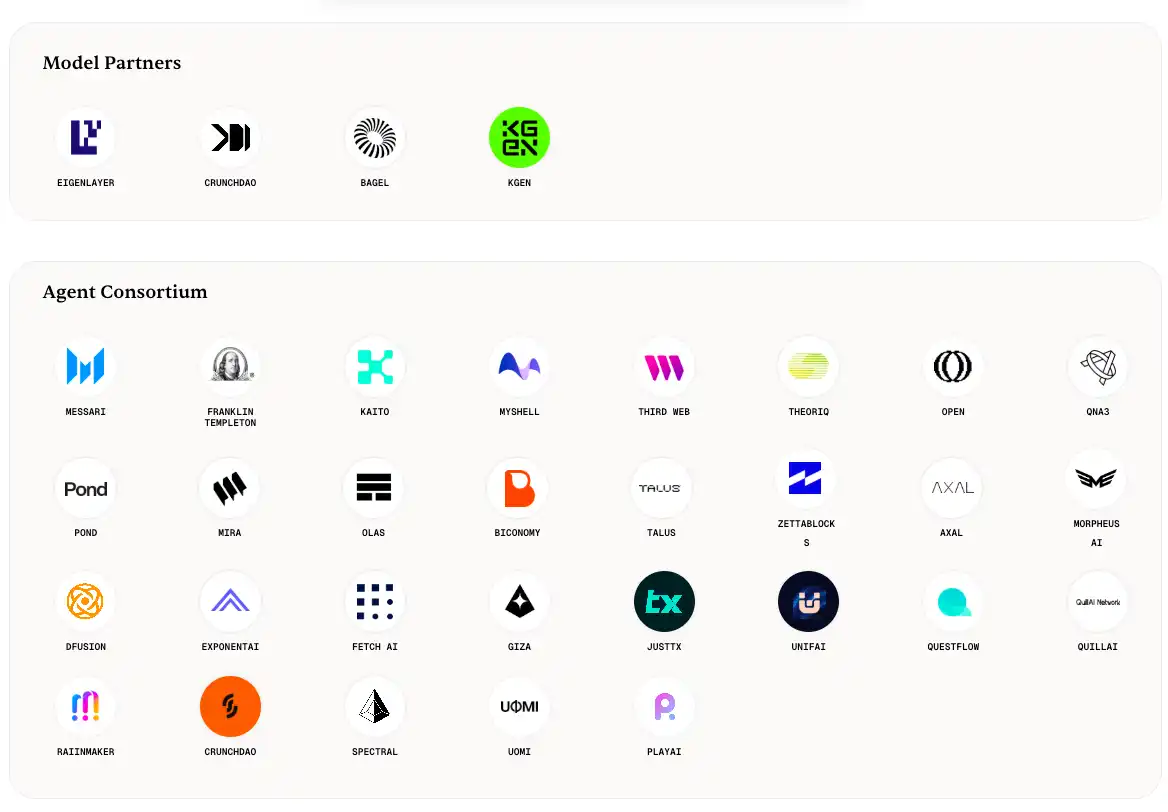
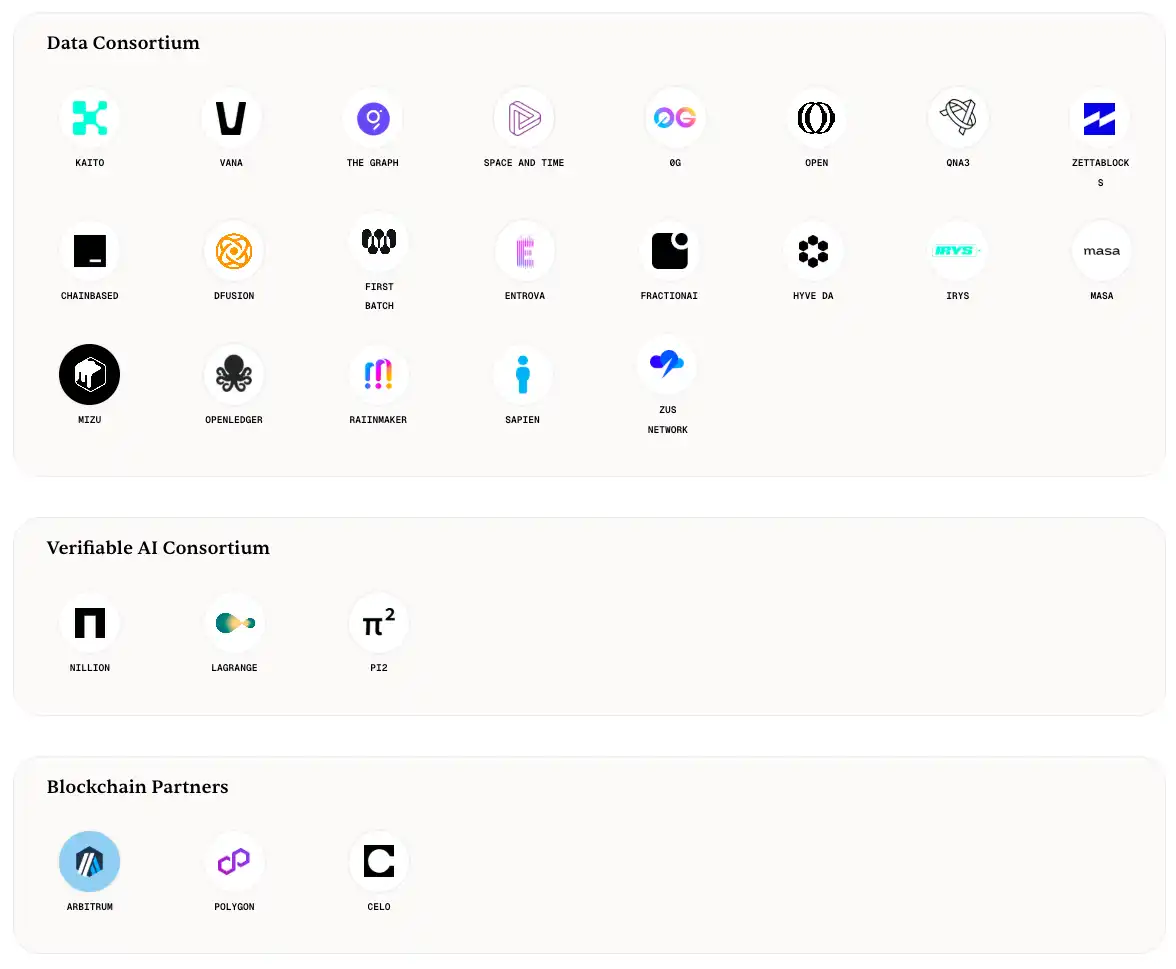
The official revealed that the ecosystem scale has reached 60+ partners / integrations, covering model cooperation partners, Agents, data providers, model and verifiable inference and other types.
Overall, Sentient's differentiation lies in defining the path to AGI as a composable open network, using SENT's incentives and staking mechanisms to try to solve the funding, distribution, and sustainability issues long faced by open-source AI. Its key variables are therefore more about systematic engineering and mechanism design rather than single-point model capabilities, including whether the quality of ecosystem接入 can持续 improve, whether incentives will导向 real usage value, and whether the multi-agent system can form a replicable model in terms of reliability and safety.


Domande pertinenti

QWhat is the total supply of SENT tokens and what is the significance of the number?

AThe total supply of SENT tokens is 34,359,738,368, which is exactly 2³⁵. The official statement mentions that the full story of how this specific number was chosen will be shared in the future, but technically savvy readers might infer the reasoning behind it.

QAccording to the tokenomics, what are the five major allocation categories for SENT tokens and their percentages?

AThe five major allocation categories are: Community Initiatives and Airdrop (44.00%), Ecosystem System and R&D (19.55%), Team (22.00%), Investors (12.45%), and Public Sale (2.00%).

QWhat is the market's expectation for Sentient's Fully Diluted Valuation (FDV) at launch, based on Polymarket data?

AAccording to Polymarket data, the probability of Sentient's FDV exceeding $200 million at launch has risen to 99%, the probability of exceeding $400 million is 87%, and the probability of exceeding $600 million is 83%. The prediction market currently has a trading volume of approximately $330,000.

QWhat is the core product architecture that Sentient is building, as described in the article?

ASentient's core product architecture is a smart network called GRID (Global Research and Intelligence Directory). It is described as a collaborative system composed of specialized agents, models, data, tools, and computing power. When a user initiates a query, the task is decomposed and routed to suitable intelligent entities/tools/data sources, and the multi-path results are aggregated into a unified output.

QWho are the key investors and advisors behind Sentient's $85 million seed funding round?

AThe $85 million seed round was co-led by Peter Thiel's Founders Fund, Pantera Capital, and Framework Ventures. Other participants included Ethereal Ventures, Foresight Ventures, Robot Ventures, Symbolic Capital, Delphi Ventures, Hack VC, Arrington Capital, HashKey Capital, and Canonical Crypto. Key contributors include Sandeep Nailwal, co-founder of Polygon, and Sreeram Kannan, founder and CEO of EigenLayer, who serves as an advisor.

Letture associate

The Shutdown of Claude Mythos Revealed the True Cost of Renting AI to Me

The sudden shutdown of Claude Mythos this week starkly highlights a critical, often overlooked risk for founders: when your core capability relies entirely on someone else's platform, your fate is not in your own hands. The key question becomes: who truly owns the intelligence your product depends on? For years, the debate around open-source models focused on cost. Now, the evidence is clear: fine-tuned open-source models can achieve frontier-level quality for specific, mission-critical tasks at a fraction of the cost. However, the deeper issue is control. Relying on a third-party API is like renting; it works until the landlord changes the rules, raises the rent, or asks you to leave—as Mythos experienced. The lesson is not to stop using frontier models—they are incredible infrastructure. The goal is ownership. Ownership means starting with a powerful open-source model and shaping it around what makes your company unique: your data, workflows, domain expertise, and definition of "good." Over time, the model becomes less generic and more reflective of your business, creating durable value. The optimistic conclusion is that AI's future doesn't hinge on one superior model. There is no single frontier. The frontier includes proprietary models, models fine-tuned on company-specific knowledge, specialized models for narrow problems, and intelligent routers orchestrating model ensembles. The most interesting development is not models getting smarter, but intelligence becoming increasingly customizable. The winning companies will be those that transform intelligence into a unique, owned asset. Looking ahead, the vision is not one model dominating all, but many teams owning the part of the frontier that matters most to them.

marsbit23 min fa

The Shutdown of Claude Mythos Revealed the True Cost of Renting AI to Me

marsbit23 min fa

Tiger Research: U.S. Strategic Bitcoin Reserve - Should the Market Be Happy or Disappointed?

Tiger Research analyzes the evolution of U.S. legislative efforts regarding a strategic Bitcoin reserve, concluding the market impact is limited in the short term but potentially positive long-term. The core event was a March 2025 executive order by former President Trump, which designated confiscated Bitcoin as a strategic reserve and promised not to sell existing holdings (approx. 190k BTC). As it contained no mandate to purchase new Bitcoin, the market reacted negatively, with prices dropping 5.7%. Legislative history shows a significant retreat from initial ambitions. The 2024 "BITCOIN Act" proposed mandatory purchases of 1 million BTC over five years. Reintroduced in 2025, it stalled due to high fiscal costs, concerns over dollar hegemony, and opposition from the Treasury Secretary. The current frontrunner, the 2026 "American Retirement and Monetary Advancement (ARMA) Act," is a compromise. It lacks any purchase requirement, instead focusing on consolidating existing government-held Bitcoin and legally prohibiting its sale for at least 20 years. While ARMA has higher passage odds due to bipartisan support and no purchase mandate, its immediate market effect is neutral. It eliminates potential government selling pressure but creates no new demand. The long-term significance is that formally establishing Bitcoin as a national reserve asset in law could later reignite debates on mandatory purchases. Therefore, the path to a government buyer is longer than initially priced by the market, but the directional narrative remains intact.

marsbit26 min fa

Tiger Research: U.S. Strategic Bitcoin Reserve - Should the Market Be Happy or Disappointed?

marsbit26 min fa

US Stock Market Trend (June 16): SpaceX Rises 42% in Two Days, New Fed Chairman Takes Office Today

**U.S. Stocks Trend (June 16): SpaceX Soars 42% in Two Days, New Fed Chair Takes Office Today** Markets surged on Monday following former President Trump's social media announcement of a completed U.S.-Iran deal to reopen the Strait of Hormuz, pending a June 19 signing. The news triggered a broad risk-on rally: oil prices crashed, tech stocks soared, bond yields fell, and defensive sectors lagged. **Market Performance:** The Nasdaq jumped 3.07%, led by semiconductor stocks like Micron (+9.2%). The S&P 500 gained 1.65%, and the Dow rose 0.92% to a record high. However, the Russell 2000 small-cap index underperformed (+0.72%). SpaceX continued its hot streak, rising another 5% pre-market after disclosures of large buys by an Australian billionaire and Cathie Wood's ARK. Boeing also rallied on the transportation optimism. Conversely, energy stocks like Chevron fell over 3% on the oil price plunge, with other defensive sectors also selling off. The day's action showed a clear rotation of funds from energy/defensive plays into AI and tech narratives. **Macro & Outlook:** The VIX fear index fell 8.37%. Treasury yields declined, and WTI crude dropped over 5%. Attention now shifts to a packed schedule: the Bank of Japan is widely expected to hike rates to 1.0% on Tuesday. The Fed's June meeting concludes Wednesday, marking new Chair Wash's debut. While rates are expected to hold, his tone on stubborn inflation and the "dot plot" will be crucial for gauging the 2024 rate path. The formal Iran deal signing is set for Friday. **Trend Perspective:** While the peace deal is a genuine positive, Monday's explosive rally may have gotten ahead of itself, pricing in a swift resolution to inflation concerns. The shortened trading week faces a triple test: BoJ tightening, the Fed's policy stance, and deal implementation details. Tech and semiconductors, which led the surge, remain vulnerable to any disappointment from these key events. The real price discovery begins with the central banks' communications this week.

marsbit47 min fa

US Stock Market Trend (June 16): SpaceX Rises 42% in Two Days, New Fed Chairman Takes Office Today

marsbit47 min fa

Trading

Spot
Futures
活动图片