Senator Urges Banking Regulator To Block Crypto Charter Linked To Trump

bitcoinistPubblicato 2026-01-14Pubblicato ultima volta 2026-01-14

Introduzione

Senator Elizabeth Warren has urged the Office of the Comptroller of the Currency (OCC) to halt the review of a national trust bank charter application from World Liberty Financial, a crypto firm linked to former President Donald Trump. Warren argues that approving the charter while Trump retains financial ties could create serious ethical conflicts and undermine public trust in regulators. The firm aims to use the charter to issue and manage its dollar-pegged stablecoin, USD1, which has grown to over $3.3 billion in circulation since its launch. Other Democrats have expressed similar concerns, emphasizing the need for regulatory independence when reviewing politically connected applicants.

United States President Donald Trump’s family-backed crypto firm has applied for a national trust bank charter, and one of the Senate’s most vocal financial critics wants regulators to stop the process until the President severs his financial ties to the venture.

According to filings and public statements, the firm aims to use the charter to issue and manage a dollar-pegged stablecoin called USD1, which has grown quickly since launch.

Warren Raises Conflict Concerns With The OCC

US Senator Elizabeth Warren sent a formal letter to Comptroller Jonathan Gould asking the Office of the Comptroller of the Currency (OCC) to pause its review of the application until Trump divests and fully eliminates financial links to World Liberty Financial, reports say.

The senator wrote that approving a federally chartered bank while the sitting President retains ties to the business could create serious government ethics problems.
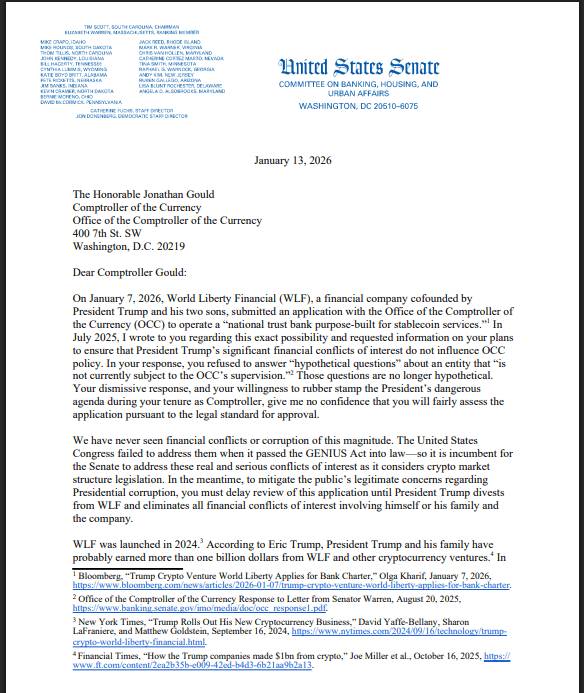
Warren's letter to Comptroller of the Currency, Jonathan Gould.

The Company’s Plan And Its Scale

World Liberty Financial wants a national trust bank that would offer stablecoin issuance, custody and conversion services.

The stablecoin USD1 has reached more than $3.3 billion in circulation since its launch, a figure regulators and lawmakers are watching closely as the firm seeks federal oversight.

The move would place certain crypto activities under the same kind of supervision given to traditional trust banks.

Pushback And Political Risk

Reports note that Warren’s demand is rooted in a concern about the public’s trust in regulators. She asked the OCC for a written reply by January 20, highlighting the urgency of the matter for lawmakers who oversee banking rules.

Other Democrats have signaled similar worries about the optics and legal questions that could follow if a regulator reviews a bank linked to the incumbent President.

Total crypto market cap currently at $3.19 trillion. Chart: TradingView

Industry Context And Reaction

Several crypto firms have recently sought national charters or conditional approvals, prompting a broader debate over how stablecoins should be regulated. Supporters of bank charters say federal oversight can protect customers and bring clarity.

Critics argue that when a highly political figure is connected to an applicant, extra caution is required so that regulatory independence is preserved. Reporting on this case has focused on both the bank application and the potential effect on trust in federal agencies.

Other Developments Around The Firm

World Liberty and related affiliates have been active on multiple fronts, including new product launches and international talks. Some outlets noted a newly announced partnership with external parties to explore broader payment uses for USD1, an effort that underlines how quickly the stablecoin has spread.

Featured image from Inc/Getty Images, chart from TradingView

Domande pertinenti

QWhat is urging the banking regulator to block the crypto charter linked to former President Trump?

AUS Senator Elizabeth Warren is urging the banking regulator to block the crypto charter.

QWhat is the name of the crypto firm backed by Trump's family that applied for the charter?

AThe firm is called World Liberty Financial.

QWhat specific product does World Liberty Financial want to issue and manage with this charter?

AThe firm wants to issue and manage a dollar-pegged stablecoin called USD1.

QWhat major concern did Senator Warren raise in her letter to the Comptroller of the Currency?

AShe raised concerns about a serious conflict of interest and government ethics problems if the charter is approved while the former President retains financial ties to the venture.

QHow much circulation has the USD1 stablecoin reached since its launch?

AThe USD1 stablecoin has reached more than $3.3 billion in circulation.

Letture associate

Bitcoin Withdrawals Continue: 8 Years of Storage in a Coldcard Cold Wallet Ended in Zero

Coldcard Hardware Wallet Hacked: Losses Mount Due to Vulnerable Seed Generation A critical vulnerability in Coldcard hardware wallets has led to a continued wave of fund thefts. According to Galaxy Research, the total stolen has reached 1,367.05 BTC (approx. $88.6 million) from 4,585 addresses, a significant increase from the initial 594.5 BTC reported on July 30, 2026. Most of the stolen funds remain on the attackers' addresses. The issue is not with the current firmware, which Coinkite has updated, but with seed phrases generated on vulnerable devices between March 2021 and the release of fixed firmware versions. Due to a programmer error, devices switched from using a hardware random number generator to the software-based Yasmarang generator, which was initialized with publicly accessible data like the chip's serial number. This made the seed phrases predictable through offline brute-force attacks, meaning wallets remain at risk until funds are moved to a new wallet generated with the patched firmware. Affected devices include Mk2/Mk3 with firmware 4.0.1–4.1.9 (and up to 5.0.3), Mk4/Mk5 up to version 5.6.0, and Q models up to 1.5.0Q. The only exceptions are seeds created with a high-entropy method like at least 50 independent dice rolls or a strong unique BIP-39 passphrase. All other owners must generate a new seed on the fixed firmware and transfer their assets. A case highlighting the human impact involves a 39-year-old long-term investor who lost 2 BTC (approx. $130,000) in minutes. He had accumulated the Bitcoin over eight years through physical labor, viewing it as a financial lifeline and a retirement plan in a country suffering from hyperinflation. His story underscores that even conservative "buy and hold in cold storage" strategies can be compromised by such underlying technical flaws. From a technical perspective, this incident echoes historical failures where weak random number generators undermined cryptographic security, challenging the assumption that offline storage is automatically foolproof.

cryptonews.ru2 h fa

Bitcoin Withdrawals Continue: 8 Years of Storage in a Coldcard Cold Wallet Ended in Zero

cryptonews.ru2 h fa

Trading

Spot
活动图片





