Senator Urges Banking Regulator To Block Crypto Charter Linked To Trump

bitcoinistPubblicato 2026-01-14Pubblicato ultima volta 2026-01-14

Introduzione

Senator Elizabeth Warren has urged the Office of the Comptroller of the Currency (OCC) to halt the review of a national trust bank charter application from World Liberty Financial, a crypto firm linked to former President Donald Trump. Warren argues that approving the charter while Trump retains financial ties could create serious ethical conflicts and undermine public trust in regulators. The firm aims to use the charter to issue and manage its dollar-pegged stablecoin, USD1, which has grown to over $3.3 billion in circulation since its launch. Other Democrats have expressed similar concerns, emphasizing the need for regulatory independence when reviewing politically connected applicants.

United States President Donald Trump’s family-backed crypto firm has applied for a national trust bank charter, and one of the Senate’s most vocal financial critics wants regulators to stop the process until the President severs his financial ties to the venture.

According to filings and public statements, the firm aims to use the charter to issue and manage a dollar-pegged stablecoin called USD1, which has grown quickly since launch.

Warren Raises Conflict Concerns With The OCC

US Senator Elizabeth Warren sent a formal letter to Comptroller Jonathan Gould asking the Office of the Comptroller of the Currency (OCC) to pause its review of the application until Trump divests and fully eliminates financial links to World Liberty Financial, reports say.

The senator wrote that approving a federally chartered bank while the sitting President retains ties to the business could create serious government ethics problems.
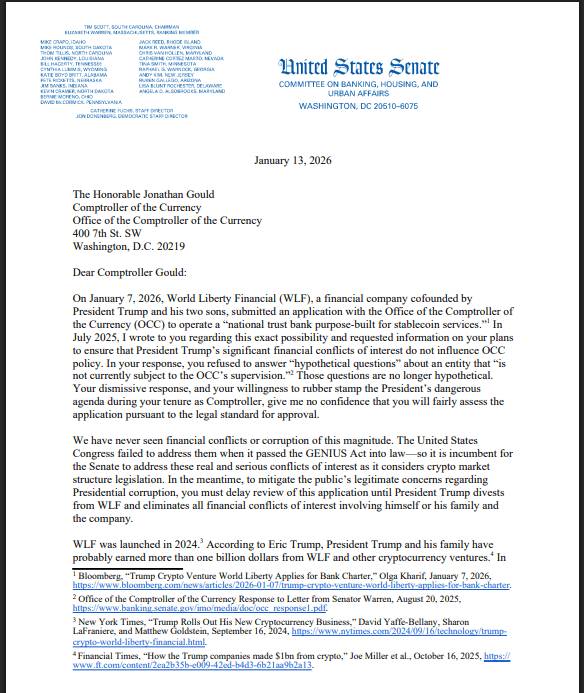
Warren's letter to Comptroller of the Currency, Jonathan Gould.

The Company’s Plan And Its Scale

World Liberty Financial wants a national trust bank that would offer stablecoin issuance, custody and conversion services.

The stablecoin USD1 has reached more than $3.3 billion in circulation since its launch, a figure regulators and lawmakers are watching closely as the firm seeks federal oversight.

The move would place certain crypto activities under the same kind of supervision given to traditional trust banks.

Pushback And Political Risk

Reports note that Warren’s demand is rooted in a concern about the public’s trust in regulators. She asked the OCC for a written reply by January 20, highlighting the urgency of the matter for lawmakers who oversee banking rules.

Other Democrats have signaled similar worries about the optics and legal questions that could follow if a regulator reviews a bank linked to the incumbent President.

Total crypto market cap currently at $3.19 trillion. Chart: TradingView

Industry Context And Reaction

Several crypto firms have recently sought national charters or conditional approvals, prompting a broader debate over how stablecoins should be regulated. Supporters of bank charters say federal oversight can protect customers and bring clarity.

Critics argue that when a highly political figure is connected to an applicant, extra caution is required so that regulatory independence is preserved. Reporting on this case has focused on both the bank application and the potential effect on trust in federal agencies.

Other Developments Around The Firm

World Liberty and related affiliates have been active on multiple fronts, including new product launches and international talks. Some outlets noted a newly announced partnership with external parties to explore broader payment uses for USD1, an effort that underlines how quickly the stablecoin has spread.

Featured image from Inc/Getty Images, chart from TradingView

Domande pertinenti

QWhat is urging the banking regulator to block the crypto charter linked to former President Trump?

AUS Senator Elizabeth Warren is urging the banking regulator to block the crypto charter.

QWhat is the name of the crypto firm backed by Trump's family that applied for the charter?

AThe firm is called World Liberty Financial.

QWhat specific product does World Liberty Financial want to issue and manage with this charter?

AThe firm wants to issue and manage a dollar-pegged stablecoin called USD1.

QWhat major concern did Senator Warren raise in her letter to the Comptroller of the Currency?

AShe raised concerns about a serious conflict of interest and government ethics problems if the charter is approved while the former President retains financial ties to the venture.

QHow much circulation has the USD1 stablecoin reached since its launch?

AThe USD1 stablecoin has reached more than $3.3 billion in circulation.

Letture associate

Agents Take Over Traffic Distribution Power: What Are Tencent, ByteDance, and Alibaba Competing For?

In the race to dominate the AI era's entry point, China's tech giants—Tencent, ByteDance, and Alibaba—are aggressively deploying AI Agents to control the future of traffic distribution. Alibaba is pursuing a dual-track "closed loop + openness" strategy. Its Qianwen app is evolving into a super-Agent integrated across its ecosystem (Taobao, Alipay, etc.) to handle complex tasks like travel planning. Concurrently, it is opening its platform to external brands (Luckin Coffee, KFC) and has launched a B2B Agent platform, "Wukong," targeting enterprise automation. Its other flagship, Quark, aims to be an "AI super search box" for information and tasks. ByteDance is executing an omnipresent "sprawl strategy." Its Doubao app boasts over 300 million monthly active users and is evolving into a default AI entry point for daily life, with plans for paid versions and e-commerce integration. Its core weapon is the Kouzi platform, a visual "AI assembly factory" for developers to build custom Agents. ByteDance is also pushing hardware integration, collaborating on AI phones and developing smart glasses to embed Doubao everywhere. Tencent is playing its long-held "ultimate card" by quietly embedding an AI Agent directly into WeChat. This Agent, accessible via a swipe, can understand user commands and automatically execute tasks by calling upon WeChat's millions of mini-programs (e.g., finding and ordering coffee). This leverages WeChat's unparalleled 1.4-billion-user ecosystem to position the app as an AI-powered "service operating system," a move that could dramatically reshape the competitive landscape. The core battleground is shifting from competing for "user screen time" to competing to be the "default execution layer" for user intent. The business model is evolving from an "attention economy" to an "intent economy," where the Agent that can most efficiently fulfill a user's need gains control over service access and token flow. This represents a fundamental change in how users connect with digital services, making the fight for the Agent入口 (entry point) a pivotal moment for redefining industry leadership in the AI age.

marsbit1 h fa

Agents Take Over Traffic Distribution Power: What Are Tencent, ByteDance, and Alibaba Competing For?

marsbit1 h fa

Trading

Spot
Futures
活动图片