Senator Defends CLARITY Act As Developer Protection Debate Heats Up

bitcoinistPubblicato 2026-03-29Pubblicato ultima volta 2026-03-29

Introduzione

A crypto developer's case is driving a key regulatory debate in Washington. Roman Storm, co-founder of Tornado Cash, was convicted in 2025 for operating an unlicensed money-transmitting business, causing concern among developers. This has fueled a public dispute between Senator Cynthia Lummis and crypto attorney Jake Chervinsky over the CLARITY Act. Chervinsky argues that Title 3 of the bill contains broad language that could classify non-custodial software developers as money transmitters, subjecting them to KYC obligations and undermining intended protections. Lummis defends recent bipartisan revisions, calling the act the "strongest protection for DeFi and developers ever enacted." However, the latest text remains unpublished, leaving the industry awaiting concrete details amid high stakes for developer liability. The bill is gaining momentum and is expected to undergo a Senate committee markup in April.

A crypto developer was convicted last year for running an unlicensed money-transmitting business. That case — and others like it — is now driving one of the sharpest disagreements in Washington over how the US plans to regulate decentralized finance.

The Conviction That Changed The Conversation

Roman Storm, co-founder of the cryptocurrency mixing platform Tornado Cash, was found guilty in August 2025 of conspiracy charges tied to the operation of an unlicensed money-transmitting service.

His conviction sent a chill through the developer community. It also made the legal definitions buried inside pending crypto legislation feel a lot more urgent.

That backdrop is now shaping a public dispute between Senator Cynthia Lummis and prominent crypto attorney Jake Chervinsky over whether the Digital Asset Market Clarity Act — widely known as the CLARITY Act — actually protects the developers it claims to defend.

Sen. Cynthia Lummis. Image: Tom Williams/CQ Roll Call via AP file

CLARITY Act: What Chervinsky Gets At

Chervinsky’s concern is specific. Title 3 of the current Senate Banking Committee draft, he argues, contains money transmitter language broad enough to pull non-custodial software developers into Bank Secrecy Act territory — meaning KYC obligations and the regulatory exposure that comes with them.

His position: that result would effectively hollow out the Blockchain Regulatory Certainty Act, which was written precisely to keep non-custodial builders out of that category.

“The biggest challenge is ensuring non-custodial software developers aren’t misclassified as money transmitters,” Chervinsky said. He called the issue non-negotiable for DeFi, and said it remains unsettled.

The tension he’s flagging isn’t small. Section 604 of the CLARITY Act does incorporate the BRCA, which states that developers who don’t hold or control user funds should not be treated as financial institutions. But Chervinsky’s read is that other language in Title 3 creates enough ambiguity to undo that protection in practice.

On Friday, Lummis fired back directly. She said recent bipartisan revisions to Title 3 make the bill the strongest protection for DeFi developers ever put into law.

“Don’t believe the FUD,” she posted on X, urging supporters to back the legislation’s passage.

BTCUSD now trading at $66,508. Chart: TradingView

Text Still Not Public

While earlier drafts of the CLARITY Act have been made public, the latest negotiated revisions referenced by Cynthia Lummis have not yet been fully released. That means the specific changes she is describing cannot be independently verified — at least for now.

What is known: the bill is gaining momentum. Bipartisan progress on stablecoin rewards provisions has pushed it closer to a Senate Banking Committee markup, expected sometime in April.

Chervinsky has noted that those stablecoin provisions have consumed most of the public attention, leaving the developer protection debate in the background despite its significance.

For developers watching closely, the stakes could not be more concrete. The question of whether writing non-custodial software qualifies someone as a money transmitter is not theoretical.

Roman Storm found that out in court. Until the revised CLARITY Act text is available for review, the industry’s only assurance is a senator’s word on social media.

Featured image from Pexels, chart from TradingView

Domande pertinenti

QWhat was Roman Storm convicted of in August 2025?

ARoman Storm, co-founder of Tornado Cash, was convicted of conspiracy charges tied to the operation of an unlicensed money-transmitting service.

QWhat is the core of Jake Chervinsky's concern regarding Title 3 of the CLARITY Act draft?

AChervinsky's concern is that Title 3 contains money transmitter language broad enough to subject non-custodial software developers to KYC obligations and Bank Secrecy Act regulations, which would undermine the intended protections of the Blockchain Regulatory Certainty Act (BRCA).

QHow did Senator Cynthia Lummis respond to the criticism of the CLARITY Act?

ASenator Lummis fired back on social media, stating that recent bipartisan revisions to Title 3 make the bill the 'strongest protection for DeFi and developers ever enacted' and urged supporters to 'Don't believe the FUD' and back the legislation's passage.

QWhy can the specific changes to the CLARITY Act that Lummis referenced not be independently verified?

AThe latest negotiated revisions to the bill have not yet been fully released to the public, so the specific changes she described cannot be independently verified.

QWhat real-world case exemplifies the high stakes of the developer protection debate for the crypto industry?

AThe conviction of Tornado Cash co-founder Roman Storm for running an unlicensed money-transmitting business is the concrete example that shows the question of whether writing non-custodial software qualifies someone as a money transmitter is not theoretical.

Letture associate

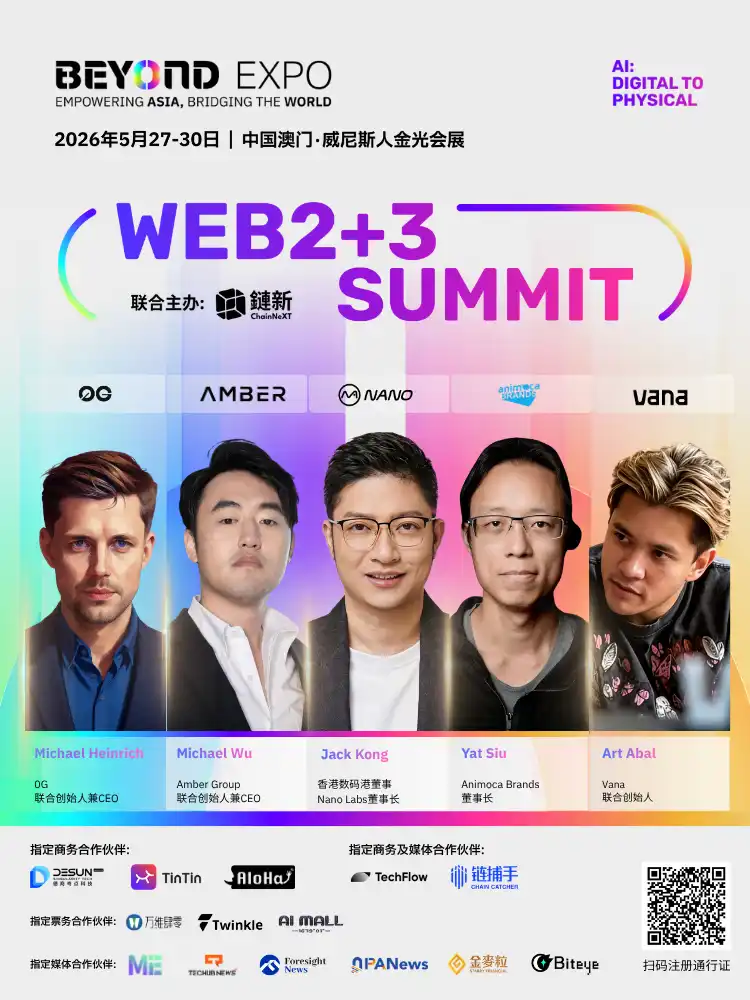
First Batch of Keynote Speakers and Partners Announced! Web2+3 Summit: Defining the Next Generation of Digital Economy

Web2+3 Summit: Defining the Next Generation of Digital Economy The 6th BEYOND International Technology Innovation Expo (BEYOND Expo 2026), Asia's largest tech and ecosystem exhibition, is launching a dedicated Web2+3 stage for the first time. Co-hosted by BEYOND Expo and ChainNeXT Group, the Web3 Summit will take place from May 28–30, 2026. Against the backdrop of accelerating global tech integration, the boundaries between Web2 and Web3 are rapidly blurring. With clearer global regulations for blockchain-driven internet (Web3) and the special issuance of a Hong Kong dollar stable币 license by the Hong Kong SAR government on April 10, 2026, Web3's decentralized principles are quickly merging with traditional industries (Web2) such as e-commerce, finance, and artificial intelligence. Focused on blockchain-driven digital economy elements, the summit will center on three core principles—implementability, commercial viability, and compliance. It will bring together top Web3 experts to discuss key integration areas like stablecoin payment finance (PayFi), real-world asset tokenization (RWA), and decentralized AI (DeAI), unveiling new opportunities for industrial innovation. The first wave of confirmed speakers includes Jack Kong (Director of Hong Kong Cyberport, Chairman of Nano Labs), Yat Siu (Chairman of Animoca Brands), Michael Wu (Co-founder & CEO of Amber Group), Michael Heinrich (Co-founder & CEO of 0G), and Art Abal (Co-founder of Vana). More Web3 ecosystem pioneers, AI, and fintech experts will be announced soon. Core forum topics include: - Web2+DeAI: New AI Paradigms Driven by Decentralized Infrastructure - Web2+RWA: Real-World Asset Tokenization and Global Liquidity - Web2+PayFi: Cross-Border Payments and Financial Innovation Powered by Crypto Infrastructure - Web2+3 AI: Autonomous Agents and the Crypto Economy - Web2+3 Wealth: On-Chain and Off-Chain Integrated Investment Ecosystems - Web2+3 Commerce: A New Landscape for Global Trade Driven by Stablecoins Additional agenda details will be released in the near future.

marsbit2 h fa

First Batch of Keynote Speakers and Partners Announced! Web2+3 Summit: Defining the Next Generation of Digital Economy

marsbit2 h fa

Trading

Spot
Futures
活动图片