Senate Judiciary flags DeFi oversight ‘gaps’ in U.S. crypto bill

ambcryptoPubblicato 2026-01-17Pubblicato ultima volta 2026-01-17

Introduzione

The Senate Judiciary Committee, led by Chuck Grassley and Dick Durbin, has raised concerns about the CLARITY Act, a broader crypto market structure bill. They warn that exemptions in the bill could allow DeFi software developers to avoid financial licensing requirements for money-transmitting businesses, potentially weakening federal criminal code enforcement tools used by the Department of Justice. The Judiciary Committee argues it was not consulted on these changes and urged the Senate Banking Committee to reject the exemptions, citing risks such as enabling money laundering. In response, the Banking Committee defended the protections for developers, stating the provisions fall under its jurisdiction and aim to prevent unfair prosecution of those without control over funds or transactions. The bill faces further uncertainty after Coinbase withdrew support, and the White House reportedly warned the exchange to return to negotiations or risk losing backing. The future of the legislation remains unclear.

The broader crypto market structure, the CLARITY Act, has hit another snag, this time from the Senate Judiciary Committee.

The Committee’s Chair, Chuck Grassley (R-Iowa), and ranking member, Dick Durbin (D-Illinois), raised an alarm about a section of the bill.

They pointed out that it would exempt some DeFi software developers from financial licensing requirements for money-transmitting businesses (MTBs).

In a letter to Senate Banking Committee Chair Tim Scott and Ranking Member Elizabeth Warren (D‐Massachusetts), Senators Grassley and Durbin emphasized that they had not been consulted. They argued that the mandate nonetheless falls within their jurisdiction.

The Senate Judiciary Committee went further, warning that the bill’s exemptions “weaken” the federal criminal code. They stressed that this code is a critical enforcement tool for the Department of Justice in combating serious crime.

“By providing a sweeping exemption to non-controlling developers or providers from critical portions of Titles 18 and 31.”

The letter further stated,

“The Senate Judiciary Committee, which has jurisdiction over Title 18, was not consulted or given the opportunity to meaningfully review the proposed changes in advance.”

The senators warned that the proposed exemptions could allow founders, such as Roman Storm of the crypto mixer Tornado Cash, to walk free, even after facilitating the laundering of large‐scale criminal proceeds.

As a consequence, the Judiciary Committee urged its banking colleagues to reject these exemptions. They emphasized the need to close potential DeFi oversight “gaps” in the bill to ensure accountability.

Senate Banking defends developer protections

For perspective, Storm was convicted of conspiracy to operate an unlicensed MTBs despite not having custody of funds or discretionary control over transactions.

This section of the bill, known as the Blockchain Regulatory Certainty Act (BRCA), was added to the broader crypto legislation.

Its purpose is to protect software developers from what lawmakers describe as “unfair” prosecution. Specifically, it seeks to shield them from liability under the Bank Secrecy Act and criminal law.

Even pro-crypto Cynthia Lummis backed these exemptions, provided the platforms don’t control the funds or transactions.
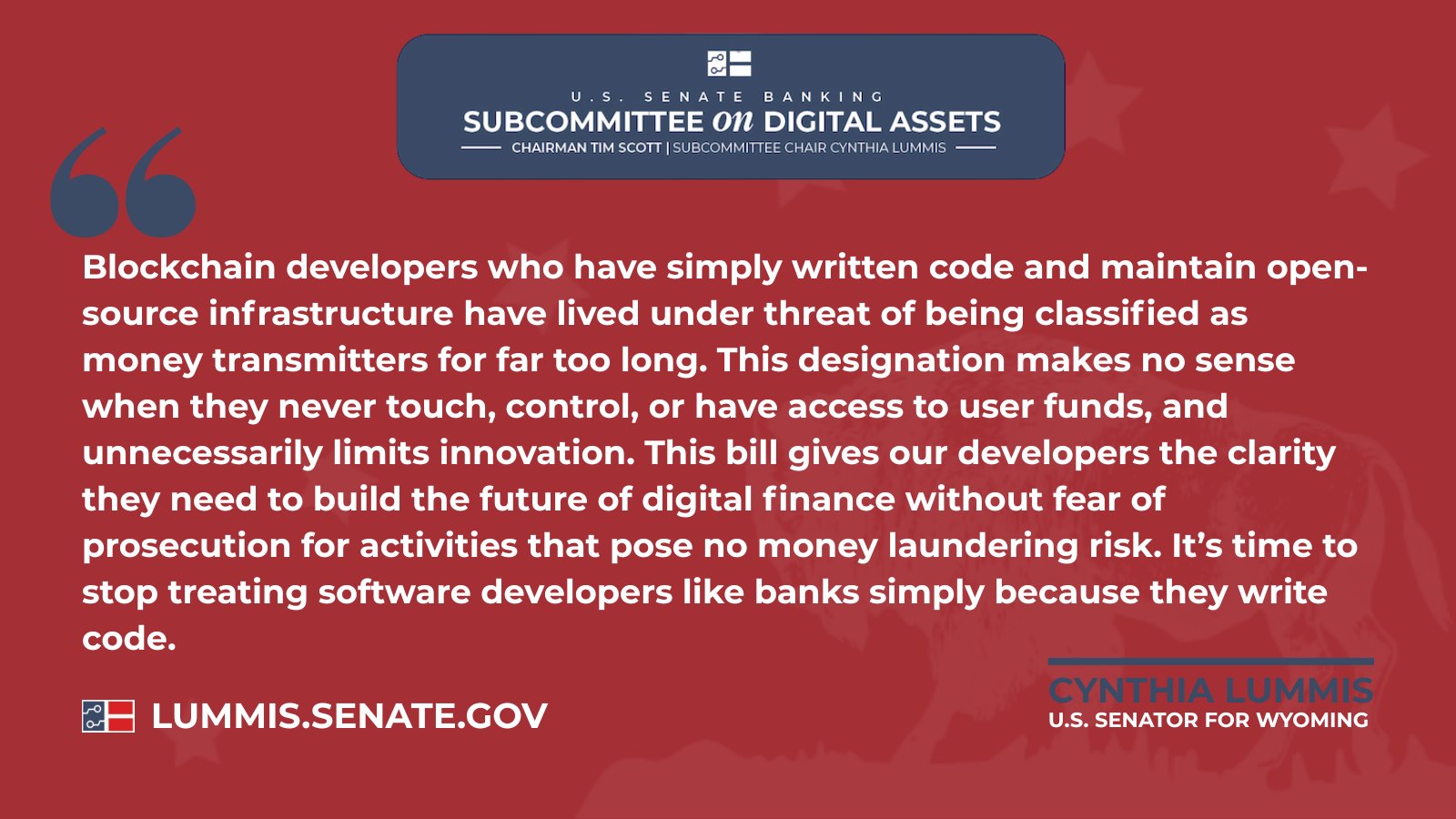
Source: X/Cynthia Lummis

In a response to Senate Judiciary claims, Tim Scott’s spokesperson, Jeff Naft, told Politico that BRCA falls within the Banking Committee and added,

“The Chairman (Scott) remains committed to protecting software developers while ensuring that law enforcement has the necessary tools to prosecute actual illegal money transmission operations.”

Uncertainty rocks crypto bill

The bill’s progress hit a roadblock after Coinbase withdrew support, citing ‘too many issues’ including a ban on stablecoin rewards.

Coinbase’s CEO Brian Armstrong’s “no bill, better than bad bill” stance has left the industry divided, intensifying uncertainty on the bill’s way forward.

That said, White House was reportedly unhappy with Coinbase’s move, calling it a ‘rug-pull’ against the entire industry.

According to reporter Eleanor Terrett, citing an insider, the White House will also pull support if Coinbase does come back to negotiations, adding that,

“This is President Trump’s bill at the end of the day, not Brian Armstrong’s”

It remains to be seen whether the bill will regain momentum in the coming days.


Final Thoughts

  • Senate Judiciary pressed for rejection of DeFi software developer exemptions to strengthen DoJ oversight in the space.
  • The White House reportedly warned Coinbase to return to negotiations or risk losing support.

Domande pertinenti

QWhat specific concern did the Senate Judiciary Committee raise about the CLARITY Act?

AThe Senate Judiciary Committee raised concerns that the bill would exempt some DeFi software developers from financial licensing requirements for money-transmitting businesses, which they argue would 'weaken' the federal criminal code and create oversight gaps.

QWhich specific legal titles did the Judiciary Committee argue were being weakened by the proposed exemptions?

AThe Judiciary Committee argued that the exemptions would weaken critical portions of Titles 18 and 31 of the U.S. Code, which fall under their jurisdiction.

QWhat is the purpose of the Blockchain Regulatory Certainty Act (BRCA) section added to the broader crypto bill?

AThe Blockchain Regulatory Certainty Act (BRCA) aims to protect software developers from what lawmakers describe as 'unfair' prosecution by shielding them from liability under the Bank Secrecy Act and criminal law, provided they don't control funds or transactions.

QWhy did Coinbase withdraw its support for the crypto bill?

ACoinbase withdrew its support for the bill citing 'too many issues,' including a proposed ban on stablecoin rewards.

QWhat was the White House's reported reaction to Coinbase's withdrawal from the bill negotiations?

AThe White House was reportedly unhappy with Coinbase's move, calling it a 'rug-pull' against the entire industry, and warned that they would also pull support if Coinbase did not return to negotiations.

Letture associate

Within Strategy's Framework, STRC's Dividend Yield Remains at 12% as Share Price Stays Below Par Value

Michael Saylor, Executive Chairman of Strategy (MSTR), confirmed that the dividend rate for its STRC perpetual preferred shares will remain at 12.00% through August 2026. The rate has increased from 9% at its July 2025 launch to the current high via a "ratchet" mechanism, which permanently raises the rate by 0.5% whenever the share price falls below $95. This mechanism is intended to push the price back toward its $100 par value and support Strategy's "at-the-market" (ATM) program for issuing new shares to fund Bitcoin purchases. However, the mechanism has not worked as intended. STRC shares closed at $89.46 on July 31, remaining about 10-11% below par value despite the record-high dividend. Competition from rival Strive's higher-yielding SATA securities has pressured demand. The persistent discount has forced Strategy to suspend new STRC issuances via its ATM program, limiting this funding channel for Bitcoin acquisitions. STRC's struggles reflect Bitcoin's own volatility, as the preferred shares historically move in tandem. Analysts have warned the ratchet structure carries long-term, one-way risk. A law firm is investigating Strategy's ability to maintain dividend payments if Bitcoin's price stays low. Retail investors own roughly 83% of outstanding STRC shares, a group seen as prone to panic selling during downturns. In response, Strategy has established financial reserves, including a liquidity cushion covering about 26 months of dividend/interest obligations, and a $2 billion share buyback program alongside a Bitcoin monetization framework, though the company emphasized it is not obligated to sell any Bitcoin.

cryptonews.ru7 min fa

Within Strategy's Framework, STRC's Dividend Yield Remains at 12% as Share Price Stays Below Par Value

cryptonews.ru7 min fa

Analyst: Bitcoin's Price Will Drop to $60k in August, Then Rebound to $70k

Financial analyst Andrey Poroshin has provided a new forecast for Bitcoin's price dynamics in August. Poroshin, an analyst at the Bitbanker exchange, expects the cryptocurrency market to experience a downturn this month, with prices retesting the $60,000 level due to a lack of supportive macroeconomic catalysts. He noted that the recent US Federal Reserve decision to hold interest rates did not significantly impact the market, while inflation remains above the 2% target. Poroshin stated that Bitcoin is ending July under pressure from moderate volatility and a lack of new macroeconomic stimuli, leading to continued market caution. According to his base scenario, Bitcoin will drop to a range of $60,000 to $62,000 before recovering to $70,000. He pointed out that even $70,000 remains below the cost of mining in the US, which has prompted some miners to shift towards AI data center operations. Poroshin cited the winding down of BitMEX's operations as a potential catalyst for a price rebound, suggesting the exit of weaker players often coincides with market reversals and reduced short-term selling pressure. He believes Bitcoin is currently less susceptible to geopolitical shocks, such as the Iran-US conflict, and does not expect significant market changes in August related to the pending CLARITY Act. Looking ahead, Poroshin forecasts that September will bring more active price fluctuations driven by potential Fed rate decisions and possible discussions or approval of the CLARITY Act.

cryptonews.ru7 min fa

Analyst: Bitcoin's Price Will Drop to $60k in August, Then Rebound to $70k

cryptonews.ru7 min fa

Trading

Spot
活动图片





