Semiconductors up 78% annually, software down 12% annually: The 'Liquidity Siphon' is playing out within tech stocks

marsbitPubblicato 2026-05-26Pubblicato ultima volta 2026-05-26

Introduzione

Semiconductor ETFs like SOXX have surged 78.5% year-to-date, while software ETFs like IGV have dropped 12.5%, creating a record performance gap exceeding 90 percentage points. This reflects a major "liquidity suction" within tech stocks, with capital flooding into semiconductors as software faces selling pressure. Driving the semiconductor boom are staggering capital expenditure plans from hyperscalers like Microsoft, Alphabet, Amazon, and Meta, whose combined 2026 capex is projected near $700 billion. This fuels demand for chips, with companies like SanDisk (up 426%), Intel (up 222%), and Micron (up 154%) leading the S&P 500. In contrast, major software firms like Microsoft, Adobe, and Salesforce are all down over 17% year-to-date. The software sector faces a dual challenge: capital is being redirected to semiconductors, and the rise of AI agents like Claude Code threatens traditional SaaS business models, triggering a narrative of AI displacement. Key unanswered questions remain: How long can hyperscalers sustain their massive capex, given potential free cash flow pressures? And will capital eventually rotate back into the deeply oversold software sector? While some analysts warn of a potential semiconductor bubble akin to the dot-com era, the sector's powerful momentum continues, making market timing exceptionally difficult.

Author: Claude, Deep Tide TechFlow

Deep Tide Introduction: The Semiconductor ETF (SOXX) has surged 78.5% year-to-date, while the Software ETF (IGV) has fallen 12.5% over the same period, creating a performance gap of over 90 percentage points, a historically extreme level.

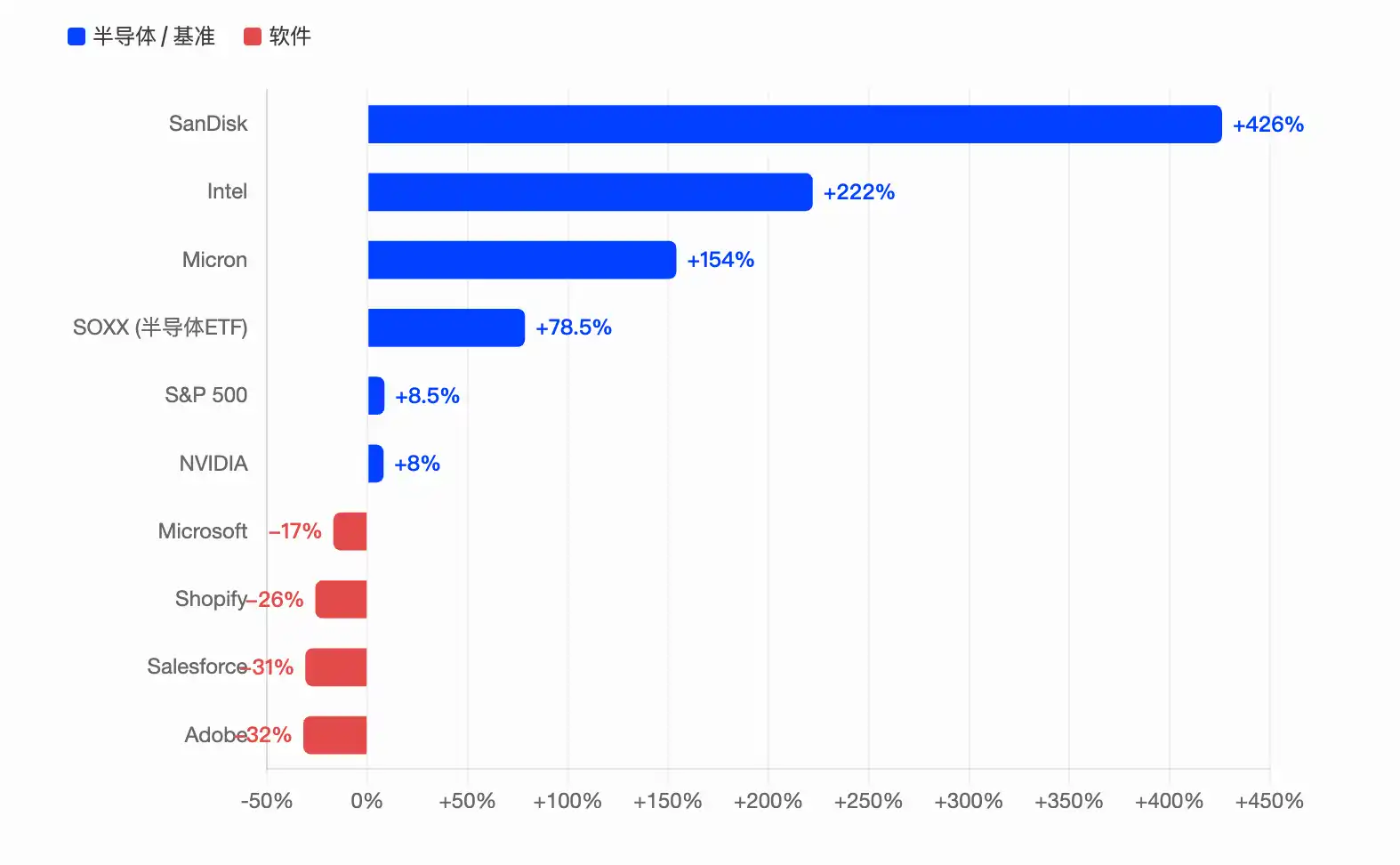
SanDisk leads the S&P 500 with a 426% annual gain, Intel has tripled, Micron is up 154%, while Microsoft, Adobe, and Salesforce have all dropped more than 17% year-to-date. The four hyperscale compute companies' combined capital expenditures for 2026 are nearing $700 billion. Capital is pouring into the chip supply chain like a black hole, while the software sector faces a double squeeze from AI displacement narratives and fund outflows.

Recently, a hot post on the Reddit investment forum overseas stated that semiconductor stocks are "basically a black hole sucking everything else in," which resonated widely.

Data confirms this intuition. As of the May 22nd close, the iShares Semiconductor ETF (SOXX) has returned 78.5% year-to-date, while the iShares Expanded Tech-Software ETF (IGV) has returned -12.5%. Two ETFs belonging to the same broad technology category show a year-to-date performance gap exceeding 90 percentage points.

According to Tickeron statistics, all software stocks in the S&P 500 are currently trading below their 200-day moving averages, while about 89% of semiconductor stocks remain above their 200-day moving averages. Both sectors fell in sync to the zero line during the 2022 bear market, after which their trajectories completely diverged. This split was not gradual but explosive.
SanDisk up 426% leads S&P 500, Intel's triple gain crushes AMD

The numbers are even more dramatic at the individual stock level.

According to Benzinga Pro data, SanDisk (SNDK) has risen about 426% year-to-date, making it the best-performing stock in the S&P 500 in 2026, following a 559% surge in 2025. This storage chip company, spun off from Western Digital, has seen NAND flash prices rise over 200% year-over-year driven by AI, with March quarter revenue growing 250% to $5.95 billion and non-GAAP gross margins reaching a high 78.4%.

According to 24/7 Wall Street, Intel (INTC) has risen about 222% year-to-date to $225, doubling AMD's gain. Intel's rebound comes from an extremely low base, coupled with progress on its 18A process node, rumors of Apple foundry orders, and yield improvement data disclosed by CEO Patrick Gelsinger in a CNBC interview. Short sellers have been severely squeezed; according to S3 Partners data, since the March 30th low point, Intel's market cap has increased over $440 billion, resulting in paper losses exceeding $12 billion for short sellers.

Micron (MU) has risen about 154% year-to-date, with a cumulative gain of 661% over the past 12 months. Earnings support this move; for the fiscal 2026 second quarter, revenue was $23.9 billion, up 196% year-over-year, with adjusted earnings per share of $12.20, far exceeding market expectations of $9.21. DRAM accounted for 79% of total revenue, with High Bandwidth Memory (HBM) being a key driver. SK Hynix Chairman Chey Tae-won even predicted that the memory chip shortage could last until 2030.

In contrast, NVIDIA (NVDA), the true "money printer" of AI compute, has risen about 8% to $15 year-to-date, performing far worse than the aforementioned second-tier semiconductor companies. According to The Motley Fool, NVIDIA's current forward P/E ratio is about 21.5x, almost on par with the S&P 500's 20.3x. This means the market is no longer paying a growth premium for NVIDIA; capital is instead flowing towards chip companies with lower valuations and greater potential upside.
$700 Billion in Capex: The Hyperscale Compute Companies' 'Arms Race'

Behind the semiconductor surge is real money.

According to data compiled by the Financial Times and multiple institutions, the combined capital expenditures for 2026 by the four hyperscale compute companies—Microsoft, Alphabet (Google's parent), Amazon, and Meta—are projected to be between $650 billion and $725 billion, nearly doubling from about $410 billion in 2025. This represents the largest concentrated infrastructure investment cycle in tech history.

According to Tom's Hardware, Jefferies analyst Brent Thill stated bluntly: "The AI economy is healthy. The bear thesis is garbage."

Specifically: Amazon leads with a single-quarter capex of $44.2 billion, with AWS growing 28%; Alphabet's Q1 capex was $35.67 billion, doubling year-over-year, with Google Cloud backlog jumping above $460 billion; Microsoft's calendar 2026 capex is projected at $190 billion, with about $25 billion attributed to price increases in memory chips and components; Meta raised its full-year capex guidance to $125-$145 billion.

According to statistics from Om Malik's blog, three of the hyperscale compute companies recorded significant non-cash investment gains in their Q1 earnings: Alphabet recorded $36.8 billion (primarily from Anthropic equity appreciation), Amazon recorded $16.8 billion, and Microsoft recorded $5.9 billion (from OpenAI). While capital expenditures are burning cash fiercely, the AI investment targets themselves are also appreciating.

Software Stocks Slaughtered by AI Displacement Narrative, IGV Posts Worst Drop Since 2008

The other side of the coin is the brutal collapse of software stocks.

According to The Motley Fool, after Anthropic released Claude Code in early 2026, the software sector experienced a sharp decline—the market's logic was not to reward AI innovation but to punish those SaaS companies potentially displaced by AI. IGV recorded its largest drop since 2008 at one point.

As of late May, Microsoft is down about 17% year-to-date, Adobe down about 32%, Salesforce down about 31%, and Shopify down about 26%. The S&P 500 Software & Services Index is about 21% below its 200-day moving average, the largest such deviation since June 2022. According to Goldman Sachs and other institutional data, short positions in mid-to-large software companies have surged sharply over the past three months, with cybersecurity and SaaS companies being the most heavily targeted areas for shorts.

Two layers of logic underlie this divergence. The first is direct capital siphoning: market liquidity is finite. When $700 billion in capex pushes chip stocks into parabolic moves, capital must be withdrawn from somewhere. As the author of that Reddit post said: "Fundamentally decent software companies just sit there or bleed slowly, while the semiconductor index goes vertical."

The second is a revaluation of the narrative. The rapid evolution of AI agents is prompting the market to re-evaluate the moats of SaaS business models: when AI can automate programming, form-filling, and customer service, how long can subscription models based on per-seat fees last? The Motley Fool points out that software companies likely to survive will need features like real data, proprietary workflows, and deep customer integration that are difficult for AI to replicate.

Cycle Peak or Structural Shift? Two Key Questions Remain Unanswered

That Reddit user ended the post with two questions, representing investors' ultimate doubts about whether the semiconductor rally can persist.

However, these two questions remain unanswered.

First: How long can the hyperscale compute companies' capital expenditures be sustained?

According to CNBC, Pivotal Research projects Alphabet's 2026 free cash flow will plunge nearly 90% from $73.3 billion in 2025 to $8.2 billion. Of Microsoft's $190 billion annual capex, $25 billion is consumed just by price increases in memory chips and components. These companies are betting future profits on AI revenue that has not yet fully materialized.

Second: Is software the next rotation target?

According to Bank of America's Chief Investment Officer Hartnett's previous judgment in the Flow Show report, software is one of the best contrarian long positions for Q2 2026, given the extreme deviation of the sector relative to its 50-day and 200-day moving averages.

However, this does not mean the semiconductor rally is over. The Philadelphia Semiconductor Index (SOX) recorded a historic streak of 18 consecutive daily gains on April 25th, rising about 45% during that period. According to Intellectia analysis, some veteran analysts are beginning to compare the current move to the 1999-2000 internet bubble, warning of a potential 25% to 30% correction. But SOX has been up in 22 of the past 23 trading days, setting 15 intraday record highs; this momentum is itself a signal.

As that Reddit user said: "I don't want to call a top because I've been slapped in the face too many times before. But the extreme concentration of gains in a single sector is starting to smell like the late stages of a cycle."


Domande pertinenti

QWhat is the central theme of the article regarding the performance of tech stocks in 2026?

AThe central theme is a 'liquidity siphon' or 'black hole' effect within tech stocks, where capital is being aggressively pulled from software stocks and funneled into the semiconductor sector, creating a historic performance gap.

QWhich two ETFs are highlighted to demonstrate the extreme divergence between the semiconductor and software sectors?

AThe iShares Semiconductor ETF (SOXX) and the iShares Expanded Tech-Software ETF (IGV) are highlighted. SOXX was up 78.5% year-to-date, while IGV was down 12.5%, a gap exceeding 90 percentage points.

QWhat is driving the massive capital expenditure from the 'hyperscale' companies, and what is the estimated total for 2026?

AThe massive capital expenditure is driven by the AI infrastructure 'arms race'. The combined capex of Microsoft, Alphabet (Google), Amazon, and Meta is estimated to be between $650 billion and $725 billion for 2026, nearly double the 2025 figure.

QWhat are the two main reasons given for the severe underperformance of software stocks?

AThe two main reasons are: 1) Direct liquidity siphoning, where funds flow from software into the surging semiconductor sector. 2) A valuation narrative shift, where AI's capabilities (like automated coding) threaten the traditional SaaS subscription business model, raising questions about its long-term viability.

QWhat two critical unresolved questions about the market trend does the article present at the end?

AThe two unresolved questions are: 1) How long can the hyperscale companies sustain their enormous capital expenditures? 2) Is software poised to become the next sector for a rotational rally, or is the semiconductor momentum still strong?

Letture associate

ETH Bull and Bear Views Compilation: Can Ethereum's Value Flow Back to ETH?

Titled "ETH Bull and Bear Views: Can Ethereum's Value Flow Back to ETH?", this article synthesizes the current heated debate around Ethereum's native token, ETH, following Bankless co-founder David Hoffman's decision to sell his entire ETH holdings. The **bullish case**, represented by figures like Tom Lee (BitMine CEO) and Raoul Pal, argues that ETH's core thesis remains intact. They contend Ethereum is the essential, secure, and neutral foundational layer for future finance—encompassing stablecoins, RWA, DeFi, L2s, and Agentic AI. Bulls bet on ETH's long-term revaluation as institutional adoption of on-chain finance grows, with significant buying activity from entities like BitMine and Consensys cited as evidence. Conversely, the **bearish perspective**, led by Hoffman and analysts like Markus Thielen, questions ETH's value capture mechanism. They acknowledge Ethereum's network success but argue that the value created by L2s, DeFi, and applications does not sufficiently accrue to the ETH token itself. Bears point to ETH's prolonged underperformance versus the broader crypto market, lack of traditional cash flows, weakening "ultrasound money" narrative, and apparent institutional retreat (e.g., Harvard Management Company exiting its ETH ETF position) as key concerns. The debate highlights a pivotal shift: ETH is no longer just a community belief asset. The central question is whether ETH can transition from being a "**used infrastructure**" to a "**continuously bought and held core asset**" as more value enters the Ethereum ecosystem. The market is now critically examining the direct link between network growth and ETH's value.

marsbit36 min fa

ETH Bull and Bear Views Compilation: Can Ethereum's Value Flow Back to ETH?

marsbit36 min fa

Crypto is dead, Perps are forever

The crypto industry is shifting from a focus on creating native assets (like altcoins and protocol tokens) to becoming a "global asset pipeline." Native cryptocurrencies, except for Bitcoin, are seen as failing in their value storage and utility promises, with demand driven largely by speculation. Attention and liquidity are now moving toward real-world assets (RWAs) like U.S. stocks, bonds, gold, and oil traded on-chain via perpetual contracts (Perps). Stablecoins like USDT and USDC set the precedent, proving blockchain's core strength is efficient global settlement and transfer, not inventing new monetary systems. Meanwhile, assets like Ethereum and many DeFi tokens struggle as their narratives weaken against tangible traditional assets and the rapid real-world progress of AI. Perpetual contracts have emerged as a pivotal innovation. They simplify trading by offering pure price exposure to any asset, bypassing complexities of ownership, custody, and traditional market hours. Projects like Hyperliquid gained traction by combining CEX-like efficiency with on-chain transparency, capitalizing on post-FTX distrust, macroeconomic volatility, and the surge in demand for 24/7 stock trading. In conclusion, while the era of speculative native "crypto assets" may be over, perpetual contracts persist as the industry's most potent financial instrument—transforming all assets into globally accessible, constantly tradable instruments centered on price speculation.

marsbit41 min fa

Crypto is dead, Perps are forever

marsbit41 min fa

Tencent, Alibaba, ByteDance in a Battle for the Skill Store

Skill is becoming a key concept in the AI field, essentially serving as a structured "instruction manual" for AI Agents that specifies tool calls, decision logic, and output standards. This allows Agents to execute predefined tasks. As the number of Skills grows, distribution platforms have emerged. Major tech companies are swiftly entering this space. In March, Tencent, Alibaba, and ByteDance launched Skill stores within their respective Agent platforms. Subsequently, players like Zhipu AI, Meituan, and Xiaohongshu joined the fray. This competition for the "Skill store" is fundamentally a battle for the AI-era user entry point; whoever controls distribution controls the users. While ByteDance's Coze has experimented with paid Skills, most platforms offer them for free. The real value lies not in the stores themselves but in using them to attract and retain users within an ecosystem, driving revenue from services like cloud computing, model calls, or advertising. The landscape features three main player types: 1) **Internet giants** (e.g., Alibaba, ByteDance, Tencent, Meituan), leveraging Skills to drive traffic and monetize through their broader ecosystems (cloud services, transactions, ads). 2) **Large model companies** (e.g., Zhipu AI, Moonshot AI), using Skill stores to increase user engagement and monetize model API calls. 3) **Content platforms** (e.g., Xiaohongshu), treating Skills as a new content format to generate traffic and ad revenue. However, transforming Skill stores into a sustainable business faces significant hurdles. Key challenges include: the **difficulty in pricing Skills** due to inconsistent outputs across different models and contexts; **lack of cost transparency** (varying token consumption); **security risks** like Skill poisoning; and the **absence of standardized protocols** for development and evaluation. Unlike standardized mobile apps, Skills are often personalized workflows resistant to uniformity, which hinders the establishment of a reliable review and monetization system akin to the App Store. While there is genuine user demand for paid Skills—particularly in enterprise (e.g., contract review) and certain personal productivity scenarios—current platforms offer developers limited and unpredictable distribution. The future of Skill stores depends on overcoming these standardization, evaluation, and safety challenges to make acquiring a Skill as straightforward as downloading an app. For now, the stores function more as display shelves than robust marketplaces.

marsbit41 min fa

Tencent, Alibaba, ByteDance in a Battle for the Skill Store

marsbit41 min fa

The Crypto Scene Is Dead, Perpetual Swaps Are Eternal

The crypto industry is undergoing a fundamental shift. The era defined by minting novel, native digital assets (altcoins) is fading. These assets, lacking real-world cash flows or clear value, are losing relevance as attention and capital flow elsewhere. Two powerful external forces are reshaping the space. First, traditional assets like U.S. stocks, bonds, gold, and oil are being tokenized and traded on-chain. Second, the explosive growth of AI, with its tangible products, has overshadowed crypto's once-dominant "future narrative." This marks a critical pivot: crypto is transitioning from being a "factory for new assets" to becoming a "global conduit for existing assets." Its validated utility is not complex financial reinvention but efficient global settlement, transfer, and trading—the original promise of blockchain. Stablecoins like USDT and USDC exemplify this, offering faster dollar movement rather than replacing it. Consequently, native ecosystems like Ethereum face profound challenges. While still crucial infrastructure, ETH struggles to capture value as users interact with Layer 2s or trade traditional assets without needing to hold it. DeFi's grand narrative of rebuilding finance has narrowed to core needs like cheap transfers and deep liquidity. The true breakout innovation is the perpetual contract (Perp). It brilliantly bypasses the complexities of direct asset ownership (custody, compliance, dividends) by creating pure price exposure. Users can speculate on the price movement of *any* asset—NVIDIA, gold, oil—24/7, globally, and with leverage. This "price casino" model, while risky and ethically fraught, delivers unmatched liquidity and accessibility. Projects like Hyperliquid succeeded not by inventing new mechanics but by perfecting the timing and execution of this model. Key drivers included making on-chain Perps feel like centralized exchanges, post-FTX trust migration towards transparency, and rising demand to trade macro assets and equities round-the-clock. In conclusion, the crypto world's most enduring successes are the dollar (via stablecoins), Bitcoin, and trading. Its new frontier is not creating alternative assets but providing a seamless, perpetual trading layer—a new API—for the world's existing financial system. The age of native altcoins is over; the age of perpetual synthetic exposure has begun.

Odaily星球日报50 min fa

The Crypto Scene Is Dead, Perpetual Swaps Are Eternal

Odaily星球日报50 min fa

Trading

Spot
Futures
活动图片




