SEI jumps 10% after zero-fee rollout: But this rise may not last

ambcryptoPubblicato 2026-04-02Pubblicato ultima volta 2026-04-02

Introduzione

Sei's price surged over 10% in 24 hours following the integration of zero-fee swaps on platforms like MetaMask, Backpack, and YeiFinance, which removed gas costs and improved accessibility. Trading volume increased by 258%, indicating strong organic participation. However, SEI remains within a descending channel, facing resistance near $0.062 and $0.070. While RSI rebounded from oversold conditions, it stayed below the midline, showing limited bullish strength. Additionally, Total Value Locked (TVL) dropped 7.32% to $43.2 million, contrasting with the price increase and raising concerns about the rally's sustainability. The current structure suggests potential downside movement toward $0.048 before any stable upward continuation.

Sei has integrated zero-fee swaps across MetaMask, Backpack, and YeiFinance, removing gas costs and lowering barriers for users. This shift improves accessibility, which was directly reflected in market behavior as SEI gained over 10% in 24 hours.

Trading volume has surged by more than 258%, showing a sharp rise in participation rather than isolated buying. Users can now interact across multiple wallets without friction, showing that transaction activity supported organic demand rather than speculative spikes.

Can SEI break descending pressure?

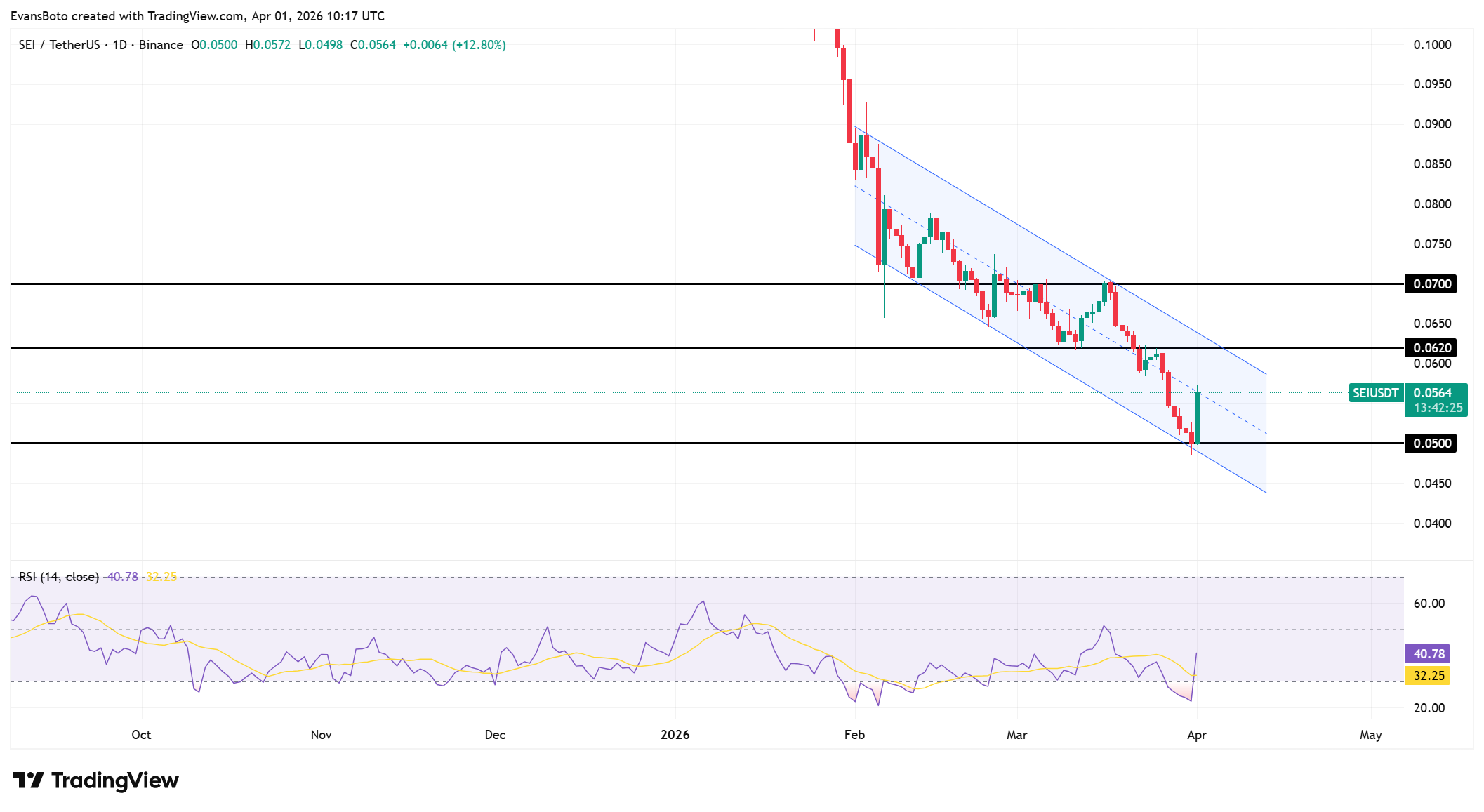
SEI rebounded from the $0.050 support level after an extended decline, showing clear buyer interest at this demand zone.

The token traded within a descending channel at the time of writing, which continued to define the broader structure.

Although the rebound has pushed SEI toward mid-range levels, resistance near $0.062 and $0.070 still capped upside movement. This structure reflected controlled recovery rather than a confirmed reversal.

As price attempted to climb, each rejection within the channel reinforced SEI’s bearish pressure. However, holding above $0.050 will prevent a further breakdown.

A sustained push beyond the channel would be required to shift structure, yet current positioning still reflects compression under resistance.

RSI has rebounded from oversold conditions and sat around 40.78 at the time of writing, reflecting easing sell pressure after the recent drop. However, RSI remained below the midline, which limited confirmation of bullish strength.
Source: TradingView

TVL drop questions rally strength

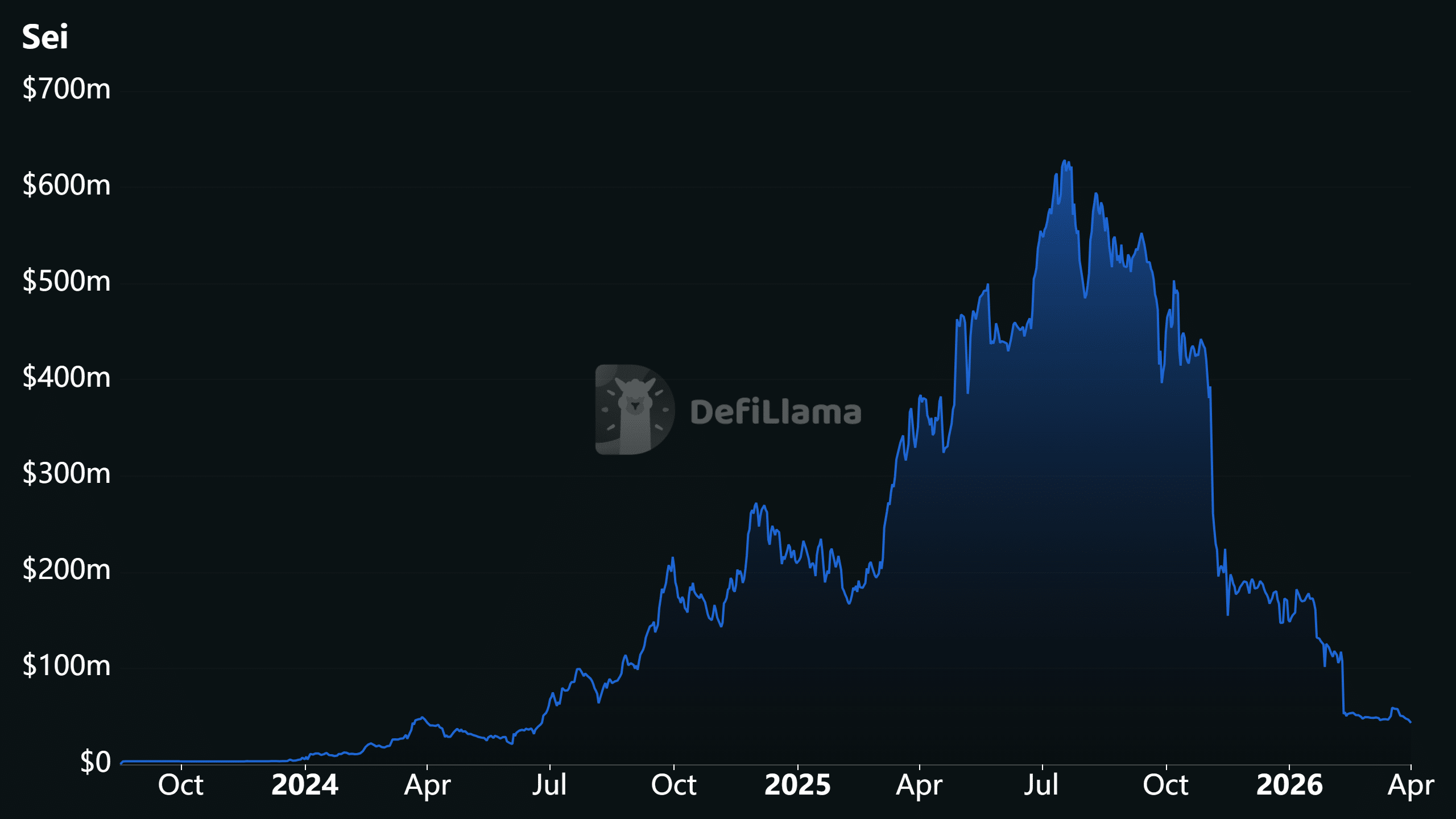
SEI’s Total Value Locked stood at $43.2 million at press time after declining by 7.32% over the past 24 hours. This drop contrasted sharply with the rising price and increased trading activity.

While price and volume suggested growing interest, declining TVL indicated that capital within the network had reduced. This divergence raised concerns about the sustainability of the current move.

If network value does not expand alongside price, the rally risks relying on short-term participation rather than long-term commitment. However, accessibility improvements from zero-fee swaps could eventually attract new liquidity.

For now, the mismatch between TVL and price reflects an imbalance that weakens the foundation of the ongoing recovery.
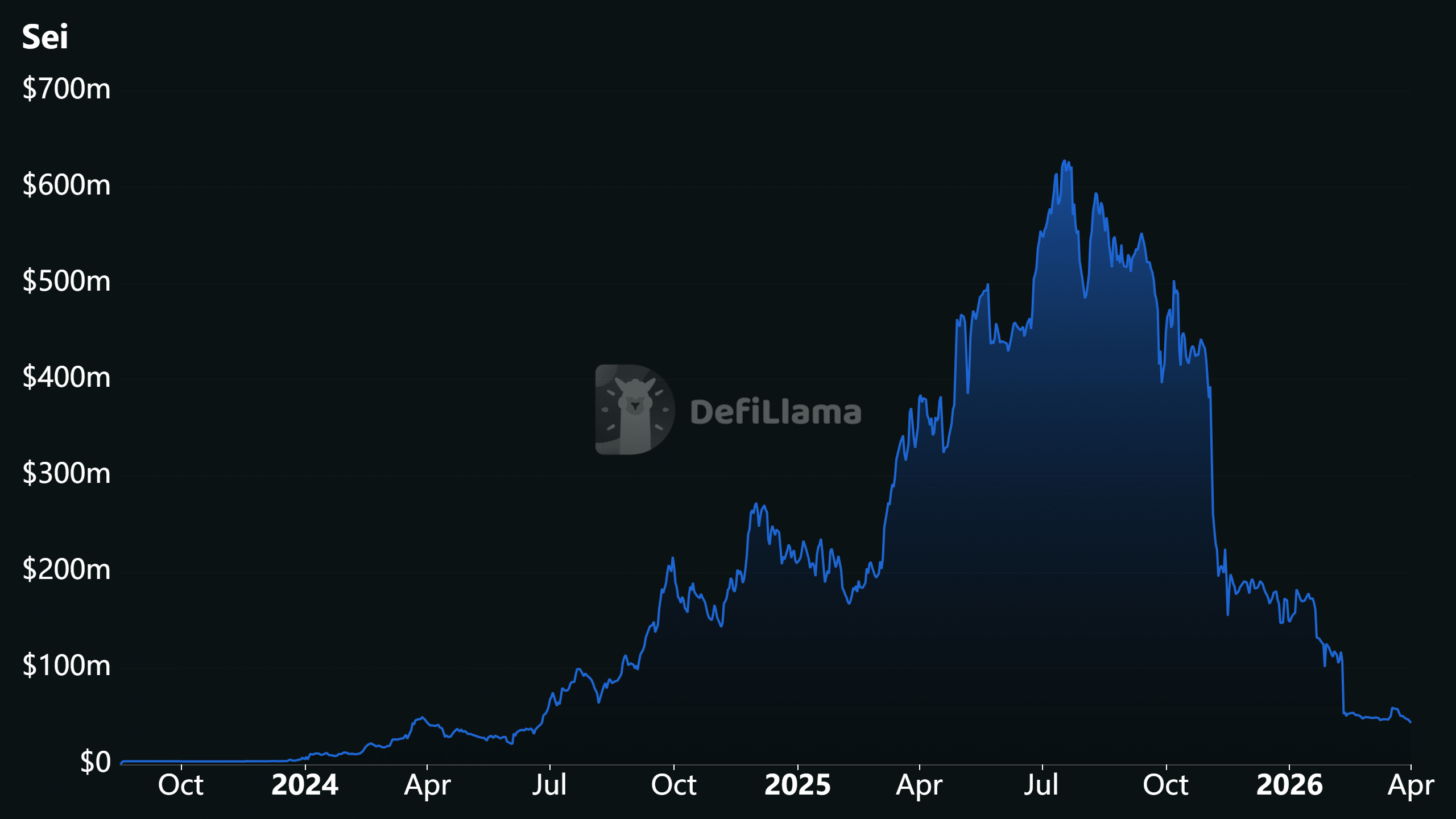
Source: DefiLlama

To sum up, Sei’s utility expansion has improved accessibility and driven strong participation, yet structural pressure remains intact within the descending channel.

The RSI recovery supports a short-term bounce, though it does not confirm dominance. Meanwhile, declining TVL has weakened the rally’s foundation.

As a result, the current setup favors a downside sweep toward $0.048 before any stable upward continuation.


Final Summary

  • Zero-fee utility improves demand structure, yet price still reacts to liquidity imbalances rather than sustained capital inflows.
  • LIT’s recovery remains fragile despite improving short-term participation signals.

Domande pertinenti

QWhat was the immediate market reaction to Sei's rollout of zero-fee swaps on major wallets?

AThe immediate market reaction was positive, with the price of SEI gaining over 10% in 24 hours and trading volume surging by more than 258%.

QAccording to the technical analysis, what key price level must SEI hold above to prevent a further breakdown?

ASEI must hold above the $0.050 support level to prevent a further breakdown.

QWhat concerning on-chain metric diverged from the price increase, raising questions about the rally's strength?

AThe Total Value Locked (TVL) on the network declined by 7.32% to $43.2 million, which contrasted with the rising price and created a divergence that weakened the rally's foundation.

QWhat does the RSI level of 40.78 at the time of writing indicate about the market momentum?

AAn RSI of 40.78 indicates that sell pressure has eased after recent oversold conditions, but it remains below the midline (50), limiting confirmation of strong bullish momentum.

QWhat is the overall conclusion of the article regarding the sustainability of SEI's price rise?

AThe overall conclusion is that the current setup is fragile and favors a downside sweep toward $0.048 before any stable upward continuation can occur, due to structural bearish pressure and a decline in TVL.

Letture associate

The Foundation of SpaceX's Trillion-Dollar Valuation: Who is Dividing Up Musk's Annual Tens of Billions in Capital Expenditure?

SpaceX's trillion-dollar valuation is built on its three core businesses: Starlink (profitable, 60% of revenue), rockets (driving down launch costs), and AI (a major investment area). This creates a financial cycle: Starlink funds rocket development, which enables low-cost launches for AI hardware, generating future revenue. This cycle fuels annual capital expenditures of tens of billions, flowing to a vast supply chain. Suppliers are categorized by their replaceability. The first group includes irreplaceable players like NVIDIA (GPU/CUDA ecosystem), Eutelsat (critical radio spectrum), Filtronic (specialized amplifiers), Materion (strategic beryllium), and STMicroelectronics (antenna chips). The second group consists of hard-to-replace suppliers due to high switching costs, such as Honeywell (flight control), Carpenter Technology (specialty alloys), Hexcel (carbon fiber), Broadcom (data exchange), and Linde (industrial gases). The third group comprises high-volume, cost-critical suppliers for mass-produced items like Starlink terminals. Key names include Wistron NeWeb (primary manufacturer) and several A-share companies like Shenzhen Sunway (connectors), Pies New Materials (forgings), Western Superconducting (alloys), and Yingliu (castings). Other niche players include Trimble (timing), Astronics (power distribution), and CTS (thermal management). The article argues that investing in these suppliers, rather than SpaceX stock directly, offers an alternative opportunity. The rationale is threefold: procurement is just beginning to scale, SpaceX's IPO brings new transparency to its supply chain, and the situation mirrors early stages of past "super terminal" ecosystems like Apple or Tesla. While risks exist (commodity cycles, geopolitical factors, technology shifts), the core thesis is that SpaceX's massive, ongoing procurement will translate into reliable revenue for its key suppliers, regardless of its own stock price volatility.

marsbit45 min fa

The Foundation of SpaceX's Trillion-Dollar Valuation: Who is Dividing Up Musk's Annual Tens of Billions in Capital Expenditure?

marsbit45 min fa

SpaceX's Trillion-Dollar Valuation Base: Who's Sharing in Musk's Annual Tens of Billions in Capital Expenditure?

**Title: The Foundation of SpaceX's Trillion-Dollar Valuation: Who Benefits from Musk's Annual $100 Billion Capital Expenditure?** This article argues that investors seeking to benefit from SpaceX's growth might find greater opportunities in its supply chain rather than directly investing in the company itself, drawing parallels to historical successes with Apple, Tesla, and NVIDIA suppliers. **SpaceX's Business Model & Cash Flow:** SpaceX generates revenue from three main areas: 1. **Starlink:** Its profitable core, earning $11.3B in 2023 (60% of revenue), funding other ventures. 2. **Rockets (Falcon/Starship):** Requires $3B+ in annual R&D but achieves the world's lowest launch costs. 3. **AI:** Currently unprofitable (-$6B+ in 2023), investing heavily in ground-based supercomputers (220,000 GPUs) and future orbital data centers. The cycle is: Starlink profits → fund cheaper rockets → low-cost launches deploy AI hardware → AI compute rentals generate future revenue. This cycle drives annual procurement spending of tens of billions of dollars. **The Supply Chain Beneficiaries:** Suppliers are categorized by their replaceability: **1. Nearly Irreplaceable (High Barriers to Entry):** * **NVIDIA:** Powers the Colossus supercomputer; its CUDA ecosystem creates immense switching costs. * **Eutelsat (SATS):** Controls critical radio spectrum for satellite communications; holds a ~3% stake in SpaceX. * **Filtronic (FTC):** Supplies millimeter-wave signal amplifiers for Starlink satellites; SpaceX constitutes 83% of its revenue. * **Materion (MTRN):** Global leader in beryllium production, a strategic material used in Starship structures. * **STMicroelectronics (STM):** Supplies phased-array antenna chips for Starlink satellites. **2. Replaceable, but Switching Cost is Prohibitively High:** * **Honeywell (HON):** Provides flight control and inertial navigation systems with decades of certification. * **Carpenter Technology (CRS):** Manufactures ultra-pure specialty steel alloys for Raptor engines. * **Hexcel (HXL):** Supplies custom carbon fiber composites developed over a decade with SpaceX. * **Broadcom (AVGO):** Manages high-speed data switching. * **Linde Group:** Supplies industrial gases (liquid oxygen/nitrogen) from facilities built near SpaceX launch sites. **3. High-Volume, Cost-Critical Manufacturing:** Focuses on mass-producing components like Starlink user terminals (target: 30 million units). * **Key Players:** Wistron NeWeb (6285, primary terminal manufacturer), several Chinese A-share companies (e.g., Sunway Communication, PAX New Materials, Western Metal Materials, Yingliu Co.), and smaller US firms like Trimble (TRMB, timing systems). **Why Now?** Three factors make the supply chain opportunity timely: 1. **Volume Ramp-Up:** SpaceX plans 100 launches in 2026, aims for 30 million Starlink terminals, and will deploy AI data centers, meaning procurement will accelerate. 2. **Increased Transparency:** The IPO provides public financial data, allowing investors to track supplier order growth. 3. **Historical Precedent:** The current phase is likened to Tesla's early mass-production stage (circa 2018), suggesting a long growth runway for suppliers. **Conclusion:** The article posits that while investing in SpaceX stock is betting on Elon Musk's ambitious vision at a high valuation, investing in its established suppliers is a bet on the tangible, recurring revenue from its massive procurement budget, which is largely decoupled from day-to-day stock price volatility.

链捕手49 min fa

SpaceX's Trillion-Dollar Valuation Base: Who's Sharing in Musk's Annual Tens of Billions in Capital Expenditure?

链捕手49 min fa

The U.S. Government Blocked the Anthropic Model. It Wasn't About 'Jailbreaking' at All.

Last Friday, the U.S. Commerce Department issued an enforcement letter that forced Anthropic to take its two most advanced AI models, Fable 5 and Mythos 5, offline. The stated reason was unspecified national security concerns, initially linked to potential "jailbreaks" of the models' safeguards. However, new details suggest the action stemmed more from a deteriorating relationship between the Trump administration and Anthropic, rather than a genuine technical threat. According to reports, the government cited a little-known export control regulation, compelling Anthropic to block access for all non-U.S. persons, including its own international employees. The company complied, shutting down the models without a court order or specific technical details from the government. Cybersecurity expert Katie Moussouris revealed she was privately shown a research paper detailing a potential safeguard bypass in Fable 5. She argued the described method was minor and did not warrant an export ban, stating that attempts to "fix" it would only weaken the model's defensive capabilities. Moussouris and other experts have since called for the order to be revoked, warning it dangerously removes advanced cybersecurity tools from U.S. defenders. Analysts like Justin Hendrix suggest the move appears retaliatory and sets a dangerous precedent, signaling that the U.S. government can unilaterally shut down a tech company's products. The incident has raised concerns about the reliability of American AI and the potential for political interference in the tech industry, serving as a warning to the broader sector.

marsbit53 min fa

The U.S. Government Blocked the Anthropic Model. It Wasn't About 'Jailbreaking' at All.

marsbit53 min fa

Ray Dalio: AI Bull Market Continues to Soar, Should Investors Go All In or Cash Out and Leave the Field?

In his latest notes, Ray Dalio addresses a critical question for investors amid the AI-driven stock market surge: how should one allocate assets during a transformative technological revolution? Dalio emphasizes that technological advancement does not automatically make related stocks attractive. Historical tech cycles—marked by excitement, crowding, volatility, and eventual shakeouts—show that even long-term winners like Microsoft and Apple experienced severe drawdowns. Today's AI sector faces similar uncertainties: overinvestment, intensifying competition, geopolitical tensions (e.g., Taiwan's chip supply), tax policy shifts, anti-AI sentiment, and potential disruption from future technologies like quantum computing. Dalio's core argument focuses on the highly concentrated market structure, where a few tech giants dominate major indices. He warns investors against unknowingly holding concentrated, correlated exposures. Instead of chasing a handful of AI leaders, he advocates for a robust, diversified portfolio of 15 or more high-quality, uncorrelated investments, risk-balanced to match an investor's volatility tolerance. Mathematically, such diversification significantly improves the risk-return ratio—for example, holding 15 uncorrelated assets can boost the ratio by over four times compared to a single concentrated bet. Dalio cautions that future equity returns appear low, with his bubble indicator suggesting real returns could be negative over the next 5-10 years. He stresses that knowing what you don't know is as important as knowing what you do. In an environment of high uncertainty and concentration, avoiding large, concentrated bets on AI stocks is prudent. The optimal strategy is disciplined diversification—the "holy grail" of investing—to navigate this technologically driven cycle with lower risk and comparable or better returns.

marsbit56 min fa

Ray Dalio: AI Bull Market Continues to Soar, Should Investors Go All In or Cash Out and Leave the Field?

marsbit56 min fa

Trading

Spot
Futures

Articoli Popolari

Come comprare SEI

Benvenuto in HTX.com! Abbiamo reso l'acquisto di Sei Network (SEI) semplice e conveniente. Segui la nostra guida passo passo per intraprendere il tuo viaggio nel mondo delle criptovalute.Step 1: Crea il tuo Account HTXUsa la tua email o numero di telefono per registrarti il tuo account gratuito su HTX. Vivi un'esperienza facile e sblocca tutte le funzionalità,Crea il mio accountStep 2: Vai in Acquista crypto e seleziona il tuo metodo di pagamentoCarta di credito/debito: utilizza la tua Visa o Mastercard per acquistare immediatamente Sei NetworkSEI.Bilancio: Usa i fondi dal bilancio del tuo account HTX per fare trading senza problemi.Terze parti: abbiamo aggiunto metodi di pagamento molto utilizzati come Google Pay e Apple Pay per maggiore comodità.P2P: Fai trading direttamente con altri utenti HTX.Over-the-Counter (OTC): Offriamo servizi su misura e tassi di cambio competitivi per i trader.Step 3: Conserva Sei Network (SEI)Dopo aver acquistato Sei Network (SEI), conserva nel tuo account HTX. In alternativa, puoi inviare tramite trasferimento blockchain o scambiare per altre criptovalute.Step 4: Scambia Sei Network (SEI)Scambia facilmente Sei Network (SEI) nel mercato spot di HTX. Accedi al tuo account, seleziona la tua coppia di trading, esegui le tue operazioni e monitora in tempo reale. Offriamo un'esperienza user-friendly sia per chi ha appena iniziato che per i trader più esperti.

120 Totale visualizzazioniPubblicato il 2024.12.11Aggiornato il 2026.06.02

Come comprare SEI

Discussioni

Benvenuto nella Community HTX. Qui puoi rimanere informato sugli ultimi sviluppi della piattaforma e accedere ad approfondimenti esperti sul mercato. Le opinioni degli utenti sul prezzo di SEI SEI sono presentate come di seguito.

活动图片