Seeking Alpha's Hot Article: Why Might the U.S. Stock Market Crash in June?

marsbitPubblicato 2026-06-04Pubblicato ultima volta 2026-06-04

Introduzione

In a recent Seeking Alpha article, financial professor and analyst Damir Tokic argues that the US stock market may be poised for a significant crash in June 2026. The core thesis centers on a "mega-bubble" in equities, particularly within the technology sector, which has driven the S&P 500 to near-record valuations, with a Shiller P/E ratio exceeding 40—a level comparable to the 2000 dot-com bubble. Tokic identifies two primary catalysts for a potential collapse. First, he points to unsustainable market exuberance fueled by what he terms the "Trump Stimulus"—massive AI capital expenditure by tech giants, which he believes is politically driven and cannot last. Second, and more urgently, he highlights the escalating Iran war as a critical threat. The ongoing closure of the Strait of Hormuz has created a severe global energy supply crunch. Strategic petroleum reserves are projected to hit critically low operational levels by June, potentially causing oil prices to spike above $200 per barrel and triggering a severe, supply-driven inflationary shock. This scenario, Tokic warns, would force the Federal Reserve's hand. Despite currently maintaining a dovish bias, the Fed would likely be compelled to officially pivot to a hawkish stance at its June FOMC meeting to combat soaring inflation and bond yields. He contends that such a shift—or even a failure to act, which would destroy Fed credibility—could be the trigger that punctures the market bubble. The resulting downturn, he con...

Author: Damir Tokic, Finance Professor, Seeking Alpha Analyst

Led by technology stocks, the S&P 500 is approaching its highest historical valuation, signaling the formation of a massive bubble. Simultaneously, the war in Iran is highly likely to trigger an inflationary shock, leading to a surge in oil prices and higher U.S. Treasury yields. The escalating situation seems to be increasing the probability of this pessimistic prediction becoming a reality. Despite the Fed maintaining a dovish official bias for now, the market has already begun pricing in rate hikes. Therefore, the Fed's official shift to a hawkish stance in June could very well serve as the catalyst that pricks this bubble.

President Trump attending the swearing-in ceremony for the new Federal Reserve Chair

Does the Ceasefire Only Benefit Tech Stocks?

The following shows the performance of the S&P 500 Index (SPY) over the past three months since the outbreak of the Iran war:

  • Since February 27, the S&P 500 has risen by 10%.

  • The Technology sector (XLK) has gained over 37%.

  • The second-best performer is the Consumer Discretionary sector (XLY), which rose only 3%. It's important to note that Amazon (AMZN) constitutes 27% of XLY's weighting, and its stock price has increased by 28%; Tesla (TSLA) constitutes 20% of XLY's weighting, and its stock price has risen by 8%. Both companies are essentially tech firms and members of the "Magnificent 7" (Mag 7).

So, what is the core issue now? Did the ceasefire in the Iran war provide an absolute benefit only to the tech sector, especially semiconductors (SMH)?

In my view, the answer is no. The market has blindly assumed the war is over. More importantly, it assumed we could escape an inflationary shock and the demand-destroying recession that would follow. Therefore, this became a green light for speculators to go on a rampage, re-inflating the bubble.

However, it must be pointed out that the current bubble is not like the 2000 dot-com bubble. That bubble was driven entirely by expectations and the uncontrolled expansion of P/E multiples. The 2026 bubble is much worse! It is built on "backward-looking" realized profits and the naive expectation that these profits will continue indefinitely. Specifically, the mega-cap companies have poured $770 billion into AI capital expenditures. Clearly, these profits are concentrated in the primary beneficiaries of this spending, mainly semiconductor companies like Micron Technology (MU).

However, the Shiller P/E (CAPE) ratios for 2000 and 2026 are almost neck and neck, both remaining above 40x. This means the severity of the 2026 bubble is already on par with that of 2000.

But, the profits of the tech giants cannot be sustained indefinitely. AI capital expenditure growth is likely to slow and eventually decline. When will this tipping point occur?

In my opinion, this $770 billion in AI capital expenditure can be traced back to that meeting between tech executives and President Trump early in his second term. At that meeting, President Trump, sitting next to Mark Zuckerberg, asked him how much Meta planned to spend on AI capex. Zuckerberg replied, "Sorry, I'm not prepared... I'm not sure which number you want."

Therefore, I believe that this $770 billion AI capital expenditure is essentially a 'Trump stimulus' imposed on the private sector, and it is unsustainable. If Democrats win the upcoming midterm elections, this trend is likely to reverse.

Thus, the market's euphoric reaction after the Iran war ceasefire is just part of the 'Trump stimulus' and likely represents a final blow-off rally. The question now is, where is the peak of this surge, and what will trigger the crash?
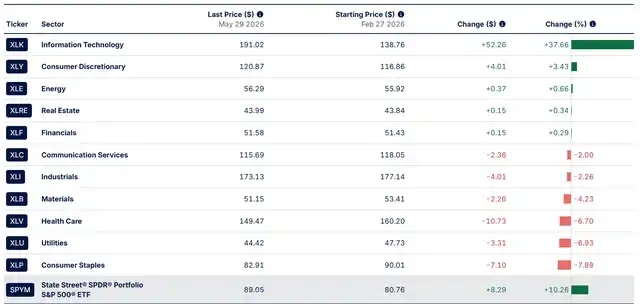
SPY Sector Performance (Data Source: SSGA.COM)

Iran War Escalation and Inflationary Shock

Now let's shift our focus back to the Iran war. This is a crucial variable because it has a high potential to trigger a classic systemic shock that could completely pop the bubble.

A classic bubble burst typically follows this trajectory: 1) Inflation accelerates, 2) The Fed raises interest rates, 3) A recession triggers a bear market.

Let's first examine inflation. Inflation can be demand-driven or supply-driven.

Demand-driven inflation is initially favorable for the market because businesses have pricing power, often accompanied by an "overheating" economy where companies initially see revenue and profit growth. The Fed then curbs demand by raising rates, but this ultimately leads to higher unemployment and a recession.

In contrast, supply-driven inflation is significantly negative for the market from the outset because businesses lose pricing power—this often occurs in a weak or stagflationary economic environment. The Fed is forced to raise rates even as the economy is weak, inevitably leading to a deeper recession.

The Iran war is triggering a destructive supply-side inflation because it is causing a global energy shortage, as well as food shortages due to fertilizer shortages and many other derivative product and chemical shortages.

Fundamentally, Iran has closed the Strait of Hormuz, and this closure has persisted for three months. During these three months, the global economy has been tapping strategic petroleum reserves to fill the lost oil gap. These reserves are expected to reach critical operational levels in June.

If Iran does not immediately reopen the Strait of Hormuz, the global economy will face its most severe energy shock ever. Due to the very real physical shortage, crude oil prices could surge to over $200 per barrel until demand is completely destroyed, leading prices to fall back down. The destruction of demand directly corresponds to a recession.

This is precisely why Trump is acutely aware of the severity of the situation. For the past two months, he has been trying to negotiate with Iran to reopen the Strait of Hormuz but to no avail.

Currently, reaching a deal with Iran seems almost impossible for three reasons:

  • First, Iran wants to retain control of the Strait of Hormuz even after reopening it, which crosses a U.S. red line;

  • Second, Iran refuses to negotiate on the nuclear issue and most likely does not want any nuclear deal, which is another U.S. red line;

  • Third, even if Trump compromises on Iran's terms to reopen the strait and reaches some deal, Israel would likely block it, as Israel sees a nuclear-armed Iran as an existential threat.

So, what is the actual situation on the ground now?

My take is that Trump's likelihood of striking a last-minute deal with Iran to prevent an inflationary shock is becoming increasingly higher.

However, Israel absolutely does not approve of such a deal. Because part of an Iran deal would involve a ceasefire on all fronts, including Lebanon. Israel could outright veto this deal by directly attacking Lebanon. For Israel, this is also an existential issue, given the very real threat posed by its neighbor, Hezbollah.

Currently, we are facing a potential for major escalation.

Reports indicate Iran has now severed all contact with the U.S., meaning all negotiations have stalled. Not only that, but Iran has also completely blockaded the Strait of Hormuz and is threatening to further close the Bab al-Mandab Strait. If this happens, over 30% of the world's energy supply would simply vanish—a true disaster.

Although Trump claims he has spoken with both Israel and Hezbollah, and even suggests negotiations with Iran are still ongoing—and just these statements have been enough to push tech stocks to new all-time highs—there has been no official confirmation of these claims to date.

The June Crash

Therefore, the probability of a crash erupting in June is becoming increasingly high. Global oil inventories will hit critical levels in June. Once they fall below that line, crude oil (CL1:COM) prices will skyrocket due to a real supply shortage, and it will become very difficult to "talk down" prices with mere words.

The consequence will be that bond yields will also soar as inflation expectations rise and fiscal concerns drive real rates higher. Moreover, when inflation spikes, trying to 'jawbone' the bond market sell-off will become futile.

Most crucially, the Federal Reserve will have to respond at its June FOMC meeting. This could very well be the final trigger that pops the bubble. Specifically, the Fed's official stance in its Summary of Economic Projections (SEP) still signals that the next move will be a rate cut, maintaining a dovish policy bias.

However, the federal funds futures market has already priced in a tightening bias. Currently, the market is pricing in over a 50% probability of one rate hike by December 2026, and potentially even two hikes.

The Fed will then be forced to align with market expectations, making an official hawkish shift at the June meeting. This alone could burst the bubble instantly. Furthermore, even if the Fed insists on maintaining a dovish bias, as it would completely lose market credibility, the 10-year Treasury yield could skyrocket, triggering an even greater systemic shock.

Investment Implications

The S&P 500's Shiller P/E ratio is approaching a new all-time high, well above 40x, forming a mega-bubble. An inflationary shock triggered by the Iran war could pop it at any moment, and the Fed's official pivot to hawkishness in June might be the fatal bullet. Investors should prepare for a major pullback, potentially as severe as the bear markets of 2000 and 2008. Remember, all bubbles eventually burst.


Domande pertinenti

QAccording to the author, why might the US stock market crash in June 2026?

AThe author posits a potential June 2026 crash due to a convergence of factors: a massive bubble in US equities, particularly in tech, driven by the 'Trump stimulus' of forced AI capital expenditure; an imminent inflationary supply shock as global strategic oil reserves hit critical levels due to the Iran war's closure of the Strait of Hormuz; and the Federal Reserve's likely official pivot to a hawkish stance at its June FOMC meeting in response, which could be the trigger that pops the bubble.

QHow does the 2026 stock market bubble differ from the 2000 dot-com bubble, as described in the article?

AThe 2026 bubble is described as worse than the 2000 bubble. While both have similarly high Shiller P/E ratios above 40, the 2000 bubble was driven by speculation and multiple expansion on future expectations. In contrast, the 2026 bubble is built on 'backward-looking' realized profits from an unsustainable $770 billion AI capital expenditure boom, which the author characterizes as a 'Trump stimulus' plan forced onto private companies. The market naively expects these extraordinary profits to continue indefinitely.

QWhat is the primary risk associated with the Iran war that could trigger a market crash?

AThe primary risk is a severe, supply-driven inflationary shock. The prolonged closure of the Strait of Hormuz by Iran is depleting global strategic oil reserves, which are projected to reach a critical operational level in June. This could cause a physical shortage, potentially sending crude oil prices soaring above $200 per barrel. Such a supply shock would force the Fed to hike rates into a weakening economy, leading to a deep recession and bursting the stock market bubble.

QWhat role does the Federal Reserve play in the author's crash scenario?

AThe Federal Reserve is seen as the potential catalyst or 'trigger' for the crash. Currently, the Fed maintains an officially dovish bias. However, the market has already priced in a tightening shift. The author argues that the Fed will be forced to officially pivot hawkish at its June FOMC meeting in response to spiking inflation and bond yields from the Iran war crisis. This official shift could instantly pop the bubble. Even if the Fed remains dovish, it would lose all credibility, causing Treasury yields to surge and triggering a systemic crisis.

QWhat does the author suggest is the nature of the $770 billion AI capital expenditure, and why is it seen as unsustainable?

AThe author characterizes the $770 billion AI capital expenditure as an unsustainable 'Trump stimulus plan' imposed on private companies, originating from a meeting early in Trump's second term. He suggests this spending is politically driven and not based on organic, sustainable business demand. The article implies that a potential Democratic victory in the upcoming midterm elections could reverse this trend, leading to a slowdown and eventual decline in AI capital spending, undermining the profits propping up the tech bubble.

Letture associate

Standing in the Light: A Comprehensive Guide to the Optical Module and CPO Supply Chain

"Standing in the Light: Understanding the Optical Module and CPO Industry Chain" This article analyzes the critical role of optical communication technology, specifically optical modules and Co-Packaged Optics (CPO), as the "nervous system" for modern AI data centers. With exponential growth in AI computational demands (e.g., NVIDIA's Vera Rubin architecture), traditional electrical interconnects using copper cables face severe bottlenecks in bandwidth, power consumption, and signal integrity over distance. The core function of an optical module is to act as a "translator," converting electrical signals from chips into optical signals for transmission over fiber (and vice-versa). Key internal components include lasers, modulators, photodetectors, drivers, and DSP chips. The industry is currently transitioning from 800G to 1.6T modules. However, the future lies in CPO. This next-generation technology integrates the optical engine directly with the switch ASIC/XPU on the same package substrate, drastically reducing power consumption (by ~3.5x according to NVIDIA), overcoming bandwidth density limits, and minimizing signal attenuation compared to traditional pluggable modules. Key challenges for CPO include advanced packaging capacity (dominated by TSMC), thermal management, repairability, and standardization. The article details the broader technology landscape, including Near-Packaged Optics (NPO, a pragmatic intermediate step), Linear-drive Pluggable Optics (LPO), Optical I/O (OIO for chip-level integration), and Optical Circuit Switches (OCS). A comprehensive CPO industry chain is mapped, highlighting shifting power dynamics: * **Architecture Definers:** NVIDIA, Broadcom, and Marvell now hold greater influence. * **Advanced Packaging & Manufacturing:** TSMC is central; Fabrinet is a key EMS player. * **Lasers ("The Heart"):** A strategic bottleneck. EML lasers are led by Lumentum and Coherent (both receiving major NVIDIA investments). CW lasers, favored for CPO/silicon photonics, see strong Chinese players like Source Photonics and Sicoya. * **Silicon Photonics Chips:** The mainstream path for CPO engines, with key players like Broadcom, Intel, Marvell, and China's Accelink. * **Fiber Connectivity Components:** A major new, high-growth market created by CPO, including Fiber Array Units (FAU), Polarization-Maintaining Fiber (PMF), and MPO connectors. Companies like Tianfu Communication and US Conec are leaders. * **Fiber & Cable:** Experiencing a super-cycle (e.g., Corning, Yangtze Optical Fiber). * **PCB/Substrates:** Requiring advanced materials (e.g., Shengyi Tech). * **DSP & SerDes:** Functions are integrated into switch ASICs in the CPO era (e.g., Broadcom, Astera Labs). * **Optical Module Makers:** Transitioning from standalone module suppliers to providers of optical engines and NPO/LPO solutions while riding the current pluggable boom (e.g., Zhongji Innolight, Eoptolink). The investment timeline is segmented: Short-term (2026-2027) features the "last feast" for pluggable modules and CPO's initial rollout. Medium-term (2027-2029) will see CPO expand and NPO peak. Long-term (2029-2032+) involves CPO/OIO penetration into intra-rack scaling. In conclusion, optical interconnects are fundamental to AI infrastructure. The competitive landscape sees US firms leading in architecture and high-end chips, TSMC in advanced packaging, and Chinese firms holding strong positions in modules, connectivity components, CW lasers, and fiber/cable. The future belongs to companies that can navigate the technological shift from "selling shovels" (modules) to "building highways" (CPO/OIO infrastructure).

marsbit3 min fa

Standing in the Light: A Comprehensive Guide to the Optical Module and CPO Supply Chain

marsbit3 min fa

Trading

Spot
Futures

Articoli Popolari

Cosa è $S$

Comprendere SPERO: Una Panoramica Completa Introduzione a SPERO Mentre il panorama dell'innovazione continua a evolversi, l'emergere delle tecnologie web3 e dei progetti di criptovaluta gioca un ruolo fondamentale nel plasmare il futuro digitale. Un progetto che ha attirato l'attenzione in questo campo dinamico è SPERO, denotato come SPERO,$$s$. Questo articolo mira a raccogliere e presentare informazioni dettagliate su SPERO, per aiutare gli appassionati e gli investitori a comprendere le sue basi, obiettivi e innovazioni nei domini web3 e crypto. Che cos'è SPERO,$$s$? SPERO,$$s$ è un progetto unico all'interno dello spazio crypto che cerca di sfruttare i principi della decentralizzazione e della tecnologia blockchain per creare un ecosistema che promuove l'impegno, l'utilità e l'inclusione finanziaria. Il progetto è progettato per facilitare interazioni peer-to-peer in modi nuovi, fornendo agli utenti soluzioni e servizi finanziari innovativi. Al suo interno, SPERO,$$s$ mira a responsabilizzare gli individui fornendo strumenti e piattaforme che migliorano l'esperienza dell'utente nello spazio delle criptovalute. Questo include la possibilità di metodi di transazione più flessibili, la promozione di iniziative guidate dalla comunità e la creazione di percorsi per opportunità finanziarie attraverso applicazioni decentralizzate (dApps). La visione sottostante di SPERO,$$s$ ruota attorno all'inclusività, cercando di colmare le lacune all'interno della finanza tradizionale mentre sfrutta i vantaggi della tecnologia blockchain. Chi è il Creatore di SPERO,$$s$? L'identità del creatore di SPERO,$$s$ rimane piuttosto oscura, poiché ci sono risorse pubblicamente disponibili limitate che forniscono informazioni dettagliate sul suo fondatore o fondatori. Questa mancanza di trasparenza può derivare dall'impegno del progetto per la decentralizzazione—un ethos che molti progetti web3 condividono, dando priorità ai contributi collettivi rispetto al riconoscimento individuale. Centrando le discussioni attorno alla comunità e ai suoi obiettivi collettivi, SPERO,$$s$ incarna l'essenza dell'empowerment senza mettere in evidenza individui specifici. Pertanto, comprendere l'etica e la missione di SPERO rimane più importante che identificare un creatore singolo. Chi sono gli Investitori di SPERO,$$s$? SPERO,$$s$ è supportato da una varietà di investitori che vanno dai capitalisti di rischio agli investitori angelici dedicati a promuovere l'innovazione nel settore crypto. Il focus di questi investitori generalmente si allinea con la missione di SPERO—dando priorità a progetti che promettono avanzamenti tecnologici sociali, inclusività finanziaria e governance decentralizzata. Queste fondazioni di investitori sono tipicamente interessate a progetti che non solo offrono prodotti innovativi, ma contribuiscono anche positivamente alla comunità blockchain e ai suoi ecosistemi. Il supporto di questi investitori rafforza SPERO,$$s$ come un concorrente degno di nota nel dominio in rapida evoluzione dei progetti crypto. Come Funziona SPERO,$$s$? SPERO,$$s$ impiega un framework multifunzionale che lo distingue dai progetti di criptovaluta convenzionali. Ecco alcune delle caratteristiche chiave che sottolineano la sua unicità e innovazione: Governance Decentralizzata: SPERO,$$s$ integra modelli di governance decentralizzati, responsabilizzando gli utenti a partecipare attivamente ai processi decisionali riguardanti il futuro del progetto. Questo approccio favorisce un senso di proprietà e responsabilità tra i membri della comunità. Utilità del Token: SPERO,$$s$ utilizza il proprio token di criptovaluta, progettato per servire varie funzioni all'interno dell'ecosistema. Questi token abilitano transazioni, premi e la facilitazione dei servizi offerti sulla piattaforma, migliorando l'impegno e l'utilità complessivi. Architettura Stratificata: L'architettura tecnica di SPERO,$$s$ supporta la modularità e la scalabilità, consentendo un'integrazione fluida di funzionalità e applicazioni aggiuntive man mano che il progetto evolve. Questa adattabilità è fondamentale per mantenere la rilevanza nel panorama crypto in continua evoluzione. Coinvolgimento della Comunità: Il progetto enfatizza iniziative guidate dalla comunità, impiegando meccanismi che incentivano la collaborazione e il feedback. Nutrendo una comunità forte, SPERO,$$s$ può affrontare meglio le esigenze degli utenti e adattarsi alle tendenze di mercato. Focus sull'Inclusione: Offrendo basse commissioni di transazione e interfacce user-friendly, SPERO,$$s$ mira ad attrarre una base utenti diversificata, inclusi individui che potrebbero non aver precedentemente interagito nello spazio crypto. Questo impegno per l'inclusione si allinea con la sua missione generale di empowerment attraverso l'accessibilità. Cronologia di SPERO,$$s$ Comprendere la storia di un progetto fornisce preziose intuizioni sulla sua traiettoria di sviluppo e sui traguardi. Di seguito è riportata una cronologia suggerita che mappa eventi significativi nell'evoluzione di SPERO,$$s$: Fase di Concettualizzazione e Ideazione: Le idee iniziali che formano la base di SPERO,$$s$ sono state concepite, allineandosi strettamente con i principi di decentralizzazione e focus sulla comunità all'interno dell'industria blockchain. Lancio del Whitepaper del Progetto: Dopo la fase concettuale, è stato rilasciato un whitepaper completo che dettaglia la visione, gli obiettivi e l'infrastruttura tecnologica di SPERO,$$s$ per suscitare interesse e feedback dalla comunità. Costruzione della Comunità e Prime Interazioni: Sono stati effettuati sforzi attivi di outreach per costruire una comunità di early adopters e potenziali investitori, facilitando discussioni attorno agli obiettivi del progetto e ottenendo supporto. Evento di Generazione del Token: SPERO,$$s$ ha condotto un evento di generazione del token (TGE) per distribuire i propri token nativi ai primi sostenitori e stabilire una liquidità iniziale all'interno dell'ecosistema. Lancio della Prima dApp: La prima applicazione decentralizzata (dApp) associata a SPERO,$$s$ è stata attivata, consentendo agli utenti di interagire con le funzionalità principali della piattaforma. Sviluppo Continuo e Partnership: Aggiornamenti e miglioramenti continui alle offerte del progetto, inclusi partnership strategiche con altri attori nello spazio blockchain, hanno plasmato SPERO,$$s$ in un concorrente competitivo e in evoluzione nel mercato crypto. Conclusione SPERO,$$s$ rappresenta una testimonianza del potenziale del web3 e delle criptovalute di rivoluzionare i sistemi finanziari e responsabilizzare gli individui. Con un impegno per la governance decentralizzata, il coinvolgimento della comunità e funzionalità progettate in modo innovativo, apre la strada verso un panorama finanziario più inclusivo. Come per qualsiasi investimento nello spazio crypto in rapida evoluzione, si incoraggiano potenziali investitori e utenti a ricercare approfonditamente e a impegnarsi in modo riflessivo con gli sviluppi in corso all'interno di SPERO,$$s$. Il progetto mostra lo spirito innovativo dell'industria crypto, invitando a ulteriori esplorazioni delle sue innumerevoli possibilità. Mentre il percorso di SPERO,$$s$ è ancora in fase di sviluppo, i suoi principi fondamentali potrebbero effettivamente influenzare il futuro di come interagiamo con la tecnologia, la finanza e tra di noi in ecosistemi digitali interconnessi.

75 Totale visualizzazioniPubblicato il 2024.12.17Aggiornato il 2024.12.17

Cosa è $S$

Cosa è AGENT S

Agent S: Il Futuro dell'Interazione Autonoma in Web3 Introduzione Nel panorama in continua evoluzione di Web3 e criptovalute, le innovazioni stanno costantemente ridefinendo il modo in cui gli individui interagiscono con le piattaforme digitali. Uno di questi progetti pionieristici, Agent S, promette di rivoluzionare l'interazione uomo-computer attraverso il suo framework agentico aperto. Aprendo la strada a interazioni autonome, Agent S mira a semplificare compiti complessi, offrendo applicazioni trasformative nell'intelligenza artificiale (AI). Questa esplorazione dettagliata approfondirà le complessità del progetto, le sue caratteristiche uniche e le implicazioni per il dominio delle criptovalute. Cos'è Agent S? Agent S si presenta come un innovativo framework agentico aperto, progettato specificamente per affrontare tre sfide fondamentali nell'automazione dei compiti informatici: Acquisizione di Conoscenze Specifiche del Dominio: Il framework apprende in modo intelligente da varie fonti di conoscenza esterne ed esperienze interne. Questo approccio duale gli consente di costruire un ricco repository di conoscenze specifiche del dominio, migliorando le sue prestazioni nell'esecuzione dei compiti. Pianificazione su Lungo Orizzonte di Compiti: Agent S impiega una pianificazione gerarchica potenziata dall'esperienza, un approccio strategico che facilita la suddivisione e l'esecuzione efficiente di compiti complessi. Questa caratteristica migliora significativamente la sua capacità di gestire più sottocompiti in modo efficiente ed efficace. Gestione di Interfacce Dinamiche e Non Uniformi: Il progetto introduce l'Interfaccia Agente-Computer (ACI), una soluzione innovativa che migliora l'interazione tra agenti e utenti. Utilizzando Modelli Linguistici Multimodali di Grandi Dimensioni (MLLM), Agent S può navigare e manipolare senza sforzo diverse interfacce grafiche utente. Attraverso queste caratteristiche pionieristiche, Agent S fornisce un framework robusto che affronta le complessità coinvolte nell'automazione dell'interazione umana con le macchine, preparando il terreno per innumerevoli applicazioni nell'AI e oltre. Chi è il Creatore di Agent S? Sebbene il concetto di Agent S sia fondamentalmente innovativo, informazioni specifiche sul suo creatore rimangono elusive. Il creatore è attualmente sconosciuto, il che evidenzia sia la fase embrionale del progetto sia la scelta strategica di mantenere i membri fondatori sotto anonimato. Indipendentemente dall'anonimato, l'attenzione rimane sulle capacità e sul potenziale del framework. Chi sono gli Investitori di Agent S? Poiché Agent S è relativamente nuovo nell'ecosistema crittografico, informazioni dettagliate riguardanti i suoi investitori e sostenitori finanziari non sono documentate esplicitamente. La mancanza di approfondimenti pubblicamente disponibili sulle fondazioni di investimento o sulle organizzazioni che supportano il progetto solleva interrogativi sulla sua struttura di finanziamento e sulla roadmap di sviluppo. Comprendere il supporto è cruciale per valutare la sostenibilità del progetto e il suo potenziale impatto sul mercato. Come Funziona Agent S? Al centro di Agent S si trova una tecnologia all'avanguardia che gli consente di funzionare efficacemente in contesti diversi. Il suo modello operativo è costruito attorno a diverse caratteristiche chiave: Interazione Uomo-Computer Simile a Quella Umana: Il framework offre una pianificazione AI avanzata, cercando di rendere le interazioni con i computer più intuitive. Mimando il comportamento umano nell'esecuzione dei compiti, promette di elevare le esperienze degli utenti. Memoria Narrativa: Utilizzata per sfruttare esperienze di alto livello, Agent S utilizza la memoria narrativa per tenere traccia delle storie dei compiti, migliorando così i suoi processi decisionali. Memoria Episodica: Questa caratteristica fornisce agli utenti una guida passo-passo, consentendo al framework di offrire supporto contestuale mentre i compiti si sviluppano. Supporto per OpenACI: Con la capacità di funzionare localmente, Agent S consente agli utenti di mantenere il controllo sulle proprie interazioni e flussi di lavoro, allineandosi con l'etica decentralizzata di Web3. Facile Integrazione con API Esterne: La sua versatilità e compatibilità con varie piattaforme AI garantiscono che Agent S possa adattarsi senza problemi agli ecosistemi tecnologici esistenti, rendendolo una scelta attraente per sviluppatori e organizzazioni. Queste funzionalità contribuiscono collettivamente alla posizione unica di Agent S all'interno dello spazio crittografico, poiché automatizza compiti complessi e multi-fase con un intervento umano minimo. Man mano che il progetto evolve, le sue potenziali applicazioni in Web3 potrebbero ridefinire il modo in cui si svolgono le interazioni digitali. Cronologia di Agent S Lo sviluppo e le tappe di Agent S possono essere riassunti in una cronologia che evidenzia i suoi eventi significativi: 27 Settembre 2024: Il concetto di Agent S è stato lanciato in un documento di ricerca completo intitolato “Un Framework Agentico Aperto che Usa i Computer Come un Umano”, mostrando le basi per il progetto. 10 Ottobre 2024: Il documento di ricerca è stato reso pubblicamente disponibile su arXiv, offrendo un'esplorazione approfondita del framework e della sua valutazione delle prestazioni basata sul benchmark OSWorld. 12 Ottobre 2024: È stata rilasciata una presentazione video, fornendo un'idea visiva delle capacità e delle caratteristiche di Agent S, coinvolgendo ulteriormente potenziali utenti e investitori. Questi indicatori nella cronologia non solo illustrano i progressi di Agent S, ma indicano anche il suo impegno per la trasparenza e il coinvolgimento della comunità. Punti Chiave su Agent S Man mano che il framework Agent S continua a evolversi, diversi attributi chiave si distinguono, sottolineando la sua natura innovativa e il potenziale: Framework Innovativo: Progettato per fornire un uso intuitivo dei computer simile all'interazione umana, Agent S porta un approccio nuovo all'automazione dei compiti. Interazione Autonoma: La capacità di interagire autonomamente con i computer attraverso GUI segna un passo avanti verso soluzioni informatiche più intelligenti ed efficienti. Automazione di Compiti Complessi: Con la sua metodologia robusta, può automatizzare compiti complessi e multi-fase, rendendo i processi più veloci e meno soggetti a errori. Miglioramento Continuo: I meccanismi di apprendimento consentono ad Agent S di migliorare dalle esperienze passate, migliorando continuamente le sue prestazioni e la sua efficacia. Versatilità: La sua adattabilità attraverso diversi ambienti operativi come OSWorld e WindowsAgentArena garantisce che possa servire un'ampia gamma di applicazioni. Man mano che Agent S si posiziona nel panorama di Web3 e delle criptovalute, il suo potenziale per migliorare le capacità di interazione e automatizzare i processi segna un significativo avanzamento nelle tecnologie AI. Attraverso il suo framework innovativo, Agent S esemplifica il futuro delle interazioni digitali, promettendo un'esperienza più fluida ed efficiente per gli utenti in vari settori. Conclusione Agent S rappresenta un audace passo avanti nell'unione tra AI e Web3, con la capacità di ridefinire il modo in cui interagiamo con la tecnologia. Sebbene sia ancora nelle sue fasi iniziali, le possibilità per la sua applicazione sono vaste e coinvolgenti. Attraverso il suo framework completo che affronta sfide critiche, Agent S mira a portare le interazioni autonome al centro dell'esperienza digitale. Man mano che ci addentriamo nei regni delle criptovalute e della decentralizzazione, progetti come Agent S giocheranno senza dubbio un ruolo cruciale nel plasmare il futuro della tecnologia e della collaborazione uomo-computer.

532 Totale visualizzazioniPubblicato il 2025.01.14Aggiornato il 2025.01.14

Cosa è AGENT S

Come comprare S

Benvenuto in HTX.com! Abbiamo reso l'acquisto di Sonic (S) semplice e conveniente. Segui la nostra guida passo passo per intraprendere il tuo viaggio nel mondo delle criptovalute.Step 1: Crea il tuo Account HTXUsa la tua email o numero di telefono per registrarti il tuo account gratuito su HTX. Vivi un'esperienza facile e sblocca tutte le funzionalità,Crea il mio accountStep 2: Vai in Acquista crypto e seleziona il tuo metodo di pagamentoCarta di credito/debito: utilizza la tua Visa o Mastercard per acquistare immediatamente SonicS.Bilancio: Usa i fondi dal bilancio del tuo account HTX per fare trading senza problemi.Terze parti: abbiamo aggiunto metodi di pagamento molto utilizzati come Google Pay e Apple Pay per maggiore comodità.P2P: Fai trading direttamente con altri utenti HTX.Over-the-Counter (OTC): Offriamo servizi su misura e tassi di cambio competitivi per i trader.Step 3: Conserva Sonic (S)Dopo aver acquistato Sonic (S), conserva nel tuo account HTX. In alternativa, puoi inviare tramite trasferimento blockchain o scambiare per altre criptovalute.Step 4: Scambia Sonic (S)Scambia facilmente Sonic (S) nel mercato spot di HTX. Accedi al tuo account, seleziona la tua coppia di trading, esegui le tue operazioni e monitora in tempo reale. Offriamo un'esperienza user-friendly sia per chi ha appena iniziato che per i trader più esperti.

1.0k Totale visualizzazioniPubblicato il 2025.01.15Aggiornato il 2026.06.02

Come comprare S

Discussioni

Benvenuto nella Community HTX. Qui puoi rimanere informato sugli ultimi sviluppi della piattaforma e accedere ad approfondimenti esperti sul mercato. Le opinioni degli utenti sul prezzo di S S sono presentate come di seguito.

活动图片













