Seed Round Secures $500 Million, It Aims to Be the 'Apple' of Payment Blockchains

比推Pubblicato 2025-12-11Pubblicato ultima volta 2025-12-11

Introduzione

Stripe's Tempo blockchain, a fork of Ethereum optimized for fintech applications, is now live on testnet. Backed by a $500 million seed round from Stripe and Paradigm, it aims to become the "Apple" of payment blockchains through vertical integration and a closed-architecture approach. Key innovations include: TIP-20, a stablecoin standard with prioritized transaction lanes; low, predictable gas fees payable in any stablecoin (converted automatically via a built-in AMM); and native smart accounts enabling batch payments, gas sponsorship, scheduled transactions, and passkey authentication. Unlike Ethereum’s open, permissionless validator set, Tempo uses a private, permissioned consensus mechanism (Simplex BFT) and is fully EVM-compatible. Its design prioritizes user experience, security, and commercial adoption over decentralization, targeting the payments industry as its primary market. The code is open-sourced under Apache/MIT licenses.

Author: Lex Sokolin

Original Title: Analysis: Stripe's Tempo is building the Apple of payment blockchains

Compiled and Edited by: BitpushNews


So fast!

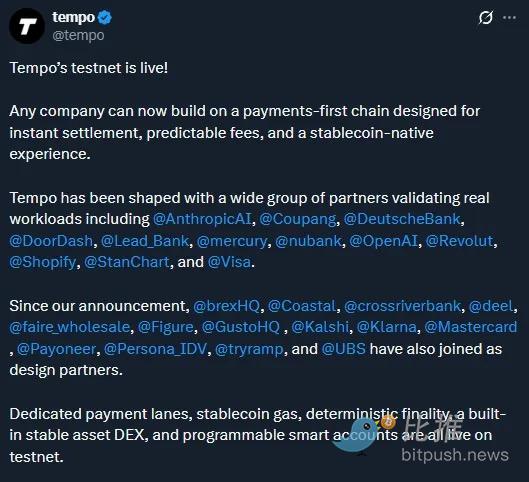
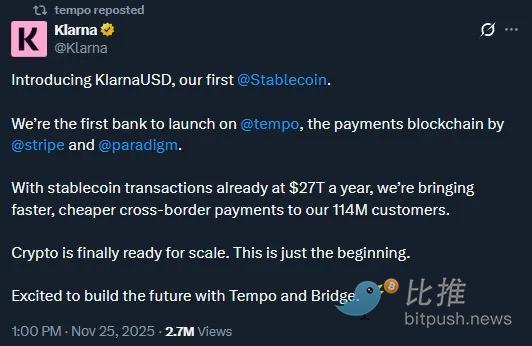
Stripe's controversial payment chain—forked from Ethereum and modified with key adaptations for fintech applications—is now live on the testnet.

It's worth noting that the project has completed a seed funding round of $500 million, co-supported by Stripe and Paradigm, targeting the payment industry as its initial market entry point.
(Source Chart: Technical Architecture Comparison Diagram)

Interested parties can check out the code repository here.

The first thing we noticed is that the technology is released under the Apache or MIT open-source licenses. This is good news.

The Apache 2.0 license is a popular permissive open-source license from the Apache Software Foundation, allowing broad commercial use, modification, and distribution, requiring only the retention of copyright notices, provision of the license text, and notation of significant modifications, while also including an explicit patent grant from contributors to users.

Therefore, the open-source community is free to adopt any of Tempo's technological achievements. This means that although Ethereum may not gain the commercial landing advantages that Tempo brings to Stripe, it can still absorb its protocol-level technological innovations.

So what are the key differences? We quote the core design notes:

Payment Channels Reserved for TIP‐20 Transfers
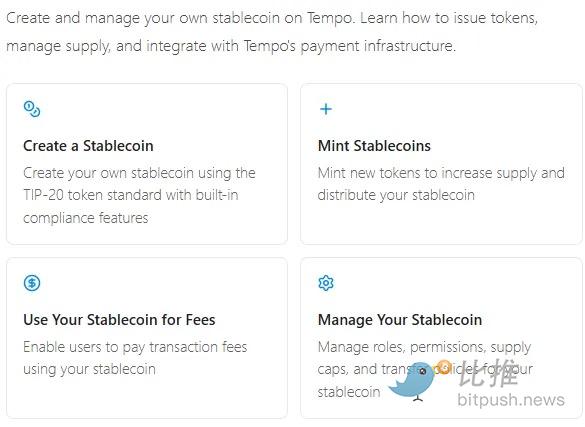
TIP‐20 is a stablecoin issuance standard created with specific functions. Its core effect is to bundle stablecoin issuance with prioritized transfers on-chain.

On Ethereum, different stablecoin issuers compete with each other, and these issuers are not fundamentally different from other token issuers.

On Tempo, the stablecoin issuance contract is solidified in the TIP20Factory, creating the potential for future on-chain revenue. Establishing a fast lane for such tokens gives them a permanent advantage. However, anyone can use this factory contract, meaning competition still exists at the distribution level, but manufacturing tends to be centralized.

Low, Predictable Fees Paid in Stablecoins
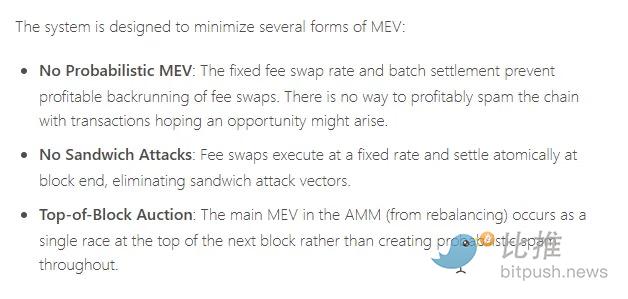
Users can pay Gas fees directly with USD stablecoins upon initiation. A fee automated market maker (AMM) will convert them into the validator's preferred stablecoin. The target cost for TIP‐20 transfers is less than one-thousandth of a dollar (<$0.001). Liquidity providers in the AMM can earn a 0.3% fee from each swap. This design also avoids Miner Extractable Value (MEV) and arbitrage attacks against transactions—which have cost users over $1 billion on Ethereum.

Generalizing the way users pay for transactions is a commendable design direction, and Tempo achieves multi-directional payment options.

Here, any asset can be converted into stablecoins to pay for Gas; on Ethereum, while any asset (including stablecoins) can also be converted to ETH to pay Gas, this process is not automated and requires support from smart accounts.

More importantly, Ethereum has execution competition between different AMMs, rather than solidifying a specific AMM within the chain mechanism. This competition is crucial when trying to spur innovation for new financial primitives; but for Tempo, which aims to industrialize financial primitives, its importance is relatively lower.

Native Smart Account Integration
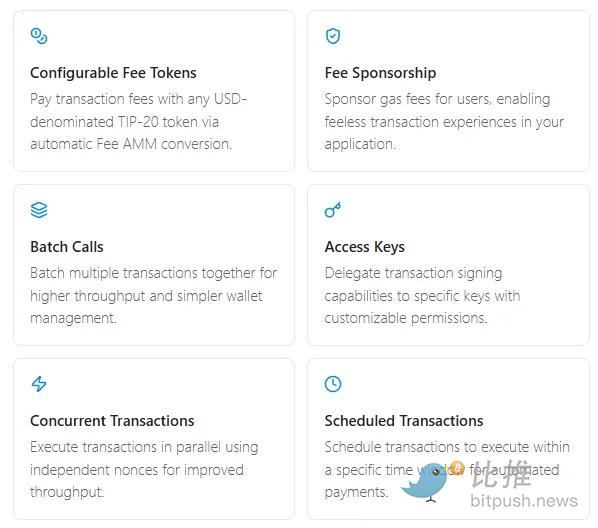
Tempo integrates the excellent concept of smart accounts into transactions: (1) supports batch processing of multiple operations (payroll, settlement, refunds); (2) a fee sponsorship mechanism, allowing applications to pay Gas on behalf of users; (3) scheduled payment functionality, supporting recurring and timed payments within protocol-level time windows; (4) modern authentication methods using passkeys (e.g., biometric login).
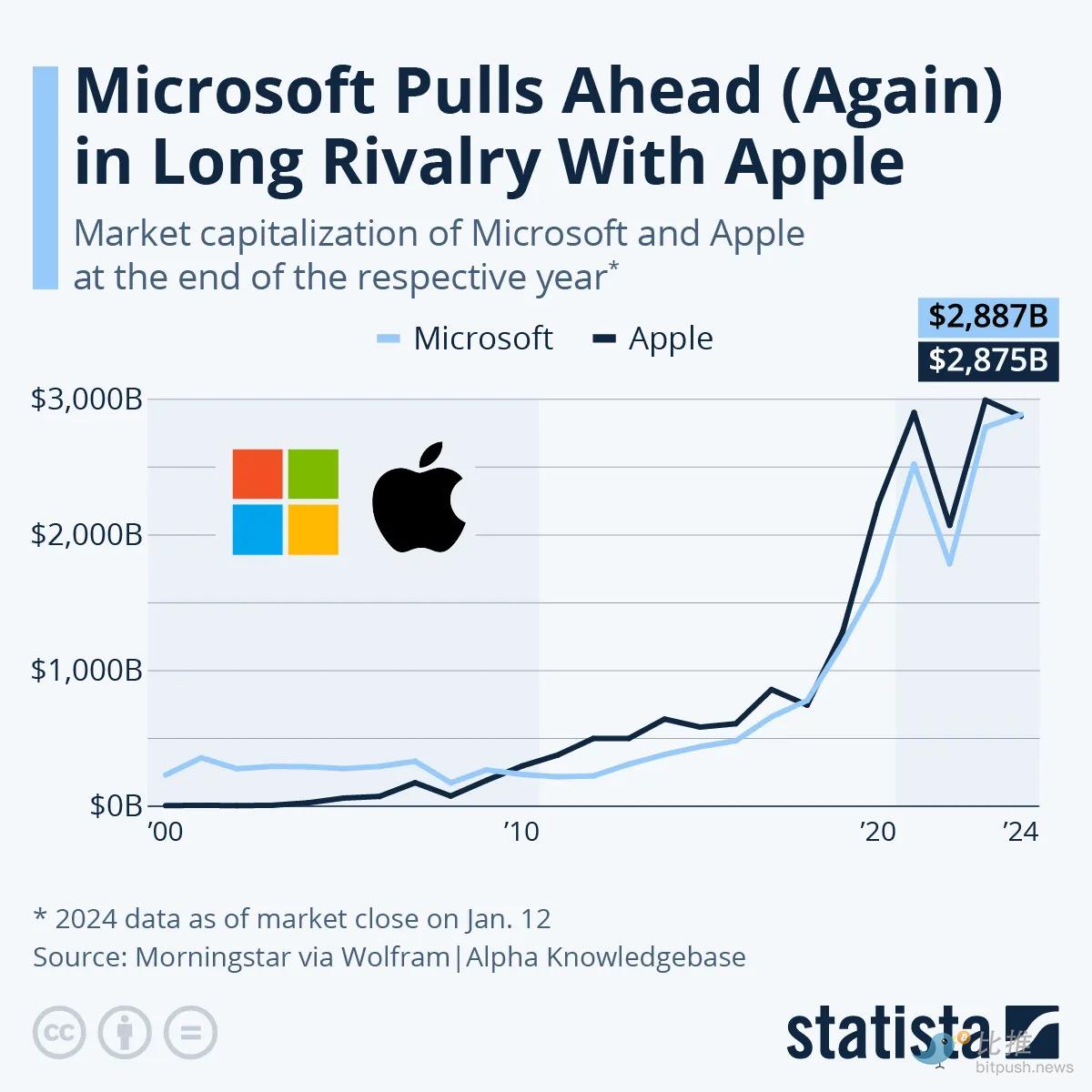
(Attached Figure: Statista chart of long-term competitive trends between Microsoft and Apple)

Just as Stripe itself integrates various fintech services into a single platform, Tempo is absorbing the most demanded payment features as native parts of the chain, rather than leaving them to third-party development and competing for user awareness. This is the Apple-style software development philosophy—all experiences are meticulously designed, proprietary, and vertically integrated—rather than the Windows-style model of gathering developers to create third-party applications (which may create functional breadth but often lack security and a unified user experience). More broadly, this reflects the fundamental difference between closed and open architecture systems.

Performance and Finality
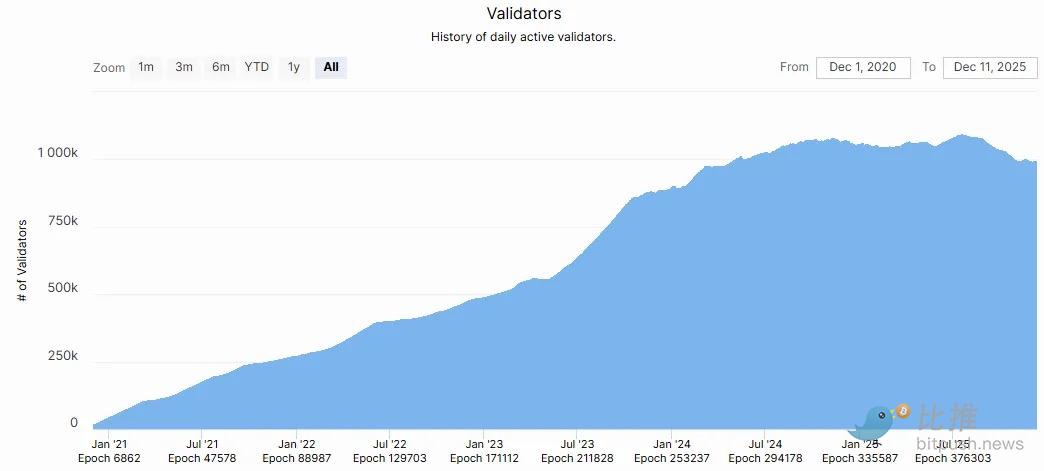
(Source: Ethereum Validator Distribution Chart)

Tempo is fully compatible with the Ethereum Virtual Machine (EVM). Developers can use the same tools, languages, and frameworks (e.g., Solidity, Foundry, Hardhat) as on Ethereum to deploy and interact with smart contracts. Its consensus algorithm uses Simplex BFT consensus (originating from Commonware, to which Tempo has invested $25 million). The validator set is currently private and permissioned, an expected design for the initial stage of a private company.

In contrast, Ethereum is antifragile and anti-censorship, meaning anyone can freely join or leave the validator set. There are currently about 1 million daily active validators on the chain.

Overall, the core impression of Stripe/Tempo is: it is advancing rapidly with a vertically integrated product approach, aiming to capture the fintech market. Its partnerships with AI companies, Web2 enterprises, and traditional banks fully demonstrate its strength in driving blockchain commercialization.


Original link:https://www.bitpush.news/articles/7595070

Domande pertinenti

QWhat is the core innovation of Tempo's TIP-20 standard compared to Ethereum's stablecoin issuance?

AThe TIP-20 standard binds stablecoin issuance with prioritized on-chain transfers by creating a dedicated payment channel for TIP-20 transfers. Unlike Ethereum where stablecoin issuers compete freely, Tempo centralizes the issuance mechanism through the TIP20Factory contract, creating potential for on-chain revenue while allowing distribution-level competition.

QHow does Tempo handle gas fee payments differently from Ethereum?

ATempo allows users to pay gas fees directly in dollar stablecoins through an automated market maker (AMM) that converts them to the validator's preferred stablecoin, with costs targeted below $0.001 per TIP-20 transfer. This differs from Ethereum where assets must be converted to ETH for gas payments, a process that isn't automated and requires smart account support.

QWhat are the key features of Tempo's native smart account integration?

ATempo's smart account integration includes: (1) batch processing for multiple operations like payroll and settlements, (2) fee sponsorship allowing applications to pay gas for users, (3) scheduled payments with protocol-level timing capabilities, and (4) modern authentication using passkeys like biometric login.

QWhat is the fundamental architectural difference between Tempo's approach and Ethereum's approach as described in the article?

ATempo follows an Apple-like closed architecture with vertical integration where payment features are natively incorporated into the chain with proprietary, carefully designed experiences. Ethereum follows a Windows-like open architecture that relies on third-party developers to create applications, resulting in broader functionality but potentially less security and unified user experience.

QHow does Tempo's consensus mechanism and validator system differ from Ethereum's?

ATempo uses Simplex BFT consensus with a private, permissioned validator set, which is expected for a private company's initial phase. Ethereum features an anti-fragile and anti-censorship design where anyone can freely join or leave the validator set, with approximately 1 million active validators daily.

Letture associate

Three Scenarios for BTC's Future Direction and a Duel Between Two Strong Forces | Special Invited Analysis

**Title: Three Scenarios for BTC's Future Trajectory and a Key Duel | Invited Analysis** The market remains at a critical juncture. Over the past week, Bitcoin (BTC) consolidated broadly between $79,500 and $80,600, validating previous technical analysis. The current focus is on whether this marks the start of a new uptrend or a pause within a larger correction. **BTC Multi-Cycle Analysis & Three Possible Scenarios** BTC's daily chart structure, following its peak at $126,200 in October 2025, presents three primary technical scenarios based on Elliott Wave theory: 1. **Bullish Scenario (End of Correction):** The corrective A-B-C wave from $126,200 ended at the $60,000 low in February 2026. The current price action is the start of a major Wave I uptrend. A subsequent Wave II pullback would not break below $60,000. 2. **Bearish Scenario 1 (Complex Correction):** The correction is unfolding as an A-B-C-D-E pattern. The current move from $60,000 is a D-wave rally. After its completion, a final E-wave decline could potentially breach the $60,000 level. 3. **Bearish Scenario 2 (Larger Correction):** The entire move down from $126,200 to $60,000 was a large A-wave. The current rally is a B-wave correction within a larger A-B-C structure, to be followed by a C-wave decline below $60,000. *Analysis suggests Scenario 2 is less probable due to time disproportions between waves. The battle is effectively between the Bullish Scenario (1) and Bearish Scenario (3).* **Key BTC Levels & Weekly Strategy** On the 4-hour chart, BTC trades above a crucial consolidation zone ("Central Pivot C"). * **Key Resistance:** $83,500-$84,500; $89,000-$90,500. * **Key Support:** $78,500-$79,500 (pivot upper bound); $73,500-$75,000; $69,500-$70,500. **Weekly Outlook:** The market direction hinges on BTC's ability to hold above or break below the $78,500-$79,500 support zone. * **Mid-term Strategy:** Neutral/Wait-and-see stance due to unclear direction. * **Short-term Tactics:** Two contingency plans using 30% max capital: * **Plan A (Bullish):** Look for long entries if price holds above $78,500-$79,500 with confirming signals. Initial stop-loss below $78,500. * **Plan B (Bearish):** Consider short positions if price breaks below $73,500-$75,000 with confirming signals. Initial stop-loss above $76,500. **HYPE Analysis & Strategy** HYPE's daily chart shows a seven-segment structure from its January low of $20.46, forming a "rising pivot" zone. * **Key Level to Watch:** $45.76 (previous high). A break above would confirm the bullish structure remains intact. * **Short-term Strategy:** Focus on pivot zone boundaries ($38.41 upper, $34.44 lower). * **Long:** Consider on support near $38.41 with bullish confirmation signals. * **Short:** Consider on a break below $34.44 with bearish confirmation signals. * Position size must be below 30% with strict stop-loss discipline. **Risk Management Reminder:** Always set an initial stop-loss upon entry. Move stop-loss to breakeven at +1% profit, then trail it upwards to lock in profits dynamically. All views are based on technical analysis for informational purposes only and do not constitute investment advice. The market is inherently risky.

Odaily星球日报2 min fa

Three Scenarios for BTC's Future Direction and a Duel Between Two Strong Forces | Special Invited Analysis

Odaily星球日报2 min fa

Sequoia Interview with Hassabis: Information is the Essence of the Universe, AI Will Open Up Entirely New Scientific Branches

Demis Hassabis, co-founder and CEO of Google DeepMind and Nobel laureate, discusses the path to AGI and its profound implications in a Sequoia Capital interview. He outlines his lifelong dedication to AI, tracing his journey from game development (e.g., *Theme Park*)—a perfect AI testing ground—to neuroscience and finally founding DeepMind in 2009. He emphasizes the critical lesson of being "5 years, not 50 years, ahead of time" for successful entrepreneurship. Hassabis reiterates DeepMind's two-step mission: first, solve intelligence by building AGI; second, use AGI to tackle other complex problems. He highlights the transformative potential of "AI for Science," particularly in biology where tools like AlphaFold have revolutionized protein folding. He envisions AI-powered simulations drastically shortening drug discovery from years to weeks and enabling personalized medicine. Furthermore, he predicts AI will spawn new scientific disciplines, such as an engineering science for understanding complex AI systems (mechanistic interpretability) and novel fields enabled by high-fidelity simulators for complex systems like economics. He posits a fundamental worldview where information, not just matter or energy, is the essence of the universe, making AI's information-processing core uniquely suited to understanding reality. He defends classical Turing machines as potentially sufficient for modeling complex phenomena, including quantum systems, as demonstrated by AlphaFold. On consciousness, Hassabis suggests first building AGI as a powerful tool, then using it to explore deep philosophical questions. He believes components like self-awareness and temporal continuity are necessary for consciousness but that defining it fully remains an open challenge. He predicts AGI could arrive around 2030 and, once achieved, would be used to probe the deepest questions of science and reality, much as envisioned in David Deutsch's *The Fabric of Reality*.

链捕手20 min fa

Sequoia Interview with Hassabis: Information is the Essence of the Universe, AI Will Open Up Entirely New Scientific Branches

链捕手20 min fa

Morgan Stanley 2026 Semiconductor Report: Buy Packaging, Buy Testing, Buy China Chips, Avoid Traditional Tracks

Morgan Stanley 2026 Semiconductor Report: Buy Packaging, Buy Testing, Buy Chinese Chips; Avoid Traditional Segments. The core theme is the shift in AI compute supply from NVIDIA dominance to a three-track system of GPU + ASIC + China-local chips. The key opportunity is capturing share in this expansion, while non-AI semiconductors face marginalization due to resource reallocation to AI. Key investment conclusions, in order of priority: 1. **Advanced Packaging (CoWoS/SoIC) - Highest Conviction**: TSMC is the primary beneficiary of explosive demand, driven by massive cloud capex. Its pricing power and AI revenue share are rising significantly. 2. **Test Equipment - Undervalued & High-Growth Certainty**: Chip complexity is causing test times to double generationally, structurally driving handler/socket/probe card demand. Companies like Hon Hai Precision (Foxconn), WinWay, and MPI offer compelling value. 3. **China AI Chips (GPU/ASIC) - Long-Term Irreversible Trend**: Export controls are accelerating domestic substitution. Companies like Cambricon, with firm customer orders and SMIC's 7nm capacity support, are positioned to benefit from lower TCO (30-60% vs NVIDIA) and growing local cloud demand. 4. **Avoid Non-AI Semiconductors (Consumer/Auto/Industrial)**: These segments face a weak, structurally hindered recovery due to AI's resource "crowding-out" effect on capacity and supply chains. 5. **Memory - Severe Internal Divergence**: Strongly favor HBM (Hynix primary beneficiary) and NOR Flash (Macronix). Be cautious on interpreting price rises in DDR4/NAND as true demand recovery. The report emphasizes a 2026-2027 time window, stating the AI capital expenditure cycle is far from over. Key macro variables include persistent export controls and AI's systemic "crowding-out" effect on traditional semiconductor supply chains.

marsbit1 h fa

Morgan Stanley 2026 Semiconductor Report: Buy Packaging, Buy Testing, Buy China Chips, Avoid Traditional Tracks

marsbit1 h fa

Circle:Sluggish Market? The Top Stablecoin Stock Continues to Expand

Circle, the issuer of the stablecoin USDC, reported its Q1 2026 earnings on May 11th, Eastern Time. Against a backdrop of weak crypto market sentiment, USDC's average circulation in Q1 was $752 billion, with a modest 2% sequential increase to $770 billion by quarter-end. New minting volumes declined due to the poor crypto market, but remained high, indicating demand expansion beyond crypto trading. USDC's market share remained stable at 28% of the total stablecoin market, while competition from Tether's USDT persists. A key highlight was "Other Revenue," which reached $42 million, more than doubling year-over-year, though sequential growth slowed to 13%. This revenue stream, including fees from services like Web3 software, the Cipher payment network (CPN), and the Arc blockchain, is critical for diversifying away from interest income. Circle's internally held USDC share increased to 18%, helping to improve gross margin by 130 basis points to 41.4% by reducing external sharing costs. However, profitability was pressured as total revenue growth slowed, primarily due to the significant weight of interest income, which is tied to USDC规模 and Treasury rates. Adjusted EBITDA was $133 million with a 19.2% margin. Management maintained its full-year 2026 guidance for adjusted operating expenses ($570-$585 million) and other revenue ($150-$170 million). The long-term target for USDC's CAGR remains 40%, though near-term volatility is expected. The article concludes that while Circle's current valuation of $28 billion appears reasonable after a recent recovery, further upside depends on the pace of stable币 adoption and potential positive sentiment from the advancement of regulatory clarity acts like CLARITY.

链捕手1 h fa

Circle:Sluggish Market? The Top Stablecoin Stock Continues to Expand

链捕手1 h fa

Tech Stocks' Narrative Is Increasingly Relying on Anthropic

The narrative of tech stocks is increasingly relying on Anthropic. Anthropic, the AI company behind Claude, has become central to the financial stories of major tech giants. Elon Musk dissolved xAI, merging it into SpaceX as SpaceXAI, and secured an exclusive deal to rent the massive "Colossus 1" supercomputing cluster to Anthropic. In return, Anthropic expressed interest in future space-based compute collaborations. Google and Amazon are also deeply invested. Google plans to invest up to $40 billion and provide significant compute power, while Amazon holds a 15-16% stake. Both companies reported massive quarterly profit surges largely due to valuation gains from their Anthropic holdings. Crucially, Anthropic has committed to multi-billion dollar cloud compute contracts with both Google Cloud and AWS. This creates a clear divide: the "A Camp" (Anthropic-Google-Musk) versus the "O Camp" (OpenAI-Microsoft). The A Camp's strategy intertwines equity, compute orders, and profits, making Anthropic a "systemic financial node." Its performance directly impacts its partners' financials and stock prices. In contrast, OpenAI, while leading in user traffic, faces commercialization challenges, lower per-user revenue, and a recently restructured relationship with Microsoft. The AI industry is shifting from a race for raw compute (symbolized by Nvidia) to a focus on monetizable applications, where Anthropic currently excels. However, this concentration of market hope on one company amplifies systemic risk. The rise of powerful open-source models like DeepSeek-V4 poses a significant threat, as they could undermine the value proposition of closed-source models like Claude. The article suggests ongoing geopolitical efforts to suppress such competitors will be a long-term strategic focus for Anthropic's allies.

marsbit1 h fa

Tech Stocks' Narrative Is Increasingly Relying on Anthropic

marsbit1 h fa

Trading

Spot
Futures
活动图片