Securitize hires former PayPal exec as US tokenization gains traction

cointelegraphPubblicato 2025-12-09Pubblicato ultima volta 2025-12-09

Introduzione

Securitize, a major tokenization platform, has hired former PayPal executive Jerome Roche as its new general counsel to strengthen its push for tokenized equity in the US. Roche previously led PayPal’s expansion into digital assets, including the PYUSD stablecoin. The company emphasized that tokenized securities are already accessible to US investors, countering the perception that such offerings are primarily available abroad. CEO Carlos Domingo stated that Securitize operates within a clear US regulatory framework using SEC-approved infrastructure, enabling fully compliant access to onchain securities. This development follows Securitize’s recent regulatory approval in the EU and signals growing acceptance of tokenization in the US, further evidenced by the SEC ending its investigation into rival platform Ondo Finance.

Major tokenization platform Securitize has doubled down on its push to bring tokenized equity to US investors, naming a former PayPal executive as its new general counsel.

Securitize on Tuesday announced the appointment of ex-PayPal executive Jerome Roche, who led the company’s expansion into digital asset projects, including the PayPal USD (PYUSD) stablecoin.

Securitize also said its tokenized securities are already available to US investors, challenging the notion that most issuers prefer to offer such products abroad due to local stock access.

“There’s been a perception that tokenized securities must be offered primarily outside the US, but our experience shows the opposite,” Securitize CEO Carlos Domingo told Cointelegraph.

“Clear regulatory path” for tokenized stocks in the US

According to Securitize, operating real-world asset (RWA) tokenization offerings inside the US regulatory perimeter is “not only possible, but scalable, at institutional quality.”

“We’ve demonstrated that there is a clear regulatory path for issuers to natively tokenize assets for US investors,” Domingo said.

“These are not synthetic representations, or derivatives, but real securities onchain,” the CEO said, adding:

“We operate using SEC-regulated infrastructure, including a registered transfer agent broker-dealer, and fund admin, which allows US investors to access and legally hold tokenized securities in a fully compliant framework.”

Securitize’s optimistic outlook on the US tokenization comes days after the platform obtained regulatory approval to operate as an investment company and a trading ánd settlement system in the European Union on Nov. 26. According to the company, the approval positioned it as one of the first operators for regulated digital securities infrastructure in both the US and EU.
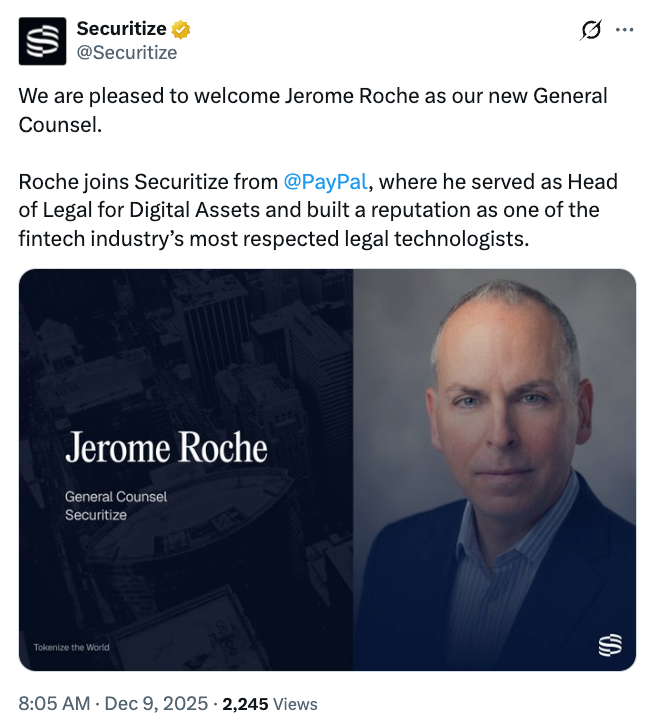
Source: Securitize

“For the first time, modern ledger technology is giving us the ability to record ownership, settle transactions, and move value in ways that are fundamentally better than the fragmented systems we’ve inherited,” Securitize’s newly appointed general counsel, Roche, said in the announcement.

“Innovation only works when it fits squarely within the guardrails of applicable law,” he added, underscoring Securitize’s global push for regulated tokenized securities.

Related: US Treasurys lead tokenization wave as CoinShares predicts 2026 growth

Securitize’s news is another sign of the US warming to tokenization. On Monday, the Securities and Exchange Commission dropped its investigation into rival tokenization platform Ondo Finance.

Ondo said the decision marks a new chapter for tokenized securities in the US, where they are poised to become a “core part of the capital markets.”

Magazine: When privacy and AML laws conflict: Crypto projects’ impossible choice


Letture associate

Strive Executive: Rethinking the Bitcoin Price Flywheel

In this article, the author discusses the future trajectory of Bitcoin's price, moving beyond the traditional "power law" model that has described its long-term price appreciation with diminishing returns. The core argument is that Bitcoin is maturing, evidenced by declining volatility and shallower market drawdowns. This maturation, often seen as leading to permanently lower returns, is framed as a precursor to a new, potentially explosive phase. The author draws an analogy to metal fatigue, where cracks propagate in three stages: initial irregular formation, a predictable middle phase describable by a power law (Paris' law), and a final rapid acceleration leading to fracture. Similarly, Bitcoin's monetization is seen in three phases: 1) Discovery (high volatility/returns), 2) Maturation (declining volatility/returns, improving risk-adjusted metrics), and 3) System-driven monetization. The key insight is that Phase 2 sets the stage for Phase 3. Lower volatility makes Bitcoin a more attractive asset for large-scale capital allocation (due to improved Sharpe ratios) and, crucially, a higher-quality collateral for loans. As perceived credit risk falls, the financial system can safely extend more dollar-denominated credit against Bitcoin holdings. This creates a self-reinforcing "flywheel": lower volatility → more capital allocation & cheaper credit → increased demand for fixed-supply Bitcoin → price rise → higher collateral value enabling more credit → continued price pressure. The conclusion posits that even if Bitcoin adoption eventually plateaus (reaching an S-curve saturation), the expansion of capital and credit chasing a fixed supply could cause its USD price to re-accelerate, breaking above the long-term power-law trajectory and entering the "third region" of rapid, system-driven monetization.

marsbit7 h fa

Strive Executive: Rethinking the Bitcoin Price Flywheel

marsbit7 h fa

Trading

Spot
活动图片