Secures Over $60 Million in Funding from Dragonfly, Sequoia, and Others. An In-Depth Look at the On-Chain Derivatives Protocol Variational | CryptoSeed

链捕手Pubblicato 2026-05-22Pubblicato ultima volta 2026-05-22

Introduzione

Variational, a decentralized derivatives trading platform, has raised over $61.8 million in total funding, including a recent $50 million Series A led by Dragonfly Capital. Investors include Sequoia Capital, Coinbase Ventures, Bain Capital Crypto, and Hack VC. The platform, with over $810 million in Open Interest (ranking 4th among on-chain derivatives protocols), is founded by Lucas Schuermann and Edward Yu. Both are Columbia University graduates and former partners at quant fund Qu Capital. They later held senior roles at Genesis Trading, handling billions in trading volume. The broader team includes talent from Google, Meta, and top trading firms like Jane Street. Operating on Arbitrum, Variational distinguishes itself by aggregating external liquidity from CEXs, DEXs, and traditional market makers using an RFQ (Request-for-Quote) model, positioning itself more as a broker than an exchange like Hyperliquid. Its dual product line features Omni for retail users (offering up to 50x leverage on ~450+ crypto and TradFi pairs) and Pro for institutional OTC trading. Currently in a pre-TGE phase, Variational has launched an "Omni Points" system, with 50% of its upcoming $VAR token supply allocated for community incentives through trading-based rewards and referrals until Q3 2026.

Author: momo, ChainCatcher

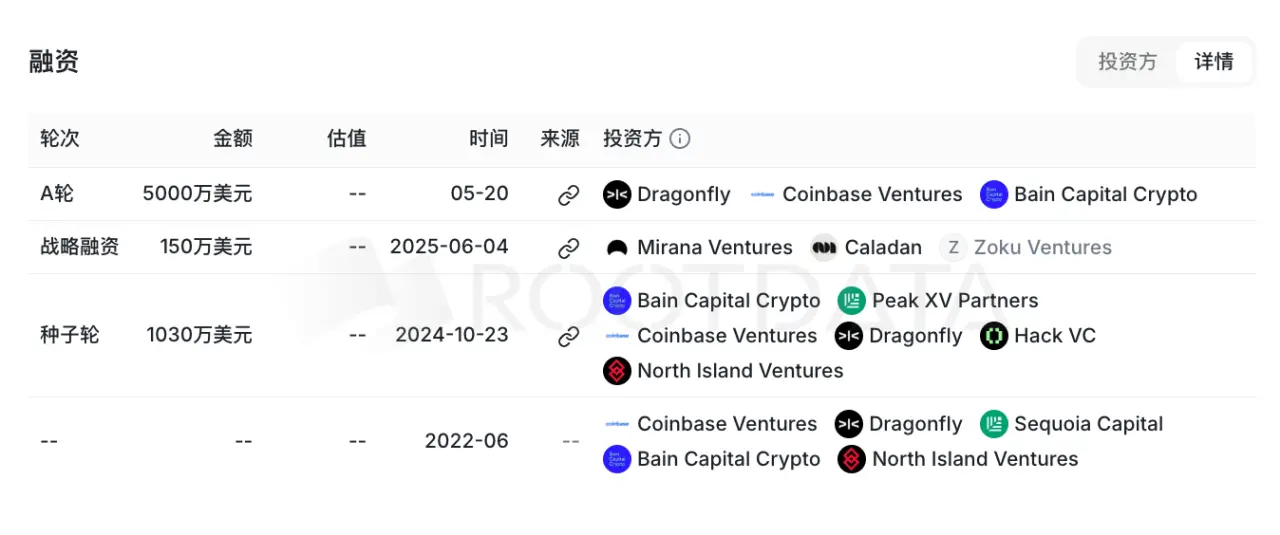
Recently, the decentralized derivatives trading platform Variational announced the completion of a $50 million Series A financing round led by Dragonfly. Combined with three previous funding rounds, Variational has raised a cumulative total of $61.8 million. Its investor lineup is quite impressive, including not only Dragonfly but also renowned institutions such as Sequoia Capital, Coinbase Ventures, Bain Capital Crypto, Hack VC, and others.
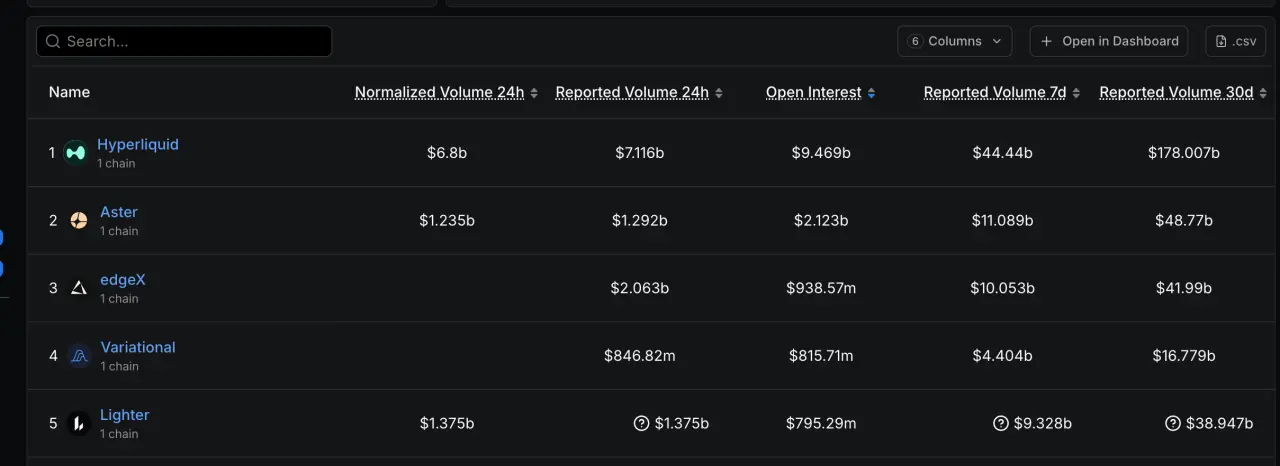
According to DeFiLlama data, the open interest (OI) on Variational has exceeded $810 million. While there remains a significant gap compared to Hyperliquid's $9.4 billion, its OI currently ranks fourth among on-chain derivatives protocols.
In the fiercely competitive decentralized derivatives sector, why has Variational continued to secure backing from top-tier institutions? What is the team's background? What are its differentiated approaches? This article provides a brief overview.

What is the team's background?

In terms of team background and entrepreneurial experience, Variational and Hyperliquid share several similarities: both teams graduated from prestigious universities, come from quantitative trading backgrounds, founded quantitative funds, and subsequently transitioned to building on-chain derivatives platforms.

However, unlike Hyperliquid's early mystique and anonymous team approach, Variational discloses its founding team's background and entrepreneurial journey in its whitepaper.
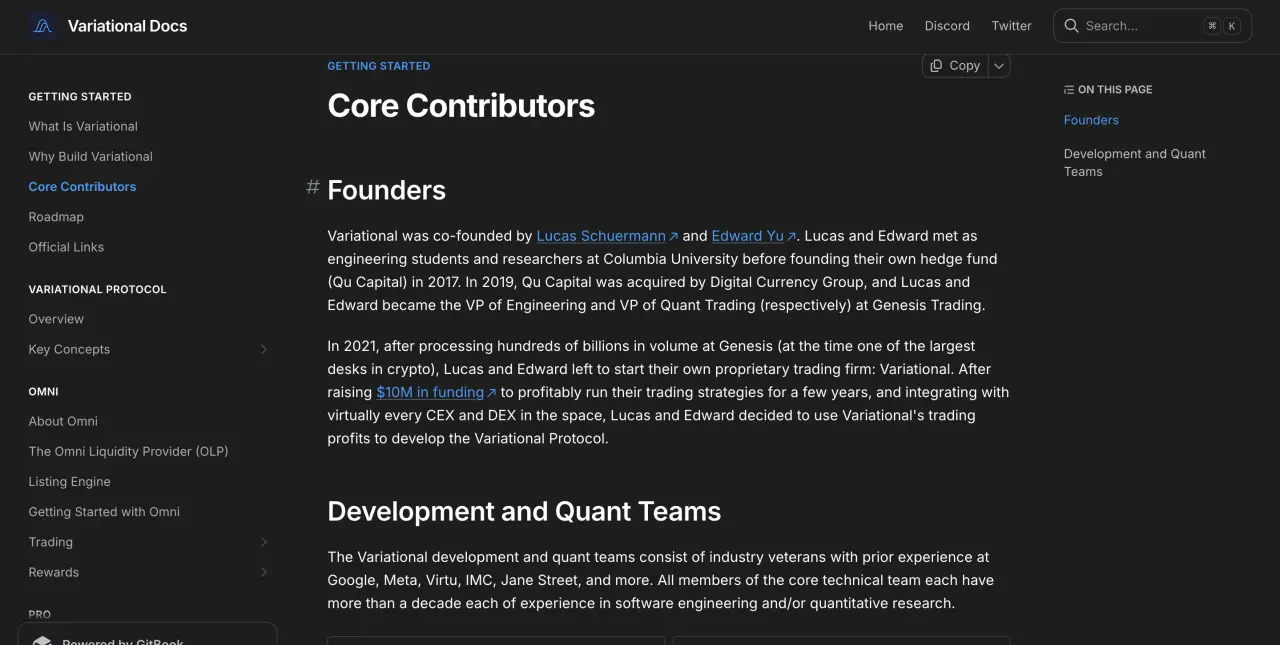
Variational was co-founded by Lucas Schuermann and Edward Yu. CEO Lucas graduated from Columbia University and was previously responsible for trading systems engineering architecture; Edward Yu has a Chinese background and was originally a quantitative analyst. The two met while studying and conducting research in the engineering department at Columbia University and co-founded the quantitative hedge fund Qu Capital in 2017.

In 2019, Qu Capital was acquired by Digital Currency Group. Subsequently, both joined Genesis Trading: Lucas served as Vice President of Engineering, and Edward Yu served as Vice President of Quantitative Trading.

According to the whitepaper, before leaving Genesis in 2021, their team had processed trading volumes in the hundreds of billions of dollars. After leaving, they founded their proprietary trading firm, Variational, and secured $10 million in funding.

In the following years, the team operated proprietary trading strategies while integrating with mainstream CEX and DEX trading interfaces. Later, based on their own trading business and system experience, they began developing and operating the Variational Protocol.

Additionally, Variational's development and quantitative team members also hail from technology and quantitative institutions such as Google, Meta, Virtu Financial, IMC Trading, and Jane Street. The whitepaper states that core technical team members generally possess over a decade of experience in software engineering or quantitative research.

What are its product features? How does it differ from Hyperliquid?

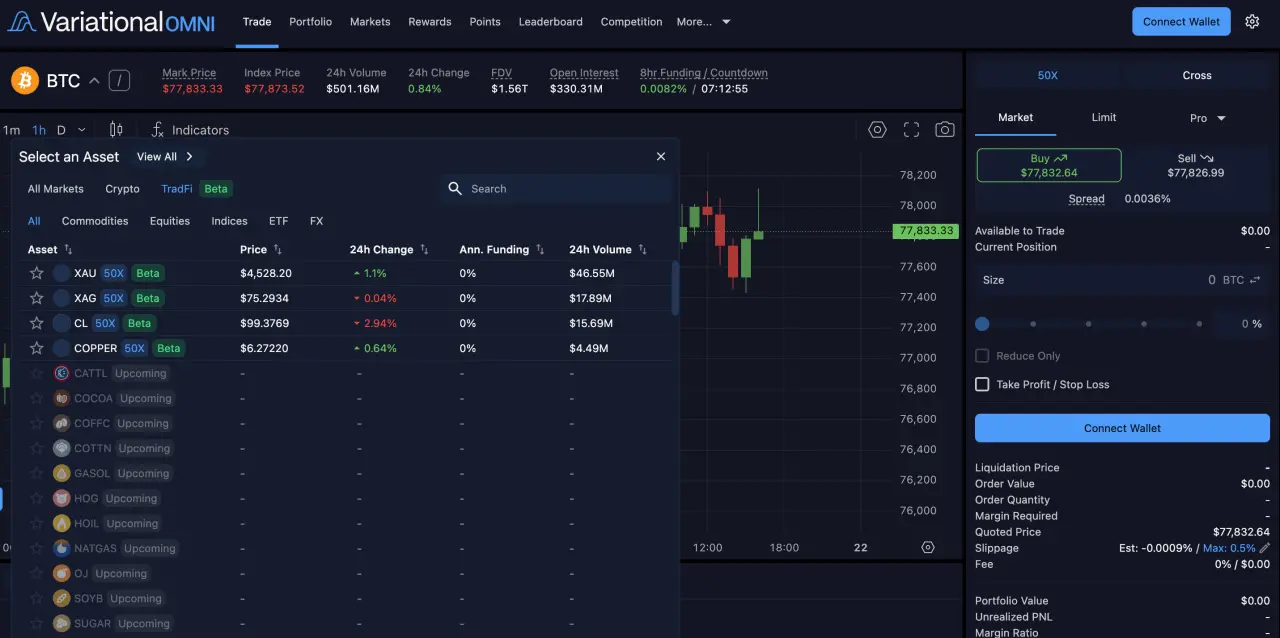
Judging from the trading interface, there isn't a significant difference between Variational and Hyperliquid. The platform currently lists approximately 450 trading pairs, mainly covering cryptocurrency and TradFi assets, offering users leverage up to 50x. The TradFi section is currently in Beta testing. According to official disclosures, the TradFi market will list over 100 trading pairs.
However, in its press release, Variational emphasizes a distinctly different positioning from Hyperliquid.

Variational describes its model as more akin to a brokerage rather than another exchange in the style of Hyperliquid. Its target users are not limited to crypto-native traders; it aims to make the on-chain derivatives trading experience closer to traditional markets through zero-fee trading and liquidity aggregation.

Currently operating on Arbitrum, Variational employs a dual-product-line model. The Omni version primarily targets retail users, positioned as a perpetual contracts trading product aggregating liquidity from multiple sources, while the Pro version caters to institutional over-the-counter derivatives trading.

The most significant difference from Hyperliquid lies in order matching and liquidity mechanisms. Hyperliquid relies on its self-built L1 chain and a public central limit order book (CLOB), with market makers or the HLP treasury within the protocol competing to provide quotes, and traders paying maker/taker fees. In contrast, Variational uses an RFQ (Request for Quote) model, with a single liquidity provider as the counterparty. It does not rely on on-chain internal market making but instead aggregates external liquidity in real-time from sources like CEXs, DEXs, OTC channels, and traditional financial market makers, managing risk through hedging.

The rationale for choosing this differentiated path, according to Variational CEO Lucas, is that on-chain liquidity still lags far behind traditional trading venues like the CME, and order book models face a "cold start" problem. Aggregating liquidity from external sources avoids the need to rebuild liquidity from scratch on-chain.

What is the current stage? What participation opportunities are available?

Variational is currently still in the Pre-TGE stage; the $VAR token has not been issued. The project initially planned a TGE in Q1 2025, which has since been postponed. No new definitive TGE date has been officially announced.

In December 2025, Variational launched the Omni Points points system. The official statement indicates that 50% of the $VAR supply will be allocated for community incentives, distributed gradually through mechanisms like Points rather than a one-time airdrop.

Regarding points, 3 million points have been retroactively distributed to early users. Subsequently, points are distributed every Friday based on the previous week's trading snapshot. The points program is scheduled to conclude by Q3 2026 at the latest.

The main current participation opportunity is to engage in perpetual contracts trading on the Omni platform. Trading volume is the core factor for earning points, with additional point bonuses available for holding positions over time and referring others.


Domande pertinenti

QWhat is the total funding amount raised by the decentralized derivatives platform Variational, and who led its Series A round?

AVariational has raised a total of $61.8 million. Its Series A round of $50 million was led by Dragonfly.

QWhat are the key differences between Variational and its competitor Hyperliquid in terms of their operational models?

AThe key difference lies in their order matching and liquidity mechanisms. Hyperliquid relies on its own L1 blockchain with a public Central Limit Order Book (CLOB). Variational uses an RFQ (Request for Quote) model, acting as a single liquidity provider counterparty that aggregates external liquidity from CEXs, DEXs, OTC channels, and TradFi market makers, then manages risk through hedging.

QWhat is the professional background of Variational's founding team prior to starting the protocol?

ACo-founders Lucas Schuermann and Edward Yu met at Columbia University. They co-founded the quantitative hedge fund Qu Capital in 2017, which was later acquired by Digital Currency Group. They then joined Genesis Trading, where Lucas served as VP of Engineering and Edward Yu as VP of Quantitative Trading, before leaving in 2021 to found Variational.

QWhat is the current stage of Variational's token ($VAR) launch, and how is the project engaging its community?

AVariational is currently in the Pre-TGE stage, and the $VAR token has not been launched yet. The previously planned TGE for Q1 2025 has been postponed with no new official date announced. The project is engaging its community through an 'Omni Points' loyalty program launched in December 2025, with 50% of the $VAR supply designated for community incentives distributed via points and other mechanisms over time.

QOn which blockchain does Variational primarily operate, and what are its two main product lines?

AVariational primarily operates on the Arbitrum blockchain. It follows a dual-product line model: the 'Omni' version targets retail users as a perpetual contracts trading product aggregating liquidity from multiple sources, while the 'Pro' version is designed for institutional over-the-counter (OTC) derivatives trading.

Letture associate

Agent Race Ends, Super Workbench Takes Over

The era of fragmented AI agents is ending. Over the past month, China's tech giants—Tencent, Alibaba, and ByteDance—have simultaneously shifted strategy: instead of launching new, standalone AI agents, they are consolidating their various agent projects into unified "super workbenches." Tencent integrated its QClaw teams into WorkBuddy, a strategic product hailed as a potential third flagship after QQ and WeChat. Alibaba is merging its QoderWork, Wukong, and MuleRun agents into a new "Qianwen Office" platform under DingTalk's leadership. ByteDance rebranded its TRAE SOLO coding agent to TRAE Work, signaling a broader focus on workflow collaboration. This convergence marks a pivotal industry consensus. The initial exploration phase, where companies rapidly built numerous overlapping agents for different scenarios, proved costly and inefficient. With open-source tools eroding technical barriers, competition has shifted from agent creation to resource consolidation and cost control. Historically, platform wars are won not by creating more products, but by simplifying them—as seen with browsers unifying web access and super-apps consolidating services. Now, the "super workbench" aims to become the unified AI entry point for work. This reflects a deeper market realization: the primary audience for AI is no longer just programmers (a market in the tens of millions) but all knowledge workers (a market of billions). The real opportunity lies in augmenting everyday tasks—managing emails, documents, data, and meetings—across the entire workday. The core battleground is becoming control over the primary AI entry point that employees use daily. Tencent's WorkBuddy leverages WeChat and Tencent Docs; Alibaba's Qianwen Office taps into DingTalk's organizational data; ByteDance's TRAE Work integrates with Feishu's workflows. Whoever owns this "super workbench" gains strategic control over orchestrating enterprise data and APIs. This shift is redefining enterprise software. Traditional SaaS applications, valued for their user interfaces, will recede into the background. Their core functionalities will be exposed as standardized "Skills" or APIs for the super workbench's agents to invoke. Software value will shift from selling user seats to charging based on API calls and outcomes delivered. The evolution of agents is moving through clear stages: first as novel standalone products, then as consolidated primary work entry points, and finally as pervasive, invisible capabilities embedded into the digital fabric. The recent moves by major tech firms signal the transition from the first stage into the second, accelerating toward the third. In the end, the most successful agent technology may become invisible—like electricity or the HTTP protocol—a fundamental, unnamed infrastructure powering work itself.

marsbit5 min fa

Agent Race Ends, Super Workbench Takes Over

marsbit5 min fa

Michael Saylor: 110 Reasons to Oppose BIP-110

Michael Saylor presents 110 arguments against Bitcoin Improvement Proposal (BIP) 110, a soft fork aimed at restricting certain non-monetary data storage uses (like inscriptions) on the Bitcoin blockchain. He acknowledges the proponents' valid concerns—such as node costs, fee pressure, and preserving Bitcoin's monetary focus—but fundamentally disagrees with the proposed solution. Saylor argues that BIP 110 represents a dangerous precedent of using consensus rules to enforce value judgments on transaction validity, moving away from Bitcoin's core principles of neutrality and permissionless innovation. His key objections are organized into eleven categories: 1) It violates neutrality and hard consensus by banning currently valid transactions. 2) It fails to meet the high burden of proof required for a consensus change, lacking concrete data on the alleged crisis. 3) Its seven bundled technical restrictions are overly broad, targeting generic script functionalities and blocking future upgrade paths. 4) It sacrifices compatibility and future optionality by closing off designed upgrade hooks. 5) Its temporary rules add significant complexity (grandfathering, expiry states) without sufficient justification. 6) The economic and security impacts, particularly on miner revenue and fee markets, are uncertain and unmodeled. 7) Superior, market-based tools (fee markets, relay/mining policies) already exist to manage blockchain load. 8) It stifles innovation by creating a chilling effect for developers. 9) Its modified activation mechanism (55% threshold, forced signaling) is aggressive and risks network splits. 10) The precedent it sets—using consensus to suppress disliked but legal uses—is more dangerous than the problem it aims to solve. 11) A better path exists: improving measurements, refining resource-based policies, and allowing market forces to work. Saylor concludes that Bitcoin's strength lies in its neutral rules, open markets, and hard consensus. Changing these foundational elements to target specific use cases is an unnecessary and risky "iatrogenic" intervention. He advocates for guarding Bitcoin's neutrality rather than acting as its redeemer.

marsbit20 min fa

Michael Saylor: 110 Reasons to Oppose BIP-110

marsbit20 min fa

Trading

Spot
活动图片

