
Second Only to GPUs and Memory: MLCCs Are Becoming the Next Billion-Dollar Windfall for AI Computing Power

marsbitPubblicato 2026-06-10Pubblicato ultima volta 2026-06-10

Introduzione

After GPU and memory, MLCC (Multi-Layer Ceramic Capacitors) is emerging as the next critical component in AI compute, potentially a multi-billion-dollar market. The article highlights a significant, industry-wide price increase for MLCCs, driven not by inventory cycles but by a fundamental, structural demand surge from AI and automotive sectors. AI servers require exponentially more MLCCs than traditional servers—from 2,000 to over 350,000 units per high-end AI rack—primarily to stabilize power for increasingly powerful, low-voltage GPUs. A key AI server's MLCC cost can reach thousands of dollars, making it the third-largest cost component after GPUs and memory. This demand is compounded by the automotive shift to EVs and advanced ADAS. Supply, however, struggles to keep up. Manufacturing high-end MLCCs involves extreme precision and faces six major barriers: proprietary technology, long customer certification cycles (12-18 months for AI), high capital intensity, patent thickets, specialized talent, and massive scale. Industry capacity grows at only ~10% annually, creating a persistent supply-demand gap projected to last until 2030. Three companies dominate this high-end market. **Murata** (40% global share) is the stable leader. **Samsung Electro-Mechanics** offers the highest growth elasticity with aggressive expansion. **Taiyo Yuden** is the purest MLCC play. While their current P/E ratios appear high, they are expected to compress rapidly as earnings surge, powered by ...

Author: Block Analytics Ltd X Merkle 3s Capital

Opening: After GPUs, What's Quietly Rising in Price?

A recent report from Huaqiangbei is causing a stir: MLCCs are about to undergo a comprehensive price hike, ranging from 10% to 70%, effective July 1st. This isn't the move of a single manufacturer but a collective price adjustment by the entire industry chain. Murata's ferrite beads, chip capacitors, and chip inductors are seeing increases concentrated between 50% to 70%; Yageo's high-capacity MLCC models are even more exaggerated, with increases ranging from 5% all the way up to 275%. First-tier distributors are being blunt: It's not about whether you want to buy anymore; whoever has spot inventory is king.

The phrase "supply can't meet demand" hasn't been heard in this industry for a long time. Over the past decade, MLCCs have been perceived as "commodity-priced standard components," often priced in fractions of a cent, with prices falling endlessly and rises being ignored. Every few years, the industry goes through a cycle of "price hikes—capacity expansion—overcapacity—price collapse," leaving veterans wary. Seeing price increases, their first reaction is often not excitement but caution. But this time is different. When a low-key sector with an annual output value of $15 billion starts talking in terms of "spot is king," there must be a greater force driving it.

Moreover, the structure of this price hike is unique. The most dramatic increases aren't for the common standard parts but for high-capacity, small-size, automotive-grade, and server-grade high-end models—the higher you go up the pyramid, the harder they are to find and the more expensive they are. This is completely different from past cycles of industry-wide price surges followed by collective declines. It indicates this round's driver isn't simple inventory speculation but structural, real demand pull from the highest-end applications.

That force is AI.

The latest research reports offer a surprising judgment: in the cost structure of AI servers, MLCCs have quietly climbed to become the third-largest cost component, behind only GPUs and memory. The fact that a small capacitor costing a few cents can rank on the same cost sheet as a GPU costing tens of thousands of dollars itself shows the rules of the game are being rewritten. On this cost sheet, the GPU and memory ranked ahead of MLCCs are recognized hard assets, the stars of capital markets over the past two years. MLCCs making it to the top three isn't due to high individual unit prices but the terrifying aggregate quantity—the total cost of hundreds of thousands of these small components collectively exceeds that of many other, higher-priced components.

When a component's name starts appearing on the cost sheet of computing power, it's no longer just a component; it's a strategic material.

This article aims to clarify this story: a sector of the most inconspicuous, most overlooked electronic components is being fundamentally reshaped by AI. Demand is expanding exponentially, while the supply side struggles to keep up like an old ox pulling a cart. The gap in between is turning into a super-cycle potentially lasting until 2030. And the three companies at the top of this sector are being revalued.

Let's look at them one by one.

Demand Side: From 4.8K Units to 600K Units

To understand how drastic this change is, first look at a set of usage numbers.

A traditional general-purpose server uses about 2,000 MLCCs. This is a typical quantity, similar to a high-end smartphone. But once we enter the AI era, the numbers start going haywire. An 8-card AI training server sees MLCC usage jump directly to 25,000 to 28,000 units, over a dozen times that of a traditional server.

The exaggeration continues. Nvidia's GB300 NVL72 rack uses 440,000 units per unit. Looking further to the next generation, the Vera Rubin platform's VR200 is expected to use 600,000 units per machine. And the top-of-the-line Vera Rubin Ultra NVL576 will see usage surge to 3 to 3.5 million units. The leap from 2,000 to 3.5 million units is a thousandfold increase.

Why does it explode to this extent? The reason isn't complicated; the key lies in "electricity."

New-generation GPUs have increasingly higher power density but operate at lower and lower voltages. Taking Rubin as an example, it runs on a power rail below 1 volt but with a power consumption as high as 1,800 watts. Power equals voltage multiplied by current. With voltage pushed below 1 volt, the current must surge above 1,800 amps. What does this mean? It's like channeling the electricity consumption of a small factory into a chip the size of a palm. With such a large current, the slightest fluctuation can cause the chip to malfunction.

The job of MLCCs is to act as a "voltage-stabilizing reservoir" for this torrent of current. When the current fluctuates, they instantly supply or absorb charge to stabilize the voltage—a process called decoupling. The larger the current, the lower the voltage, and the faster the fluctuations, the more numerous and densely packed these "reservoirs" need to be. So, the more powerful the GPU, the higher the demand for MLCCs rises, and it's a non-linear increase.

Besides the explosive growth in quantity, a structural substitution is occurring. Aluminum polymer capacitors, once widely used in servers, are now being replaced by MLCCs. This switch brings another 1.5x to 2x increase in usage. Because MLCCs are smaller, more stable, and have a longer lifespan, their advantages are overwhelming on densely packed compute boards where space is precious. The space on a compute board is fixed, but the current that needs to be stabilized is growing ever larger. The only thing engineers can do is make individual components smaller and use them more densely. Hence, MLCCs, being both small and stable, naturally become the first choice. This substitution isn't a one-time event but will continue with each new platform iteration, adding a layer of structural growth on top of the quantity explosion.

There's also an easily overlooked point: MLCCs shouldn't be placed far from the GPU; on the contrary, they need to be placed as close as possible. Because current fluctuations occur on a nanosecond scale; the closer the reservoir is, the more timely the response. Therefore, in high-end solutions, a large number of MLCCs are densely packed directly under and around the GPU. This layout itself dictates that usage can only increase, not decrease.

As quantity increases, the value per unit also rises. In the GB300 rack, the MLCC value per unit is about $1,530. For Vera Rubin, this number jumps to $4,320, a 182% increase. That means, for MLCCs alone, the value per rack increases by nearly $3,000. The more intense the computing arms race, the larger this pie becomes.

The endgame of computing power is electricity, and what controls the electricity is this cheapest component.

Beyond AI, a second leg is running, and that is new energy vehicles (NEVs). A pure electric vehicle uses about 18,000 MLCCs, 6 times that of a fuel vehicle. Adding L3+ advanced driver-assistance systems pushes usage even higher, reaching the 15,000 to 20,000 unit range. Electrification plus intelligence equals another massive incremental market for MLCCs, and the unit price and gross margin for automotive-grade products are much higher than for consumer-grade ones.

The significance of the automotive leg isn't just volume, but also quality. MLCCs in vehicles must withstand repeated exposure to high temperatures, vibrations, and humidity. Reliability requirements are orders of magnitude higher than for consumer-grade, and the certification cycle is much longer. This means there are naturally fewer manufacturers capable of producing automotive-grade MLCCs, leading to cleaner competitive dynamics and more stable prices. For leading manufacturers, the two legs of AI servers and NEVs are both high-reliability, high-value, high-barrier segments. Their demand peaks also happen to be offset, perfectly filling production capacity.

Putting this all together, the trend is clear. The market size for MLCCs used in AI servers is about $1.4 billion in fiscal year 2025 and is expected to reach $6.1 billion by fiscal year 2030, representing a five-year compound annual growth rate (CAGR) of 34%. Notably, MLCCs for AI servers currently account for only about 5% of the global MLCC market. A segment comprising only 5% is the fastest-growing among all subsegments, meaning its marginal pull on the entire industry far exceeds its current size.

The demand-side story is complete—a steeply upward curve. But the crux of the matter never lies solely in demand. What truly determines how far and how strong this cycle can go is whether the supply side can keep up.

The answer is: Very difficult.

Supply Side: Why Is Capacity Expansion So Difficult?

First, explain in simple terms how MLCCs are made, and you'll understand the barriers to entry in this business.

The first step is powder production. The core dielectric material for MLCCs is barium titanate, but not just any barium titanate. It requires ultra-fine powder with particle size controlled between 50 to 300 nanometers. How small is this? A few hundred of these particles could line up across the diameter of a human hair. The quality of the powder directly determines the performance ceiling of the final product.

The second step is tape casting, where the powder is mixed into a slurry and spread into an ultra-thin film, like making a crepe. For high-end products, the single-layer thickness is only 0.4 to 0.5 micrometers, dozens of times thinner than plastic wrap, requiring uniform thickness and zero defects.

The third step is printing internal electrodes onto the tape. The fourth step involves stacking the printed electrode layers; high-end products can stack over 1,000 layers. After stacking, the structure undergoes binder burnout and sintering at 1,200 to 1,300 degrees Celsius in a reducing atmosphere, fusing the thousands of layers into a dense monolithic block. Finally, end termination, plating, and testing.

The entire process might not sound complicated, but each step is fiendishly difficult. In 2025, Murata achieved the world's first mass production of a 47 microfarad capacitor in the 0402 size. What level is this? It's equivalent to packing the capacitance that previously required a much larger component into a volume the size of a sesame seed. Only a handful of companies globally can achieve such extreme process technology.

Why is it so hard? In essence, there are six layers of barriers piled together, forming an almost insurmountable moat.

The first is the technology barrier. The material formulations for MLCCs are the result of nearly 80 years of accumulation by Japanese manufacturers. The subtle differences in formulations are incomprehensible and impossible to copy for outsiders. More critically, the core equipment—high-precision tape casters, stackers, special kilns—are built by the leading manufacturers themselves and are not available on the market. Money alone isn't enough because the key machines aren't for sale.

The second is the customer barrier. The certification cycle for MLCCs used in AI servers is 12 to 18 months; for automotive-grade, it's even harsher at 2 to 3 years. Once a manufacturer enters a major customer's supply chain, the customer is unlikely to switch easily due to the high time and risk costs of re-certification. This stickiness makes leading manufacturers' positions exceptionally solid.

The third is the capital barrier. Investing in a high-end production line costs $300 to $500 million, and it takes 4 to 5 years from construction to full capacity operation. This means money invested today yields full returns only after five years, during which time you bear the risks of technological iteration and demand fluctuations. Without substantial capital and a long-term vision, you simply can't play.

The fourth is the patent barrier. Murata holds the most patents in this industry, receiving the IEEE Milestone Award in 2024. It's extremely difficult for latecomers to produce high-end products while circumventing these patents. The fifth is the talent barrier. It takes 5 to 10 years to train a core engineer to work independently. The lifetime employment system at Japanese firms further locks these precious talents within the system, making them hard to poach. The sixth is the scale barrier. Leading manufacturers produce trillions of units annually. The cost advantages and process data accumulation from this scale are beyond the reach of new entrants.

A true moat is never a single piece of technology but something built over decades, something that can't be bought or copied.

Precisely because of these six barriers, MLCC capacity expansion is extremely slow, with overall industry capacity growing only about 10% annually. Eight intertwined reasons lie behind this: lead times for key equipment are 12 to 18 months; process debugging for a new line takes 6 to 12 months; yield ramp-up is a slow process that can't be rushed; there's a long-term shortage of high-end talent; there are bottlenecks in upstream raw materials; manufacturers remember the painful lessons from past blind capacity expansions and are hesitant to make heavy bets; technology iteration is too fast—a line invested in today may become obsolete tomorrow; and there's structural mismatch—what can be produced isn't what the market wants. These eight factors combined mean capacity simply can't grow quickly.

The most interesting reason here is the sixth one—past lessons. In the last cycle, many manufacturers expanded capacity wildly at the peak. When demand fell back, the new capacity concentratedly released, crashing prices and taking years to recover. This memory makes today's leading manufacturers exceptionally cautious about expansion. They'd rather earn a little less from capacity expansion than risk destroying the high-price cycle they've waited so long for. This collective "restraint" is essentially supply discipline, and it is precisely this discipline that makes the supply-demand gap in this round harder to fill than ever before. In other words, the slow expansion is half due to objective constraints and half due to subjective unwillingness.

So the question arises: Mainland China's electronics industry has advanced rapidly in recent years, why can't it produce high-end MLCCs yet?

The gap is real. The dielectric layer thickness for high-end products is 0.4 micrometers, while the current level in Mainland China is 1 to 2 micrometers, nearly two generations behind; the number of stacked layers for high-end products exceeds 1,000, while the mainstream in Mainland China remains at 300 to 500 layers. More critically, the high-end powder at the very upstream is a major bottleneck, heavily reliant on Japan's Sakai Chemical Industry, which alone holds about 28% of the global market share. Being constrained by formulation, equipment, and materials makes it very difficult for Mainland Chinese manufacturers to break into the high-end market in the short term; their competition remains primarily in the mid-to-low end.

So the current situation is: demand is sprinting at 34% annually, while supply can only crawl at 10% annually. The resulting scissors gap is the most solid foundation for this super-cycle. The supply-demand gap won't disappear immediately; instead, it will continue to widen. This leads to the most crucial part—who will take the biggest slice of this feast?

The Big Three: Who is the Biggest Winner?

The global high-end MLCC market is essentially a game for three companies. Each has its own character and strategy.

Murata Manufacturing — The Absolute Leader

Murata is the undisputed king of this industry. Its stock price is approximately ¥8,711, with a market capitalization of ¥17.65 trillion, roughly equivalent to $114.5 billion. It holds a commanding 40% share of the global MLCC market, and in the most valuable segment—AI server MLCCs—its share reaches 45% to 70%. In other words, at least one out of every two AI servers uses Murata's high-end capacitors.

Murata's profitability is equally formidable. Its gross margin is 42.1%, and its operating margin is 15.4%, placing it in the first tier within manufacturing. In fiscal year 2026, its capacitor business revenue is projected at ¥936.4 billion, accounting for 51.1% of total revenue, truly forming half of its business. Murata is also willing to spend on expansion, with capital expenditure planned at ¥250 billion for fiscal year 2027. Yet, even so, its MLCC capacity growth can only achieve 10% annually—even the leader can't move fast, highlighting the rigidity of the supply side. Its new 10-story factory in Izumo, with an investment of ¥47 billion, fully demonstrates its long-term commitment.

Regarding valuation, Murata's TTM P/E ratio is 68.7x, with forward P/E ranging from 40x to 55x, expected to drop to 30x-40x by fiscal year 2028. It has received positive ratings from multiple institutions. More notably, in May 2026, Murata announced a ¥150 billion share buyback. A leader willing to use real money to buy back its own stock is the most powerful endorsement of its future.

Murata's role is clear: it is the most stable one in this race, the first choice for those seeking certainty.

Samsung Electro-Mechanics (SEMCO) — The King of Growth Elasticity

If Murata is stability, then Samsung EM is elasticity. Its stock price is approximately ₩1,664,000, with a market cap of ₩125.7 trillion, about $96 billion. It holds a 20% to 25% share of the global MLCC market and a 39% to 40% share in AI server MLCCs, solidly holding the second position.

Its most attractive aspect is growth. In Q1 2026, revenue was ₩3.21 trillion, up 17% year-over-year; operating profit was ₩2,806 billion, surging 40% year-over-year. Profit growth far outpacing revenue indicates a shift toward higher-end products and improving profitability. Even more aggressive is its capacity expansion plan—capital expenditure for 2026 is set to more than double, from ₩1.15 trillion to over ₩2 trillion. It also secured a ₩1.5 trillion order for silicon capacitors for AI, to be delivered in 2027-2028, locking in future growth upfront.

Structurally, MLCCs account for about 45% of Samsung EM's revenue but contribute over half of its operating profit—they are the absolute cash cow. Backed by the broader Samsung Group ecosystem, it enjoys natural advantages in customer resources and upstream-downstream synergies.

Most enticing is its valuation elasticity. Its TTM P/E is a seemingly scary 150x+, but looking forward, it's expected to compress to 59x by fiscal year 2027 and further to 41x by fiscal year 2028—the fastest compression among the three. The underlying logic is an earnings explosion: EPS is projected to grow 4.6 times over three years, from ₩9,361 to ₩43,348. When profits grow at such a steep slope, today's seemingly high valuation may appear cheap tomorrow.

Elasticity means whose sail is fullest when the industry's wind picks up.

Samsung EM's role: those seeking maximum upside potential will keep an eye on it.

Taiyo Yuden — The Purest MLCC Play

The third company is Taiyo Yuden. Its stock price is approximately ¥15,000, with a market cap of ¥2.0 trillion, about $12.4 billion, the smallest among the three. Its global MLCC market share is 8% to 10%, smaller in scale than the first two, but it has a unique characteristic—the highest purity. MLCCs account for 70.9% of its revenue, the highest in the industry. This means it is almost the purest proxy for the MLCC theme; every ripple in the industry will be amplified in its performance.

Taiyo Yuden is at a clear inflection point of recovery. Its operating margin rebounded from a trough of 2.8% in fiscal year 2024 to 5.6% in fiscal year 2026, with targets of 7.8% for fiscal year 2027 and 15% by 2030. This is a clear path of profit recovery. The driver is explicit: its AI server MLCC sales are expected to grow 80% in fiscal year 2027. Its mid-term plan is also ambitious, aiming for cumulative capital investment of ¥270 billion over five years by 2030.

Regarding valuation, Taiyo Yuden's TTM P/E ranges from 134x to 147x, with forward P/E between 46x and 81x, expected to fall back to 30x-40x by fiscal year 2028. Being the smallest in market cap and the purest play, it also has the highest Beta among the three. Simply put, when the industry rises, it rises the most; when it falls, it falls the hardest.

Its role: those wanting the purest exposure to MLCCs will choose it.

Valuation Comparison and Investment Framework

Putting the three together for comparison paints a clearer picture.
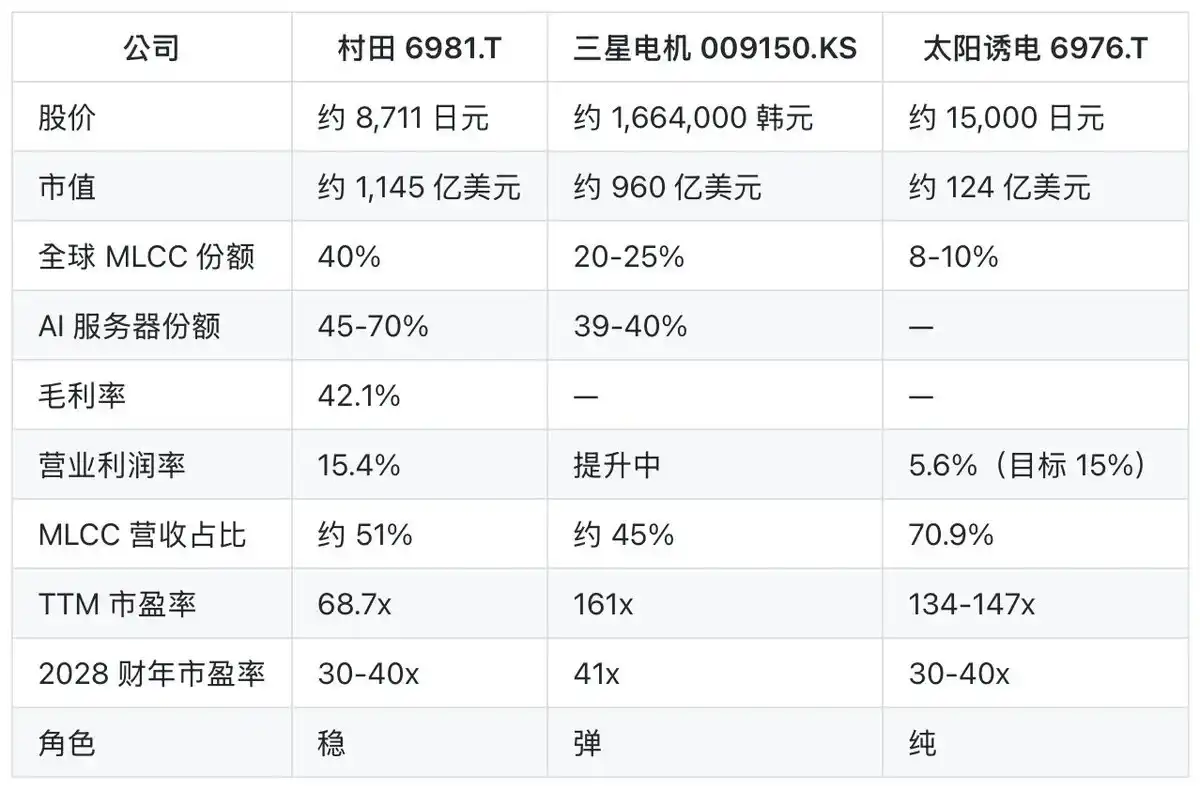
At first glance, the TTM P/E ratios of all three aren't low: Murata at 68x, Taiyo Yuden at 134x+, Samsung EM as high as 161x. Does this mean they are already too expensive and chasing is dangerous?

This judgment needs more careful dissection. A high P/E ratio has completely different meanings at different points in a cycle. If a company's earnings have already peaked, a high P/E is a danger signal. But if earnings are on the eve of an explosion, today's high P/E is precisely because the denominator (earnings) hasn't yet risen. The forward P/E ratios for all three companies are rapidly compressing downward—Murata from 68x to the 30s, Samsung EM from 161x to 41x—this compression isn't achieved through stock price decline but through profit growth. This is a classic feature of the early stage of a cycle: the market has priced in part of the AI expectation but is far from fully reflecting the impending price hike红利 (bonus).

The market has given this cycle a heavy definition: the largest, longest MLCC super-cycle in history, continuing until 2030. And the current position is merely the early stage of the upturn, comparable to the latter half of 2017 in the previous cycle—the show has just begun.

Why is the price hike so critical? Because MLCCs are a business highly dependent on capacity utilization, with fixed costs comprising a large portion. Once prices rise, the extra money almost directly translates into profit. According to estimates, for Taiyo Yuden, a 5% increase in average selling price could boost operating profit by 37%. This is the power of operating leverage—small changes in price are amplified into multiples of change in profit.

In an industry with locked-in supply, every bit of price increase almost directly becomes profit.

And the room for price hikes this round is considerable. Potential increases for high-end MLCCs could reach 100% to 150%, while even standard products have room for 30% to 50% increases. Overlaying this price elasticity onto the previously mentioned supply-demand gap—supply growing 10% annually, demand growing 34% annually, with the gap widening until 2028—you can understand why this is called a super-cycle. The ceiling on supply is firmly in place, while the floor of demand keeps rising. The space in between is where the imagination for profits and stock prices lies.

ETFs and Purchase Channels

After all this, many will ask: How to participate?

First, a slightly disappointing fact: there are no pure MLCC-themed ETFs on the market. This sector is too niche and not yet covered by specialized index products. However, indirect exposure is still possible through some relevant instruments.

In the Korean market, the most noteworthy is the SOL AI Semiconductor TOP2 Plus ETF, where Samsung EM has a 27.3% weighting, with a net asset value of about ₩5 trillion. It's a decent choice for gaining exposure to Samsung EM's elasticity. In the Japanese market, consider NEXT FUNDS' 1625.T, where Murata, TDK, and Taiyo Yuden combined account for about 8% to 12% weighting, effectively packaging the Japanese giants into a basket. In the U.S. market, MLCC-related holdings in EWJ total about 3.5%, and MKOR has a 4.85% weighting for Samsung EM; both concentrations are relatively low, making them more suitable as part of a portfolio rather than the main vehicle.

For more direct exposure, consider ADRs. Murata's ADR is MRAAY, and Taiyo Yuden's is TYOYY; both can be purchased in the U.S. market, avoiding the hassle of directly trading Japanese stocks.

Risks and Conclusion

For any investment, understanding the risks is as important as seeing the opportunities. There are five risk points to keep in mind for this sector.

First, a reduction in AI capital expenditure, a high-risk item. The entire demand-side story is built on cloud providers and compute players continuously pouring money. If industry investment slows, the demand curve flattens, directly impacting the super-cycle logic.

Second, high valuation, also high risk. As mentioned, current P/E ratios already reflect some expectations. If subsequent profit realization falls short, valuation could face downward pressure.

Third, capacity expansion in Mainland China, a medium risk. Expansion by Mainland Chinese manufacturers in the mid-to-low end could cause price disturbances but is unlikely to break into the high-end segment in the short term, thus having limited impact on the core markets of the Big Three.

Fourth, Yen appreciation, a medium risk. Both Murata and Taiyo Yuden are Japanese companies. Significant Yen appreciation would erode their overseas revenue and profits, putting pressure on their Yen-denominated stock prices.

Fifth, weakness in consumer electronics, also a medium risk. The traditional bulk of MLCC demand still comes from consumer electronics, a market experiencing a K-shaped recovery—stable high-end, weak low-end—and the overall drag cannot be ignored.

Listing these risks isn't meant to scare anyone off but to make it clear—the logic of this super-cycle is solid, but it's not a one-way street without variables. The sustainability of demand, valuation digestion, and currency fluctuations all require continuous monitoring.

Returning to the opening question: After GPUs, what's quietly rising in price? The answer is now clear. It's MLCCs, these small capacitors that were previously taken for granted. They are undergoing an identity transformation—from a commodity whose price drifted with the tides, producible by anyone, into a strategic material locked in by certification, constrained by capacity, and repriced by AI.

As computing power becomes the oil of this era, the MLCCs that control every drop of electrical current are the indispensable pipelines no one notices.


Domande pertinenti

QWhat are the main factors driving the significant price increase and supply shortage in the high-end MLCC market, according to the article?

AThe primary driver is structural demand from high-end applications, specifically AI servers and electric vehicles, not mere inventory speculation. AI servers require exponentially more MLCCs for power delivery and stabilization in high-power-density, low-voltage GPUs (e.g., 60,000 to 350,000 per rack). This demand is compounded by a shift from aluminum polymer capacitors to MLCCs in servers and high reliability requirements in EVs. On the supply side, capacity expansion is severely constrained by six major barriers: high technical/patent barriers, long client certification cycles (12-18 months for AI servers), massive capital requirements (3-5 billion USD per high-end line with a 4-5 year ramp-up), talent shortages, dependence on key raw materials, and a collective 'supply discipline' among incumbents who fear repeating past boom-bust cycles. Annual supply growth is only around 10%, far below the ~34% demand CAGR for AI MLCCs.

QWho are the three leading companies in the global high-end MLCC market, and what are their key characteristics and competitive positions?

A1. **Murata (村田)**: The absolute leader with ~40% global MLCC share and 45-70% in the high-end AI server segment. It is valued for its scale, profitability (42.1% gross margin), technology moat built over 80 years, and stability. Its role is the 'certainty' pick. 2. **Samsung Electro-Mechanics (SEMCO)**: The 'growth elasticity' player with 20-25% global share and 39-40% in AI server MLCCs. It boasts the most aggressive capacity expansion plans (doubling CapEx in 2026), strong profit growth, and benefits from the Samsung Group ecosystem. Its high P/E is expected to compress rapidly with earnings growth. 3. **Taiyo Yuden (太陽誘電)**: The 'purest' MLCC play, with MLCCs constituting 70.9% of its revenue—the highest concentration. It is the smallest of the three and offers the highest beta (volatility) tied directly to the MLCC cycle. It is currently in a profitability recovery phase, targeting significant margin expansion by 2030.

QHow does the MLCC usage in an AI server compare to a traditional server, and what explains this dramatic increase?

AA traditional general-purpose server uses about 2,000 MLCCs. In contrast, an 8-GPU AI training server uses 25,000-28,000 MLCCs—over a tenfold increase. The most advanced racks, like Nvidia's GB300 NVL72 and the future Vera Rubin platforms, require 440,000 to 350,000+ MLCCs per unit. The explosion is driven by power delivery needs: next-gen GPUs run at very low voltages (<1V) but extremely high power (e.g., 1,800W), leading to massive current (over 1,800A). MLCCs act as 'decoupling capacitors' or 'stabilizing reservoirs' to smooth out nanosecond-level current fluctuations very close to the GPU. Lower voltage and higher current density necessitate more, smaller capacitors placed densely around the chip. Additionally, the replacement of bulkier aluminum polymer capacitors with MLCCs in server power delivery adds a further 1.5x to 2x multiplier to the count.

QWhat are the primary investment vehicles or methods mentioned for gaining exposure to the MLCC theme, and what are their limitations?

AThe article notes there is **no pure-play MLCC thematic ETF**. Indirect exposure can be gained through: 1. **Country/Region ETFs with high concentrations**: * South Korea's **SOL AI Semiconductor TOP2 Plus ETF** (Samsung Electro-Mechanics weight: 27.3%). * Japan's **NEXT FUNDS 1625.T** (combined ~8-12% weight in Murata, TDK, Taiyo Yuden). * US-listed **iShares MSCI Japan ETF (EWJ)** and **iShares MSCI South Korea ETF (MKOR)** have lower single-digit exposures. 2. **American Depositary Receipts (ADRs)**: A more direct method for US investors. * Murata: **MRAAY** * Taiyo Yuden: **TYOYY** The key limitation is the lack of a dedicated, concentrated fund, forcing investors to use baskets with varying levels of 'purity' to the theme.

QWhat are the key risks to the 'MLCC super-cycle' investment thesis outlined in the article?

AThe article identifies five main risks: 1. **High Risk - AI Capex Slowdown**: The entire demand story hinges on sustained, massive investment in AI infrastructure by cloud and tech companies. A slowdown would directly undermine the cycle. 2. **High Risk - Elevated Valuations**: Current high P/E ratios (e.g., 68x for Murata, 161x for SEMCO) already price in significant growth expectations. If future earnings fail to meet these high expectations, significant valuation compression could occur. 3. **Medium Risk - Chinese Capacity Expansion**: While Chinese manufacturers currently lag in high-end technology, their rapid expansion in mid-to-low-end markets could create price pressure and disrupt the overall market structure. 4. **Medium Risk - Yen Appreciation**: For Japanese players Murata and Taiyo Yuden, a strong yen would negatively impact their overseas revenue and profits when converted back to JPY, pressuring their stock prices. 5. **Medium Risk - Consumer Electronics Weakness**: The traditional core market for MLCCs remains consumer electronics, which is experiencing a 'K-shaped' recovery. Prolonged weakness in this segment could offset some gains from the high-growth AI/EV sectors.

Letture associate

SemiAnalysis Report Claims Delay in Two Key Technologies, Triggers Sharp Decline in 'Optoelectronics', Sparking Online Debate Over CPO

A report from analysis firm SemiAnalysis, claiming significant delays in two key AI data center technologies, triggered a sharp sell-off in the photonics sector and sparked intense online debate. The report, dated June 10, states that NVIDIA's 800VDC power architecture rollout is pushed to 2028 and CPO (Co-Packaged Optics) mass production is likely delayed until 2028 or even 2029. Following the news, U.S. optical communication stocks fell sharply, with AAOI dropping 17% and Lumentum down about 8%. The delays were attributed to engineering challenges like photonic engine yield and cost-effectiveness, not a disappearance of demand. Simultaneously, an interview with NVIDIA's networking SVP Gilad Shainer presented an opposing, optimistic view, stating CPO is "the most exciting thing" and shipments would begin scaling in the second half of the year. This contradiction fueled debate on social media. Bears pointed to unresolved reliability and maintenance hurdles for CPO. Bulls argued the delay simply redirects capital to interim solutions like traditional pluggable optical modules and NPO (Near-Packaged Optics), extending their revenue runway. Some users questioned the report's internal logic and timing, noting similar views had circulated earlier. Analysts highlighted potential beneficiaries, including companies in the 1.6T pluggable modules, NPO, and 400VDC power transition supply chains. The consensus suggests the market reaction reflects a recalibration of the technology adoption timeline rather than a fundamental weakening of AI infrastructure demand, with key bottlenecks like power, storage, and GPUs remaining unchanged.

marsbit30 min fa

SemiAnalysis Report Claims Delay in Two Key Technologies, Triggers Sharp Decline in 'Optoelectronics', Sparking Online Debate Over CPO

marsbit30 min fa

U.S. Stock Market Trend: Nasdaq Plunges 3.5% Intraday Before a Remarkable Recovery, All Eyes on CPI Tomorrow

"US Stock Market Trends: Nasdaq Plunges 3.5% Before Dramatic Recovery, Eyes on Tomorrow's CPI" On Tuesday, US markets experienced a wild swing. The Nasdaq initially surged nearly 0.7% before plummeting to a 3.5% intraday loss following a post by Donald Trump on Truth Social. He stated that Iran had shot down a US Apache helicopter in the Strait of Hormuz and that the US "must...respond." The index, however, staged a remarkable recovery in the final two hours, closing down only 0.97%, as subsequent remarks from Trump and Vice President Vance suggested a potential Iran deal within days. The S&P 500 fell 0.26%, while the Dow Jones gained 0.17%, supported by its non-tech components. This incident marked the first loss of a US military asset since tensions with Iran escalated in late February. Despite the event, crude oil prices fell sharply (WTI -3.93%) due to expectations of a near-term deal, OPEC+ plans to increase output, and fears that strong jobs data could lead to Fed rate hikes. Market attention is now laser-focused on the May CPI data release Wednesday morning. This report is seen as critical evidence for whether hot job growth is fueling inflation and will heavily influence expectations for the Federal Reserve's upcoming meeting. A hotter-than-expected reading could trigger further sell-offs, particularly in tech, while a cooler print could spark a significant rebound. The article notes a clear sector rotation, with money flowing out of tech (Nasdaq down over 5% in a week) into defensive sectors like healthcare and consumer staples. Other assets like gold and Bitcoin also remain under pressure. The overarching sentiment is one of "war fatigue," with markets desperately awaiting concrete results from the prolonged Iran negotiations rather than reacting to each new headline.

marsbit1 h fa

U.S. Stock Market Trend: Nasdaq Plunges 3.5% Intraday Before a Remarkable Recovery, All Eyes on CPI Tomorrow

marsbit1 h fa

Trading

Spot
Futures

Articoli Popolari

Cosa è GROK AI

Grok AI: Rivoluzionare la Tecnologia Conversazionale nell'Era Web3 Introduzione Nel panorama in rapida evoluzione dell'intelligenza artificiale, Grok AI si distingue come un progetto notevole che collega i domini della tecnologia avanzata e dell'interazione con l'utente. Sviluppato da xAI, un'azienda guidata dal rinomato imprenditore Elon Musk, Grok AI cerca di ridefinire il modo in cui interagiamo con l'intelligenza artificiale. Mentre il movimento Web3 continua a prosperare, Grok AI mira a sfruttare il potere dell'IA conversazionale per rispondere a query complesse, offrendo agli utenti un'esperienza che è non solo informativa ma anche divertente. Cos'è Grok AI? Grok AI è un sofisticato chatbot di intelligenza artificiale conversazionale progettato per interagire dinamicamente con gli utenti. A differenza di molti sistemi di intelligenza artificiale tradizionali, Grok AI abbraccia un'ampia gamma di domande, comprese quelle tipicamente considerate inappropriate o al di fuori delle risposte standard. Gli obiettivi principali del progetto includono: Ragionamento Affidabile: Grok AI enfatizza il ragionamento di buon senso per fornire risposte logiche basate sulla comprensione contestuale. Supervisione Scalabile: L'integrazione dell'assistenza degli strumenti garantisce che le interazioni degli utenti siano sia monitorate che ottimizzate per la qualità. Verifica Formale: La sicurezza è fondamentale; Grok AI incorpora metodi di verifica formale per migliorare l'affidabilità delle sue uscite. Comprensione del Lungo Contesto: Il modello di IA eccelle nel trattenere e richiamare una vasta storia di conversazione, facilitando discussioni significative e consapevoli del contesto. Robustezza Adversariale: Concentrandosi sul miglioramento delle sue difese contro input manipolati o malevoli, Grok AI mira a mantenere l'integrità delle interazioni degli utenti. In sostanza, Grok AI non è solo un dispositivo di recupero informazioni; è un partner conversazionale immersivo che incoraggia un dialogo dinamico. Creatore di Grok AI Il cervello dietro Grok AI non è altri che Elon Musk, un individuo sinonimo di innovazione in vari campi, tra cui automotive, viaggi spaziali e tecnologia. Sotto l'egida di xAI, un'azienda focalizzata sull'avanzamento della tecnologia AI in modi benefici, la visione di Musk mira a rimodellare la comprensione delle interazioni con l'IA. La leadership e l'etica fondamentale sono profondamente influenzate dall'impegno di Musk nel superare i confini tecnologici. Investitori di Grok AI Sebbene i dettagli specifici riguardanti gli investitori che sostengono Grok AI rimangano limitati, è pubblicamente riconosciuto che xAI, l'incubatore del progetto, è fondato e supportato principalmente dallo stesso Elon Musk. Le precedenti imprese e partecipazioni di Musk forniscono un robusto sostegno, rafforzando ulteriormente la credibilità e il potenziale di crescita di Grok AI. Tuttavia, al momento, le informazioni riguardanti ulteriori fondazioni di investimento o organizzazioni che supportano Grok AI non sono facilmente accessibili, segnando un'area per potenziali esplorazioni future. Come Funziona Grok AI? Le meccaniche operative di Grok AI sono innovative quanto il suo framework concettuale. Il progetto integra diverse tecnologie all'avanguardia che facilitano le sue funzionalità uniche: Infrastruttura Robusta: Grok AI è costruito utilizzando Kubernetes per l'orchestrazione dei container, Rust per prestazioni e sicurezza, e JAX per il calcolo numerico ad alte prestazioni. Questo trio garantisce che il chatbot operi in modo efficiente, si scaldi efficacemente e serva gli utenti prontamente. Accesso alla Conoscenza in Tempo Reale: Una delle caratteristiche distintive di Grok AI è la sua capacità di attingere a dati in tempo reale attraverso la piattaforma X—precedentemente nota come Twitter. Questa capacità consente all'IA di accedere alle informazioni più recenti, permettendole di fornire risposte e raccomandazioni tempestive che altri modelli di IA potrebbero perdere. Due Modalità di Interazione: Grok AI offre agli utenti la scelta tra “Modalità Divertente” e “Modalità Normale”. La Modalità Divertente consente uno stile di interazione più giocoso e umoristico, mentre la Modalità Normale si concentra sulla fornitura di risposte precise e accurate. Questa versatilità garantisce un'esperienza su misura che soddisfa varie preferenze degli utenti. In sostanza, Grok AI sposa prestazioni con coinvolgimento, creando un'esperienza che è sia arricchente che divertente. Cronologia di Grok AI Il viaggio di Grok AI è segnato da traguardi fondamentali che riflettono le sue fasi di sviluppo e distribuzione: Sviluppo Iniziale: La fase fondamentale di Grok AI si è svolta in circa due mesi, durante i quali sono stati condotti l'addestramento iniziale e il perfezionamento del modello. Rilascio Beta di Grok-2: In un significativo avanzamento, è stata annunciata la beta di Grok-2. Questo rilascio ha introdotto due versioni del chatbot—Grok-2 e Grok-2 mini—ognuna dotata delle capacità per chattare, programmare e ragionare. Accesso Pubblico: Dopo lo sviluppo beta, Grok AI è diventato disponibile per gli utenti della piattaforma X. Coloro che hanno account verificati tramite un numero di telefono e attivi per almeno sette giorni possono accedere a una versione limitata, rendendo la tecnologia disponibile a un pubblico più ampio. Questa cronologia racchiude la crescita sistematica di Grok AI dall'inizio all'impegno pubblico, enfatizzando il suo impegno per il miglioramento continuo e l'interazione con gli utenti. Caratteristiche Chiave di Grok AI Grok AI comprende diverse caratteristiche chiave che contribuiscono alla sua identità innovativa: Integrazione della Conoscenza in Tempo Reale: L'accesso a informazioni attuali e rilevanti differenzia Grok AI da molti modelli statici, consentendo un'esperienza utente coinvolgente e accurata. Stili di Interazione Versatili: Offrendo modalità di interazione distinte, Grok AI soddisfa varie preferenze degli utenti, invitando alla creatività e alla personalizzazione nella conversazione con l'IA. Avanzata Struttura Tecnologica: L'utilizzo di Kubernetes, Rust e JAX fornisce al progetto un solido framework per garantire affidabilità e prestazioni ottimali. Considerazione del Discorso Etico: L'inclusione di una funzione di generazione di immagini mette in mostra lo spirito innovativo del progetto. Tuttavia, solleva anche considerazioni etiche riguardanti il copyright e la rappresentazione rispettosa di figure riconoscibili—una discussione in corso all'interno della comunità AI. Conclusione Come entità pionieristica nel campo dell'IA conversazionale, Grok AI incarna il potenziale per esperienze utente trasformative nell'era digitale. Sviluppato da xAI e guidato dall'approccio visionario di Elon Musk, Grok AI integra conoscenze in tempo reale con capacità di interazione avanzate. Si sforza di spingere i confini di ciò che l'intelligenza artificiale può realizzare, mantenendo un focus su considerazioni etiche e sicurezza degli utenti. Grok AI non solo incarna il progresso tecnologico, ma rappresenta anche un nuovo paradigma conversazionale nel panorama Web3, promettendo di coinvolgere gli utenti con sia conoscenze esperte che interazioni giocose. Man mano che il progetto continua a evolversi, si erge come testimonianza di ciò che l'incrocio tra tecnologia, creatività e interazione simile a quella umana può realizzare.

489 Totale visualizzazioniPubblicato il 2024.12.26Aggiornato il 2024.12.26

Cosa è GROK AI

Cosa è ERC AI

Euruka Tech: Una Panoramica di $erc ai e delle sue Ambizioni in Web3 Introduzione Nel panorama in rapida evoluzione della tecnologia blockchain e delle applicazioni decentralizzate, nuovi progetti emergono frequentemente, ciascuno con obiettivi e metodologie uniche. Uno di questi progetti è Euruka Tech, che opera nel vasto dominio delle criptovalute e del Web3. L'obiettivo principale di Euruka Tech, in particolare del suo token $erc ai, è presentare soluzioni innovative progettate per sfruttare le crescenti capacità della tecnologia decentralizzata. Questo articolo si propone di fornire una panoramica completa di Euruka Tech, un'esplorazione dei suoi obiettivi, della funzionalità, dell'identità del suo creatore, dei potenziali investitori e della sua importanza nel contesto più ampio del Web3. Cos'è Euruka Tech, $erc ai? Euruka Tech è caratterizzato come un progetto che sfrutta gli strumenti e le funzionalità offerte dall'ambiente Web3, concentrandosi sull'integrazione dell'intelligenza artificiale nelle sue operazioni. Sebbene i dettagli specifici sul framework del progetto siano piuttosto sfuggenti, è progettato per migliorare l'engagement degli utenti e automatizzare i processi nello spazio crypto. Il progetto mira a creare un ecosistema decentralizzato che non solo faciliti le transazioni, ma incorpori anche funzionalità predittive attraverso l'intelligenza artificiale, da cui il nome del suo token, $erc ai. L'obiettivo è fornire una piattaforma intuitiva che faciliti interazioni più intelligenti e un'elaborazione delle transazioni più efficiente all'interno della crescente sfera del Web3. Chi è il Creatore di Euruka Tech, $erc ai? Attualmente, le informazioni riguardanti il creatore o il team fondatore di Euruka Tech rimangono non specificate e piuttosto opache. Questa assenza di dati solleva preoccupazioni, poiché la conoscenza del background del team è spesso essenziale per stabilire credibilità nel settore blockchain. Pertanto, abbiamo classificato queste informazioni come sconosciute fino a quando dettagli concreti non saranno resi disponibili nel dominio pubblico. Chi sono gli Investitori di Euruka Tech, $erc ai? Allo stesso modo, l'identificazione degli investitori o delle organizzazioni di supporto per il progetto Euruka Tech non è prontamente fornita attraverso la ricerca disponibile. Un aspetto cruciale per i potenziali stakeholder o utenti che considerano di impegnarsi con Euruka Tech è la garanzia che deriva da partnership finanziarie consolidate o dal supporto di società di investimento rispettabili. Senza divulgazioni sulle affiliazioni di investimento, è difficile trarre conclusioni complete sulla sicurezza finanziaria o sulla longevità del progetto. In linea con le informazioni trovate, anche questa sezione rimane allo stato di sconosciuto. Come funziona Euruka Tech, $erc ai? Nonostante la mancanza di specifiche tecniche dettagliate per Euruka Tech, è essenziale considerare le sue ambizioni innovative. Il progetto cerca di sfruttare la potenza computazionale dell'intelligenza artificiale per automatizzare e migliorare l'esperienza dell'utente all'interno dell'ambiente delle criptovalute. Integrando l'IA con la tecnologia blockchain, Euruka Tech mira a fornire funzionalità come operazioni automatizzate, valutazioni del rischio e interfacce utente personalizzate. L'essenza innovativa di Euruka Tech risiede nel suo obiettivo di creare una connessione fluida tra gli utenti e le vaste possibilità presentate dalle reti decentralizzate. Attraverso l'utilizzo di algoritmi di apprendimento automatico e IA, mira a ridurre le sfide degli utenti alle prime armi e semplificare le esperienze transazionali all'interno del framework Web3. Questa simbiosi tra IA e blockchain sottolinea l'importanza del token $erc ai, fungendo da ponte tra le interfacce utente tradizionali e le avanzate capacità delle tecnologie decentralizzate. Cronologia di Euruka Tech, $erc ai Sfortunatamente, a causa delle limitate informazioni disponibili riguardo a Euruka Tech, non siamo in grado di presentare una cronologia dettagliata dei principali sviluppi o traguardi nel percorso del progetto. Questa cronologia, tipicamente preziosa per tracciare l'evoluzione di un progetto e comprendere la sua traiettoria di crescita, non è attualmente disponibile. Man mano che le informazioni su eventi notevoli, partnership o aggiunte funzionali diventano evidenti, gli aggiornamenti miglioreranno sicuramente la visibilità di Euruka Tech nella sfera crypto. Chiarimento su Altri Progetti “Eureka” È importante sottolineare che più progetti e aziende condividono una nomenclatura simile con “Eureka.” La ricerca ha identificato iniziative come un agente IA della NVIDIA Research, che si concentra sull'insegnamento ai robot di compiti complessi utilizzando metodi generativi, così come Eureka Labs ed Eureka AI, che migliorano l'esperienza utente nell'istruzione e nell'analisi del servizio clienti, rispettivamente. Tuttavia, questi progetti sono distinti da Euruka Tech e non dovrebbero essere confusi con i suoi obiettivi o funzionalità. Conclusione Euruka Tech, insieme al suo token $erc ai, rappresenta un attore promettente ma attualmente oscuro nel panorama del Web3. Sebbene i dettagli sul suo creatore e sugli investitori rimangano non divulgati, l'ambizione centrale di combinare intelligenza artificiale e tecnologia blockchain si erge come un punto focale di interesse. Gli approcci unici del progetto nel promuovere l'engagement degli utenti attraverso l'automazione avanzata potrebbero distinguerlo mentre l'ecosistema Web3 progredisce. Con l'evoluzione continua del mercato crypto, gli stakeholder dovrebbero tenere d'occhio gli sviluppi riguardanti Euruka Tech, poiché lo sviluppo di innovazioni documentate, partnership o una roadmap definita potrebbe presentare opportunità significative nel prossimo futuro. Così com'è, attendiamo ulteriori approfondimenti sostanziali che potrebbero svelare il potenziale di Euruka Tech e la sua posizione nel competitivo panorama crypto.

507 Totale visualizzazioniPubblicato il 2025.01.02Aggiornato il 2025.01.02

Cosa è ERC AI

Cosa è DUOLINGO AI

DUOLINGO AI: Integrare l'apprendimento delle lingue con Web3 e innovazione AI In un'era in cui la tecnologia rimodella l'istruzione, l'integrazione dell'intelligenza artificiale (AI) e delle reti blockchain annuncia una nuova frontiera per l'apprendimento delle lingue. Entra in scena DUOLINGO AI e la sua criptovaluta associata, $DUOLINGO AI. Questo progetto aspira a fondere la potenza educativa delle principali piattaforme di apprendimento delle lingue con i benefici della tecnologia decentralizzata Web3. Questo articolo esplora gli aspetti chiave di DUOLINGO AI, esaminando i suoi obiettivi, il framework tecnologico, lo sviluppo storico e il potenziale futuro, mantenendo chiarezza tra la risorsa educativa originale e questa iniziativa indipendente di criptovaluta. Panoramica di DUOLINGO AI Alla sua base, DUOLINGO AI cerca di stabilire un ambiente decentralizzato in cui gli studenti possono guadagnare ricompense crittografiche per il raggiungimento di traguardi educativi nella competenza linguistica. Applicando smart contracts, il progetto mira ad automatizzare i processi di verifica delle competenze e le allocazioni di token, aderendo ai principi di Web3 che enfatizzano la trasparenza e la proprietà da parte degli utenti. Il modello si discosta dagli approcci tradizionali all'acquisizione linguistica, facendo forte affidamento su una struttura di governance guidata dalla comunità, che consente ai detentori di token di suggerire miglioramenti ai contenuti dei corsi e alle distribuzioni delle ricompense. Alcuni degli obiettivi notevoli di DUOLINGO AI includono: Apprendimento Gamificato: Il progetto integra traguardi blockchain e token non fungibili (NFT) per rappresentare i livelli di competenza linguistica, promuovendo la motivazione attraverso ricompense digitali coinvolgenti. Creazione di Contenuti Decentralizzati: Apre opportunità per educatori e appassionati di lingue di contribuire con i propri corsi, facilitando un modello di condivisione dei ricavi che beneficia tutti i collaboratori. Personalizzazione Guidata dall'AI: Utilizzando modelli avanzati di machine learning, DUOLINGO AI personalizza le lezioni per adattarsi ai progressi individuali, simile alle funzionalità adattive presenti nelle piattaforme consolidate. Creatori del Progetto e Governance A partire da aprile 2025, il team dietro $DUOLINGO AI rimane pseudonimo, una pratica comune nel panorama decentralizzato delle criptovalute. Questa anonimato è inteso a promuovere la crescita collettiva e il coinvolgimento degli stakeholder piuttosto che concentrarsi su sviluppatori individuali. Lo smart contract distribuito sulla blockchain di Solana annota l'indirizzo del wallet dello sviluppatore, che segna l'impegno verso la trasparenza riguardo alle transazioni, nonostante l'identità dei creatori sia sconosciuta. Secondo la sua roadmap, DUOLINGO AI mira a evolversi in un'Organizzazione Autonoma Decentralizzata (DAO). Questa struttura di governance consente ai detentori di token di votare su questioni critiche come l'implementazione di funzionalità e le allocazioni del tesoro. Questo modello si allinea con l'etica dell'empowerment della comunità presente in varie applicazioni decentralizzate, enfatizzando l'importanza del processo decisionale collettivo. Investitori e Partnership Strategiche Attualmente, non ci sono investitori istituzionali o capitalisti di rischio identificabili pubblicamente legati a $DUOLINGO AI. Invece, la liquidità del progetto proviene principalmente da scambi decentralizzati (DEX), segnando un netto contrasto con le strategie di finanziamento delle aziende tradizionali di tecnologia educativa. Questo modello di base indica un approccio guidato dalla comunità, riflettendo l'impegno del progetto verso la decentralizzazione. Nel suo whitepaper, DUOLINGO AI menziona la formazione di collaborazioni con “piattaforme educative blockchain” non specificate, mirate ad arricchire la sua offerta di corsi. Sebbene partnership specifiche non siano ancora state divulgate, questi sforzi collaborativi suggeriscono una strategia per mescolare innovazione blockchain con iniziative educative, ampliando l'accesso e il coinvolgimento degli utenti attraverso diverse vie di apprendimento. Architettura Tecnologica Integrazione AI DUOLINGO AI incorpora due componenti principali guidate dall'AI per migliorare la sua offerta educativa: Motore di Apprendimento Adattivo: Questo sofisticato motore apprende dalle interazioni degli utenti, simile ai modelli proprietari delle principali piattaforme educative. Regola dinamicamente la difficoltà delle lezioni per affrontare le sfide specifiche degli studenti, rinforzando le aree deboli attraverso esercizi mirati. Agenti Conversazionali: Utilizzando chatbot alimentati da GPT-4, DUOLINGO AI offre una piattaforma per gli utenti per impegnarsi in conversazioni simulate, promuovendo un'esperienza di apprendimento linguistico più interattiva e pratica. Infrastruttura Blockchain Costruito sulla blockchain di Solana, $DUOLINGO AI utilizza un framework tecnologico completo che include: Smart Contracts per la Verifica delle Competenze: Questa funzionalità assegna automaticamente token agli utenti che superano con successo i test di competenza, rinforzando la struttura di incentivi per risultati di apprendimento genuini. Badge NFT: Questi token digitali significano vari traguardi che gli studenti raggiungono, come completare una sezione del loro corso o padroneggiare competenze specifiche, consentendo loro di scambiare o mostrare digitalmente i loro successi. Governance DAO: I membri della comunità dotati di token possono partecipare alla governance votando su proposte chiave, facilitando una cultura partecipativa che incoraggia l'innovazione nell'offerta di corsi e nelle funzionalità della piattaforma. Cronologia Storica 2022–2023: Concettualizzazione I lavori per DUOLINGO AI iniziano con la creazione di un whitepaper, evidenziando la sinergia tra i progressi dell'AI nell'apprendimento delle lingue e il potenziale decentralizzato della tecnologia blockchain. 2024: Lancio Beta Un lancio beta limitato introduce offerte in lingue popolari, premiando i primi utenti con incentivi in token come parte della strategia di coinvolgimento della comunità del progetto. 2025: Transizione DAO Ad aprile, avviene un lancio completo della mainnet con la circolazione di token, stimolando discussioni nella comunità riguardo a possibili espansioni nelle lingue asiatiche e ad altri sviluppi dei corsi. Sfide e Direzioni Future Ostacoli Tecnici Nonostante i suoi obiettivi ambiziosi, DUOLINGO AI affronta sfide significative. La scalabilità rimane una preoccupazione costante, in particolare nel bilanciare i costi associati all'elaborazione dell'AI e nel mantenere una rete decentralizzata reattiva. Inoltre, garantire la creazione e la moderazione di contenuti di qualità in un'offerta decentralizzata presenta complessità nel mantenere standard educativi. Opportunità Strategiche Guardando al futuro, DUOLINGO AI ha il potenziale per sfruttare partnership di micro-credentialing con istituzioni accademiche, fornendo validazioni verificate dalla blockchain delle competenze linguistiche. Inoltre, l'espansione cross-chain potrebbe consentire al progetto di attingere a basi utenti più ampie e a ulteriori ecosistemi blockchain, migliorando la sua interoperabilità e portata. Conclusione DUOLINGO AI rappresenta una fusione innovativa di intelligenza artificiale e tecnologia blockchain, presentando un'alternativa focalizzata sulla comunità ai sistemi tradizionali di apprendimento delle lingue. Sebbene il suo sviluppo pseudonimo e il modello economico emergente comportino alcuni rischi, l'impegno del progetto verso l'apprendimento gamificato, l'istruzione personalizzata e la governance decentralizzata illumina un percorso per la tecnologia educativa nel regno di Web3. Man mano che l'AI continua a progredire e l'ecosistema blockchain evolve, iniziative come DUOLINGO AI potrebbero ridefinire il modo in cui gli utenti interagiscono con l'istruzione linguistica, potenziando le comunità e premiando il coinvolgimento attraverso meccanismi di apprendimento innovativi.

463 Totale visualizzazioniPubblicato il 2025.04.11Aggiornato il 2025.04.11

Cosa è DUOLINGO AI

Discussioni

Benvenuto nella Community HTX. Qui puoi rimanere informato sugli ultimi sviluppi della piattaforma e accedere ad approfondimenti esperti sul mercato. Le opinioni degli utenti sul prezzo di AI AI sono presentate come di seguito.

活动图片