Second Largest Whale Cuts Losses and Liquidates, Can AAVE Still Be Bought Amid Deepening Conflict?

Odaily星球日报Pubblicato 2025-12-22Pubblicato ultima volta 2025-12-22

Introduzione

The second-largest AAVE whale, excluding the project team, protocol contracts, and exchanges, has sold off 230,000 AAVE tokens (worth approximately $38 million) at a loss, causing a 12% price drop. The sale occurred amid growing tensions between the Aave team and its community over governance and financial control. The conflict began when the community discovered that Aave Labs, without prior communication, redirected front-end exchange fees—previously directed to the Aave DAO treasury—to its own address after switching the default trading path to Cow Swap. This change could divert an estimated $10 million annually from the community to the team. Aave Labs defended the move, arguing that front-end products are separate from the protocol and that the team has the right to monetize its own infrastructure. In response, a proposal was made to transfer control of Aave’s brand assets—including domains and social accounts—to AAVE token holders. Founder Stani Kulechov opposed the proposal, calling it oversimplified and poorly structured, further escalating community backlash. The situation highlights deeper structural tensions in DeFi between team-controlled products and community-governed protocols. The outcome of the ongoing snapshot vote on the proposal may significantly influence AAVE’s price and long-term community trust.

Original | Odaily Planet Daily (@OdailyChina)

Author | Azuma (@azuma_eth)
The leading lending protocol Aave is embroiled in a public opinion storm, with the conflict between the team and the community intensifying, which has objectively shaken the confidence of token holders in the AAVE token itself.

In the early hours of today, the second-largest AAVE holding whale, excluding the project team, protocol contracts, and CEXs, cut losses and liquidated 230,000 AAVE (worth approximately $38 million), causing AAVE to drop 12% short-term. It is reported that this "number two big brother" purchased the AAVE holdings from late last year to early this year at an average price of $223.4. The average selling price today was about $165, resulting in a final loss of $13.45 million.

  • Odaily Note: The whale address is https://debank.com/profile/0xa923b13270f8622b5d5960634200dc4302b7611e.

Origin of the Incident: Fee Flow Dispute

To understand the current community crisis at Aave, we need to start with a recent change to the Aave frontend.

On December 4th, Aave announced a partnership with Cow Swap, adopting the latter as the default trading path for the swap function on the Aave frontend (Odaily Note: previously it was ParaSwap), utilizing its anti-MEV features for better quotes.
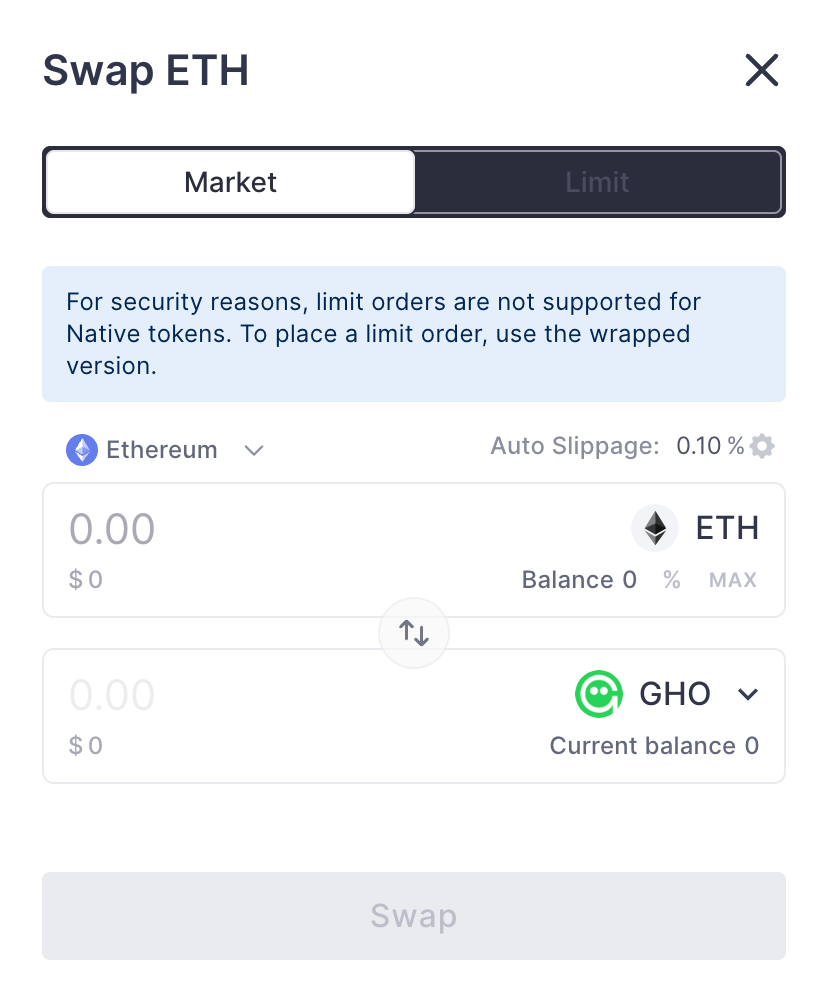
This seemed like a normal functional upgrade, but the community soon discovered that the additional fees generated by this function (including referral fees or positive slippage surplus fees), which previously flowed to the Aave DAO treasury address when using ParaSwap, were now being directed to the Aave Labs address after switching to Cow Swap.

Community representative EzR3aL was the first to notice this change, which Aave had not actively mentioned. They questioned the Aave team in the governance forum and estimated that, just tracking the income flow on Ethereum and Arbitrum, this fee change could generate around $200,000 in weekly revenue, corresponding to an annualized income of over $10 million — this meant Aave had redirected at least tens of millions of dollars in revenue from the community address to the team address, seemingly without anyone knowing.

Core Controversy: Who Really Owns the Aave Brand?

As EzR3aL's post gained traction, a large number of AAVE holders felt betrayed, especially considering that Aave made this change without communicating with the community or making any disclosure, somewhat hinting at an intention to conceal this alteration.

In response to community质疑 (queries/doubts), Aave Labs replied directly under EzR3aL's post, stating that there should be a clear distinction between the protocol layer and the product layer. The swap function interface on the Aave frontend is entirely operated by Aave Labs, which is responsible for capital investment, construction, and maintenance. This function is completely independent of the DAO-managed protocol. Therefore, Aave Labs has the right to independently decide how to operate and profit from it... The income previously flowing to the Aave DAO address was a donation from Aave Labs, but it was not an obligation.

In short, Aave Labs' stance is that the frontend interface and its ancillary functions essentially belong to the team's product, and the revenue generated should also be regarded as company property, not to be confused with the protocol and related income controlled by the DAO.

This statement quickly sparked heated discussion within the community regarding the ownership of the Aave protocol versus its products. A well-known DeFi analyst wrote an article titled "Who Really Owns 'Aave'?: Aave Labs vs Aave DAO". Odaily Planet Daily also published a Chinese translation, which can be read for further context.

On December 16th, the矛盾 (contradiction/conflict) was further intensified. Former Aave CTO Ernesto Boado initiated a proposal in the governance forum requesting the control of Aave brand assets (including domain names, social media accounts, naming rights, etc.) be transferred to AAVE token holders. The relevant assets would be managed through a DAO-controlled entity (the specific form to be determined later) with strict anti-encroachment protection mechanisms.

The proposal received nearly ten thousand views and hundreds of high-quality replies within the Aave governance forum. Various participants in the Aave ecosystem expressed their positions in the comments below the proposal. Although some voices believed the proposal's execution plan was insufficient and risked exacerbating the conflict, most replies expressed support.

Founder's Statement, But Community Unconvinced

As community sentiment heated up, Aave founder Stani responded in the forum: "...This proposal leads us in a direction unfavorable to the Aave ecosystem. It attempts to force a complex legal and operational issue into a simple 'yes/no' vote without providing a clear execution path. Handling such a complex issue should involve a specially designed structured process, achieving consensus through multiple interim checks accompanied by specific solutions. For the reasons above, I will vote against this proposal..."
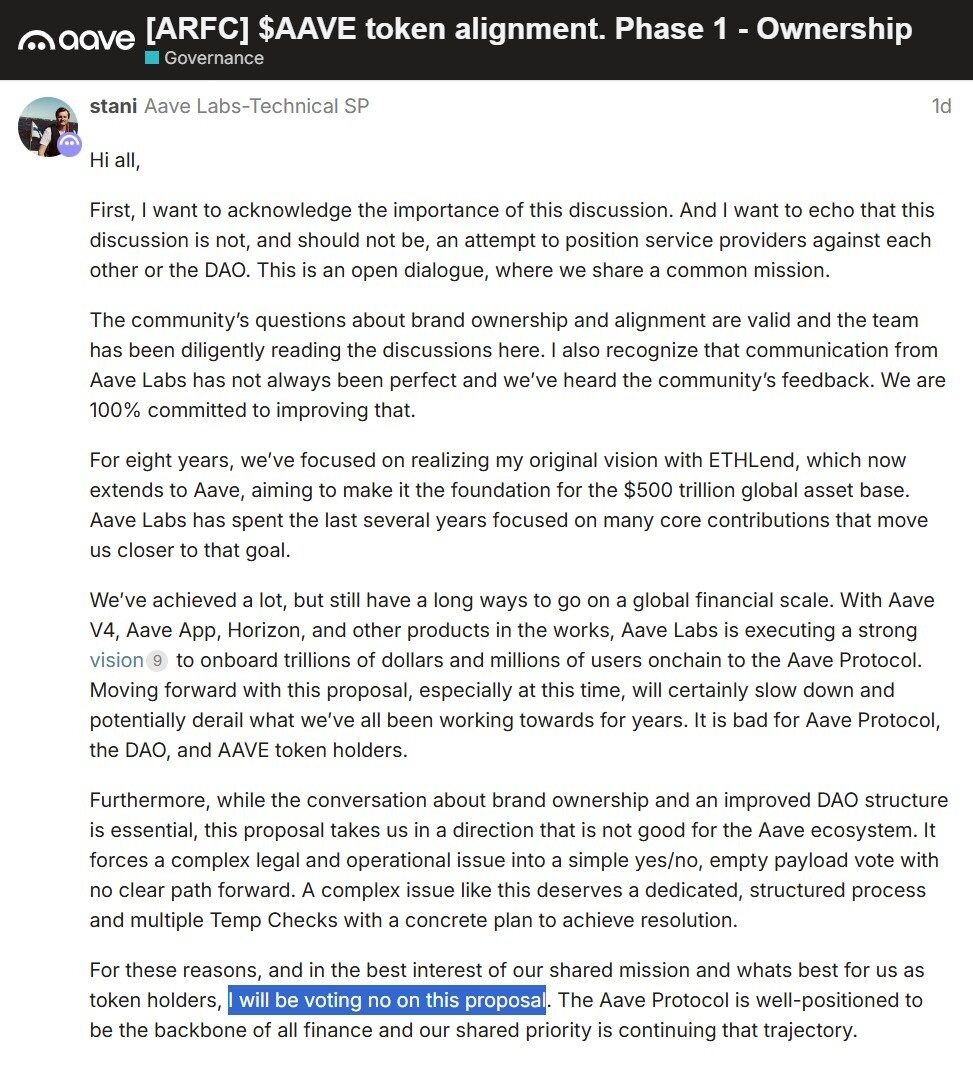
From a business operations perspective, Stani's claim that the proposal is too rash might not be wrong. However, in the current discussion atmosphere, this statement can easily be interpreted as 'the Aave founder disagrees with transferring brand assets to token holders,' which obviously further intensified the conflict between the community and the team.

After Stani's statement, even some attacking remarks against Stani appeared in the original post's comments. More users expressed their dissatisfaction via the forum or social media. An OG user mentioned it was the first time he considered liquidating his AAVE holdings. A loyal AAVE believer stated: "AAVE holders should realize this is just another DeFi shitcoin. It's neither better nor worse than the others."

The latest community development is the one mentioned at the beginning of this article: the number two big brother cutting losses and exiting with a loss exceeding ten million dollars.

Can AAVE Still Be Bought?

Just two weeks ago, Odaily Planet Daily wrote an article titled "What Did the Smart Money Aggressively Buying AAVE at Lows See?". At that time, AAVE was still a favorite of top institutions like Multicoin Capital. Its优质 (high-quality) brand reputation, substantial locked funds, clear expansion path, and strong revenue and buyback flow all proved that AAVE was a 'true value token' different from other altcoins.

But in just two weeks, a舆论危机 (public opinion crisis) spanning from fee ownership to brand control and then to team-community relations has rapidly plunged AAVE from a "representative of value tokens" into the center of controversy, even landing it on the short-term top decliners list due to emotional impact.

As of writing, Aave Labs has stated below Ernesto's proposal that they have initiated an ARFC snapshot vote on the proposal, allowing AAVE token holders to formally express their stance and clarify the future direction. The outcome of this vote and the subsequent handling attitude of the Aave Labs team will undoubtedly significantly impact Aave community faith and the short-term price performance of AAVE.

It is important to emphasize that this incident is not merely "negative news" or "performance change," but a集中拷问 (concentrated interrogation) of Aave's existing governance structure and boundaries of rights.

If you believe that Aave Labs will still maintain high alignment with Aave DAO's long-term interests, and the current friction is more of a communication and process失误 (mistake), then the price pullback led by emotions might be a good entry window; but if you think this controversy exposes not an occasional problem, but a structural contradiction of long-term unclear rights between the team and the protocol, lacking institutional constraints, then this storm might just be the beginning.

From a broader perspective, Aave's controversy is not an isolated case. As DeFi matures, protocol revenue becomes genuinely considerable, and brands and frontends begin to possess commercial value, some inherent structural contradictions between protocols and products, teams and communities will surface. Aave is pushed into the spotlight this time not because it erred more, but because it has gone further.

This debate over fees, brand, and control rights poses a question that needs answering not just by AAVE, but is an inevitable question the entire DeFi industry must eventually face.


Domande pertinenti

QWhat was the main reason behind the community crisis and whale selling AAVE tokens?

AThe crisis stemmed from a dispute over fee redirection from Aave's front-end swap function. After switching to Cow Swap, fees that previously flowed to the Aave DAO treasury were redirected to Aave Labs, causing community backlash over undisclosed changes and raising questions about revenue ownership.

QHow did Aave Labs justify redirecting the swap fees to their own address instead of the DAO treasury?

AAave Labs argued that the front-end interface and its swap functionality are separate from the protocol managed by the DAO. They claimed ownership of the product layer, stating that the fees generated were company property, not DAO revenue, and previous donations to the DAO were voluntary, not obligatory.

QWhat proposal did former Aave CTO Ernesto Boado make to address the community's concerns?

AErnesto Boado proposed transferring control of Aave's brand assets—including domains, social media accounts, and naming rights—to AAVE token holders through a DAO-controlled entity, aiming to ensure community governance and anti-encroachment protections.

QHow did Aave founder Stani Kulechov respond to the proposal, and what was the community's reaction?

AStani opposed the proposal, calling it overly simplistic for a complex legal and operational issue and advocating for a structured process with multiple checks. The community perceived this as resistance to decentralizing control, intensifying opposition and leading to negative sentiment, including whale sell-offs.

QWhat broader DeFi industry issue does the Aave controversy highlight?

AThe controversy underscores structural tensions in DeFi between teams and communities over revenue sharing, brand ownership, and governance control. It reflects a industry-wide challenge as protocols mature and front-end products gain commercial value, forcing debates on equitable distribution of power and profits.

Letture associate

Fei-Fei Li's Team Clarifies the Concept of 'World Models', Sora Merely a Renderer

"World Models" has become a widely used yet confusing term in AI. To address this, a team led by Fei-Fei Li and World Labs proposed a functional taxonomy based on the Partially Observable Markov Decision Process framework. This taxonomy categorizes systems called "world models" into three distinct projections: Renderers, Simulators, and Planners. Renderers, like OpenAI's Sora and other video generation models, focus on producing photorealistic visual outputs for human perception. They prioritize visual fidelity over physical accuracy. Simulators, such as NVIDIA Omniverse, aim to compute precise future environmental states for computational tasks like engineering analysis or digital twins. Planners, like Vision-Language-Action models, take in observations and goals to output executable actions for robots or agents. The article clarifies that most current "world models," including Sora, are primarily Renderers. They generate convincing visuals but lack the core ability to simulate state transitions based on actions, a key requirement for a true world model in classic reinforcement learning definitions. This conceptual confusion has practical implications, leading to potential misalignment in technology selection, investment, and public understanding of AI capabilities. Clear categorization is crucial. It helps enterprises avoid costly mistakes (e.g., using a renderer for robot training), allows investors to accurately assess markets, and enables researchers to build comparable benchmarks. While future systems may integrate these functions, recognizing current boundaries is essential for honest assessment and progress.

marsbit1 h fa

Fei-Fei Li's Team Clarifies the Concept of 'World Models', Sora Merely a Renderer

marsbit1 h fa

Bloomberg Uncovered: How Do China's Wealthy Circumvent the Annual $50,000 Limit to Transfer Assets?

**Summary: How Wealthy Chinese Circumvent $50,000 Annual Foreign Exchange Limits** Despite China's strict capital controls, including an annual $50,000 per person foreign exchange quota, an estimated $150 billion in funds still leaves the country annually via various gray and underground channels. This report outlines the evolution of China's "capital wall" and the methods used to bypass it. **The Evolving Capital Controls:** * **Foundation (1994):** The system of "current account convertibility with strict capital account controls" was established. * **Quota Set (2007):** The $50,000 individual annual forex purchase limit was formalized. * **Crackdown Begins (2015-2017):** Following market volatility, enforcement tightened. Banks were required to scrutinize transactions, and channels like using UnionPay cards for Hong Kong insurance premiums or buying overseas property were blocked. * **Digital & Legal Upgrades (2024-2026):** Enhanced algorithms now flag suspicious patterns (e.g., "smurfing"). The Common Reporting Standard (CRS) provides Chinese tax authorities with data on citizens' offshore accounts. Unlicensed cross-border brokers have been targeted. **Five Primary Methods for Moving Capital:** 1. **Underground Banking / "Hawala" (Duiqiao):** The largest-scale method. No money crosses borders. Clients pay RMB to a domestic account; an overseas associate deposits equivalent foreign currency into the client's offshore account. Risks include high fees, account freezes, and legal penalties. 2. **"Smurfing" or "Ant Moving":** Using multiple individuals' $50,000 quotas to pool funds for one offshore recipient. Increasingly detected by anti-money laundering algorithms. 3. **Trade Invoice Manipulation:** Businesses over-invoice imports or under-invoice exports via offshore shell companies, creating a pretext to transfer excess funds abroad under the guise of trade. 4. **Channel Migration:** After a crackdown on internet brokers, funds flow toward more compliant but costly channels like major banks' cross-border wealth management services or Qualified Domestic Institutional Investor (QDII) quotas. 5. **Structural Arrangements:** High-net-worth individuals use complex, high-cost legal structures involving offshore trusts, insurance, and investment migration programs to transfer asset ownership. **Regulatory Response: Focusing on People, Not Just Money** The current strategy extends oversight from enterprises to **individual residents**. Tools like CRS allow retroactive visibility into offshore assets. Cryptocurrencies, once seen as a potential loophole, are now actively monitored and prosecuted as an illegal channel. The underlying driver remains: with significant wealth concentrated among millions of affluent households seeking diversification amid domestic economic shifts, the incentive to move assets offshore persists despite regulatory barriers.

marsbit1 h fa

Bloomberg Uncovered: How Do China's Wealthy Circumvent the Annual $50,000 Limit to Transfer Assets?

marsbit1 h fa

Trading

Spot
Futures

Articoli Popolari

Come comprare AAVE

Benvenuto in HTX.com! Abbiamo reso l'acquisto di Aave Protocol (AAVE) semplice e conveniente. Segui la nostra guida passo passo per intraprendere il tuo viaggio nel mondo delle criptovalute.Step 1: Crea il tuo Account HTXUsa la tua email o numero di telefono per registrarti il tuo account gratuito su HTX. Vivi un'esperienza facile e sblocca tutte le funzionalità,Crea il mio accountStep 2: Vai in Acquista crypto e seleziona il tuo metodo di pagamentoCarta di credito/debito: utilizza la tua Visa o Mastercard per acquistare immediatamente Aave ProtocolAAVE.Bilancio: Usa i fondi dal bilancio del tuo account HTX per fare trading senza problemi.Terze parti: abbiamo aggiunto metodi di pagamento molto utilizzati come Google Pay e Apple Pay per maggiore comodità.P2P: Fai trading direttamente con altri utenti HTX.Over-the-Counter (OTC): Offriamo servizi su misura e tassi di cambio competitivi per i trader.Step 3: Conserva Aave Protocol (AAVE)Dopo aver acquistato Aave Protocol (AAVE), conserva nel tuo account HTX. In alternativa, puoi inviare tramite trasferimento blockchain o scambiare per altre criptovalute.Step 4: Scambia Aave Protocol (AAVE)Scambia facilmente Aave Protocol (AAVE) nel mercato spot di HTX. Accedi al tuo account, seleziona la tua coppia di trading, esegui le tue operazioni e monitora in tempo reale. Offriamo un'esperienza user-friendly sia per chi ha appena iniziato che per i trader più esperti.

329 Totale visualizzazioniPubblicato il 2024.12.11Aggiornato il 2026.06.02

Come comprare AAVE

Discussioni

Benvenuto nella Community HTX. Qui puoi rimanere informato sugli ultimi sviluppi della piattaforma e accedere ad approfondimenti esperti sul mercato. Le opinioni degli utenti sul prezzo di AAVE AAVE sono presentate come di seguito.

活动图片