SEC Moves To Bar FTX Execs And Ex-Alameda Research CEO From Public Company Roles

bitcoinistPubblicato 2025-12-20Pubblicato ultima volta 2025-12-20

Introduzione

The US Securities and Exchange Commission (SEC) has filed proposed final consent orders against former Alameda Research CEO Caroline Ellison and ex-FTX executives Gary Wang and Nishad Singh. The regulator alleges they participated in a multi-year scheme where FTX raised over $1.8 billion by misleading investors about the safety of the platform and the relationship with Alameda. The SEC claims Alameda was given special privileges, including an unlimited line of credit funded by FTX customer deposits, which were misused for trading, investments, and executive loans. Without admitting guilt, the three agreed to permanent antifraud violations bans. Ellison accepted a 10-year officer-director bar, while Wang and Singh agreed to 8-year bans.

The US Securities and Exchange Commission (SEC) has released new sanctions against Caroline Ellison, the former CEO of Alameda Research, along with Gary Wang and Nishad Singh, former executives of the now-defunct cryptocurrency exchange FTX, as part of a larger case surrounding FTX’s misconduct.

SEC Targets Key FTX Figures In Fraud Case

On Friday, the regulator announced that it has filed proposed final consent judgments in the US District Court for the Southern District of New York concerning Ellison, Wang, and Singh.

The complaints against Ellison and Wang were initially filed in December 2022, while the allegations against Singh were issued in February 2023.

The SEC’s filings claim that from May 2019 to November 2022, Sam Bankman-Fried and FTX raised over $1.8 billion from investors by misleading them into believing that the exchange was a secure trading platform for cryptocurrency.

They purportedly claimed to employ sophisticated risk mitigation measures designed to safeguard customer assets and insisted that Alameda Research, a crypto asset hedge fund owned by Bankman-Fried and Wang, was merely another customer without any special advantages.

In stark contrast to these representations, the SEC alleges that Ellison, Wang, and Singh knowingly engaged in actions that exempted Alameda from these risk mitigation protocols.

Ellison Agrees To 10-Year Ban

The regulator also claimed that Alameda was granted a virtually unlimited line of credit funded by FTX customer deposits. Allegations further assert that Wang and Singh developed the software code that facilitated the redirection of customer funds from FTX to Alameda, while Ellison reportedly misused these funds in her trading activities.

Additionally, the complaints detail how Sam Bankman-Fried, with the knowledge and consent of Ellison, Wang, and Singh, directed “hundreds of millions of dollars” of customer funds to Alameda.

The complaint asserts that these funds were used for further venture investments and personal loans to Bankman-Fried and other executives, including Wang and Singh.

In light of these serious allegations, Ellison, Wang, and Singh have agreed to final judgments, pending court approval, without admitting to the SEC’s claims.

They consented to be permanently barred from violating the antifraud provisions outlined in Section 10(b) of the Securities Exchange Act of 1934, as well as Rule 10b-5 and Section 17(a) of the Securities Act of 1933.

Ellison, who had a romantic relationship with FTX’s former CEO, specifically agreed to a 10-year ban from serving as an officer or director of any public company, while Wang and Singh accepted an 8-year ban.

The daily chart shows FTT’s uptick seen on Friday. Source: FTTUSDT on TradingView.com

At the time of writing, FTX’s native token, FTT, is trading at $0.5086, having recorded a notable 6% surge following the SEC’s statement on the matter. However, the cryptocurrency remains far below the highs it reached just before the exchange’s collapse, sitting at 99.3% of its record high.

Featured image from DALL-E, chart from TradingView.com

Domande pertinenti

QWho are the key individuals targeted by the SEC in the latest action regarding FTX?

AThe SEC has targeted Caroline Ellison, the former CEO of Alameda Research, and Gary Wang and Nishad Singh, former executives of FTX.

QWhat was the primary allegation the SEC made against Sam Bankman-Fried and FTX regarding investor funds?

AThe SEC alleged that Sam Bankman-Fried and FTX raised over $1.8 billion from investors by misleading them into believing FTX was a secure crypto trading platform with sophisticated risk mitigation measures to protect customer assets.

QWhat specific role did the SEC allege that Gary Wang and Nishad Singh played in the misconduct?

AThe SEC alleged that Gary Wang and Nishad Singh developed the software code that allowed customer funds to be diverted from FTX to Alameda Research.

QWhat are the consequences of the proposed final judgments for Ellison, Wang, and Singh?

AThey have consented to be permanently barred from violating antifraud provisions of securities laws. Caroline Ellison agreed to a 10-year ban from serving as an officer or director of any public company, while Gary Wang and Nishad Singh accepted an 8-year ban.

QHow did FTX's native token, FTT, react to the SEC's announcement?

AFTT's price surged by 6% following the SEC's statement, trading at $0.5086 at the time of writing, though it remains 99.3% below its all-time high.

Letture associate

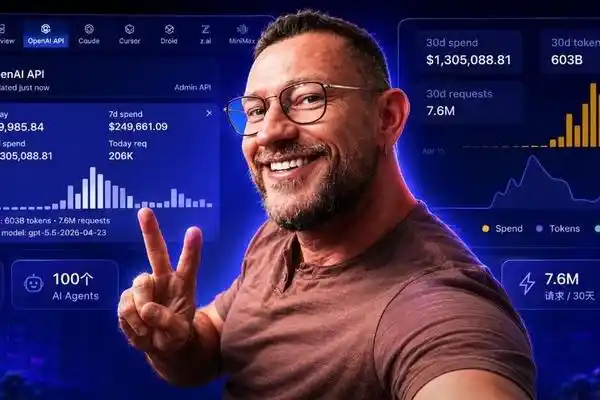
3 People with 100 AI Programmers, Burning Through $1.3 Million a Month! OpenAI: I'll Foot the Bill

In a striking demonstration of AI-powered development, Peter Steinberger (creator of OpenClaw) shared that his three-person team spent $1.3 million in one month to run approximately 100 AI agents (primarily Codex instances). OpenAI covered the cost. The expenditure consumed 6.03 trillion tokens across 7.6 million requests. Steinberger argues that, with "fast mode" disabled, the cost falls below that of a single engineer while providing significantly greater output. This "cloud programmer army" handles core but tedious software engineering tasks: reviewing pull requests, finding security vulnerabilities, deduplicating issues, fixing bugs, monitoring benchmarks, and even generating PRs after meetings. This shifts AI's role from merely writing code to maintaining the entire collaborative fabric of a project. Steinberger's tool, CodexBar (a macOS menu bar app), tracks usage and costs across various AI coding services, highlighting how token consumption is becoming a key metric—a new "means of production." The experiment poses a profound question: if token cost ceases to be a barrier, how will software development transform? As model prices fall, the capability for small teams to leverage large numbers of AI agents could become commonplace, fundamentally altering the scale and speed of development. The future, Steinberger suggests, is arriving rapidly.

marsbit18 min fa

3 People with 100 AI Programmers, Burning Through $1.3 Million a Month! OpenAI: I'll Foot the Bill

marsbit18 min fa

In the AI Era, How to Onboard Without Starting from Scratch

In the AI era, onboarding new employees often resembles a botched relay race baton handoff, where the organization maintains speed while the newcomer starts from zero. The author, after joining Ramp, argues the core problem is a lack of accessible, shared organizational "context"—the collective knowledge from meetings, documents, Slack discussions, and decisions. Instead of relying on slow, manual onboarding or isolated AI tools, the solution is building a continuously updated "company brain." This system acts as a central, AI-native knowledge base that absorbs all company signals. The author describes building a prototype using an Obsidian vault powered by Claude, fed by automated meeting transcripts and notes, and topped with reusable agent "skills." The current enterprise AI approach, deploying specific workflow agents, is likened to the "chatbot era"—useful but disconnected. The real gap is the absence of a shared brain that all agents and employees can access from day one. The future lies in making context layer infrastructure the priority: write context first, then install tools; record every meeting; build the wiki before the dashboard. When new hires, AI agents, and even customers can immediately access this living company brain, the costly "ramp-up" period becomes obsolete. True organizational speed is achieved when maximum velocity and seamless context transfer happen simultaneously.

marsbit35 min fa

In the AI Era, How to Onboard Without Starting from Scratch

marsbit35 min fa

Trading

Spot
Futures
活动图片